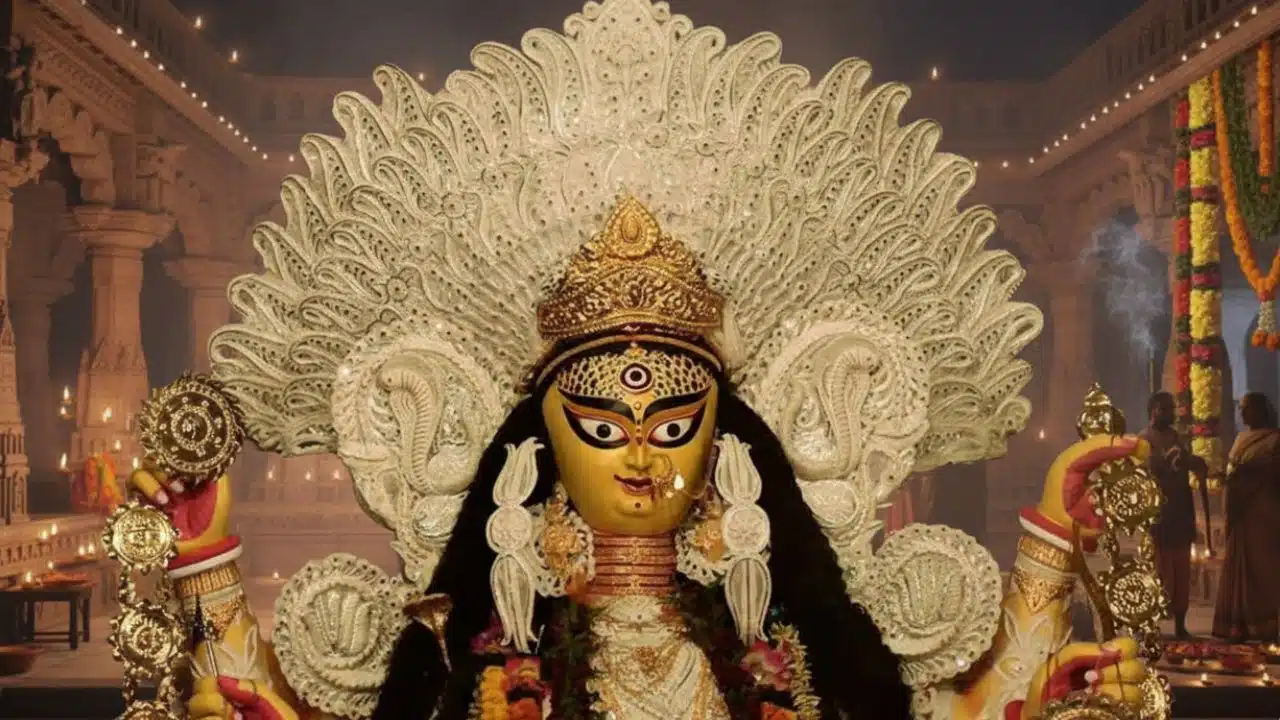
Jagadhatri Puja 2025 brings with it the sacred glow of devotion, humility, and triumph of divine strength. Celebrated with grandeur across Bengal—especially in Chandannagar, Krishnanagar, and parts of Howrah—this festival honors Goddess Jagadhatri, the compassionate form of Durga, who symbolizes power tempered with patience.
Observed after Kali Puja, Jagadhatri Puja transforms streets into rivers of light and artistry, blending spirituality with community celebration. From intricately crafted idols to night-long cultural programs, every moment reflects Bengal’s timeless faith and creativity.
This year, devotees are eager to know the exact dates, puja timings (muhurats), and rituals that mark the auspicious occasion. In this guide, we reveal Jagadhatri Puja 2025’s divine schedule, its ritual significance, and the spiritual message that continues to unite millions in devotion and cultural pride.
Key Facts: Jagadhatri Puja 2025
- Main Puja Day (Nabami): Friday, October 31, 2025. This is the primary day for rituals and offerings.
- Nabami Tithi (Lunar Day): The sacred Ninth Lunar Day begins at 10:06 AM on Thursday, October 30, 2025.
- Tithi Conclusion: The Nabami Tithi will conclude at 10:03 AM on Friday, October 31, 2025.
- Auspicious Anjali (Offering): The most sacred window for pushpanjali (floral offering) is on Friday, October 31, between 8:32 AM and 9:28 AM, before the tithi ends and avoiding the inauspicious Barabela period.
- Core Philosophy: The Goddess is worshipped as the destroyer of the ego (symbolized by the Elephant Demon, Karindrasura) and the restorer of humility among the gods.
The Sacred Timings: Understanding the 2025 Schedule
While Jagadhatri Puja is a four-day festival in many parts of Chandannagar (starting from Saptami), the spiritual pinnacle across Bengal is the Nabami Tithi. The 2025 schedule, as detailed in Bengali Panjikas, presents a specific scenario that worshippers must note.
According to the provided almanac data, the Nabami Tithi—the lunar day dedicated to the Goddess—commences at 10:06 AM on Thursday, October 30. It remains active for approximately 24 hours, concluding at 10:03 AM on Friday, October 31.
However, the main rituals and public celebrations are slated for Friday. This is dictated by the Hindu astronomical principle of Udaya Tithi, which holds that the lunar day prevalent at the time of sunrise is the one observed for all primary religious rites (puja and vrata). As the Nabami Tithi is active during the sunrise on October 31, this day becomes the official ‘Jagadhatri Puja’ day.
Pandits and almanacs have further specified a highly auspicious window for the central Anjali ritual. Devotees are advised to perform their offerings between 8:32 AM and 9:28 AM on Friday morning. This timing is strategically chosen to be completed well within the Nabami Tithi and to consciously avoid the Barabela (an inauspicious period of the day), ensuring all prayers are conducted under the most favourable celestial alignment.
A Tale of Two Cities: The Rivalry and Radiance of Bengal’s Puja Hubs
Unlike the ubiquitous Durga Puja, the worship of Jagadhatri is intensely concentrated in two historic towns on the banks of the Hooghly: Krishnanagar in Nadia and Chandannagar in Hooghly. These two cities share a connected history yet boast fiercely distinct celebration styles.
Krishnanagar: The Royal Origins
Tradition attributes the origin of Jagadhatri Puja in Bengal to Maharaja Krishnachandra Roy of Krishnanagar in the 18th century (circa 1750s). According to popular legend, the Maharaja was imprisoned by the Nawab of Bengal, Alivardi Khan, for failing to pay taxes. He was released on Vijaya Dashami, the final day of Durga Puja, and was sailing back home, grief-stricken at having missed the kingdom’s greatest festival.
In his despair, he reportedly had a divine vision of the Goddess, who commanded him to worship her in a new form exactly one month later, on the Shukla Nabami of the month of Kartik. The result was the first Raj Rajeshwari (Royal) Jagadhatri Puja, a tradition that continues at the Krishnanagar Rajbari (Royal Palace) to this day, marked by its classical artistry and adherence to royal rituals.
While this story is popular, some historical accounts suggest the puja may have pre-dated the Maharaja, possibly starting in nearby Santipur. Regardless, it was Krishnachandra’s patronage that cemented it as a major festival.
Chandannagar: The City of Light
If Krishnanagar is the cradle of the puja, Chandannagar is its global stage. The festival here was reportedly started around 1750 by Indranarayan Chowdhury, a wealthy local zamindar and associate of Maharaja Krishnachandra.
What sets Chandannagar apart is its revolutionary approach to the celebration, which evolved under its unique history as a French colony (known as Farasdanga). The celebration here is less about a single royal patron and more about Barowari (community-funded) pujas, fostering intense competition in two areas: idol height and illumination.
Chandannagar’s lighting, or alok-sajja, is legendary. It is an indigenous art form that transforms the town into a glittering wonderland. Elaborate light-based dioramas, moving chandeliers, and thematic gates attract millions of visitors.
The festival culminates in a spectacular immersion procession, where colossal idols are paraded through the streets on wheeled platforms, accompanied by these dazzling light displays—an event some have compared to the scale of Rio de Janeiro’s carnival.
The Artisans’ Story: Chandannagar’s Luminous Legacy
The grandeur of Jagadhatri Puja is powered by thousands of artisans, particularly the lighting artists of Chandannagar. This cottage industry, which illuminates festivals across India and the world, finds its most passionate expression at home.
The legacy began humbly nearly seven decades ago with pioneers like Sridhar Das, who, as a boy, first experimented with dynamic lighting using simple bulbs and coloured cellophane paper.
Today, it is a sophisticated industry. Among its current generation of artists is Chitralekha Pal, noted as one of the only women artisans in a male-dominated trade. She highlights the industry’s year-round demand, which peaks during this festival.
The industry is also innovating. Artisans are increasingly shifting from heavy iron frames to lighter, eco-friendly fibre-based structures, making the massive installations easier to transport and more sustainable.
Myth, Meaning, and Modern Identity
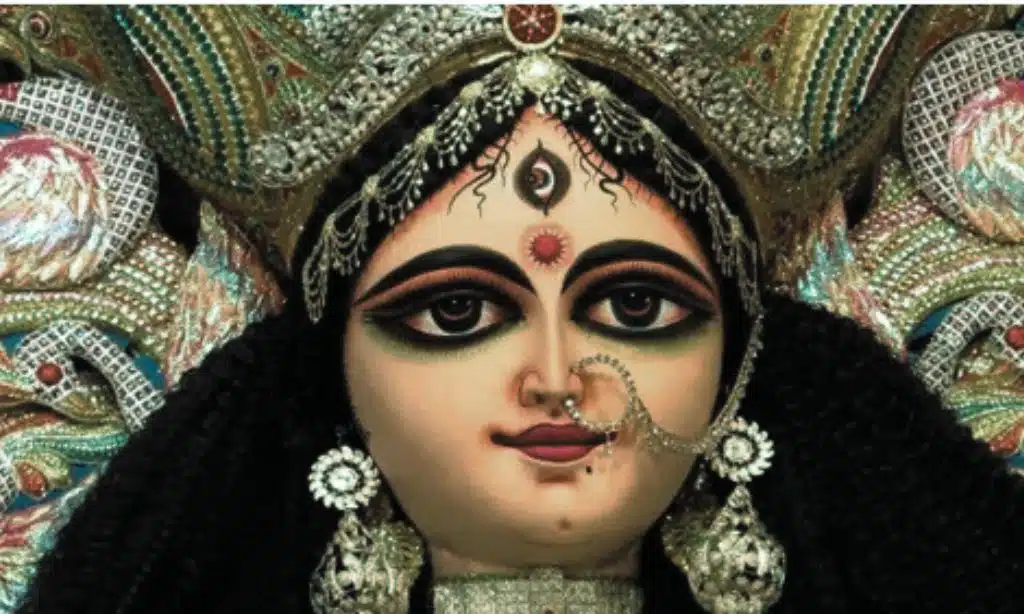
Beyond the spectacle, Jagadhatri Puja is rooted in a deep philosophical and mythological narrative from the Devi Mahatmya and Tantric traditions.
The Goddess Who Humbles Gods
The mythology of Jagadhatri begins where Durga’s ends. After the defeat of the demon Mahishasura, the gods (Devas), who had combined their powers to create Durga, became arrogant, believing their strength was their own.
To teach them humility, the Supreme Shakti (Divine Mother) appeared before them as a celestial light. She placed a simple blade of grass in front of them and challenged their power. First, Pawan (the Wind God) tried to move it and failed. Then, Agni (the Fire God) tried to burn it and failed.
The gods, humbled, realized the source of all power was the Goddess herself, who then revealed her form as Jagadhatri. Her name, from the Sanskrit Jagat (world) and Dhatri (holder or sustainer), signifies her as the fundamental force that upholds the entire universe.
Her iconography is symbolic: she rides a lion that stands over a defeated Karindrasura, the Elephant Demon. The elephant, in this context, represents the uncontrolled, frantic mind and, by extension, the ego.
The Philosophy of the Sustainer
The festival is a celebration of Sattva Guna—the quality of purity, peace, and equilibrium. In Tantric philosophy, she forms a divine triad with her other aspects: Kali represents Tamas (darkness, chaos), and Durga represents Rajas (passion, action). Jagadhatri, as Sattva, is the balance, the tranquility, and the wisdom that sustains creation.
This symbolism was famously articulated by the 19th-century saint Sri Ramakrishna Paramhansa, who had a deep connection to the puja.
This concept was also woven into the fabric of India’s national identity by the novelist Bankim Chandra Chatterjee. In his seminal 1882 novel Anandamath, which gave India its national song “Vande Mataram,” he depicted Jagadhatri, Kali, and Durga as three aspects of Bharat Mata (Mother India): Jagadhatri as the glorious mother she “used to be,” Kali as the tormented mother she “is now” (under colonial rule), and Durga as the radiant mother she “will be in the future.”
The Festive Economy: Bengal’s Creative Powerhouse
Jagadhatri Puja is not just a cultural event; it is a massive economic engine. While specific figures for this puja are not isolated, it is a vital component of West Bengal’s “creative economy,” which is anchored by its series of autumnal festivals.
- A Multi-Billion Dollar Ecosystem: Studies on the preceding Durga Puja—which received UNESCO’s Intangible Cultural Heritage tag—place the value of Bengal’s festive creative economy between ₹32,000 crore and ₹50,000 crore (approx. $3.8 billion to $6 billion).
- Livelihood Support: This ecosystem supports an estimated 10 lakh livelihoods, spanning idol makers (like the famed Kumartuli artisans), pandal designers, electricians, decorators, priests, and retailers.
- Artisan Benefits: Government policies, such as the GST reduction on handicrafts from 12% to 5%, have provided direct relief to these artisans, boosting their profitability and sustaining these traditional crafts.
Jagadhatri Puja, particularly for the Chandannagar lighting industry and the idol makers of Krishnanagar, serves as a critical economic extension of this season, ensuring sustained income for artisan communities after the main Durga Puja commissions are completed.
What to Watch Next
As preparations for October 31 begin, all eyes will be on the twin hubs. The key development to watch is the growing aspiration within Chandannagar to have its unique lighting artistry recognized by UNESCO, following the successful bid by Kolkata for its Durga Puja.
With its blend of deep spirituality, royal history, revolutionary art, and significant economic impact, Jagadhatri Puja 2025 is set to be a powerful reminder of Bengal’s cultural richness. It is a festival that teaches a timeless lesson: true strength lies not in arrogance, but in the quiet, sustaining power of humility.