The fragile week-old Gaza ceasefire agreement has been violently shattered, as the Israeli military launched a series of targeted Gaza Air Strikes across the Strip on Sunday, October 19, 2025. Israel’s actions were in direct response to what the Israel Defense Forces (IDF) termed a “blatant violation of the ceasefire agreement” after troops operating near Rafah came under anti-tank missile and gunfire attack. The immediate return to hostilities—the most serious breakdown since the truce took effect—has drawn international condemnation and dimmed hopes for a lasting peace.
The strikes, concentrated in the southern city of Rafah and central Gaza, mark a perilous escalation, with both sides quickly trading accusations of being the primary aggressor. The armed wing of Hamas, the Izz ad-Din al-Qassam Brigades, swiftly denied any involvement in the clashes, stating its full commitment to the ceasefire and claiming that communications with its units in Israeli-controlled areas were cut off months ago. The immediate question now is whether the US-brokered agreement, intended to pave the way for a major long-term peace plan, can withstand the renewed pressure.
- When: Sunday, October 19, 2025, less than two weeks after the formal ceasefire began (October 11, 2025).
- Where: The initial clashes and subsequent Israeli Air Strikes were reported in the Rafah area of southern Gaza and later near Nuseirat and Jabalia.
- Trigger: The Israel Defense Forces (IDF) stated the strikes were a response to an attack involving anti-tank missiles and gunfire on Israeli troops operating to dismantle terrorist infrastructure in Rafah.
- Fatalities: Palestinian medical sources reported several casualties from the strikes, including at least two Palestinians killed in a strike on Jabalia in northern Gaza and four Palestinians killed in an airstrike targeting a cafe in central Gaza’s Deir al-Balah area.
- Accusations: The IDF labelled the attack on its troops as a “blatant violation of the ceasefire agreement.” In turn, the Hamas armed wing denied all knowledge of the clashes, and a senior political official accused Israel of “fabricating flimsy pretexts to justify its crimes.
- Political Response: Israeli Prime Minister Benjamin Netanyahu instructed security officials to “take firm action against terror targets in the Gaza Strip.
A Ceasefire Under Strain
The current round of violence tests an already tenuous US-brokered ceasefire agreement that officially took effect on October 11, 2025. This truce followed two years of devastating conflict initiated by the October 7, 2023, attacks. The peace deal’s Phase One stipulated the release of all living Israeli hostages, a proportional release of Palestinian prisoners, an Israeli pullback to the ‘Yellow Line’ (a defined area inside Gaza), and a significant increase in humanitarian aid.
However, the days leading up to Sunday’s strikes were rife with friction. Tensions had soared over delays in the return of the remains of deceased Israeli hostages, which the Hostages Family Forum had already labelled a “blatant violation of the agreement by Hamas” days earlier. Simultaneously, the Rafah border crossing, a crucial artery for aid, remains closed, and aid agencies consistently reported critical shortages due to ongoing Israeli restrictions, despite the ceasefire terms.
Details of the October 19 Escalation
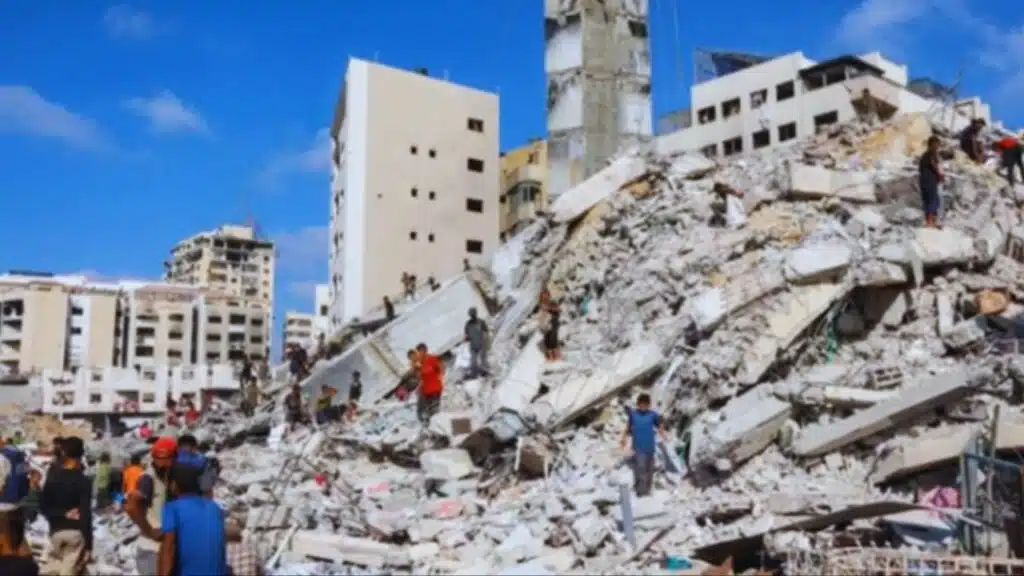
IDF Justification: ‘Blatant Violation’ in Rafah
The catalyst for Sunday’s military action, which involved both fighter jets and artillery, was a hostile engagement in the southern Rafah area.
The IDF released a full statement confirming the air strikes, asserting that their forces were operating to dismantle terrorist infrastructure in the Rafah area, in accordance with the ceasefire terms. The military statement detailed the incident: “Earlier today, terrorists fired an anti-tank missile and gunfire toward IDF troops operating to dismantle terrorist infrastructure in the Rafah area… In response, the IDF has begun striking in the area to eliminate the threat and dismantle tunnel shafts and military structures used for terrorist activity. These terrorist actions constitute a blatant violation of the ceasefire agreement, and the ID1F will respond firmly”.
According to an Israeli military source, the retaliatory strikes hit more than 20 targets by Sunday afternoon, including tunnels and buildings used by militant operatives.
Hamas Denial and Counter-Accusations
In a significant counter-narrative, Hamas and its armed wing, the al-Qassam Brigades, categorically denied any active involvement in the Rafah fighting. The al-Qassam Brigades issued a statement affirming its “full commitment” to the ceasefire and claiming that Rafah is a “red zone” under Israeli military control where contact with its units has been severed since March 2025.
Senior Hamas official Izzat al-Rishq doubled down on the denial, accusing the Israeli leadership of political manoeuvring. In a statement, al-Rishq said, “Hamas affirms its full commitment to the ceasefire agreement and stresses that it is the Zionist occupation that continues to violate the agreement and fabricate flimsy pretexts to justify its crimes”. This reflects a pattern of mutually exclusive claims over breaches of the truce, often centred on the Israeli-controlled buffer zone known as the “Yellow Line.
Latest Data and Humanitarian Impact
The renewed strikes immediately led to civilian casualties, adding to the already catastrophic humanitarian toll of the conflict. The figures below provide context on the immense scale of the two-year war preceding this new breach.
1. Total Casualties in Gaza War (as of October 7, 2025)
According to the OCHA Humanitarian Situation Update #329, based on data from the Gaza Ministry of Health (MoH) and published on October 9, 2025, the total number of Palestinian fatalities from direct violence has reached 67,173 as of October 7, 2025. Among these, approximately 20,179—or about 30%—were children. Additionally, the report notes a total of 169,780 Palestinians injured, as recorded by the MoH in Gaza. These figures underscore the catastrophic human toll of the ongoing conflict.
2. Discrepancy in Civilian-to-Combatant Ratio (GHM vs OHCHR Estimates)
While the Gaza Ministry of Health (MoH) reported 67,173 fatalities as of October 7, 2025, estimates on the combatant-to-civilian breakdown vary significantly. A study by the OHCHR, which cross-verified fatalities, found that approximately 70% of Palestinians killed in residential buildings were women and children (Wikipedia, Casualties of the Gaza war, OHCHR Analysis). Other independent analyses estimate that roughly 80% of total Palestinian fatalities are civilians, based on MoH data profiles.
3. Immediate Post-Ceasefire Casualties (October 11–19, 2025)
The Government Media Office in Gaza reported that, prior to Sunday’s major air strikes, Israel had committed 47 violations since the ceasefire took effect, resulting in 38 deaths and 143 wounded Palestinians. The most recent strikes on October 19 added to this toll:
- Six Palestinian Fatalities reported in central and northern Gaza on Sunday (4 in Deir al-Balah, 2 in Jabalia), in addition to casualties from the Rafah strikes.
- Total aid workers killed since October 7, 2023, reached at least 565 as of early October 2025.
Official Responses and Political Fallout
Israeli Government & Military
Following the initial reports of the attack on IDF troops, Prime Minister Benjamin Netanyahu ordered his security forces to respond with decisiveness. His office confirmed that he instructed the army to “take firm action against terror targets in the Gaza Strip”.
Israeli Defense Minister Yisrael Katz echoed this hardline position, stating that the response was a warning. Paraphrased from the minister’s statement, Katz warned that “Hamas will pay a heavy price for any shooting and violation of the ceasefire, and if the message is not understood, the intensity of the responses will increase.
The renewed fighting has also emboldened the right wing of Netanyahu’s coalition. Far-right politician Itamar Ben-Gvir publicly called for the Prime Minister to “order the IDF to renew full-scale fighting in the Strip at full strength,” arguing that the belief in Hamas adhering to the agreement was a “false illusion”.
Hamas and Palestinian Authorities
Beyond the formal denial of responsibility for the Rafah attack by the al-Qassam Brigades, the general mood among Palestinian leadership remains focused on accusing Israel of systematically undermining the truce. The Government Media Office in Gaza stated on October 19 that the continued closure of the Rafah crossing, a violation in itself, coupled with cross-border shootings, demonstrates Israel’s intent.
Expert Analysis and International Reactions
The re-ignition of violence confirms the fears of many international observers that the peace deal remains deeply fragile, resting on a foundation of unresolved core issues.
Hady Amr, a scholar at the Brookings Institution, highlighted the monumental challenges ahead, even before the strikes: “After two years of excruciating violence… the daily bloodshed has paused. The harder work now begins.” (Brookings Institution). This work involves addressing the physical destruction of Gaza, which requires billions in aid, and establishing a credible political pathway.
Regional diplomats, speaking on condition of anonymity, had previously noted that the first days and weeks of the ceasefire were expected to be “tense” and “scratchy,” with a high potential for minor breaches. This current escalation, however, moves beyond “scratchy” to a near-collapse.
UN experts have consistently warned that any peace plan, including the current one, that does not unconditionally address fundamental international law and Palestinian self-determination is a “recipe for further injustice, future violence and instability” (OHCHR). The experts specifically criticised placing conditions like the demilitarisation of Gaza without addressing Israeli demilitarisation.
Impact on Civilians and Aid
The immediate humanitarian impact is twofold: renewed fear and halted reconstruction. Many Palestinians had cautiously begun returning to their devastated homes in northern Gaza following the ceasefire’s implementation. The airstrikes, particularly those reported in central and northern areas like Jabalia and Nuseirat, risk reversing this minimal return to normalcy.
The ongoing closure of the Rafah border crossing to aid—confirmed by Israel to stay closed “until further notice”—is critically problematic. With humanitarian aid already “critically scarce,” this closure blocks essential supplies needed for a population facing widespread health issues and malnutrition. An average of four aid workers have been killed each week in Gaza so far in 2025, underscoring the lethal difficulty of operations even under a supposed truce (OCHA, UNRWA).
One resident in Rafah, whose family had just returned to what little remained of their home, was quoted by local media expressing despair: “We knew it wouldn’t last. The sound of the explosions is a knife in the heart. We just want to live without fear, even if we live in the rubble.
The Mediators’ Role
The pressure is now squarely on the mediators—the United States, Egypt, Qatar, and Türkiye—to salvage the agreement. The immediate next steps will determine if the conflict reverts to full-scale war:
- US Intervention: US President Donald Trump has previously warned that if Hamas continues to violate the deal, the US would consider allowing Israeli forces to resume full fighting. His administration’s immediate diplomatic posture will be crucial.
- Prisoner Exchange: The staggered process of prisoner and detainee release, a central pillar of the deal, could be instantly halted. While Israel has released nearly 2,000 Palestinian prisoners, the remainder of the exchange, particularly the return of bodies, is a massive point of contention.
- Expansion of Strikes: If Hamas or other factions respond with rocket fire, Israel will be expected to increase the intensity and breadth of its response, potentially leading to the complete abandonment of the ‘Yellow Line’ withdrawal and a return to full military occupation of Gaza territory.
The Gaza Air Strikes on October 19 represent a severe crisis point. The next 72 hours of diplomatic activity will either cement the truce’s failure or force a rapid de-escalation that both sides seem politically reluctant to embrace.
The Information is Collected from BBC and NBC News.