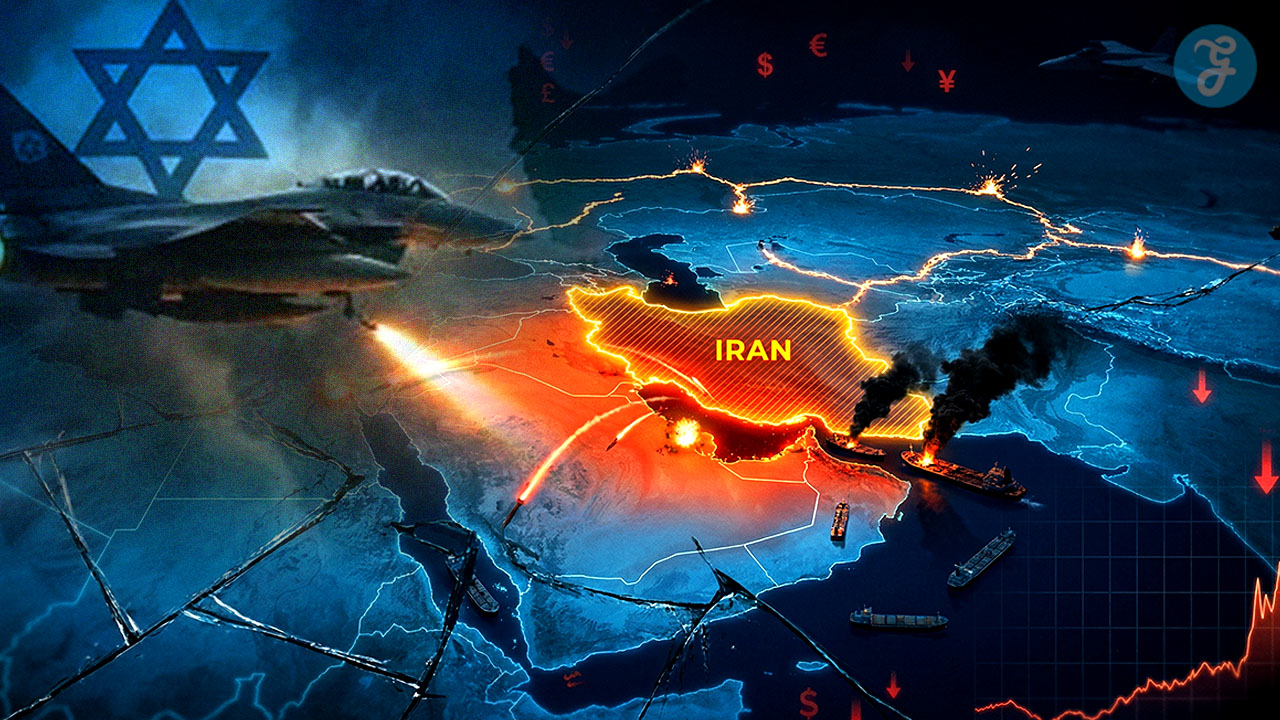
Is World War III Likely in 2026? In Part 1, we analyzed the physical flashpoints, Taiwan, Ukraine, and the Middle East, that could trigger a global cascade. But in 2026, the first shots of a “World War” might not be fired by a tank or a missile.
Part 2 examines the “Invisible Fronts” (Cyber, AI, and Space) that operate in the gray zone, the deep economic consequences of a systemic rupture, and most importantly, the remaining diplomatic off-ramps that could pull the world back from the brink.
Key Takeaways: The Invisible War of 2026
- Silent Triggers: The war likely begins with cyberattacks on critical infrastructure, not missiles.
- AI Speed Trap: Automated defense systems risk escalating conflicts faster than human diplomacy can stop them.
- Space Vulnerability: Jamming or blinding satellites (“Orbital Denial”) could trigger a “use it or lose it” nuclear response.
- Economic Siege: Expect total tech embargoes and asset seizures, fracturing the global economy into rival blocs.
- Nuclear Risk: The expiration of the New START treaty (Feb 2026) removes critical safety rails against tactical nuclear use.
- Peace Brokers: De-escalation will likely rely on neutral third parties (India, Brazil) rather than direct US-Russia/China talks.
The Invisible Front: Cyber, AI, and Infrastructure
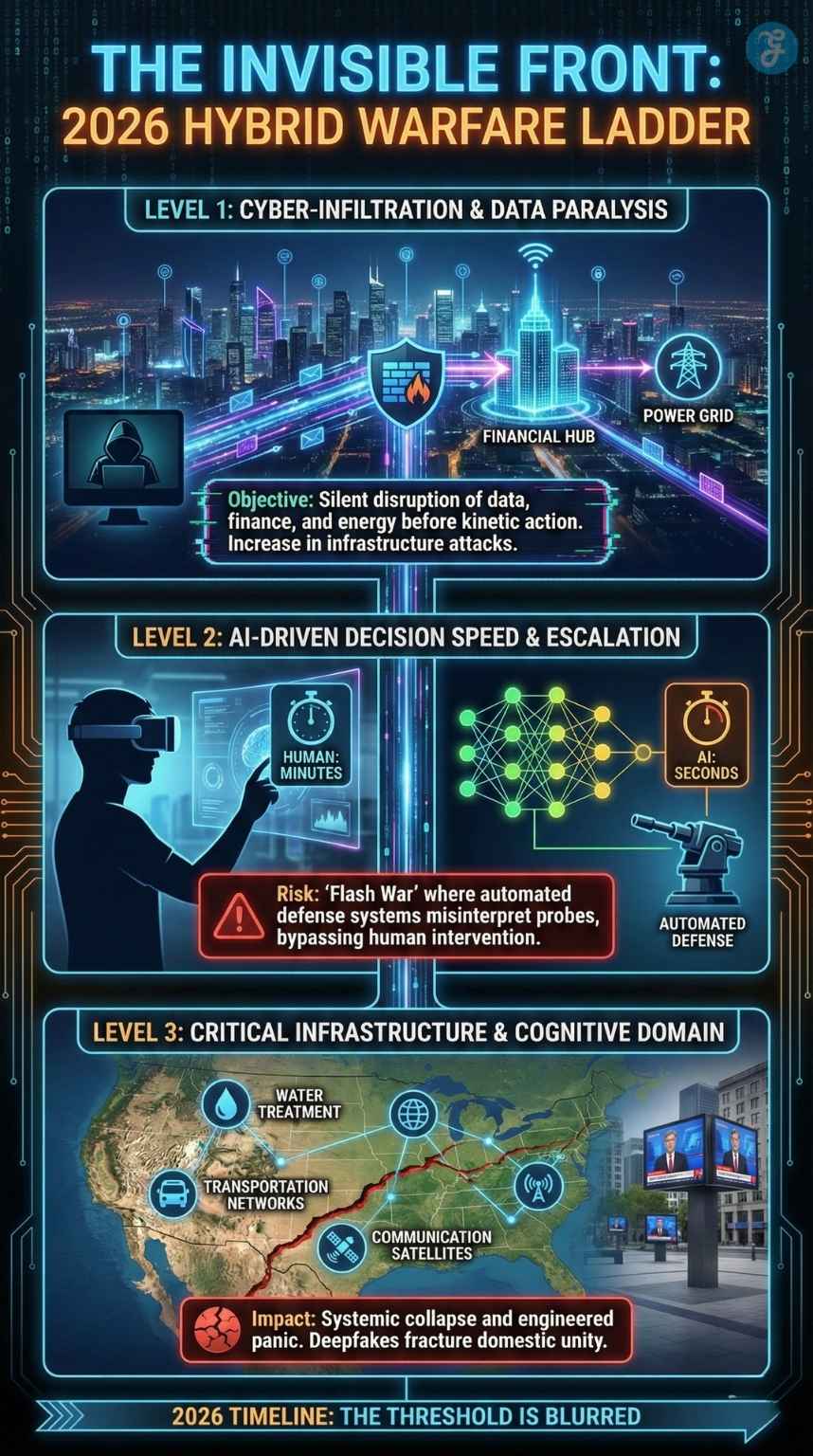
While Part 01 focused on physical armies, the 2026 threat landscape is defined by hybrid warfare. The line between “peace” and “war” is blurriest here.
A 2025 report by the Atlantic Council noted that critical infrastructure attacks have risen 40% year-over-year. In a World War III scenario, the goal is systemic paralysis: disabling a nation’s ability to move data, money, and power before they can move troops.
The AI Escalation Paradox
Artificial intelligence speeds up decision-making, but it also creates a dangerous new dynamic: the “Flash War.” If autonomous defense systems misinterpret a cyber-probe as a nuclear launch preparation, retaliation could be automated before human leaders can intervene.
-
Algorithmic Bias in War: AI systems trained on “worst-case scenarios” may recommend escalation faster than a human diplomat would.
-
The Speed Gap: Hypersonic missiles hit targets in minutes; AI defenses must react in seconds. This removes the “cooling off” period that saved the world during the Cold War.
Prediction: The most likely trigger for a NATO-Russia or US-China direct escalation is not a ship collision, but a state-sponsored cyberattack on critical infrastructure (water, power, air traffic) that causes mass civilian casualties, crossing a “red line” that demands a kinetic response.
The Space Domain: The “High Ground” Is Fragile
Space is no longer a sanctuary. It is a contested warfighting domain. With thousands of Low Earth Orbit (LEO) satellites launched by commercial entities (Starlink, Kuiper, etc.) in the mid-2020s, the military relies on civilian infrastructure.
Escalation Ladder in Space:
-
Reversible Jamming: Temporary GPS denial over a conflict zone.
-
Dazzling/Blinding: Lasers are used to temporarily disable optical sensors.
-
Kinetic Destruction: Missiles destroying satellites (creates debris fields).
-
Orbital War: Hunter-killer satellites physically engaging targets.
Prediction: In 2026, there will be a rise in “soft-kill” incidents, such as mysterious outages or GPS spoofing, which are difficult to definitively attribute but undermine military confidence. If a major power loses its “eyes” (early warning satellites), they may assume a nuclear first strike is incoming, triggering a “use it or lose it” launch.
Information Warfare: The Battle For Reality
Before a physical invasion, a “cognitive invasion” occurs. In 2026, deepfake technology has matured to the point where distinguishing real leadership orders from fabricated ones is difficult.
-
The Scenario: A deepfake video of a president declaring a nuclear strike is released on social media. Even if debunked in 20 minutes, the panic caused in financial markets and military alert levels could be irreversible.
-
Target: The goal is to fracture domestic unity, making the population unwilling to support a war effort.
Reader Cheat Sheet
| Concept | What It Means In 2026 | Why It Matters | 2026 Watch Signals |
| “Kinetic vs. Non-Kinetic” | War fought with code/sanctions vs. bombs. | Major powers may cripple rivals without firing a shot. | Grid blackouts, banking outages, GPS drifts. |
| “Orbital Denial” | Blinding satellites or jamming comms. | Modern militaries (and economies) cannot function without space. | ASAT (anti-satellite) tests and unexplained satellite maneuvers continue to plague modern militaries. |
| “The War Economy” | States are shifting industry to military production. | Signals a long-term commitment to conflict, not just posturing. | Rationing of critical minerals, “dual-use” tech bans. |
| “Off-Ramps” | Diplomatic mechanisms to freeze conflict. | The only way to stop an escalation spiral before nuclear use. | Third-party mediation (e.g., Brazil, India, Switzerland). |
Economic Fallout: From “Decoupling” To “Siege”
In Part 01, we discussed shipping shocks. Part 2 looks deeper at the structural economy. A global war in 2026 would fracture the global economy into distinct blocs, ending the era of globalization as we knew it (1990–2020).
The “Siege Economy” Matrix
| Sector | Scenario: Limited Conflict | Scenario: Global War |
| Tech & Chips | Export controls tighten; prices rise 20-30%. | Total embargo; TSMC production halts; global tech depression. |
| Energy | Price spikes; strategic reserves released. | Rationing in Europe/Asia; tanker wars close Hormuz/Malacca. |
| Finance | Sanctions on specific banks. | Weaponization of SWIFT/digital currencies; seizure of sovereign reserves. |
Prediction: The economic weapon of 2026 is not just sanctions, but “Asset Weaponization.” We saw the precursor with the Venezuela bond surge and Russian asset freezes. In a full conflict, neutral nations might see their assets frozen if they don’t pick a side, forcing the “Global South” into a difficult alignment.
The Nuclear Threshold: Tactical vs. Strategic
The binary view of “peace vs. nuclear armageddon” is outdated. The 2026 risk involves Tactical Nuclear Weapons (TNWs), smaller yield warheads designed for battlefield use.
-
The “Escalate to De-escalate” Doctrine: Some military strategists argue that using a single, low-yield tactical nuke on a naval fleet could “shock” the enemy into surrender without triggering a full global exchange.
-
The Gamble: This theory is untested. Most simulations suggest that once the nuclear taboo is broken, rapid escalation to strategic (city-destroying) weapons is nearly impossible to stop.
Humanitarian Impact: The Migration Weapon
A global conflict in 2026 would trigger displacement on a scale unseen since 1945.
-
Weaponized Migration: Cynical actors may intentionally target civilian infrastructure (heating, water) to force millions of refugees toward rival borders, destabilizing those nations politically.
-
The “Climate Multiplier”: War in regions already stressed by climate change (like the Sahel or South Asia) creates a compound crisis that aid agencies cannot manage.
Guardrails and De-Escalation: Is There a Way Back?
The most critical question for 2026 is: How does it stop? Not just Is World War III Likely in 2026? With the New START treaty expiring (Feb 5, 2026) and communication channels frayed, the mechanisms for peace are rusty.
The 3 Paths to De-Escalation
-
The “Freeze” Model (Korea Style):
-
Mechanism: Fighting stops, but no peace treaty. Lines of control are hardened.
-
Likelihood: High. This is the most plausible outcome for a Ukraine or Taiwan skirmish. It requires exhaustion on both sides.
-
-
The “Grand Bargain” (Yalta Style):
-
Mechanism: Great Powers meet to divide spheres of influence explicitly.
-
Likelihood: Low. Trust is too low, and the “blocs” are too fluid.
-
-
The “Third-Party” Bridge:
-
Mechanism: Non-aligned powers (India, Brazil, Turkey, and Saudi Arabia) facilitate back-channel talks when direct US-China or US-Russia talks are politically impossible.
-
Likelihood: Moderate. These nations have economic incentives to prevent a total global collapse.
-
2026 Watch Signal: Watch for “Track 2” diplomacy, meetings between retired generals, scientists, or intelligence chiefs in neutral cities (Geneva, Muscat, or Singapore). These are often the first sign that leaders are looking for an exit ramp.
Bottom Line
Is World War III Likely in 2026? If defined as a sudden, total nuclear exchange, still unlikely. If defined as a grinding, hybrid conflict fought across space, cyberspace, and economic supply chains with sporadic conventional battles, we are arguably already in the opening phase.
The danger in 2026 is that the “Invisible War” hits so hard and fast that it forces the “Kinetic War” to begin before diplomacy can intervene. The expiration of New START in February is the canary in the coal mine. If that passes without a replacement framework, the seatbelts are off.