Squid Game, the South Korean dystopian survival thriller that took the world by storm, revolves around a secret contest where 456 financially struggling players risk their lives in deadly children’s games for a chance to win a massive cash prize.
While the show’s premise is undeniably gripping, many viewers have wondered: Is the Squid Game based on a true story?
“Is the Squid Game based on a true story?”
This question has intrigued millions of viewers worldwide since the release of the South Korean survival thriller on Netflix. The series, which follows 456 contestants risking their lives in deadly children’s games for a massive cash prize, captivated audiences with its intense storyline and poignant social commentary.
While the show is not directly based on real events, its creator, Hwang Dong-hyuk, drew inspiration from real-life societal issues and personal experiences to craft its gripping narrative.
Inspiration from Economic Struggles
Hwang conceived the idea for Squid Game based on his own economic struggles, as well as the class disparity and capitalistic pressures in South Korea. He initially wrote the story in 2009 but couldn’t find a production company willing to fund the project until Netflix showed interest around 2019.
Real-Life Events That Shaped Squid Game
The Ssangyong Motor Strike
One of the most significant real-life inspirations for Squid Game is the Ssangyong Motor Strike that occurred in South Korea in 2009. This event directly influenced the backstory of the show’s main character, Seong Gi-hun. In the series, Gi-hun is laid off from his job at Dragon Motors after 16 years of employment, leading him to participate in the deadly games out of financial desperation.
The actual Ssangyong Motor Company strike was a turbulent period that saw more than 2,600 employees (nearly 40% of the workforce) laid off as the struggling car manufacturer faced financial ruin. This announcement triggered a 77-day occupation of the factory by workers, culminating in violent clashes between strikers and riot police.
Armed with slingshots and steel pipes, the workers faced a heavily armed police force equipped with rubber bullets and tasers. The chaos turned the factory into a battlefield, with helicopters hovering overhead, creating intense winds that added to the workers’ plight.
The aftermath of the strike left a deep scar on South Korea’s labor history. Many workers faced severe physical injuries, legal battles, and financial ruin. The psychological toll was devastating, with around 30 deaths attributed to suicide and stress-related issues in the years following the unrest. The conflict extended beyond the factory walls, symbolizing the struggles of ordinary workers in an economy increasingly skewed towards the wealthy.
Impact on Squid Game’s Narrative
Hwang Dong-hyuk sought to channel these real-world experiences into the series, crafting a narrative that resonated with audiences worldwide. The show’s central theme—that anyone can fall to the bottom of the economic ladder overnight—is a stark reflection of the Ssangyong workers’ plight. The series’ depiction of life-and-death stakes in a controlled environment mirrors the high-stakes battle for survival faced by workers during the strike.
Other Influences on Squid Game
Japanese Comics and Animations
Hwang has acknowledged drawing inspiration from Japanese comics and animations, particularly mentioning works like “Battle Royale” and “Liar Game.” “Battle Royale” is a popular Japanese action novel and film that depicts a group of junior high school students forced to fight to the death by a totalitarian government. Liar Game” features contestants encouraged to cheat and lie to obtain other contestants’ money in a tournament, with losers forced to bear debts proportional to their losses.
Childhood Games
“I wanted to write a story that was an allegory or fable about modern capitalist society, something that depicts an extreme competition, somewhat like the extreme competition of life,” Hwang explained. But I wanted it to use the kind of characters we’ve all met in real life.” To achieve this, Hwang focused on using children’s games as the basis for the deadly challenges in the series.
The Games in Squid Game: Origins and Symbolism
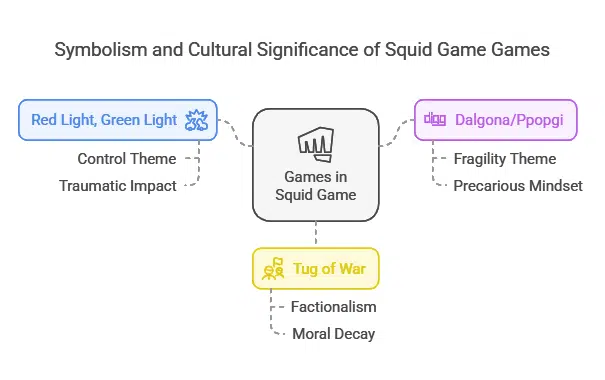
While the deadly versions of the games in Squid Game are fictional, they are based on real children’s games played in South Korea. Here’s a breakdown of some of the games featured in the series and their origins:
1. Red Light, Green Light
The first game in Squid Game, Red Light, Green Light, is based on a beloved playground game known by many names worldwide, including Statues and Grandmother’s Footsteps. In Korea, it’s called “Mugunghwa kochi pieotseumnida,” which roughly translates to “The Mugunghwa flower has bloomed.” This is the phrase sung by the creepy doll in the show.
Symbolically, Red Light, Green Light serves as a perfect opening game, showing contestants in a truly traumatic fashion that even the slightest misstep can result in death. It reinforces the theme of control that pervades the game and effectively whittles down the playing field.
2. Dalgona/Ppopgi
The second game involves ppopgi, also called dalgona, which was once a popular Korean street food. Traditionally, if a person buying the dalgona managed to eat around the shape in the middle without breaking it, they would receive a second, free candy.
In Squid Game, this innocent treat becomes a life-or-death challenge. The terrifying delicacy and fragility of the game reflect the Squid Game players’ precarious state of mind after witnessing the mass deaths in the first game. Like the candy, the players hang delicately in the balance, with even the slightest mistake meaning their destruction.
3. Tug of War
Tug of war, known as juldarigi in Korea, holds deep cultural significance. Variations of tug of war have been played in festivals and community celebrations for many years, especially in agricultural areas. It’s often played between the east and west sides of villages, with the winners supposedly earning a superior harvest that season.
In Squid Game, the tug-of-war round marks a turning point, shifting the competition directly between players rather than between players and the organization. This change sets up the factionalism and backstabbing that pervades the later episodes of the show. After each game, the players’ morals and internal emotions are in an increasingly unpredictable tug of war.
The Creation of Squid Game: A Timeline
To better understand the development of Squid Game, here’s a timeline of key events:
| Year | Event |
| 2009 | Hwang Dong-hyuk conceives the idea for Squid Game based on his own economic struggles and societal issues in South Korea. |
| 2009-2019 | Hwang struggles to find a production company willing to fund the project. |
| 2019 | Netflix shows interest in Squid Game as part of their drive to expand foreign programming offerings. |
| 2021 | The first season of Squid Game is released worldwide on September 17, achieving critical acclaim and international attention. It becomes Netflix’s most-watched series and receives numerous accolades. |
| 2023 | Production for the second season begins in July. |
| 2024 | The second season is released on December 26. |
| 2025 | The third and final season is scheduled to be released. |
The Impact and Legacy of Squid Game
Since its release in September 2021, Squid Game has become a global phenomenon, breaking viewership records on Netflix and receiving critical acclaim. The series has won numerous awards, including six Primetime Emmy Awards and a Golden Globe.
The show’s success can be attributed to its ability to blend thrilling entertainment with poignant social commentary. By drawing inspiration from real-life events and societal issues, Squid Game has resonated with audiences worldwide, sparking discussions about wealth inequality, capitalism, and the human condition.
Takeaways
To answer the question “Is the Squid Game based on a true story?”—no, it is not directly based on actual events or people. However, its creator drew heavily from real-life societal issues, such as economic inequality, labor disputes like the Ssangyong Motor Strike, and cultural traditions, to craft a story that feels hauntingly plausible. By blending fiction with elements rooted in reality, Squid Game serves as both an entertaining thriller and a thought-provoking commentary on modern society’s challenges.
Ultimately, while Squid Game may not depict a true story, it holds up a mirror to real-world struggles faced by many today—making it all the more impactful and relevant.