The four-day work week is no longer a “cute idea” from startup culture. It has become a serious workplace option tested by governments, large employers, and thousands of employees across many countries. The big question is also simple: is the 4-day work week working—or did early success stories hide problems that show up later?
This retrospective looks at what the world has learned after years of trials. You will see what improved, what broke, and what companies had to change to make a four-day schedule work. You will also get practical guidance: how to decide if your organization is ready, which model fits best, and what to measure so you do not guess your way into a risky rollout.
If you are searching for 4-day work week results 2026, you are likely trying to answer one of these: Does productivity stay strong? Do employees actually feel better? Does customer service suffer? And is this becoming permanent—or fading away?
Why The 4-Day Work Week Gained Momentum

The push for a shorter week did not come from one place. It came from a mix of worker burnout, hiring pressure, remote-work changes, and a growing belief that long hours do not always mean high output.
Burnout, Productivity Decline, And The Pandemic Shift
Many workers learned a hard lesson in the early 2020s: being “always on” feels busy, but it does not always produce better results. Teams faced:
- More meetings, not more progress
- More messages, not more clarity
- Longer workdays, not better focus
- Higher stress, not higher quality
This matters because the four-day week is not only about time off. It is also about how work is designed. When teams reduce hours, they are forced to cut waste, simplify decisions, and focus on outcomes.
In many industries, the pandemic also rewired expectations. Workers got used to flexibility and began to value time as much as pay. Employers, in turn, needed a strong talent offer. For some, the four-day week became a recruiting and retention tool that stood out more than another small salary bump.
Early Trials That Changed The Conversation
The idea gained credibility because it moved beyond theory. Several early and high-profile trials created momentum:
- Iceland’s public-sector trials (mid-to-late 2010s): A large-scale test of reduced hours helped normalize the idea that “full-time” does not always mean 40 hours.
- Japan’s corporate experiments (including Microsoft Japan’s well-known test): Helped popularize the concept that productivity can improve when time is limited and meetings shrink.
- The UK pilot wave: Brought structure, coaching, and measurement into the process, making it easier for other organizations to copy.
These early examples did not “prove” the four-day week works everywhere. But they proved something important: it can work in real life when the schedule change is matched with smarter systems.
How The 4-Day Work Week Actually Works In Practice
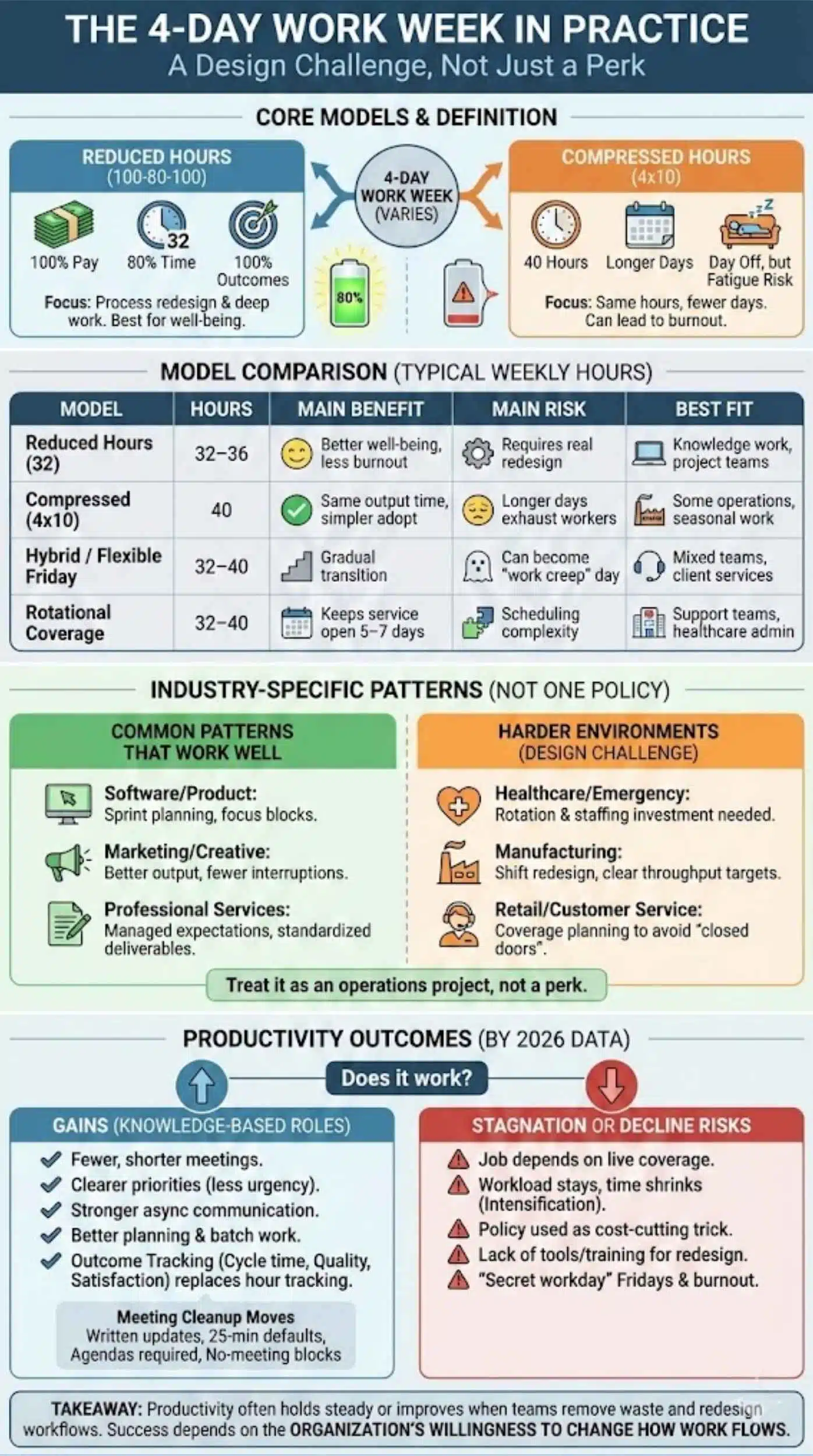
A key reason people argue about this topic is simple: not everyone means the same thing by “four-day work week.” Some organizations reduce hours. Others compress hours. Some keep pay the same. Others do not. Some close on Fridays. Others rotate days off.
Understanding the models is the first step toward a fair evaluation.
Reduced Hours Vs Compressed Hours
These are the two most common structures:
Reduced-hours model (often linked to “100-80-100”)
- Employees get 100% pay
- Work 80% of the time (often ~32 hours)
- Aim to keep 100% of outcomes through better focus and process changes
Compressed-hours model (4 x 10)
- Employees keep the same weekly hours (often 40)
- Work longer days
- The “benefit” is a day off, but fatigue can rise
Here is a quick comparison:
| Model | Typical Weekly Hours | Main Benefit | Main Risk | Best Fit |
| Reduced hours (32) | 32–36 | Better well-being, less burnout | Requires real redesign | Knowledge work, project teams |
| Compressed (4×10) | 40 | Same output time, simpler to adopt | Longer days exhaust workers | Some operations, seasonal work |
| Hybrid / flexible Friday | 32–40 | Gradual transition, less shock | Can become “work creep” day | Mixed teams, client services |
| Rotational 4-day coverage | 32–40 | Keeps service open 5–7 days | Scheduling complexity | Support teams, healthcare admin |
If your goal is well-being and sustainable productivity, reduced hours usually matches the spirit of the four-day movement better than compression.
Industry-Specific Implementations
A four-day week looks very different depending on the work type.
Common patterns that work well
- Software / product teams: Use sprint planning, fewer meetings, and deeper focus blocks.
- Marketing / creative teams: Better output quality with fewer interruptions.
- Professional services: Works when client expectations are managed and deliverables are standardized.
Harder environments (but not impossible)
- Healthcare and emergency services: Requires rotation and staffing investment.
- Manufacturing lines: Needs shift redesign, cross-training, and clear throughput targets.
- Retail and customer service: Requires coverage planning so customers do not experience “closed doors” frustration.
The takeaway: the four-day week is not one policy. It is a design challenge. The organizations that succeed treat it like an operations project, not a perk.
The Productivity Question: What The Data Shows In 2026
If you search 4-day work week productivity, you are usually trying to answer one fear: “If people work less, will the business fall behind?”
By 2026, the pattern across many trials is consistent: productivity often holds steady or improves when teams remove time-wasting habits. But outcomes vary widely by role type, maturity of processes, and whether workloads were redesigned.
Productivity Gains In Knowledge-Based Roles
Knowledge work is full of “hidden waste.” The four-day week tends to surface it fast. Organizations that report success often share similar changes:
- Fewer meetings (and shorter meeting rules)
- Clearer priorities (less “everything is urgent”)
- More documented decisions (less back-and-forth)
- Stronger async communication (less interruption)
- Better planning and batch work (less context switching)
In practical terms, many teams improved output by doing less “busy work.” A common example is meeting reduction:
Meeting cleanup moves that often help
- Replace status meetings with written updates
- Set default meeting length to 25 minutes
- Require an agenda and owner for every meeting
- Ban meetings for decisions that can be made in writing
- Create “no meeting blocks” for deep work
Many teams also changed how they measure performance. Instead of tracking hours, they tracked outcomes:
- Cycle time (how long tasks take)
- On-time delivery rates
- Quality scores (defects, rework, complaints)
- Customer satisfaction metrics
- Revenue per employee (where applicable)
When these shifts happen, employees often report that four days feel more productive than five. Not because they “work harder,” but because the system stops stealing their time.
Where Productivity Stagnated Or Declined
The four-day week struggles when any of these are true:
- The job depends on live coverage (phones, walk-ins, emergency response)
- Workload stays the same but time shrinks (work intensification)
- Management uses the policy as a cost-cutting trick
- Teams lack tools and training to redesign workflows
Client-facing teams can also face pressure. If customers still expect five-day responsiveness, a “closed Friday” model may backfire unless there is coverage.
Common failure patterns include:
- Friday becomes a “secret workday”
- People cram the same meetings into fewer days
- Managers increase monitoring instead of improving clarity
- Teams burn out from intensity, even with an extra day off
So, does the 4-day work week increase productivity? It often can—but only if the organization is willing to change how work flows.
Employee Well-Being And Work-Life Balance Outcomes
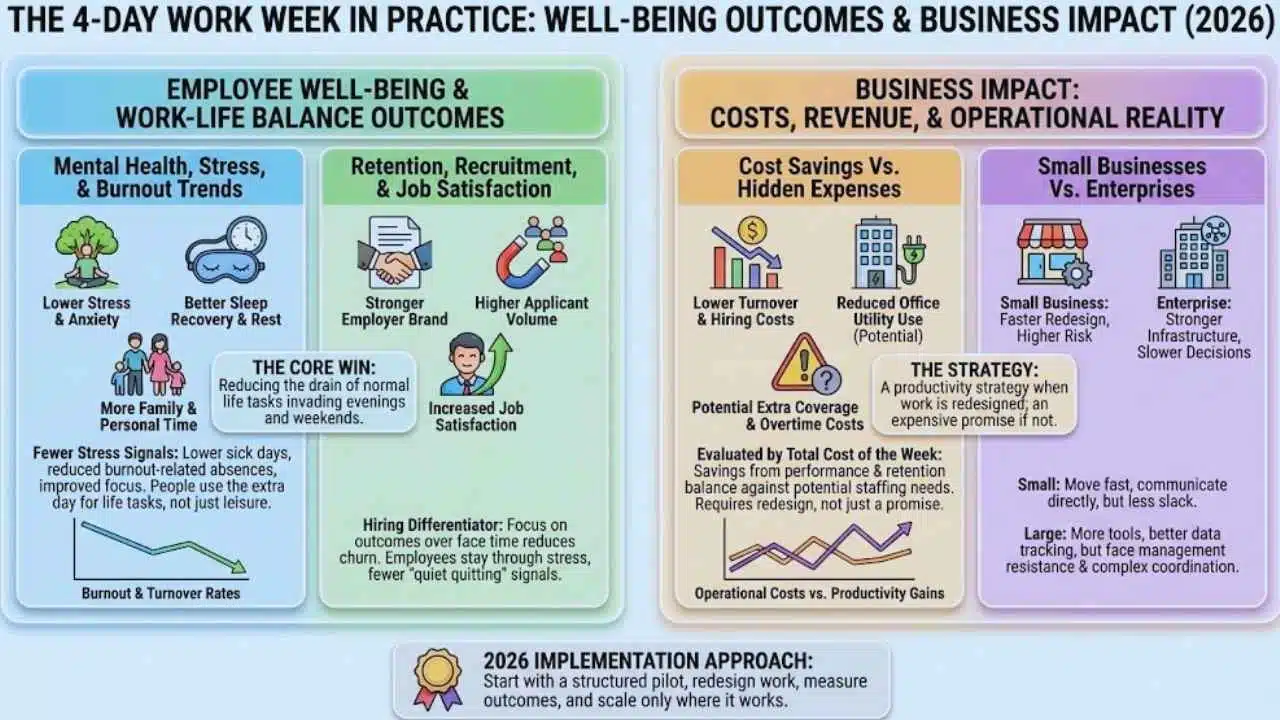
Well-being is one of the strongest reasons people support the model. Many workers do not want “more leisure.” They want normal life tasks to stop invading evenings and weekends.
In 2026, well-being outcomes are often the clearest win—when the model is implemented honestly and workloads are managed.
Mental Health, Stress, And Burnout Trends
A shorter week can reduce stress for a very simple reason: it creates breathing room. People use the extra day for:
- Sleep recovery
- Family care
- Health appointments
- Household tasks
- Learning and skill-building
- Rest that is not rushed
This matters because chronic stress harms performance over time. When employees are mentally drained, they make more mistakes, avoid complex problems, and struggle with creativity.
A practical sign the policy is helping is not just “happier staff.” It is fewer stress signals, such as:
- Lower sick days (especially burnout-related)
- Fewer last-minute absences
- Lower turnover
- Better engagement scores
- Improved manager feedback on focus and energy
Retention, Recruitment, And Job Satisfaction
Even in markets where companies cannot legally mandate a four-day week, many can offer it as a differentiator. In hiring, it sends a message: “We care about outcomes, not face time.”
Recruiting benefits often show up as:
- Higher applicant volume
- Better offer acceptance
- Stronger employer brand
- Reduced churn in key roles
Retention benefits often show up as:
- Employees staying through stressful seasons
- Fewer “quiet quitting” signals
- Better internal mobility because people have energy to grow
A simple truth from years of workplace research still applies in 2026: people do not leave only because of pay. They leave because the job drains their life. A well-run four-day week reduces that drain.
Business Impact: Costs, Revenue, And Operational Reality
The business case depends on whether a four-day week becomes a productivity strategy—or an expensive promise with no redesign.
Cost Savings Vs Hidden Expenses
Possible cost benefits:
- Lower office utility use (in some setups)
- Reduced turnover costs (hiring is expensive)
- Lower sick leave and absence costs
- Better performance through focus and fewer mistakes
Possible hidden costs:
- Need for extra staffing to maintain coverage
- Higher overtime if workloads are not managed
- Increased coordination time if schedules vary widely
- Customer dissatisfaction if service levels drop
A useful way to evaluate the business impact is to compare “total cost of the week,” not just payroll:
Cost categories to track
- Turnover and hiring (monthly)
- Overtime and extra coverage
- Customer support backlogs
- Revenue per employee
- Quality errors and rework time
Small Businesses Vs Enterprises
Small businesses can benefit because they move faster. They can redesign processes quickly and communicate changes directly.
But small businesses also face risks:
- Less slack staffing
- Higher impact if one person is absent
- Customers may expect direct access five days a week
Enterprises often have stronger infrastructure:
- More tools for async work
- More data tracking
- More ability to rotate coverage
But large organizations can struggle with:
- Slow decision-making
- Middle-management resistance
- Complex coordination across departments
For both, the best approach in 2026 is often the same: start with a structured pilot, redesign work, measure outcomes, and scale only where it works.
Countries And Governments: Who Made It Permanent
By 2026, government involvement is split into two styles:
- Trials and pilots to test reduced hours
- Legal frameworks that allow compressed schedules or flexible requests
Some countries moved further than others. Many did not “mandate” a four-day week nationwide. Instead, they enabled it, funded pilots, or shifted public-sector work patterns.
Countries With Widespread Adoption
Examples often discussed in four-day work week conversations include:
- Iceland: Known for large-scale reduced-hours movement in many workplaces.
- Belgium: Introduced a legal option to compress full-time hours into four days for many workers.
- UK (partial): Many private employers have adopted versions after structured trials.
- Japan (partial): Some public institutions and companies have offered four-day options, often linked to productivity modernization.
It is important to note: “adoption” does not always mean the same thing. Belgium’s model, for example, is often compressed hours, while other programs focus on reduced hours.
Why Some Governments Stepped Back
Even when trials show promise, governments face tough constraints:
- Public service coverage needs (citizens still need service)
- Budget pressure (staffing and overtime issues)
- Political optics (“less work for same pay” debates)
- Uneven results across departments
Some public organizations also found that the benefits were real but required deeper reform—like better digital systems, simplified processes, and clearer accountability. Without that reform, the schedule change alone could not carry the weight.
Criticism And Limitations Of The 4-Day Work Week
The four-day week is not a magic fix. And in 2026, the strongest critiques are not ideological. They are practical.
Not All Jobs Can Be Condensed
Some roles are time-based by nature:
- Emergency response
- Hospital care
- Transportation operations
- On-site maintenance and repairs
- Certain retail and service roles
These jobs can still benefit from shorter hours, but it often requires:
- Rotational staffing
- Hiring more people
- Changing coverage windows
- Redesigning workflows to reduce waste
Without those changes, a four-day schedule can simply shift stress from one place to another.
Risk Of Work Intensification
Work intensification is one of the biggest dangers. It happens when:
- Hours drop
- Workload stays the same
- Expectations remain unchanged
- Employees feel pressured to “prove” it works
Warning signs include:
- More late-night messages
- People “secretly” working on off days
- Increased anxiety about performance
- Shorter breaks and skipped lunches
- Higher error rates due to speed
A four-day week that causes intensification is not a success. It is a compressed version of burnout.
So, Is The 4-Day Work Week Actually Working In 2026?
Yes—in many contexts, the four-day work week is working. But it is not working because people magically became more productive. It is working because successful organizations changed how they operate.
The fairest 2026 answer looks like this:
- It works best in knowledge work and outcomes-based environments where waste can be removed.
- It can work in service and operational roles when coverage is redesigned and staffing is planned.
- It struggles when organizations reduce time without redesigning workloads, meetings, and decision-making.
- It fails when leadership treats it as a perk without building systems to support it.
If you are deciding whether to try it, the smart move is not to debate online. The smart move is to run a measured pilot.
Here is a simple readiness checklist:
- Do we know our biggest time-wasters?
- Can we measure output clearly?
- Can we reduce meetings fast?
- Can we protect off-days from “creep”?
- Can we maintain customer coverage?
- Do managers support outcome-based work?
If you can answer “yes” to most of these, the four-day week is worth testing.
What The Future Of Work Looks Like Beyond 2026
Beyond 2026, the four-day week is becoming part of a bigger trend: work is shifting from time-based control to outcome-based design.
What many organizations are moving toward is not one fixed schedule, but smarter flexibility:
- Reduced hours where possible
- Rotational coverage where needed
- Flexible Fridays or seasonal schedules
- Stronger async systems
- Clearer performance measures
The future of work is likely not “everyone works four days.” It is “work is designed to fit life and output,” with fewer rituals that waste time. The four-day week is a powerful tool inside that future—but it is not the only tool.
Final Thoughts
By 2026, the four-day work week is no longer a bold experiment. It is a proven option—when applied with intention, structure, and accountability. The evidence shows that shorter workweeks can support productivity, improve employee well-being, and strengthen retention, but only when organizations redesign how work gets done instead of simply cutting a day.
The real lesson from the past several years is clear. Time alone does not drive performance. Focus, clarity, and systems do. Companies that treat the four-day work week as a strategic shift tend to succeed. Those that treat it as a perk often struggle.
Looking ahead, the future of work is not about choosing between four days or five. It is about building smarter, more human-centered work models that value outcomes over hours. In that future, the four-day work week will remain an important tool—but never a one-size-fits-all solution.