

The calendars have turned. In just two days, it will be 2026—the year the world finally returns to North America. For the last eight years, the “United 2026” bid, the joint hosting agreement between the United States, Mexico, and Canada, has existed largely as a corporate PowerPoint presentation.
It was sold to FIFA and the world as the “sure thing.” We were told that, unlike the rushed infrastructure of Qatar 2022 or the chaotic preparations of Brazil 2014, North America was “ready-made.” The stadiums were built. The hotels were open. The airports were vast. It was supposed to be the tournament where the organizers could simply turn on the lights and let the football speak.
But as we sit here, barely six months away from the opening kickoff at the Estadio Azteca on June 11, the reality is far more complex. The “easy” World Cup has morphed into the most logistically terrifying sporting event in human history.
We are about to witness the first-ever 48-team World Cup, stretched across a continent, spanning three time zones, three currencies, and three distinct political climates. From the humid heat of Miami to the high altitude of Mexico City and the coastal cool of Vancouver, the scale is breathtaking. But scale brings friction.
As the clock ticks down, the question is no longer “Can they host it?” The infrastructure is there. The real question is, “Can they survive it?”
Here is the definitive audit of North America’s 2026 World Cup readiness as we enter the World Cup year.
Key Takeaways
-
The Transit Trap: Avoid “car-only” cities if you rely on public transport; stick to the Northeast (NY/Philly) or West Coast (Seattle/Vancouver) if possible.
-
The Grass Factor: Watch for player complaints about turf-to-grass conversions in domed stadiums like Dallas and Houston.
-
Border Reality: If you plan to follow your team across borders, apply for visas now, even in late 2025.
-
Heat Safety: If you are attending matches in Monterrey, Miami, or KC, prepare for dangerous heat levels; hydration will be a security issue.
The United States: The Heavy Lifter with Heavy Baggage
The United States is hosting the lion’s share of the tournament, with 60 of the 80 matches and every game from the quarterfinals onward. The sheer wealth of the US sporting infrastructure is undeniable, but paradoxically, the country’s greatest strength—its massive NFL stadiums—has become its biggest headache.
The “Turf War” and the Grass Panic
Throughout 2025, the single loudest debate in American soccer has been about grass. FIFA mandates natural grass for all World Cup matches. However, many of the selected venues—specifically AT&T Stadium in Dallas, Mercedes-Benz Stadium in Atlanta, and MetLife Stadium in New Jersey (the host of the Final)—normally operate on artificial turf.
The retrofit process has been a race against time. We spent much of 2025 watching engineers install experimental grow-light systems and drainage layers over concrete floors. The concern isn’t just that the grass will look green; it’s whether it will hold up. We saw in the Copa América 2024 that temporary grass laid over artificial surfaces can be unstable, leading to seams shifting and player injuries.
FIFA’s pitch experts have been camped out in New Jersey for months. The nightmare scenario for the organizers is a “Soldier Field” situation, where the pitch tears up during the final. While the stadium authorities assure us the technology is ready, the European federations remain skeptical. Managers from England and France have already voiced concerns about the “hardness” of the playing surface, causing fatigue and injury, a narrative that will likely dominate the pre-tournament press conferences.
The “Transit Shame”: A Tale of Two Cities
If the stadiums are a technical challenge, the transportation is a cultural crisis. The US is famously car-centric, and nowhere is this more glaring than in Arlington (Dallas), the host of the most matches in the tournament (9 games).
Arlington is the largest city in America with absolutely no mass public transit. There is no train from Dallas-Fort Worth Airport to the stadium. There is no subway. There is only the highway.
In 2025, local organizers unveiled a massive, complex shuttle bus system designed to move 90,000 fans from remote parking lots and hotels to the stadium. Transportation experts have called it a “high-wire act.” If one major highway accident occurs on I-30 on a match day, the entire system could gridlock. Unlike the seamless metro systems of Doha or Moscow, fans in Dallas, Kansas City, and Houston will be at the mercy of Uber surge pricing and traffic jams.
Conversely, cities like Philadelphia and Seattle are shining examples of readiness, with stadiums integrated into the city grid via rail. The disparity between the “transit-ready” cities and the “car-dependent” cities will define the fan experience. We are likely to see two World Cups: one where fans party in city centers and walk to the game, and one where fans spend four hours sitting in traffic in a shuttle bus.
Security: The “Whole-of-Government” Shield
On the security front, the US is taking no chances. Since late 2024, the Department of Homeland Security has designated the World Cup a SEAR-1 event—the highest security rating possible, equivalent to a Super Bowl or presidential inauguration.
However, the international conversation has focused heavily on gun violence. European and South American travel advisories issued in late 2025 explicitly warned fans about US gun laws. This is a PR hurdle the organizers have struggled to clear. While the “Green Zones” around stadiums will be the safest places on earth, the perception of safety in the wider cities remains a point of friction.
Mexico: The Soul of the Game (and the Infrastructure Struggles)
If the US brings the money, Mexico brings the soul. Mexico will become the first nation to host the World Cup three times (1970, 1986, 2026). The passion is not in doubt—the ticketing demand for the opener at the Estadio Azteca broke every server record FIFA had. But the physical readiness of Mexico’s host cities—Mexico City, Guadalajara, and Monterrey—has been a bumpy road.
The Azteca Renovation
The Estadio Azteca is the cathedral of North American soccer. But let’s be honest: by 2024, the cathedral was crumbling. The renovation project, which finally accelerated in 2025, was massive. It involved stripping out luxury boxes to restore capacity, fixing water supply issues, and modernizing the locker rooms.
As of December 2025, the Azteca is “95% ready.” The iconic chaotic charm remains, but the amenities have been dragged into the 21st century. However, concerns remain about the surrounding infrastructure in the Santa Úrsula neighborhood. Access roads are narrow, and traffic in Mexico City is legendary. The government has promised “exclusive fan corridors” for traffic, but seasoned travelers to CDMX know that enforcing traffic laws there is more of a suggestion than a rule.
The Water Crisis and Heat
A silent crisis looming over the Mexico matches is the water shortage, particularly in Monterrey. The city faced severe droughts in 2024 and 2025. Hosting tens of thousands of thirsty tourists puts an immense strain on the local grid. While the stadiums have their own reservoirs, the ethics of diverting water to a sporting event while locals face rationing have sparked protests throughout the last year.
Furthermore, the heat in Monterrey and Guadalajara in June is punishing. Unlike the air-conditioned domes in the US, these are open-air venues. FIFA has mandated cooling breaks, but the midday kickoffs (scheduled to suit European TV audiences) will test the endurance of players and fans alike.
Safety Beyond the Stadium
The issue of cartel violence cannot be ignored. While Mexico City is generally safe for tourists in the central bubbles, the US State Department has maintained strict travel advisories for parts of Jalisco (Guadalajara) and Nuevo León (Monterrey). The Mexican government has deployed the National Guard to secure tourist corridors, creating a “security bubble” for the tournament. Inside the bubble, it will be a fiesta. Outside the bubble, the risks remain real. For the average fan, sticking to the official zones will be mandatory.
Canada: The Quiet Partner with Loud Problems
Canada often gets forgotten in the “United” bid, hosting only 10 games between Toronto and Vancouver. But for a country that prides itself on order and efficiency, the lead-up to 2026 has been surprisingly chaotic.
The BMO Field Squeeze
Toronto’s BMO Field is the smallest venue in the tournament. To meet FIFA’s 45,000-seat minimum, the city has spent 2025 adding massive temporary stands. The result is a stadium that looks a bit like a Frankenstein creation—a small MLS stadium wearing a massive, oversized suit.
The cost of this expansion has ballooned. Originally estimated at $290 million CAD, the price tag for Toronto’s hosting duties has soared past half a billion dollars. This has caused significant political backlash in Ontario, with citizens questioning why tax dollars are funding temporary seats that will be torn down in August 2026.
The Vancouver Housing Crunch
Vancouver is one of the most beautiful cities in the world, and BC Place is a stunning venue. But Vancouver is also in the midst of a severe housing crisis. Hotel prices for June 2026 are already seeing astronomically high rates—some reports suggest basic rooms going for $800 to $1,000 a night.
The city has cracked down on Airbnb and short-term rentals to preserve housing for locals, which paradoxically reduces the inventory for fans. This has created an “accommodation gap.” We are seeing plans for cruise ships to dock in Vancouver harbor to serve as floating hotels, a solution Qatar used, but one that highlights the lack of infrastructure for a surge event of this magnitude.
The Border Bottleneck
Canada has some of the strictest border control policies in the Western world. Processing thousands of fans arriving from Mexico, South America, and Europe via land and air is a bureaucratic nightmare. Unlike the Schengen Zone in Europe, there is no “open border” between the US, Canada, and Mexico.
A fan driving from Seattle to Vancouver for a match faces a border crossing that, on a normal summer Friday, can take three hours. During the World Cup, that could triple. Despite talks of a “Fan ID” fast lane, the reality of three sovereign border agencies coordinating perfectly seems optimistic at best.
The Logistics of a Continent
The biggest opponent in 2026 won’t be France, Brazil, or Argentina. It will be Distance.
The “Jet Lag” Tournament
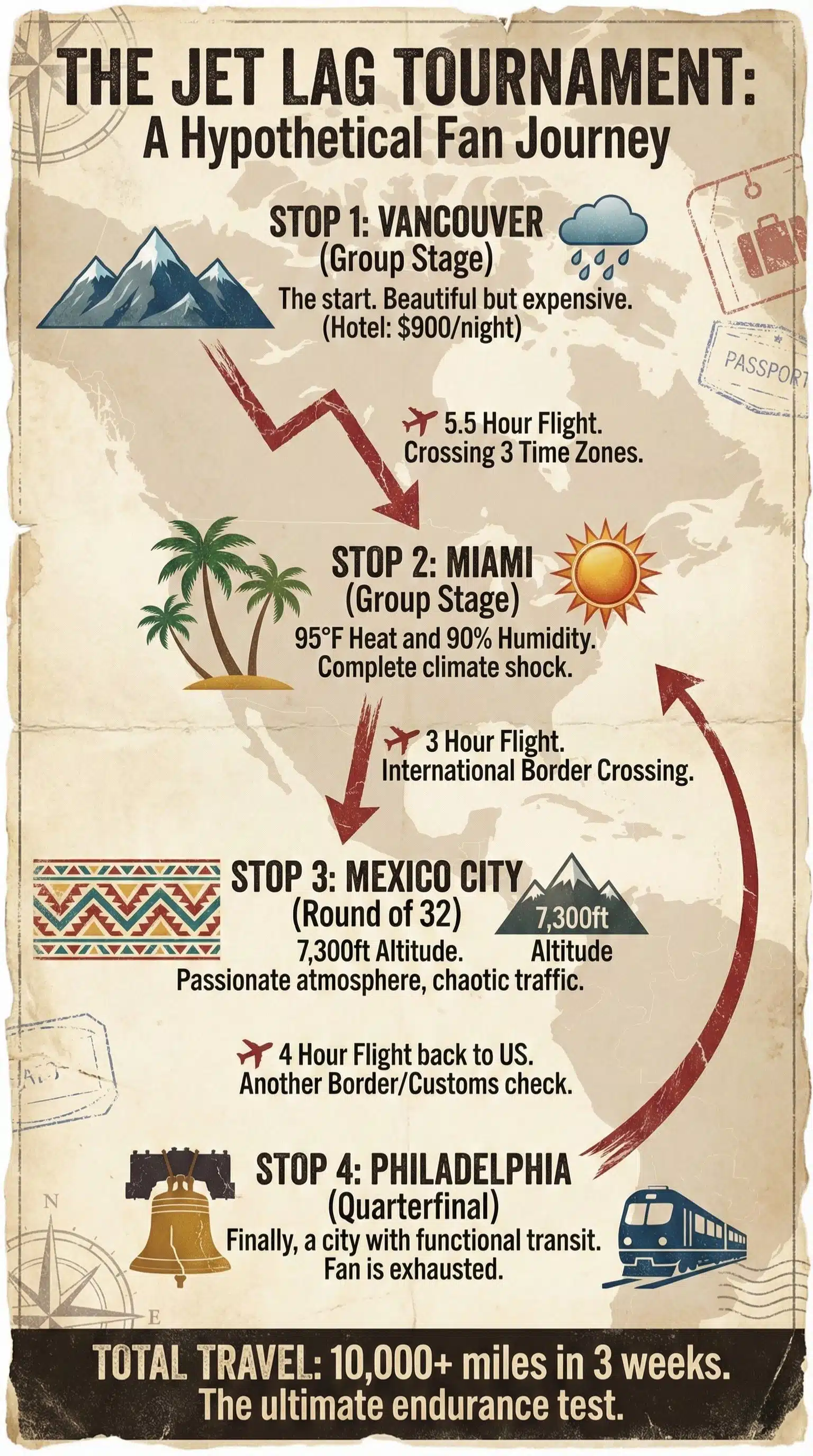
In Qatar, the longest distance between stadiums was 45 minutes by bus. In 2026, a team might play a group game in Seattle and their next game in Miami. That is a 6-hour flight across three time zones.
FIFA has tried to mitigate this by creating “regional clusters” (West, Central, and East) for the Group Stages. This was the smart move. A team drawn into the “West Cluster” will play in Vancouver, Seattle, Los Angeles, and San Francisco.
However, once the Knockout Stage begins, the clusters dissolve. A Round of 32 team could fly from Boston to Houston, then back to Philadelphia. The physical toll this travel will take on players is unprecedented. Recovery science will be the MVP of the tournament. We may see teams rotate squads more heavily simply because the starters are swollen from 40,000 feet of altitude every three days.
The Visa Bureaucracy
We mentioned the borders, but the visa wait times are the “silent killer” of fan attendance. As of late 2025, the wait time for a US visitor visa interview in countries like Colombia (a huge football market) was still over 600 days. While the US State Department has launched a “World Cup Priority” lane, the backlog is immense.
There is a genuine fear that we will see empty seats, not because people didn’t buy tickets, but because they couldn’t get the stamp in their passports in time. The “United” bid promised a seamless entry; the reality is a mountain of paperwork.
The Fan Experience: Price vs. Passion
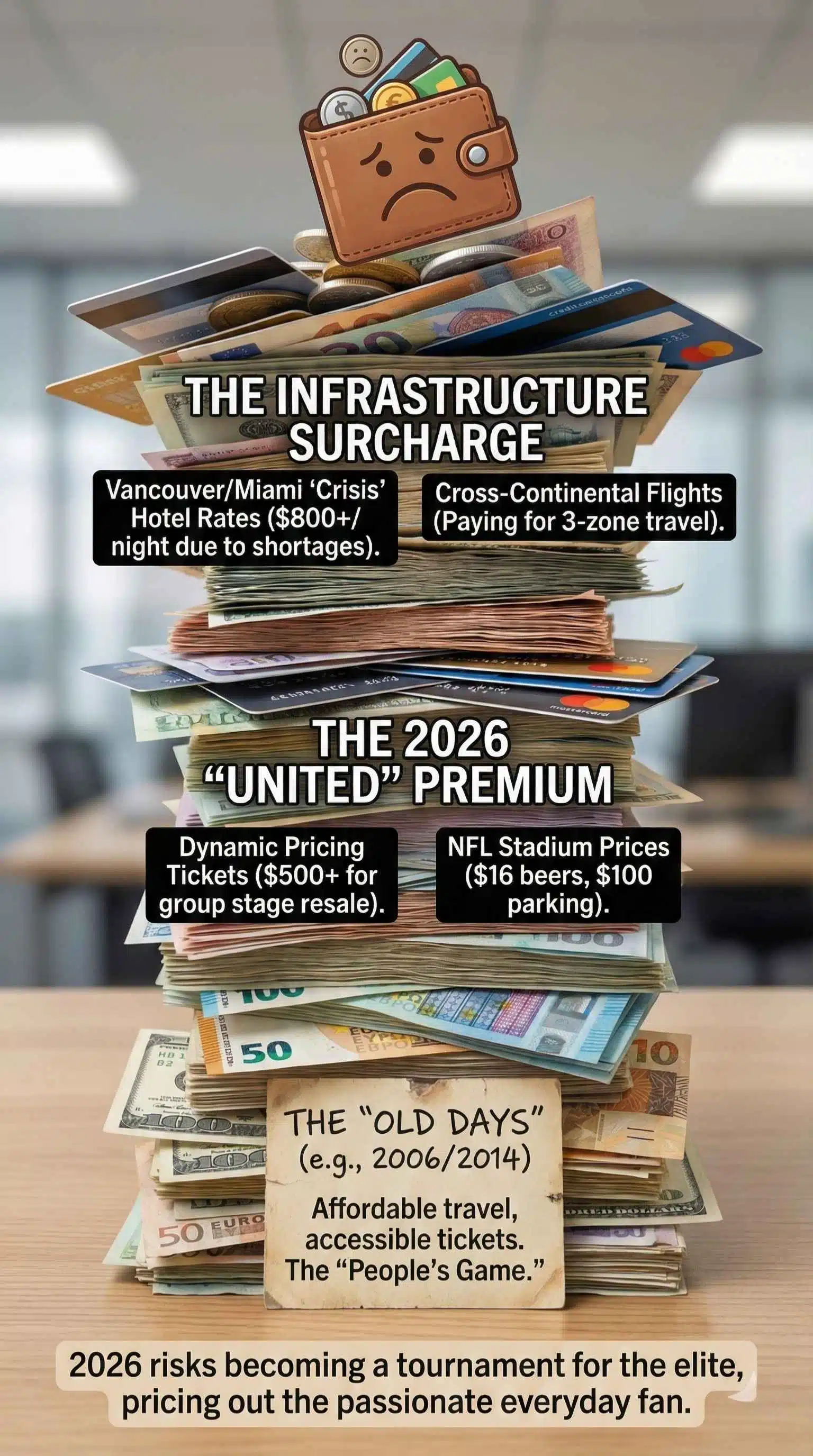
Finally, we must talk about the cost. This will be the most expensive World Cup ever for the average fan.
In 2025, we saw the “dynamic pricing” model take over American sports completely. We can expect tickets on the secondary market to rival Super Bowl prices. A beer at an NFL stadium is already $16. Parking is $100. Add in the inflated hotel costs and the flights between cities, and the 2026 World Cup risks becoming a tournament for the elite, rather than the “people’s game.
This contrasts sharply with the atmosphere in Mexico, where football is a religion accessible to all. The clash between the corporate, sanitized American experience and the raw passion of the Latin American fans will be fascinating to watch. Will the “prawn sandwich brigade” (corporate hospitality) drown out the drums and chants?
The Verdict: Ready, But At What Cost?
So, is North America ready?
- Technically? Yes. The stadiums are standing. The lights work. The broadcast technology will be state-of-the-art. The sheer competence of the American event management industry ensures that the games will look spectacular on television.
- Logistically? Barely. The transit issues in cities like Dallas and the border friction between the three nations are disasters waiting to happen. There will be stories of fans missing games because they were stuck in customs or gridlocked on a Texas highway.
- Culturally? It’s complicated. The US is ready to host a “show,” but it may struggle to host a “festival.” The sprawling geography prevents the condensed, carnival atmosphere we saw in Germany in 2006 or Russia in 2018.
As we stare down the barrel of 2026, the organizers have six months to fix the grass, clear the visa backlog, and pray the shuttle buses run on time. It will be the biggest, richest, and loudest World Cup of all time.
But for the fans on the ground, it might also be the hardest work they’ve ever done to watch a football match.
The Final Whistle: A Tournament on the Edge
As the countdown clock hits zero and 2026 officially begins, the “United” World Cup stands at a fascinating precipice. It is too big to fail, yet perhaps too massive to succeed perfectly.
We are about to witness a collision of two worlds: the polished, corporate efficiency of American mega-events and the chaotic, vibrant soul of global football culture. The stadiums will be magnificent cathedrals of sport, and the broadcast will be flawless. But beyond the sideline, the cracks are visible. The scorching heat, the brutal travel schedules, and the silent frustration of visa queues are the uninvited guests at this party.
For the organizers, the next six months are not about celebration; they are about damage control. For the fans, this tournament will be a test of endurance as much as passion.
When the first ball is kicked at the Estadio Azteca on June 11, the logistics won’t matter for 90 minutes. But once the whistle blows, the reality of moving 48 nations across a continent will set in. North America is ready to host the games, but whether it is ready to host the world remains the ultimate cliffhanger.
Buckle up. The road to the trophy is long, the traffic is heavy, but the destination will be historic. Welcome to 2026.






























