
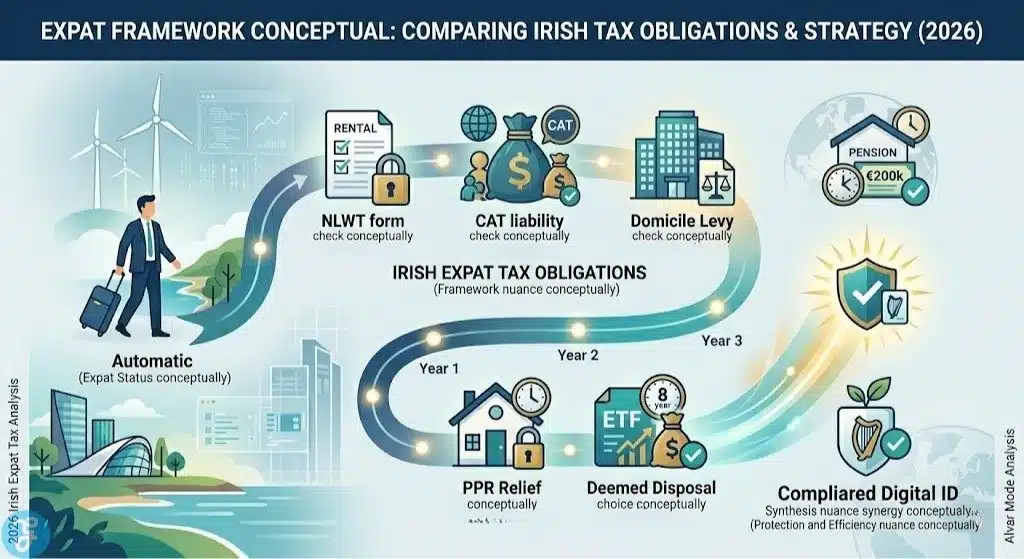
Leaving the Emerald Isle for new horizons doesn’t mean your relationship with the Revenue Commissioners is over. As we navigate the 2026 fiscal year, the transition to a fully digital tax ecosystem and the introduction of refined investment rates have created a landscape where “out of sight” definitely doesn’t mean “out of mind.” Managing your residual Irish obligations requires a strategy that balances your new local tax rules with Ireland’s unique “Ordinary Residence” and “Deemed Disposal” frameworks. Whether you are renting out a property in Dublin or holding onto a preserved pension, staying ahead of these 13 points is the difference between financial efficiency and a surprise audit.
How We Selected Our 13 Best Irish Expat Tax Management Facts
To assemble this list, we analyzed the latest 2026 Finance Act updates and the Revenue’s revised guidelines for non-resident taxpayers. Our selection prioritized the “hidden” traps that catch expats off guard, such as the three-year tail of Ordinary Residency and the “dry tax” of the 8-year deemed disposal on Irish funds. We focused on practical mechanisms like the updated NLWT online system and the specific 2026 rental income relief of €1,000. These 13 points were chosen because they represent the most common areas of financial leakage or compliance risk for the Irish diaspora today, providing a clear roadmap for managing Irish expat tax obligations effectively.
13 Crucial Insights for Managing Irish Tax from Abroad
The following points detail the technical hurdles and strategic opportunities available to those navigating the current tax year from overseas.
1. The Three-Year “Ordinary Residence” Tail
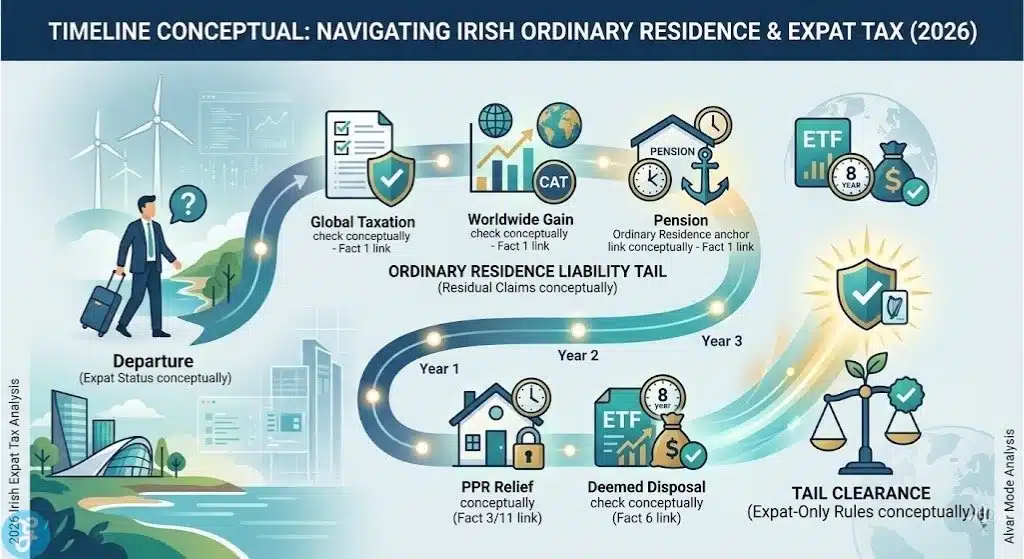
Many believe their Irish tax liability ends the day they board the plane. However, if you have been tax resident in Ireland for three consecutive years, you remain “Ordinarily Resident” for a further three years after you leave. This means you are still liable for Irish tax on worldwide income (excluding employment income from a foreign trade) and worldwide capital gains during this period.
Best for: individuals moving to low-tax jurisdictions who still hold global investment portfolios.
Why We Chose It:
-
It is a common misconception that residency is a simple “on/off” switch.
-
It requires careful timing of asset disposals to avoid dual-taxation traps in the first 36 months abroad.
Things to consider:
-
Your “domicile” status also interacts with this, often keeping you in the Irish net for even longer if your permanent home remains Ireland.
2. The 2026 Exit Tax Reduction to 38%
For those holding Irish-domiciled ETFs or life policies, the “Exit Tax” has been a point of contention. As of January 1, 2026, the rate has finally been reduced from 41% to 38%. While still higher than the standard 33% CGT, this 3% drop significantly improves the long-term compounding potential for those keeping their savings in Irish “equivalent” funds.
Best for: long-term investors holding Irish-based life wraps or mutual funds.
Why We Chose It:
-
It marks a significant downward shift in investment taxation for the 2026 cycle.
-
It narrows the gap between fund-based and direct shareholding taxation.
Things to consider:
-
The 8-year deemed disposal rule still applies, which can be a liquidity headache.
3. PPR Relief “Working Abroad” Exception
Usually, you lose your Principal Private Residence (PPR) relief on your Irish home once you rent it out. However, there is a specific exception: if you move abroad for employment, you can treat that entire period as “deemed occupation” for Capital Gains Tax (CGT) purposes. This protects your tax-free gain when you eventually sell, provided you lived in the house before leaving and return to live in it afterward.
Best for: homeowners who plan to return to Ireland after a multi-year overseas contract.
Why We Chose It:
-
It is a massive financial safeguard that many homeowners unknowingly forfeit.
-
It allows you to generate rental income without destroying your future CGT exemption.
Things to consider:
-
You must return to the property as your main home to fully reactivate the relief.
4. The €1,000 Residential Rental Income Relief
For the 2026 tax year, non-resident landlords can claim a specialized tax relief of up to €1,000 against their Irish rental income. This relief was expanded for 2026–2028 to specifically help offset the rising costs of property maintenance and compliance for small-scale landlords.
Best for: landlords renting out a single Irish property to cover their mortgage.
Why We Chose It:
-
It is a direct “cash-back” incentive that provides meaningful relief for small portfolios.
-
It helps mitigate the 20% withholding tax often applied to non-resident rent.
Things to consider:
-
The property must be registered with the Residential Tenancies Board (RTB) to qualify for the claim.
5. Mandatory NLWT Online Notifications
The days of paper Form R185s are over. Since the launch of the Non-Resident Landlord Withholding Tax (NLWT) system, tenants or collection agents must now make “Rental Notifications” (RNs) via ROS or myAccount. You need to ensure your tenants are actually using this system, as it is the only way for you to receive credit for the 20% tax withheld.
Best for: landlords who do not use a professional management company.
Why We Chose It:
-
It is the new 100% digital standard for non-resident rental compliance.
-
Failing to use it results in “lost” tax credits that are difficult to reclaim later.
Things to consider:
-
If your tenant forgets to file the RN, you technically have no proof of tax paid to Revenue.
6. Deemed Disposal: The “Dry Tax” Risk
If you hold an Irish ETF for 8 years, Revenue treats it as if you sold it, even if you haven’t. This “deemed disposal” requires you to pay 38% tax on the gain up to that point. For someone living abroad, this can be a shock as it creates a tax bill without any actual cash proceeds from a sale.
Best for: long-term savers who have been away for a decade and still hold Irish brokerage accounts.
Why We Chose It:
-
It is one of the most punitive and “invisible” rules in the Irish tax code.
-
The 8-year anniversary can creep up while you are living in a different timezone.
Things to consider:
-
You get a credit for this tax when you eventually do sell the fund.
7. Domicile Levy: The €200,000 Threshold
For high-net-worth individuals, the “Domicile Levy” is a significant risk. If you are Irish-domiciled, own Irish property worth more than €5 million, and have a worldwide income exceeding €1 million, you may be liable for a flat €200,000 annual levy. This applies even if you are not a tax resident in Ireland.
Best for: wealthy individuals maintaining significant estates or assets in Ireland.
Why We Chose It:
-
It is a specific wealth tax targeted at those with deep Irish ties but no residency.
-
It effectively acts as a minimum tax contribution for the high-net-worth diaspora.
Things to consider:
-
Any Irish income tax you do pay is credited against this levy.
8. The “Split-Year” Relief Trap
When you leave Ireland mid-year, you can claim “Split-Year Treatment.” This ensures that income earned abroad after your departure is not taxed in Ireland. However, many forget that this relief only applies to employment income. Other income, such as dividends or interest, is still taxed as if you were resident for the full year.
Best for: professionals moving abroad during the middle of the calendar year.
Why We Chose It:
-
It is a vital tool for the year of departure, but its limitations are often misunderstood.
-
It prevents a massive tax bill on your initial foreign salary in your final Irish filing.
Things to consider:
-
You must prove that you intend to be non-resident in Ireland for the following year.
9. Pension Drawdown: The €200k Tax-Free Limit
If you have an Irish pension but are retiring abroad, you can still take up to 25% of your fund as a lump sum. The first €200,000 of this is tax-free in Ireland. However, depending on where you are living, your new country might try to tax that “tax-free” Irish lump sum.
Best for: retirees with preserved Irish pension benefits living in foreign jurisdictions.
Why We Chose It:
-
It is a cornerstone of retirement planning that remains accessible to non-residents.
-
The interplay between Irish tax-free rules and foreign tax laws is a major risk area.
Things to consider:
-
Always check the Double Taxation Agreement (DTA) between Ireland and your new home.
10. Capital Acquisitions Tax (CAT) and Ordinary Residence
Gift and Inheritance Tax (CAT) in Ireland doesn’t just care about the asset; it cares about the people. If either the person giving the gift (donor) or the person receiving it (donee) is “Ordinarily Resident” in Ireland, the gift is subject to Irish CAT. This catches many who move home for a few years and then leave again.
Best for: families planning to pass down wealth or property across borders.
Why We Chose It:
-
It extends Ireland’s reach far beyond its borders via the residency of the individuals.
-
A parent in Ireland giving a gift to a child abroad can trigger Irish tax regardless of the child’s location.
Things to consider:
-
There is a 5-year residency rule for non-domiciled individuals before this kicks in.
11. The 12-Month “Grace Period” for PPR
If you sell your former Irish home while living abroad, Revenue allows you to treat the final 12 months of ownership as “residence,” even if the house was empty or rented out. This essentially gives you a one-year window to sell the property without incurring any CGT on that final year’s growth.
Best for: individuals who decide to sell their Irish property soon after moving away.
Why We Chose It:
-
It provides a helpful buffer for those struggling to sell in a slow market.
-
It is an automatic relief that is often missed in self-assessment filings.
Things to consider:
-
If you rent it out for longer than 12 months, the relief is restricted proportionately.
12. Filing Form 11 as a Non-Resident
If your Irish rental income exceeds €5,000 (net), you are required to register for “Self-Assessment” and file a Form 11. Many mistakenly use Form 12 (the PAYE form), which is for lower levels of non-PAYE income. Using the wrong form can lead to late penalties and an incorrect tax calculation.
Best for: landlords with multiple Irish income streams or significant property holdings.
Why We Chose It:
-
It clarifies the administrative distinction between “occasional” and “regular” income.
-
Form 11 allows for more comprehensive expense deductions than Form 12.
Things to consider:
-
The ROS (Revenue Online Service) deadline is generally in mid-November for 2026.
13. Auto-Enrolment 2026 and Remote Workers
Starting in 2026, Ireland’s new auto-enrollment pension scheme is launching. If you are working for an Irish company remotely while living abroad, you might be automatically enrolled if you meet the age and salary criteria. You need to check if this “extra” Irish pension matches your long-term plans or if you should opt-out.
Best for: remote workers employed by Irish firms but living in the EU or UK.
Why We Chose It:
-
It is a brand-new 2026 development that impacts anyone on an Irish payroll.
-
It changes the “net pay” calculation for Irish-salaried expats.
Things to consider:
-
The state adds €1 for every €3 you contribute, which is a significant incentive if you plan to return.
Managing your Irish tax affairs from abroad is no longer a matter of simply filing a paper return once a year. The 2026 shift toward NLWT digital notifications and the reduction in Exit Tax rates suggest a government that is trying to modernize, yet the “Ordinary Residence” and “Domicile” rules ensure that Ireland’s reach remains long. For the proactive, the key to success lies in utilizing the specific “Working Abroad” property exemptions and staying within the €200,000 tax-free pension thresholds. By treating your Irish assets as a distinct but integrated part of your global wealth, you can ensure that you are not paying more than your fair share to the Revenue Commissioners.
Overview of Irish Expat Tax Obligations: A Comparative Summary
The following comparison illustrates how different types of assets and residency statuses are handled under the current 2026 Irish tax protocols. This high-level view helps identify which obligations carry the highest risk of an automated audit.
Asset Tracking and Residency Summary
The data presented below highlights the varying levels of liability Ireland maintains over different expat financial behaviors this year.
| Asset / Status | Residency Trigger | 2026 Tax Rate | Key Compliance Tool |
| Rental Property | Non-Resident | 20% (Withheld) | NLWT System (RNs) |
| Irish ETFs/Funds | Worldwide | 38% | Deemed Disposal (8 yrs) |
| Former Home (Sale) | PPR Rules | 33% (CGT) | 12-Month Grace Period |
| Global Income | Ordinary Resident | Varies (Income Tax) | 3-Year Residency Tail |
| Pension (Lump Sum) | DTA Rules | 0% (up to €200k) | Revenue QROPS Check |
| Gifts / Inheritance | Donor/Donee | 33% (CAT) | Group Thresholds |
Our Top 3 Picks and Why?
-
The PPR “Working Abroad” Exception: This is our top pick because it preserves your largest tax-free asset. Without this knowledge, an expat could lose tens of thousands in future CGT when they eventually sell their family home.
-
The 3-Year Ordinary Residence Tail: We chose this because it is the most common “gotcha.” Many believe they are safe once they leave, only to find Ireland taxing their global investment gains for years after departure.
-
NLWT Online Notifications: This is a vital pick for 2026 because it is a new “enforcement” milestone. Relying on old paper methods is now a guarantee that your tax credits will be lost in the system.
How to Manage Your Irish Expat Tax Obligations by Yourself?
Navigating these obligations requires a shift in mindset from “leaving it behind” to “active management.” The goal in 2026 is to ensure that your digital records are so clean that an automated Revenue flag can be resolved in minutes.
The Selection Framework
-
Audit Your Residency Timeline: Mark the exact day you left Ireland. You will not be truly “clear” of the Ordinary Residence tail until exactly three years from the following January 1st.
-
Review Your BankID/ROS Access: Ensure you maintain your digital access to Revenue’s online services. Trying to set this up from abroad after it has expired is a bureaucratic nightmare.
-
Document Your Home’s “Status”: If you rent your house, get a valuation on the day you move out. This provides the “baseline” for any future CGT calculations if you don’t return.
-
Monitor Your Global Domicile: If you plan to never return, you may want to establish a “Domicile of Choice” in your new country to eventually break the Domicile Levy and CAT links.
Use the decision matrix below to find the best compliance path for your specific situation in 2026.
Decision Matrix
This matrix compares different types of Irish expats with the most logical action for the current tax year.
| If your profile is… | Choose X if… | Choose Y if… |
| The Homeowner | Claim PPR Exception if you move for work. | Use 12-Month Grace if you sell immediately. |
| The Fund Investor | Plan for 38% Exit Tax if you hold Irish ETFs. | Watch the 8-Year Clock to avoid a “dry tax” bill. |
| The Landlord | Register with RTB to claim the €1,000 relief. | Ensure Tenant uses RNs to get your 20% credit. |
| The High Earner | Watch €1M Income Cap to avoid Domicile Levy. | Apply Split-Year Relief in your year of departure. |
The Final Checklist: 5-Point Expat Readiness Plan
-
Verify your “Ordinary Residence” end-date based on your departure day.
-
Log into ROS and confirm your contact details are updated to your foreign address.
-
Send your tenant the “Unique Property Identifier” required for the NLWT system.
-
Check the “8-year anniversary” of any Irish funds or life assurance policies you hold.
-
Review the Double Taxation Agreement (DTA) between Ireland and your new country for pension and dividend rules.
Securing Your Financial Legacy Across Borders
Managing Irish expat tax obligations in 2026 is about understanding that the border is now digital. While the “3-year tail” and “deemed disposal” rules can feel like a heavy weight, the 2026 reduction in Exit Tax and the new rental reliefs show a path toward a more balanced relationship with Revenue. By treating your Irish assets as a distinct but integrated part of your global wealth, you can move forward with confidence, knowing that your financial ties to home are secure, compliant, and optimized for your new life abroad.w