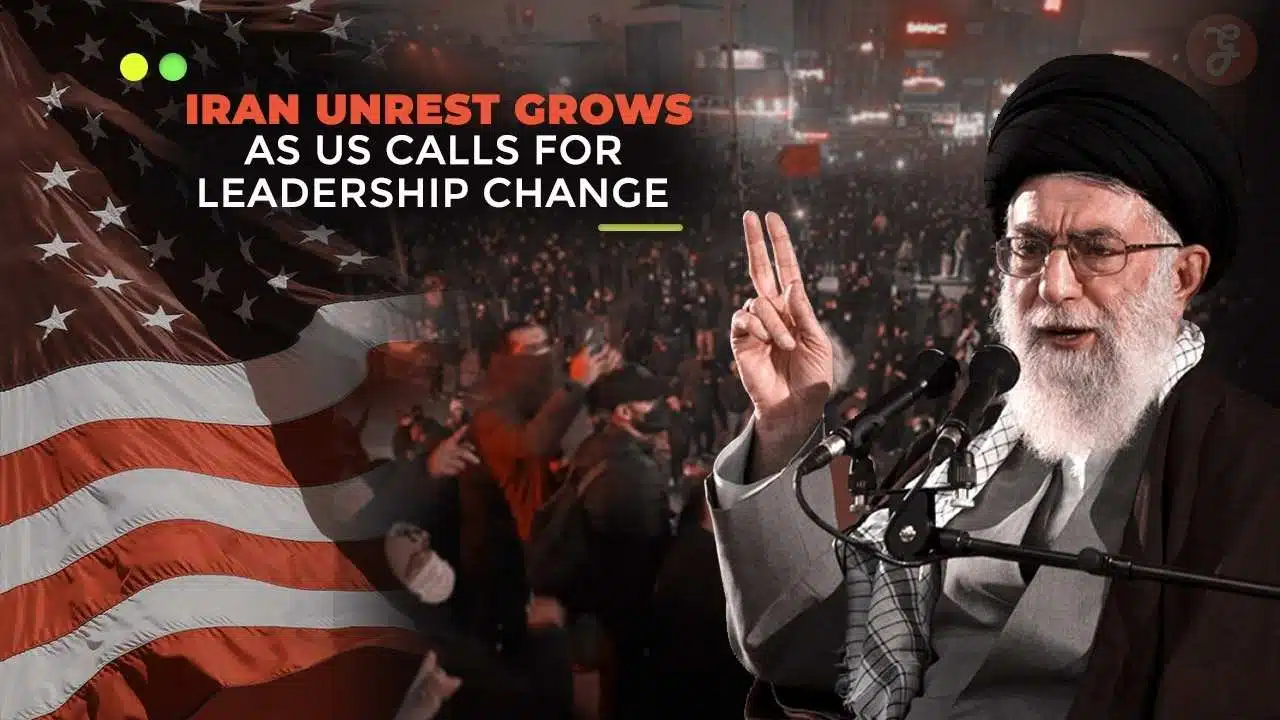
The Iran Leadership Transition 2026 has officially moved from a theoretical policy discussion in Washington think tanks to the primary objective of the United States government. For the first time since the revolution of 1979, the White House has explicitly signaled that the survival of the Islamic Republic is no longer a geopolitical necessity, but an obstacle that is actively being dismantled.
On January 18, 2026, President Donald Trump’s declaration that “it is time to look for new leadership” marked the final death knell of the containment strategy. In its place, the administration has launched an aggressive, multi-front campaign to facilitate the collapse of the regime in Tehran.
This analysis provides a deep-dive examination of the mechanics behind this historic moment, dissecting the new US “Bessent Doctrine” of financial strangulation, the internal fracturing of the IRGC, and the geopolitical vacuum rapidly forming in the Middle East.
Key Takeaways: The 2026 Crisis at a Glance
- US Policy Pivot: President Trump has officially shifted from a policy of “maximum pressure” to “active leadership transition,” explicitly calling for the end of the Islamic Republic for the first time.
- The “Bessent Doctrine”: New targeted sanctions by Treasury Secretary Scott Bessent have frozen the “shadow banking” networks used to pay IRGC wages, leading to unprecedented desertions and low morale within the security forces.
- Economic Trigger: The collapse of the Rial to 1.4 million per dollar and the imposition of a 25% US tariff on buyers of Iranian oil have severed the regime’s last economic lifelines from China and India.
- The “Digital Berlin Wall” Falls: Unlike in 2019, the regime’s internet blackout has failed due to the proliferation of 50,000+ smuggled Starlink terminals and mesh networks, allowing real-time footage of the crackdown to reach the UN.
- Geopolitical Isolation: With the fall of Assad in Syria (Dec 2024) and the capture of Nicolás Maduro in Venezuela (Jan 2026), Tehran has lost its “Axis of Resistance” partners and is facing this crisis in total isolation.
- Three Future Scenarios: Intelligence analysts predict one of three outcomes for 2026: a rapid “Romanian-style” collapse, a protracted “Syrian-style” civil war, or an internal military coup by the IRGC to remove the clergy.
A Convergence of Crises: The Road to 2026
This sudden strategic pivot does not occur in a vacuum. The current instability is the culmination of a “perfect storm” that has battered the Iranian theocracy over the last fourteen months, leaving the regime more vulnerable than at any point in its history.
The unraveling began in December 2024 with the fall of the Assad regime in Syria, which stripped Tehran of its critical “forward operating base” in the Levant and severed its logistical land bridge to Hezbollah. This geopolitical isolation was compounded in June 2025 by “Operation Rising Lion,” a devastating Israeli air campaign that left Iran’s nuclear and ballistic missile infrastructure in ruins, publicly exposing the regime’s inability to defend its own skies. Now, with the economy in freefall and millions flooding the streets, the Islamic Republic faces a terminal crisis of legitimacy that no amount of internal repression can easily fix.
The “Bloody January” Uprising: Anatomy of a Revolution
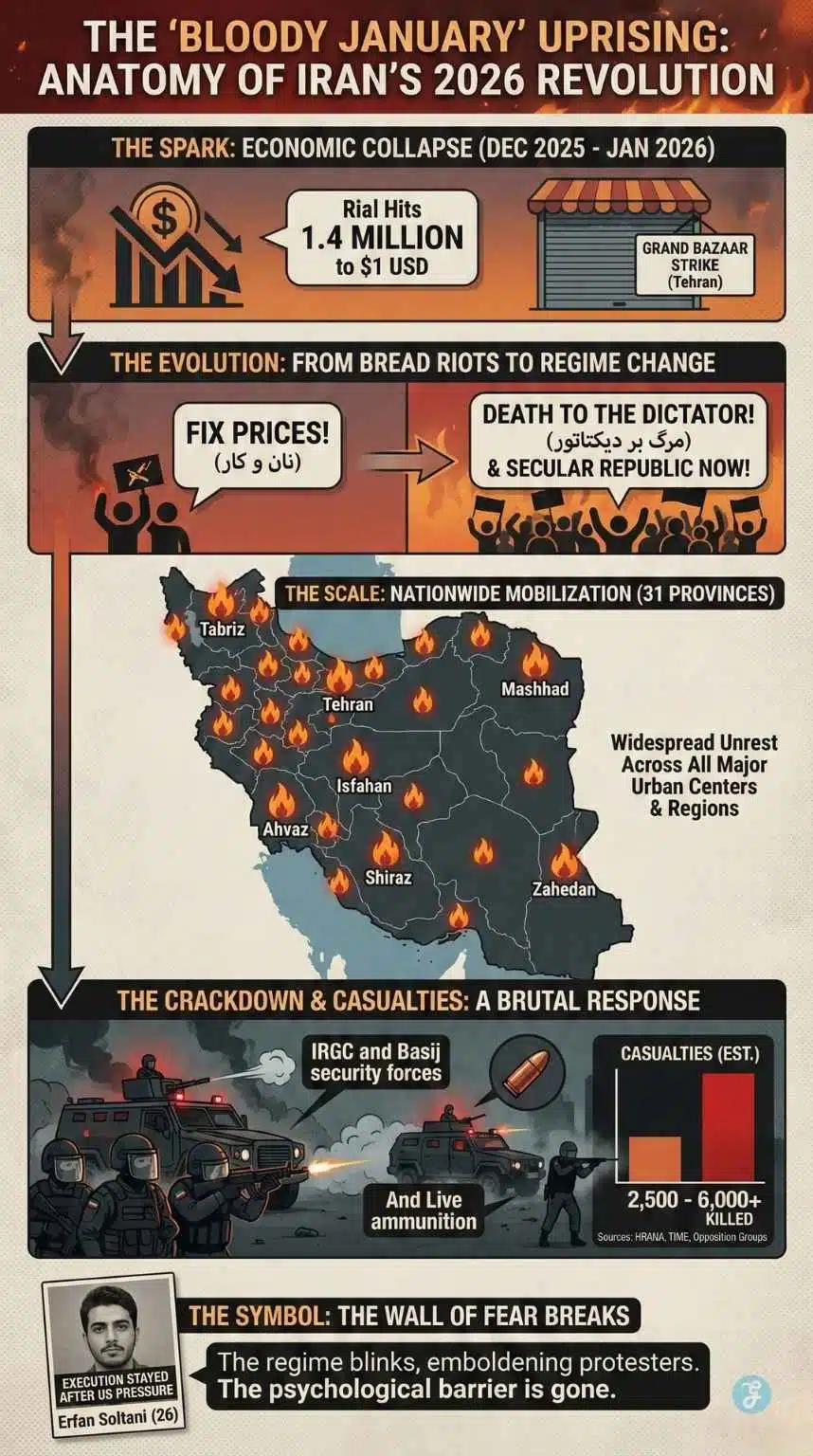
To understand the trajectory of 2026, one must first analyze the nature of the current unrest. Unlike the Green Movement of 2009, which was a political dispute within the system, or the 2019 gasoline protests, which were sporadic bursts of economic rage, the uprising that began on December 28, 2025, is a structural revolution.
From Bread Riots to Regime Change
The spark was technically economic. On the morning of December 28, the Iranian Rial free-fell to an unprecedented low of 1.4 million to the US dollar. This hyper-inflationary event instantly wiped out the life savings of the middle class and made basic staples like bread and medicine unaffordable for the working poor. The initial reaction was a massive strike in Tehran’s Grand Bazaar, historically the bellwether of Iranian political shifts. When the merchant class, the traditional conservative backbone of the clergy, closed their shutters, they signaled that the social contract with the Mullahs was irrevocably broken.
However, the speed at which economic grievances morphed into political demands was unprecedented.
Within 48 hours, slogans shifted from “Fix the Prices” to “Death to the Dictator” and, more significantly, “We Want a Republic, Not a Caliphate.”
This semantic shift is crucial; it indicates that the population is no longer asking for reform within the Islamic Republic, but for the end of the Islamic Republic itself. The protests spread rapidly to all 31 provinces, uniting the urban elite in North Tehran with the working-class populations of Khuzestan and the Baluchi regions, bridging a class divide that the regime has historically exploited to stay in power.
The Evolution of Dissent [Comparison Analysis]
Purpose: To visually demonstrate why 2026 is structurally different from previous uprisings, supporting the “Terminal Crisis” thesis.
| Feature | 2009 Green Movement | 2019 “Bloody November” | 2026 “Leadership Transition” |
| Primary Trigger | Disputed Election Results | 200% Fuel Price Hike | Currency Collapse (Rial) & Hyper-inflation |
| Core Demand | “Where is my vote?” (Reform) | “Restore Subsidies” (Economic) | “Death to the Dictator” (Regime Change) |
| Demographic | Urban Middle Class / Students | Working Class / Poor | Unified Cross-Class (Bazaar + Labor + Students) |
| US Policy | “Strategic Silence” (Obama) | “Maximum Pressure” (Trump Term 1) | “Active Transition Support” (Trump Term 2) |
| Regime Status | Unified & Strong | Cracks Appearing | Fractured, Bankrupt & Isolated |
The Scale of the Crackdown vs. The Wall of Fear
The regime’s response has been brutal, yet arguably ineffective in stemming the tide. Reports from the Human Rights Activists News Agency and confirmed by satellite imagery analysis indicate that security forces have utilized heavy machine-gun fire in cities like Shiraz, Karaj, and Mahabad. The death toll is a subject of fierce contention; while Supreme Leader Ali Khamenei vaguely acknowledged “thousands” of deaths in a rare moment of candor on January 17, opposition groups estimate the figure could be as high as 6,000.
Hospitals in major urban centers are reporting “war-zone conditions,” with doctors threatened by intelligence agents if they treat gunshot victims. Yet, the “wall of fear”, the psychological barrier that prevents populations from challenging a violent state, appears to have shattered. In previous years, public executions quelled dissent. In 2026, they seem to fuel it.
A defining moment of this psychological shift was the case of Erfan Soltani, a 26-year-old protester from Karaj, sentenced to hang. In the past, such a sentence would be carried out swiftly to send a message. However, following a direct warning from the White House promising “specific, personal consequences” for the judge and executioners, the execution was stayed. This hesitation was interpreted by the streets not as mercy, but as weakness. It proved that the regime is terrified of external escalation, emboldening the protesters to push harder.
The US Strategic Pivot: The “Bessent Doctrine” Explained
While the courage of the Iranian people is the engine of this transition, the fuel is being cut off by Washington. The Iran Leadership Transition 2026 strategy is underpinned by a new economic warfare framework spearheaded by US Treasury Secretary Scott Bessent. This approach, colloquially dubbed the “Bessent Doctrine,” moves beyond broad sectoral sanctions to targeted “financial decapitation.”
Targeting the “Shadow Banking” Arteries
For years, Iran survived US sanctions by utilizing a vast “shadow banking” network, a web of shell companies in Hong Kong, the UAE, and Turkey that laundered oil revenue. On January 15, 2026, the US Treasury designated and sanctioned the specific nodes of this network, including Nikan Pezhvak and Empire International.
These entities were not just random trading firms; they were the specific clearinghouses used by the IRGC to convert crude oil into hard currency (Euros and Yuan) to pay the salaries of the Basij militia and the security forces. By freezing these specific assets and threatening secondary sanctions on any bank that processes their transactions, Secretary Bessent has struck at the regime’s jugular.
The logic is simple: The ideological fervor of the IRGC’s top commanders may be infinite, but the loyalty of the foot soldiers is transactional. If the regime cannot pay the monthly wages of the riot police, the crackdown collapses. Intelligence reports suggest that salary delays in the security sector have already jumped from two weeks to two months since the sanctions were implemented, leading to a spike in “sick days” and desertions among lower-ranking personnel.
The “Bessent Doctrine” Target List
Purpose: To break down the complex financial sanctions into digestible facts. It explains exactly how the US is bankrupting the regime.
| Target Entity / Mechanism | Role in Regime Survival | Impact of Jan 2026 Sanctions |
| Nikan Pezhvak Co. | Major “Shadow Bank” used to launder oil money in the UAE. | Assets Frozen: Immediate halt to IRGC payroll transfers. |
| Empire International | Clearinghouse for converting Chinese Yuan to Euros. | Blacklisted: Cut off from global SWIFT access; funds trapped. |
| 25% Global Tariff | Penalty on nations buying Iranian oil (China/India). | Demand Destruction: Chinese imports dropped 40% in Jan. |
| IRGC Commanders | Individual repression leaders (e.g., Basij Chiefs). | Personal Liability: Seizure of overseas properties & travel bans. |
| Starlink Terminals | Smuggled internet access points. | Exempted: The US Treasury waived fees to ensure connectivity. |
The “25% Tariff Wall” and Diplomatic Isolation
Simultaneously, the Trump administration has leveraged US market dominance to close the loopholes that China and India previously exploited. The imposition of a generic 25% tariff on goods from any nation found to be purchasing Iranian oil has forced Beijing and New Delhi to recalculate their risk exposure.
For China, facing its own economic slowdown, access to the American consumer market is far more valuable than the discount on Iranian crude. Tracking data from January 2026 shows a 40% drop in Iranian oil tankers departing for Chinese ports compared to the previous month. This effectively caps the regime’s last remaining revenue stream. The US message to the world is clear: You can trade with the United States, or you can fund the Islamic Republic, but you cannot do both.
Trump’s Rhetorical Escalation
The shift is not just financial; it is deeply psychological. President Trump’s rhetoric has evolved from isolationism to active instigation. By explicitly stating, “Help is on the way” and labeling the Supreme Leader a “criminal” in international forums, the US is denying the regime any path to diplomatic rehabilitation. This stands in stark contrast to the 2009 approach, where the Obama administration hesitated to voice support for fear of tainting the opposition. The 2026 strategy operates on the belief that the regime is already tainted beyond repair, and US support acts as a force multiplier for the opposition’s morale.
Inside the Bunker: The Regime’s Existential Crisis
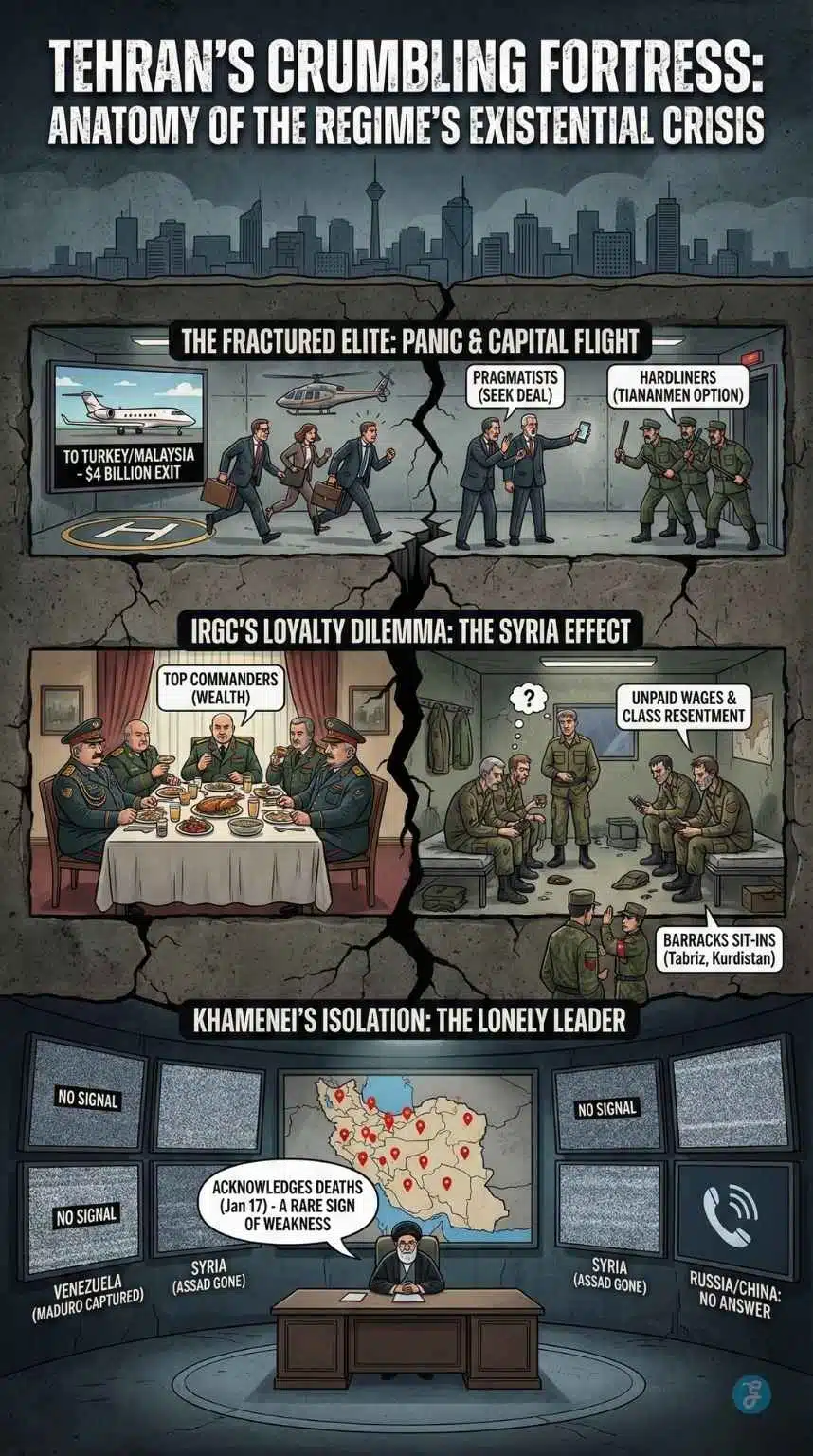
Inside Tehran’s fortified compounds, the mood is reportedly apocalyptic. The monolithic unity that the Islamic Republic projects to the world is fracturing under the pressure of the Iran Leadership Transition 2026 narrative.
The Fracturing of the Elite
Intelligence leaks and reports from outlets like Fox News indicate a massive wave of capital flight. It is estimated that in the last three months alone, regime insiders have moved over $4 billion into cryptic accounts in Turkey, Malaysia, and crypto-assets. This phenomenon, often called the “rats leaving a sinking ship” scenario, is a lagging indicator of regime stability. When the elites stop investing in the country and start extracting wealth, they have privately accepted that the end is near.
Politically, the regime is split into two warring camps. On one side, the “Pragmatic Survivalists,” led ostensibly by figures like Foreign Minister Abbas Araghchi, are advocating for immediate concessions, halting executions, and releasing political prisoners, to stave off a US or Israeli military strike. On the other side, the “Ideological Suicides,” comprising the hardline core of the IRGC and the Supreme Leader’s inner circle, believe that any step backward will lead to a Soviet-style collapse. They argue for a “Tiananmen Square” solution: absolute brutality to reset the status quo.
However, the “Ideological Suicides” face a problem: they may give the order to fire, but fewer hands are willing to pull the trigger.
The IRGC’s Loyalty Dilemma
The Islamic Revolutionary Guard Corps (IRGC) is often viewed as a monolith, but it is actually a tiered organization with deep internal rifts. The “Syria Effect” has been devastating for the corps’ cohesion. For a decade, the intervention in Syria provided the IRGC with lucrative smuggling routes, combat pay, and a sense of purpose. The fall of Assad in 2024 ended the gravy train.
Now, the mid-level commanders, the majors and colonels who actually run the battalions, are seeing their benefits slashed while the top generals continue to live in luxury. This class resentment within the Guard is the regime’s greatest vulnerability. There are unconfirmed but persistent reports of IRGC units in Tabriz and the Kurdish regions refusing to deploy against local protesters, opting instead to stay in their barracks. If this “barracks sit-in” spreads to Tehran, the regime is finished.
The Geopolitical Vacuum: Who Replaces the Mullahs?
As the Iran Leadership Transition 2026 becomes a probability, the world’s attention turns to the question of succession. Who, or what, fills the vacuum left by the collapse of the Theocracy?
The Opposition Landscape
The opposition is more organized than in previous years, though still fragmented.
- The Crown Prince & The Constitutionalists: Reza Pahlavi remains the most visible figurehead for the diaspora. His platform of a secular, parliamentary democracy resonates with the urban middle class, who remember the pre-1979 era with nostalgia. His calls for a “peaceful transition” and amnesty for army regulars have made him a palatable option for military defectors.
- The “Neighborhood Youth” (Javanane Mahallat): Inside Iran, leadership is decentralized. These local committees coordinate protests via encrypted apps, devoid of a single head to decapitate. While effective for disruption, their lack of a central political program makes them a wildcard in a post-transition government.
- The Ethnic Federalists: Kurdish, Baluchi, and Arab factions are pushing for a federalized Iran with significant local autonomy. This creates tension with the Persian nationalist core, posing the risk of balkanization if a central authority collapses too quickly.
Israel’s Role: The “Silent Partner”
Israel has played the role of the “icebreaker” in this transition. Defense Minister Israel Katz’s description of the June 2025 strikes as a “promo” was accurate. By systematically dismantling Iran’s air defenses and radar systems, Israel removed the regime’s shield.
Currently, Israeli strategy has shifted from kinetic strikes to intelligence dominance. Mossad is reportedly providing real-time tactical data to opposition groups, helping them evade security cordons. Furthermore, Israel’s cyber-warfare units are actively disrupting regime communications, jamming the internal networks used by the Basij to coordinate crackdowns. Israel’s goal is clear: a collapsed Iran is preferable to a nuclear Iran, even if the resulting chaos lasts for years.
The Energy Paradox: Why the World Isn’t Panicking
For decades, the Islamic Republic’s ultimate insurance policy was the “Oil Weapon”, the threat that any attempt to topple the regime would spike global crude prices to $200 a barrel and crash the Western economy. In January 2026, that weapon had misfired.
Despite the chaos in the streets and the USS Abraham Lincoln parked in the Gulf, Brent Crude is trading steadily at $65 per barrel. This market apathy is driven by three factors:
- US Energy Dominance: US shale production has hit an all-time high of 14.2 million barrels per day, creating a buffer that insulates American consumers from Middle East volatility.
- The “Saudi Put”: Riyadh has quietly signaled that it utilizes less than 70% of its production capacity. If Iranian exports (approx. 1.2 million bpd) vanish overnight, Saudi Aramco can fill that gap within 48 hours.
- China’s Weakness: The slowing Chinese economy has reduced global demand. Beijing, fearing the new US “25% Tariff Wall,” has prioritized protecting its manufacturing exports over securing Iranian oil, effectively abandoning its role as Tehran’s economic lung.
Analysis: The regime has lost its ability to hold the global economy hostage. The world has priced in the collapse of the Islamic Republic and found it manageable.
The Failure of the Digital Kill-Switch
In 2019, the regime successfully crushed protests by severing Iran’s connection to the global internet for a week, blinding the world to the massacre. In 2026, the “Digital Curtain” has been torn down.
The difference is the proliferation of Low Earth Orbit (LEO) satellite internet. Since President Trump’s January 8th reference to “Freedom Connect,” SpaceX has reportedly waived service fees for terminals in Iran. Smuggling networks, once used for alcohol and satellite TV, have flooded the country with an estimated 50,000 Starlink Mini units, compact devices that can be powered by a car battery and hidden in a backpack.
While the regime attempts to jam these frequencies, the sheer volume of devices has created a “whack-a-mole” dynamic that they cannot win. Furthermore, protesters are utilizing Bluetooth-based “Mesh Networks” (like Bridgefy 2.0) that allow phones to communicate off-grid, hopping messages from device to device until they reach a satellite uplink. The result is that HD footage of the crackdowns in Shiraz and Tabriz is reaching the UN Security Council in near real-time, stripping the regime of the cover of darkness.
The Collapse of the “Axis of Resistance”
The isolation of Tehran is best understood by looking at the empty chairs at the table. For years, Iran projected power through a “Forward Defense” strategy, relying on allies in Damascus, Beirut, and Caracas to dilute American pressure. That security architecture has been systematically dismantled.
- The Syria Blow (Dec 2024): The fall of the Assad regime severed the land bridge to Hezbollah, turning the IRGC’s Quds Force from a regional power broker into a homeless militia.
- The Maduro Capture (Jan 2026): The collapse of Nicolás Maduro in Venezuela removed Iran’s primary partner in the Western Hemisphere and a key hub for money laundering and gold-for-oil swaps.
- The Moscow Silence: Perhaps most telling is the silence from the Kremlin. Bogged down in the “Winter Siege” in Ukraine, Russia has offered no tangible support to Khamenei. President Putin, sensing the shifting winds, appears to be cutting his losses rather than doubling down on a losing bet.
Analysis: Iran is no longer the head of an axis; it is a besieged bunker. The regime is fighting this war entirely alone.
Three Future Scenarios for 2026
Based on the current trajectory, intelligence analysts and geopolitical forecasters are looking at three primary scenarios for how the Iran Leadership Transition 2026 unfolds.
Scenario A: The “Romanian” Collapse [40% Probability]
This is the rapid-fire scenario. Under the weight of unpaid wages and relentless protests, the lower ranks of the military and police mutiny. The security apparatus disintegrates over the course of 48 to 72 hours. Supreme Leader Khamenei attempts to flee (likely to Russia or Venezuela) or is captured. Violence is high but short-lived. A provisional government, likely a coalition of army generals and technocrats backed by the diaspora, steps in to restore order. This is the “best-case” scenario for the West, allowing for a relatively quick stabilization and the restoration of oil exports under a friendly regime.
Scenario B: The “Syrian” Civil War [30% Probability]
The IRGC hardliners refuse to surrender. They retreat from the rebellious cities and consolidate power in their strongholds, effectively fracturing the country. The Kurds and Baluchis declare independence, sparking ethnic conflicts. The central government collapses, but no single entity has the power to rule the whole. Iran descends into a protracted civil war, with warlords controlling different provinces. This scenario is a nightmare for global energy markets and regional security, likely requiring a UN or NATO intervention to secure nuclear sites.
Scenario C: The “Military Junta” Transition [30% Probability]
In this scenario, the IRGC realizes the Clergy is a liability. To save themselves and their economic empires, the Generals stage a coup against the Supreme Leader. They abolish the position of the Velayat-e Faqih, declare a military dictatorship, and offer a “grand bargain” to the West: “We will give up the nuclear program and stop terror funding if you let us stay in power.” This would result in an Egypt-style military government—secular but authoritarian. While it removes the theological threat, it leaves the oppressive security state largely intact.
A New Geopolitical Reality
For the international community, the time for hedging bets has passed. The era of strategic patience is over, and the collapse of the mullahs’ regime will reshape the Middle East more profoundly than any event since the fall of the Ottoman Empire.
This shift promises a future where Iran is no longer a pariah state exporting terror, but a nation returned to its people, a stabilization that would secure global energy flows and peace in the Levant for a generation. As the Iran Leadership Transition 2026 unfolds, the world is witnessing not just the end of a government but the rebirth of a nation.
Final Words: The Point of No Return
The events of January 2026 indicate that the Islamic Republic has passed the point of no return. The convergence of economic bankruptcy, military humiliation by Israel, and a resolute US policy of Iran Leadership Transition 2026 has stripped the regime of its survival mechanisms.
The “Bessent Doctrine” is effectively starving the beast, while the brave men and women on the streets of Tehran, Isfahan, and Mashhad are fearlessly confronting it. The United States has cast its vote for a new Iran, and the Iranian people are currently counting the ballots in the streets. The transition has arguably already begun; the only remaining question is how much more blood the dying regime will spill before it finally succumbs to history.