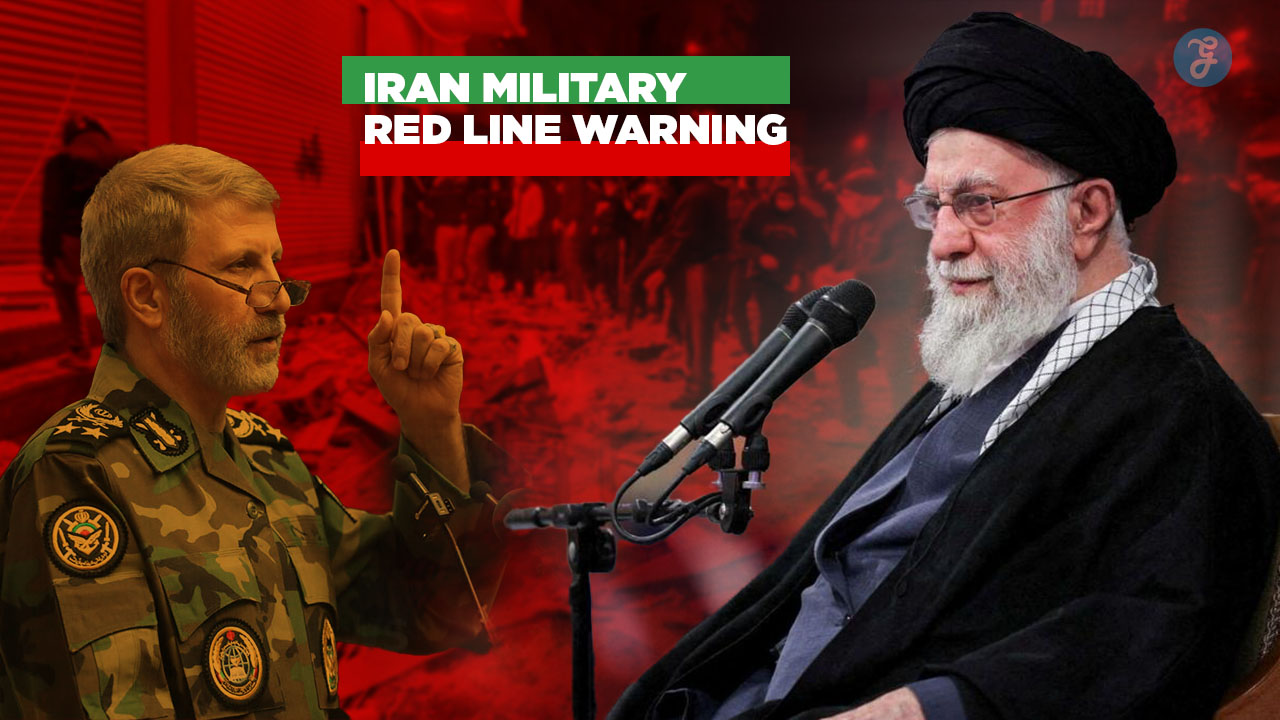
The Middle East stands on the precipice of a conflict that could reshape global security for a generation. The catalyst is a document issued just five days ago, on January 6, by Iran’s Supreme National Security Council: the so-called “Red Line” Decree, also known as the Anticipatory Defense Doctrine.
This is not just another piece of fiery rhetoric from Tehran. It is a formal, legalistic pivot in military doctrine that effectively ends the four-decade era of “Strategic Patience.” For the first time, Iran has codified its right to strike first based on “objective signs of threat,” a move that analysts say has lowered the threshold for regional war to its lowest point since the 1980s.
Below is an in-depth analysis of why 2026 has become the year of the “Red Line,” the internal and external pressures driving this desperation, and what the “Bloody New Phase” actually looks like on the ground.
The Doctrinal Pivot: From Patience to Pre-emption
For over forty years, the Islamic Republic’s military strategy was built on the concept of Second-Strike Deterrence. Tehran understood that its conventional military could not survive a head-to-head confrontation with the United States or Israel. Consequently, it invested in a “Shadow War” framework: proxy networks (the Axis of Resistance), a massive ballistic missile arsenal for retaliation, and “strategic patience”, the ability to absorb small-scale strikes without escalating into full-scale war.
The January 6 Decree has shredded that playbook. The new doctrine, termed “Anticipatory Defense Doctrine,” introduces three dangerous new variables:
- The “Objective Threat” Trigger: Iran now claims the right to launch missiles or drones if it perceives “tangible signs” of an imminent attack. The danger lies in the ambiguity. Does a US carrier group moving into the North Arabian Sea count as a “tangible sign”? Does a major cyber-attack on Iran’s power grid justify a pre-emptive strike on Tel Aviv?
- Legitimizing Direct State Action: Historically, Iran hid behind proxies like Hezbollah or the Houthis. The Decree explicitly states that the Artesh (regular army) and the IRGC will now act directly and “decisively” to protect national stability.
- End of Proportionality: The document warns that any infringement on sovereignty will be met with a response that is “determining”, military-speak for an escalation designed to end a conflict on Tehran’s terms rather than simply matching the enemy’s blow.
The Ghost of June 2025: Operation Raising Lion
To understand why Tehran is acting with such perceived recklessness in 2026, we must look back at the trauma of June 13–25, 2025. During this 12-day window, Israel launched Operation Raising Lion, the largest air campaign in its history.
The strikes were surgically focused on two goals: decapitating the IRGC leadership and crippling the nuclear program. The results were devastating for the Iranian establishment.
The Decapitation: Key IRGC Leadership Lost [June 2025]
| Name | Position | Fate |
| Mohammad Bagheri | Chief of General Staff | Killed in the initial strike on Tehran HQ |
| Hossein Salami | Commander-in-Chief, IRGC | Assassinated during a strategic meeting |
| Amir Ali Hajizadeh | Head of Aerospace Forces | Killed in a strike on the missile production site |
| Mohammad Kazemi | Head of IRGC Intelligence | Killed during a follow-up strike on June 15 |
The loss of these veterans left a vacuum filled by a younger, more radicalized generation of officers. These new leaders believe that Salami’s “patience” is what allowed Israel to strike with impunity. The Red Line Decree is their way of ensuring that they are the ones who pull the trigger next time.
The Internal Tsunami: A State Under Siege
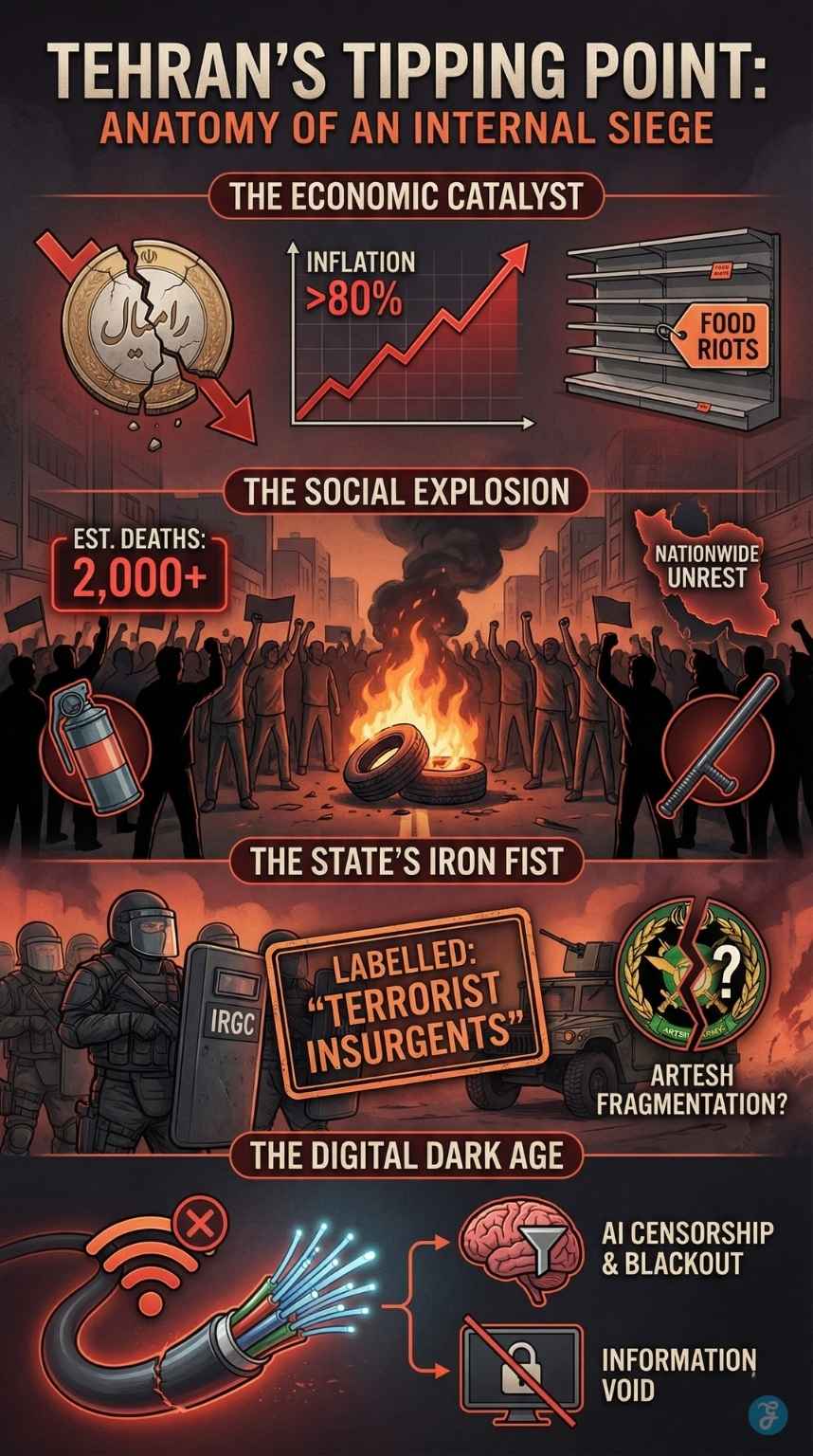
While the world watches the borders, the most immediate “bloody” aspect of 2026 is happening in the streets of Tehran, Shiraz, and Tabriz. Since December 28, 2025, Iran has been gripped by what is being called the “Food Riots” or the “Livelihood Uprising.”
The economic situation is no longer a crisis; it is a collapse.
- Inflation: Currently estimated at 82% for basic goods.
- The Rial: Trading at historic lows, making imported medicine and spare parts nearly impossible to obtain.
- The Trigger: The “Snapback” of UN sanctions in late 2025, which effectively cut off Iran’s last remaining legal oil exports to Asia.
The regime’s response has been more brutal than even the 2022 “Woman, Life, Freedom” protests. On January 10, 2026, the IRGC officially rebranded protesters as “terrorist insurgents” and “foreign mercenaries.”
Current Situation Report [Jan 2026]
Human rights groups, including HRANA, report that at least 2,000 people have been killed in the last week alone. A nationwide internet blackout has turned the country into a “black box,” with reports of security forces using heavy machine guns and armored vehicles in residential areas of Sistan and Baluchestan.
The “Locked and Loaded” Factor: Trump’s Return
Adding fuel to the fire is the geopolitical posture of US President Donald Trump. Since returning to office in January 2025, his administration has pursued a “Maximum Pressure 2.0” campaign that makes the first term look moderate.
On January 2, 2026, Trump issued a message on Truth Social that has since become the rallying cry for the US interventionist wing:
“If Iran shoots and violently kills peaceful protesters, which is their custom, the United States of America will come to their rescue. We are locked and loaded and ready to go.”
The phrase “Locked and Loaded” has specific military connotations. Intelligence reports suggest that the US has increased its B-52 presence in Diego Garcia and moved an additional carrier strike group to the Mediterranean. This “pincer” movement around Iran is exactly what the January 6 Decree was designed to deter—or, more dangerously, what it was designed to pre-empt
The Four Pillars of the 2026 Crisis
While the “Red Line” Decree may appear to be a simple military warning, it is actually the byproduct of four distinct, intersecting pressures that have pushed Tehran into a corner. To understand why 2026 has entered a “bloody new phase,” one must look beyond the rhetoric and examine the structural collapse of Iran’s traditional defense model.
This section deconstructs the legal, military, geographical, and technological pillars that now define the regime’s “Anticipatory Defense Doctrine”, a framework born out of desperation, isolation, and a fundamental shift in the regional balance of power.
Pillar 01- The Legal Framing: Reimagining Article 51
In a sophisticated diplomatic maneuver, Tehran is no longer positioning its military actions as “retaliation,” but as “Legitimate Anticipatory Self-Defense.”
- The Argument: Iranian legal scholars and the National Defense Council are citing a broad interpretation of Article 51 of the UN Charter. They argue that in the modern era of hypersonic missiles and cyber warfare, an “armed attack” begins the moment a “tangible threat” is detected, not when the first explosion occurs.
- The Global Precedent: By adopting this language, Iran is ironically using the same “Pre-emptive Strike” logic pioneered by the U.S. in the early 2000s. This legal “mirroring” is designed to make it harder for the international community to condemn Iranian strikes without also delegitimizing Western military doctrines.
Pillar 2: The “Use-It-or-Lose-It” Strategic Dilemma
Military analysts at the Institute for the Study of War (ISW) suggest that Iran’s conventional deterrence was fundamentally shattered during the June 2025 air campaign.
- Degraded Arsenals: Estimates show that 40–50% of Iran’s mobile missile launchers and command-and-control bunkers were damaged in 2025.
- The Logic of Desperation: This has created a “Use-It-or-Lose-It” environment. If Iran waits for a second wave of U.S. or Israeli strikes, it fears their remaining assets will be destroyed on the ground before they can be fired. The Red Line Decree is a signal that Tehran will launch its remaining arsenal the moment it perceives a countdown has begun, choosing a regional war over quiet disarmament.
Pillar 3: The Collapse of Strategic Depth (Syria & Hezbollah)
For decades, Iran’s “Red Line” was in Southern Lebanon and Damascus. In 2026, that buffer is gone.
- The Fall of Assad: The December 2024–2025 collapse of the Assad regime in Syria severed the “Land Bridge” that allowed the IRGC to supply its proxies.
- Hezbollah’s Neutralization: With the Lebanese Armed Forces (LAF) actively disarming Hezbollah units south of the Litani River (as of January 2026), Iran has lost its “Forward Deterrent.”
- Retreat to the Border: Without Syria or a dominant Hezbollah to absorb the first blow, Iran’s borders are now fully exposed. This loss of “strategic depth” has forced the regime to adopt a much more aggressive, “spiky” defense posture within its own territory.
Pillar 4: The “Digital Dark Age” and the AI-Driven Blackout
The “Bloody Phase” is being hidden by the most advanced censorship event in human history. Unlike the 2019 or 2022 blackouts, the January 2026 Blackout is not just a “kill switch.”
- AI Packet Filtering: The regime is using AI-driven traffic analysis to allow critical banking and state functions to remain online while identifying and “scrubbing” any outgoing video or image packets from civilian devices.
- The Information Gap: This is why human rights organizations are currently paralyzed. While state media claims “calm,” leaked reports from hospital staff suggest a death toll nearing 2,000, while official numbers remain frozen at 116. This “Digital Dark Age” prevents the international community from building a cohesive case for humanitarian intervention.
The Red Line Decree is the final evolution of a cornered state. By combining legal reinterpretation with a “use-it-or-lose-it” military mindset, and cloaking the resulting internal violence in a “Digital Dark Age,” Iran has created a situation where the next miscalculation will almost certainly result in a total regional conflagration.
Analysis of Possible Outcomes
As we move deeper into January 2026, there are three primary paths this “Bloody Phase” could take:
Scenario 1: The Miscalculation Loop
Because the Decree allows for action based on “perceived threats,” a simple cyber-glitch or an unannounced naval exercise could trigger an Iranian missile volley. If Iran strikes a US or Israeli target pre-emptively, the response will be “Operation Midnight Hammer”, a full-scale air and sea invasion aimed at regime change.
Scenario 2: The Internal implosion
The IRGC is currently stretched thin. They are fighting a domestic insurgency while preparing for an international war. If the conventional army (Artesh) refuses to fire on protesters—as some reports from Tabriz suggest is already happening- the regime may choose to launch an external war specifically to “rally around the flag” and force domestic unity through martial law.
Scenario 3: The Nuclear Breakout
With their conventional defenses (proxies and leadership) decimated, the “Red Line” Decree may be a smoke screen for a final dash to a nuclear weapon. If Iran formalizes its withdrawal from the NPT in the coming weeks, the “bloody phase” will likely involve a desperate Israeli-US attempt to neutralize the remaining hardened sites at Fordow, potentially involving tactical nuclear bunkerbusters.
Final Words: The End of Diplomacy?
The “Red Line” Decree or “Anticipatory Defense Doctrine” is more than a warning; it is a confession. It is the confession of a regime that feels it has run out of space to move. With its economy in ruins, its people in open revolt, and its enemies “locked and loaded,” Tehran has decided that the only way to survive is to make the cost of conflict so high that the world flinches first.
However, in 2026, the world is no longer in a mood to flinch. As the streets of Tehran burn and the missiles are fueled, the “Bloody Phase” is no longer a prediction; it is the reality of the new year.