
Health is one of the most valuable assets you have. At the same time, digital tools are changing how you track, manage, and improve your wellbeing. From smartwatches to telehealth apps and AI-powered health platforms, you now have more options than ever before.
That also means more decisions to make. Investing in health technology is not only about buying gadgets. It is about where you invest your time, attention, and money so that technology genuinely supports your life instead of distracting you.
Understanding Health Technology: What You Are Investing In
Health technology, or health tech, covers any digital tool that helps you prevent, monitor, treat, or manage health conditions. It includes both the tools you use directly and the systems working in the background.
Every day definition of health technology
For a beginner, health technology often looks like:
- Health and fitness apps on your phone
- Smartwatches, smart rings, and fitness trackers
- Telehealth or online doctor consultations
- Apps that track sleep, stress, or nutrition
- Digital platforms your clinic uses to share test results
Some tools are consumer-focused. Others are built for hospitals, insurers, or researchers but still affect your experience as a patient.
Why health tech is growing so fast
Several trends push health tech forward:
- Digital health is now a global market worth hundreds of billions of dollars and growing strongly toward the end of this decade.
- Surveys show that around four in ten adults in some countries already own a wearable device that tracks health data.
- Telehealth and virtual care remain widely used, especially in primary care and among older adults.
- Investors continue to fund digital health companies, with AI-focused startups capturing a growing share of funding.
In short, health tech is no longer a niche. It is becoming part of everyday health.
How you “invest” in health technology
You invest in health tech in two main ways:
- As a user
- You spend time learning and using tools
- You spend money on devices, apps, and services
- As a financial investor
- You buy stocks, funds, or back startups in the health tech space
We are focusing on you as a user, with a short look at financial investing for curious minds.
Understanding health technology
| Aspect | What it means | Why it matters for beginners |
| Tools you see | Apps, wearables, telehealth, home devices | Direct impact on your daily habits and routines |
| Tools you do not see | Hospital systems, data platforms, and AI | Shape your care experience and access |
| Market growth | Large and rapidly growing global industry | More choices, more noise, more need for smart decisions |
| Your type of investment | Time and money as a user | Determines your health outcomes and satisfaction |
Types of Health Technology for Everyday Users
Health technology comes in many forms. Not all of them are necessary for you. The key is to match tool categories with your real needs.
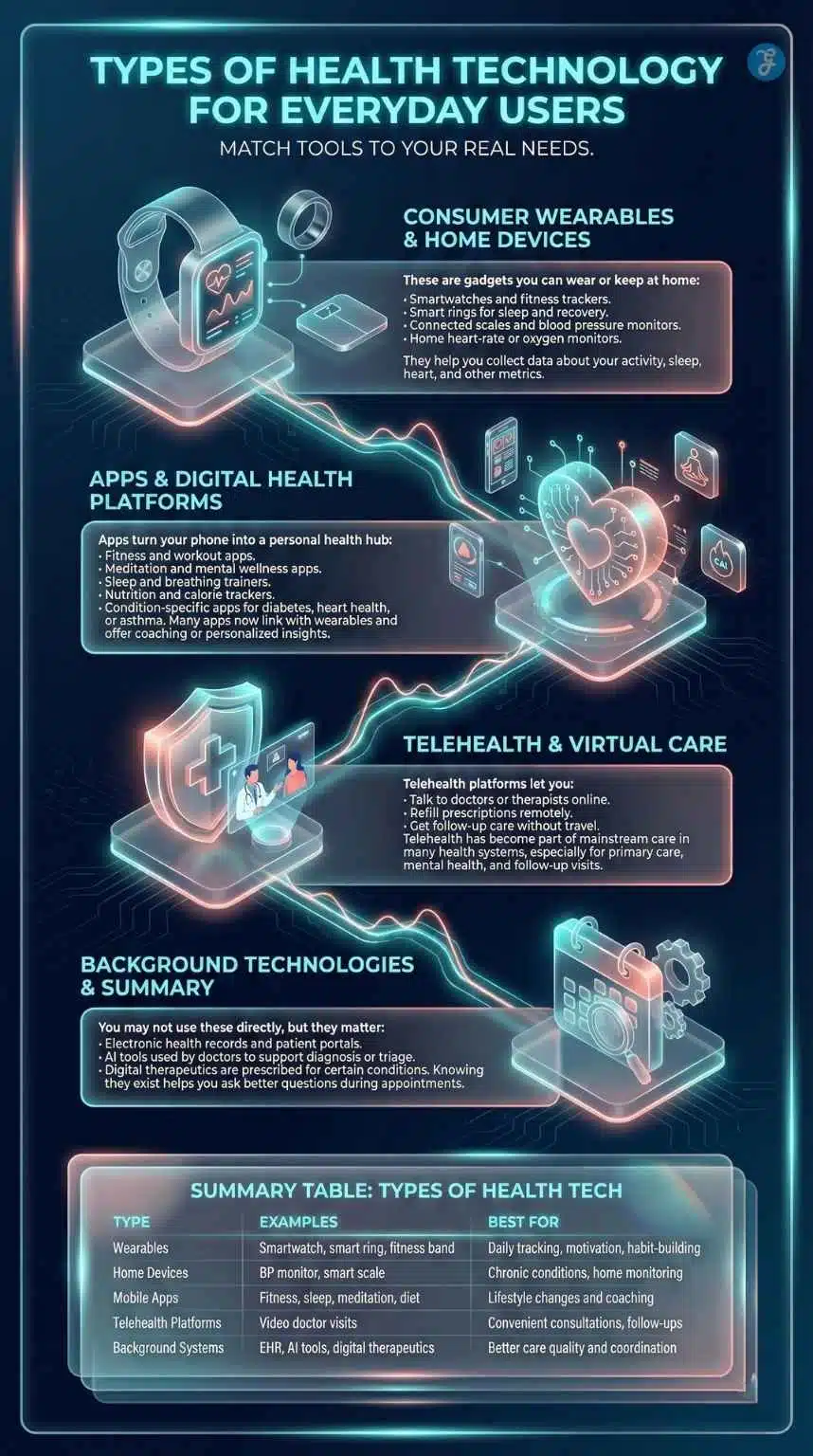
Consumer wearables and home devices
These are gadgets you can wear or keep at home:
- Smartwatches and fitness trackers
- Smart rings for sleep and recovery
- Connected scales and blood pressure monitors
- Home heart-rate or oxygen monitors
They help you collect data about your activity, sleep, heart, and other metrics.
Apps and digital health platforms
Apps turn your phone into a personal health hub:
- Fitness and workout apps
- Meditation and mental wellness apps
- Sleep and breathing trainers
- Nutrition and calorie trackers
- Condition-specific apps for diabetes, heart health, or asthma
Many apps now link with wearables and offer coaching or personalized insights.
Telehealth and virtual care
Telehealth platforms let you:
- Talk to doctors or therapists online
- Refill prescriptions remotely
- Get follow-up care without travel
Telehealth has become part of mainstream care in many health systems, especially for primary care, mental health, and follow-up visits.
Background technologies
You may not use these directly, but they matter:
- Electronic health records and patient portals
- AI tools used by doctors to support diagnosis or triage
- Digital therapeutics are prescribed for certain conditions
Knowing they exist helps you ask better questions during appointments.
Types of health tech
| Type | Examples | Best for |
| Wearables | Smartwatch, smart ring, fitness band | Daily tracking, motivation, habit-building |
| Home devices | BP monitor, smart scale | Chronic conditions, home monitoring |
| Mobile apps | Fitness, sleep, meditation, diet | Lifestyle changes and coaching |
| Telehealth platforms | Video doctor visits | Convenient consultations, follow-ups |
| Background systems | EHR, AI tools, digital therapeutics | Better care quality and coordination |
Set Your Goals Before Investing in Health Technology
This is the first section that directly uses the phrase investing in health technology. Before you buy gadgets or subscribe to apps, you need clarity about what you want.
Define your health priorities
Ask yourself simple questions:
- What bothers me most right now?
- What is my main health goal in the next three to six months?
- Do I currently see a doctor or therapist for this?
Write down one primary goal and, at most, two secondary goals.
Decide how much time you can invest
Time is often more important than money:
- If you have only ten minutes a day, a simple step goal and a quick breathing exercise may be enough
- If you can commit thirty to forty minutes, you might add structured workouts or guided therapy sessions
- Be honest, overestimating your time leads to abandoned apps and devices
Decide how much money you can invest
Set a rough monthly budget before you start investing in health technology:
- Low budget: Use free apps and your phone’s built-in health features. Consider basic, affordable devices only if necessary
- Medium budget: One good wearable plus one or two quality app subscriptions
- Higher budget: Advanced devices, remote programs, or online coaching
The goal is not to spend the most. It is to get good value for every unit of currency and every minute you spend.
Goal-setting before investment
| Area | Key question | Practical example |
| Health goal | What is my top health priority? | “Sleep better” or “Lower blood pressure.” |
| Time budget | How much time can I commit daily? | 10, 20, or 40 minutes per day |
| Money budget | How much can I spend each month? | Free, only a small subscription, or a higher investment |
| Alignment | Does this tool support my main goal? | Wearable for steps vs an app for guided therapy |
How to Evaluate Health Tech Products and Services
Once you know your goals, you need a simple checklist for evaluating tools. This reduces hype and helps you avoid disappointment.
Look for evidence and credibility
Good health tools should be grounded in science:
- Check if there is clinical research or validation
- Look for approval or clearance where needed for medical devices
- Read independent reviews from users and professionals
Be wary of tools that promise to cure serious diseases or offer instant results without effort.
Check privacy and data security
Digital health relies on sensitive data. At the same time, data privacy and security remain major concerns for users and regulators.
Look for:
- Clear privacy policy
- Explanation of data storage and sharing
- Ability to export or delete your data
- Two-factor authentication for accounts
If you do not feel comfortable with how your data is handled, do not use the tool.
Evaluate usability and integration
A tool is only useful if you can use it consistently:
- Simple and clear interface
- Language and instructions you understand
- Works with your phone, watch, or other devices
- Does not require too many manual steps every day
Integration with your doctor’s system or patient portal is a bonus, but not always essential.
Consider cost versus value
Look at the total cost:
- Upfront device price
- Subscription fees
- Accessories or extra features
Compare this with the benefits you expect:
- Does it help you avoid extra clinic visits?
- Does it support long-term lifestyle change?
- Does it reduce your stress or improve your sleep?
Evaluation checklist
| Factor | What to check | Red flag example |
| Evidence | Studies, approvals, expert input | Big promises, no data |
| Privacy | Data use, sharing, control | Vague policy, sells data without consent |
| Usability | Simplicity, accessibility, integration | Confusing app, too many steps |
| Cost vs value | Price, subscription, long-term benefits | High cost, low impact on your real goals |
Investing Your Time: Build Sustainable Digital Health Habits
You can buy the best device in the world, but without consistent use, it becomes an expensive toy. The real power of health tech lies in your daily habits.
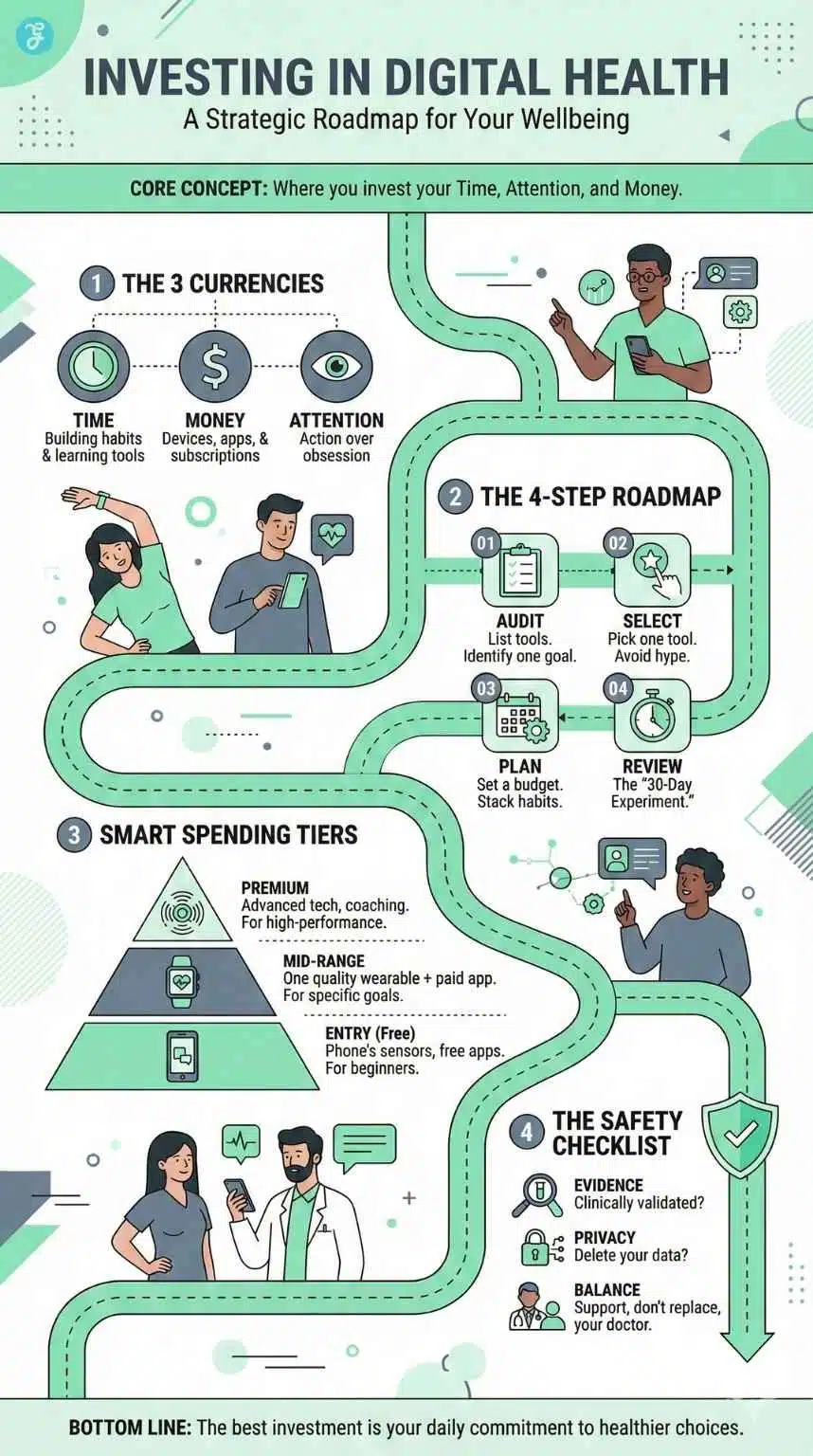
Start with a short experiment
Try a 30-day experiment:
- Pick one main goal
- Choose one primary tool that supports this goal
- Set simple rules
such as:
- Walk 8,000 steps per day
- Meditate for 5 minutes daily
- Track your blood pressure three times per week
At the end of 30 days, review what changed and how you feel.
Build routines around existing habits
Health tech works best when it fits your life:
- Check your tracker when you brush your teeth
- Start a guided breathing session after you turn off your computer
- Review your sleep score during your morning coffee
By linking new habits to existing ones, you reduce friction.
Avoid common time traps
Be careful with:
- Constantly switching apps or devices
- Tracking too many metrics
- Spending more time staring at dashboards than actually moving, resting, or eating well
Your goal is better health, not perfect graphs.
Time investment tips
| Strategy | Description | Example |
| 30-day experiment | Test one tool for a short, clear period | One sleep app plus a daily wind-down routine |
| Habit stacking | Attach tech use to existing habits | Check step count after lunch |
| Focused tracking | Track a few metrics that really matter | Steps, sleep, and blood pressure only |
| Reduce noise | Limit app switching and constant tweaking | Change tools only after the full review period |
Investing Your Money: Smart Spending Strategies
Spending wisely is a key part of investing in health technology. The aim is to avoid impulse purchases and choose tools that deliver real value.
Create a simple budget
Entry-level
- Use free apps and built-in phone tools
- Spend only on a basic wearable if you truly need it
Mid-range
- One quality wearable, such as a mainstream smartwatch or fitness tracker
- One or two paid apps for sleep, workouts, or mental health
Premium
- Advanced devices, specialized sensors, or digital coaching programs
Check your budget every few months. Cancel subscriptions you do not use.
Decide when to buy devices
Consider buying a wearable or home device if:
- You have a clear health goal that supports
- You already built a basic habit without the device
- You researched accuracy and comfort
- You can afford it without financial stress
If you are not yet consistent with simple habits, start with free tools.
Think carefully about subscriptions
Subscriptions can be useful, but add up quickly:
- Choose plans that offer clear coaching, personalized programs, or community support
- Prefer monthly plans at first so you can cancel easily
- Review your bank statements regularly to catch forgotten subscriptions
A brief note on financial investing
Some people may want to go beyond being users and become financial investors in health tech companies. Digital health funding remains active, especially for AI-driven solutions, but investors are more cautious and demand proof of value.
If you consider this path:
- Learn basic investment principles
- Use diversified funds rather than single stocks
- Seek professional financial advice
Money investment tips
| Area | Guideline | Example |
| Budget | Set a monthly limit before spending | Decide a fixed amount for apps and devices |
| Devices | Buy only when linked to clear goals | Tracker for walking habit, not just curiosity |
| Subscriptions | Start small and review often | One quality app instead of many unused ones |
| Financial investing | Learn first, diversify, and get advice | Consider broad funds instead of single stocks |
Real-Life Scenarios for Using Health Technology
Concrete examples can make decisions easier. Here are four simple scenarios.
Busy professional with limited time
Goals:
- Reduce stress
- Sit less and move more
- Improve sleep quality
Possible toolkit:
- Smartwatch or phone-based step counter
- Short, guided breathing or meditation app
- Sleep tracking with gentle reminders to wind down
Focus on micro-changes that fit within breaks and evenings.
A person managing a chronic condition
Goals:
- Monitor key metrics
- Avoid complications
- Stay in touch with the care team
Possible toolkit:
- Connected blood pressure monitor or glucose monitor
- Condition-specific app with reminders and education
- Patient portal or telehealth access for follow-up visits
Always coordinate with your doctor before adding new devices.
Beginner focusing on fitness
Goals:
- Build a regular exercise habit
- Gain basic strength and stamina
- Avoid injury
Possible toolkit:
- Basic fitness tracker or app counting steps and workouts
- Simple bodyweight or beginner exercise program
- Stretching or mobility app for recovery
Start slow, track progress, and adjust based on how your body feels.
Supporting an older family member
Goals:
- Improve safety at home
- Avoid falls or missed medications
- Reduce loneliness and confusion
Possible toolkit:
- Simple wearable with fall detection or emergency alerts
- Medication reminder app with clear alarms
- Video calling and telehealth tools with large buttons and fonts
Provide training and ongoing support to help them use these tools confidently.
Scenarios and tools
| Scenario | Main goals | Example tools |
| Busy professional | Stress, movement, sleep | Smartwatch, breathing app, sleep tracker |
| Chronic condition | Monitoring, prevention, follow-up | Connected monitor, condition app, telehealth |
| Fitness beginner | Exercise habit, basic strength | Step counter, workout app, stretching program |
| Older family member support | Safety, meds, connection | Fall detection device, reminders, video telehealth |
Risks, Limits, and Ethical Concerns
Health technology is powerful but not perfect. Understanding its limits keeps your expectations realistic.
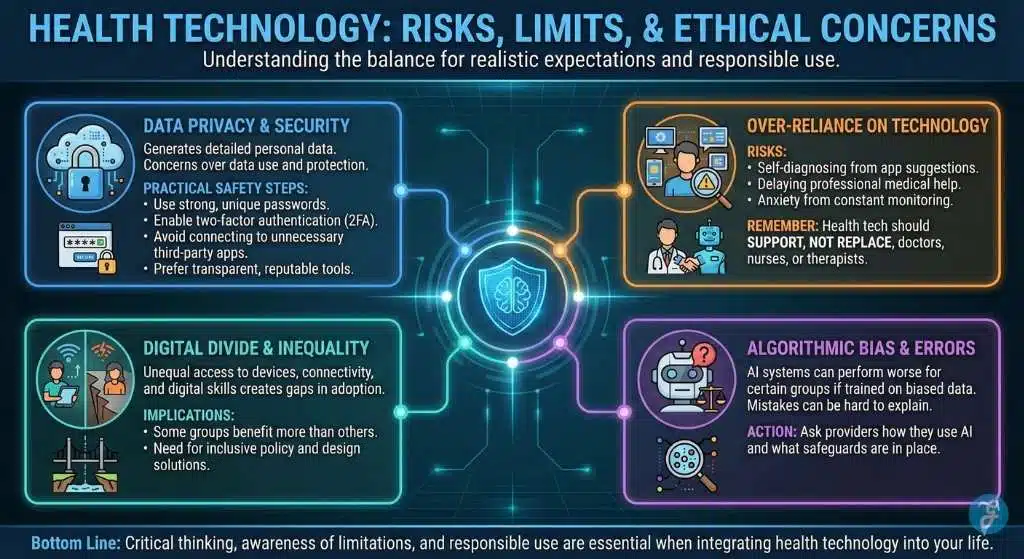
Data privacy and security
Digital health generates detailed personal data. At the same time, funding and partnerships in digital health have raised questions about how this data is used and protected.
Practical steps for safety:
- Use strong, unique passwords
- Enable two-factor authentication
- Avoid connecting your accounts to unnecessary third-party apps
- Prefer tools from transparent, reputable companies
Over-reliance on technology
Risks include:
- Self-diagnosing based on app suggestions
- Delaying or avoiding professional medical help
- Anxiety from constant monitoring
Health tech should support, not replace, doctors, nurses, or therapists.
Digital divide and inequality
Not everyone has equal access to devices, connectivity, or digital skills. Research shows gaps in adoption by income, education, and age.
This means:
- Some groups benefit more from digital tools than others
- Policymakers and providers need to design inclusive solutions
Algorithmic bias and errors
AI systems used for triage, diagnostics, or recommendations can:
- Perform worse for certain groups if trained on biased data
- Make mistakes that are hard to explain
Ask your providers how they use AI and what safeguards they have in place.
Risks and responses
| Risk type | Example problem | Practical response |
| Privacy | Data shared without clear consent | Choose tools with strong, clear policies |
| Over-reliance | Ignoring symptoms because the app is “normal.” | Use apps as support, not as a final authority |
| Inequality | Some groups are left out of digital services | Support inclusive policies and training |
| AI bias and error | Misclassification by algorithms | Ask questions, keep humans in the loop |
Step-by-Step Roadmap to Start Today
Here is a simple roadmap to guide your first steps in investing in health technology.
Step 1: Audit your current situation
- List your current devices and apps
- Note which ones you actually use weekly
- Write your main health concerns and goals
Step 2: Choose one primary goal and tool
- Select one clear goal
- Pick one tool that helps most with that goal
- Commit to testing it for 30 days
Step 3: Plan your time and money
- Decide when each day or week you will use the tool
- Set a small budget if you are adding a device or subscription
- Put a reminder on your calendar for a review after 30 days
Step 4: Review and adjust
After 30 days, ask:
- Did this tool move me closer to my goal?
- How did it affect my mood, energy, or daily routine?
- Is the time and money investment worth it?
Then:
- Keep what works
- Change or cancel what does not
- Add a second tool only if needed
Summary: Roadmap
| Step | Action | Outcome goal |
| Step 1 | Audit tools and goals | Clear picture of the starting point |
| Step 2 | Pick one goal and one tool | Focus and simplicity |
| Step 3 | Plan time and budget | Realistic and sustainable use |
| Step 4 | Review results after 30 days | Data-based decision about next steps |
Future Trends That Will Shape Health Technology
Understanding upcoming trends helps you make smarter long-term decisions.
AI-powered personalization
AI is now a central theme in digital health funding. Many new tools use AI to:
- Analyze large datasets
- Personalize recommendations
- Support faster diagnosis or triage
This can improve convenience and outcomes, but it also raises questions about transparency and fairness.
Hybrid and continuous care
More health systems combine:
- In-person visits
- Telehealth sessions
- Remote monitoring at home
This “hybrid” model means your wearable, app, and clinic may eventually work together more closely.
Preventive and home-based care
Digital health is shifting focus from treating illness to preventing it:
- Continuous monitoring for risk detection
- Early alerts for issues with heart, sleep, or glucose
- At-home testing kits for screening
For beginners, this means that even simple data, like steps and sleep, can feed into broader health strategies over time.
What it means for your investment decisions
When investing in health technology over the coming years:
- Expect more AI features in almost every tool
- Prioritize devices and apps that can integrate with others
- Focus on tools that encourage long-term lifestyle change, not just short-term data collection
Future trends
| Trend | What it looks like in practice | Impact on your choices |
| AI personalization | Smarter insights and recommendations | Check transparency and explanation |
| Hybrid care | Mix of in-person and virtual services | Choose tools that connect with providers |
| Preventive focus | Early detection and continuous monitoring | Use data to support long-term health plans |
Bottom Line: Make Investing in Health Technology Work for You
Investing in health technology is not about chasing the latest gadgets. It is about making thoughtful choices that support your health, save time, and fit your budget.
Key points to remember:
- Start with your health goals, not with devices
- Invest your time first by building simple, sustainable habits
- Spend money carefully on tools that clearly support your goals
- Stay aware of privacy, bias, and over-reliance risks
- Review your tools regularly and adjust based on real results
When used wisely, investing in health technology can help you move from reactive, episodic care to proactive, continuous care. The most important investment, however, remains your daily commitment to healthier choices.
FAQs About Investing in Health Technology
Is investing in health technology really worth it for a beginner?
It can be very worthwhile if you pick tools that match your needs. A simple step counter or sleep app can already create awareness and motivation. Start small, avoid overspending, and focus on habits.
How much money should I budget each month?
There is no single right amount. Many beginners do well by:
- Starting with free tools
- Trying one paid app if they feel motivated
- Adding a wearable only when they see clear benefits
The key is to monitor your usage. If you are not using a paid tool regularly, cancel it.
What is the safest way to start with health apps and wearables?
- Choose well-known tools with good user reviews
- Read the privacy policy before you sign up
- Start with basic features instead of advanced analytics
- Talk to your doctor if you plan to use a device for a medical condition
Can health apps and wearables replace my doctor?
No. Apps and wearables cannot replace professional medical advice, diagnosis, or treatment. They are support tools that help you track and understand your health, but decisions about serious symptoms should always involve a qualified professional.
What are the biggest risks of investing in health technology?
Major risks include:
- Sharing sensitive data without understanding who sees it
- Relying on app advice instead of medical care
- Spending money on tools that you do not use
- Feeling anxious or obsessed about your numbers
You can reduce these risks with careful tool selection, strong privacy settings, and realistic expectations.
How do I know if a health technology product is trustworthy?
Look for:
- Evidence of clinical testing or expert endorsement
- Clear information about who created it
- Transparent data and privacy policies
- Honest marketing that does not promise instant miracles
If something sounds too good to be true, it usually is.