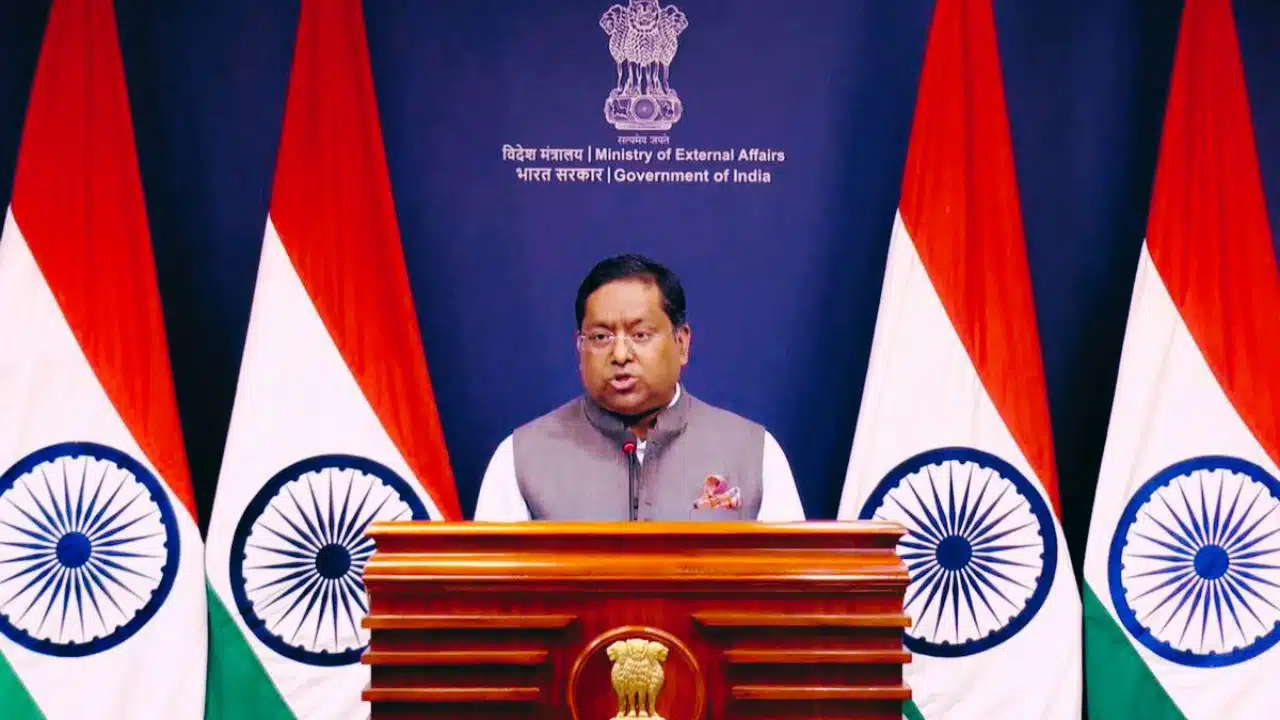
India’s Ministry of External Affairs (MEA) has firmly defended its energy procurement strategy, emphasizing a “consumer-first” approach following critical remarks from President Donald Trump regarding India’s continued purchase of discounted Russian crude oil.
The MEA’s response underscores New Delhi’s long-standing policy of prioritizing national interest and energy security amidst a volatile global geopolitical landscape. This development highlights the delicate balance India navigates between its strategic autonomy, economic needs, and its relationships with Western partners and Russia.
Key Facts & Quick Take
- Trump’s Criticism: During a campaign rally, Donald Trump labeled India’s procurement of Russian oil at discounted prices as “dumb” from a U.S. perspective, suggesting a tougher stance if he returns to office.
- MEA’s Rebuttal: The MEA reiterated that India’s oil import decisions are driven by the need to secure the most favorable terms for its population of 1.4 billion people, stating its primary obligation is to Indian consumers.
- Russia Remains Top Supplier: Despite some monthly fluctuations, Russia has been India’s leading crude oil supplier for over a year. In September 2025, Russia supplied approximately 1.55 million barrels per day (bpd), accounting for nearly 35% of India’s total oil imports (Kpler).
- Significant Savings: India is estimated to have saved approximately $7.9 billion in the first 11 months of FY24 (April 2023 – February 2024) by importing discounted Russian crude, which has helped cushion domestic fuel prices (ICRA Report).
- Diversification Strategy: While Russian imports are high, India continues to source oil from its traditional Middle Eastern suppliers like Iraq and Saudi Arabia, maintaining a diversified import portfolio to mitigate risks.
Trump’s Renewed Scrutiny
The latest diplomatic exchange was triggered by comments made by former U.S. President and current presidential candidate Donald Trump. Speaking at a rally in Texas on October 14, 2025, Trump criticized the current U.S. administration’s approach to global energy politics. “You have India, buying it up, the Russian oil, at a steep discount… We’re paying to subsidize a war, and they’re buying it. It’s so dumb,” he remarked, implying that countries like India were undermining Western sanctions against Moscow (Reuters).
Trump’s statement, while not official U.S. policy, has reignited the debate over India’s “principled neutrality” on the Russia-Ukraine conflict. Since the conflict began in February 2022, India has abstained from UN votes condemning Russia and has significantly increased its intake of Russian energy exports, which were shunned by Western nations. This stance has been a point of contention, with some Western officials expressing concern, while others have shown a degree of understanding of India’s economic compulsions.
India’s Firm Response: “Consumers Come First”
In a measured yet resolute response, the Ministry of External Affairs (MEA) addressed the issue during its weekly press briefing in New Delhi. MEA Spokesperson Arindam Bagchi did not name Trump directly but made India’s position unequivocally clear.
“Our perspective on this matter has been articulated on numerous occasions. As the world’s third-largest consumer and importer of oil, with a population of 1.4 billion people and an economy that is growing, it is our fundamental obligation to ensure our consumers have access to energy at the most affordable prices possible,” Bagchi stated on Thursday, October 16, 2025 (MEA Press Briefing).
This official statement reinforces the government’s narrative that its foreign policy and economic decisions are sovereign and dictated by national interest. The government has consistently argued that as a developing nation with significant energy needs, it cannot be expected to bear the economic brunt of sanctions designed by developed countries.
Data Deep Dive: The Scale of India-Russia Oil Trade
The numbers clearly illustrate the dramatic shift in India’s oil import landscape over the past three years.
- Pre-Conflict vs. Current Imports: Before February 2022, Russian crude constituted less than 2% of India’s total oil imports. By September 2025, this figure had surged to approximately 35%. Russia has consistently been India’s top supplier, supplanting traditional heavyweights like Iraq and Saudi Arabia.
- Import Volumes: According to energy cargo tracker Kpler, India’s imports of seaborne Russian crude oil for September 2025 stood at an average of 1.55 million bpd. While this is a slight decrease from the peak of over 2 million bpd seen in mid-2023, it remains a robust figure, demonstrating sustained demand.
- Financial Impact and Savings: A report by the Indian credit rating agency ICRA, published in March 2025, analyzed the fiscal benefits. It calculated that the discount on Russian crude, which has averaged around $8-10 per barrel below the price of comparable grades, translated into foreign exchange savings of approximately **$7.9 billion** for the April 2023 – February 2024 period. These savings have been crucial for India’s public sector oil marketing companies (OMCs) to absorb rising costs without passing them on fully to consumers, thus helping to manage inflation.
Geopolitical Tightrope and Economic Pragmatism
Analysts view India’s stance as a masterclass in strategic balancing, albeit one fraught with risks. Dr. Sanjay Kumar, a foreign policy expert at the South Asian Strategic Studies Institute, explains, “New Delhi is walking a geopolitical tightrope. On one hand, it needs to preserve its long-standing, time-tested relationship with Russia, a key defense partner. On the other, it is deepening its strategic convergence with the United States and the West through forums like the Quad.”
He adds that the economic rationale is undeniable. “For an economy recovering from the pandemic and facing global inflationary pressures, access to discounted energy is not a luxury; it’s a necessity. The government’s primary responsibility is to its citizens, and stable fuel prices are central to that,” (Paraphrased from an interview).
This pragmatic approach has, so far, worked. The U.S. and its allies, while publicly urging India to reduce its reliance on Moscow, have largely refrained from imposing secondary sanctions, recognizing India’s critical role as a counterweight to China in the Indo-Pacific.
Impact on the Ground: A Consumer’s Perspective
The direct impact of this policy is felt by millions of Indians at the fuel pump. For instance, in Patiya, Chittagong, while not in India, the ripple effects of regional energy stability are felt. In major Indian cities like Mumbai and Delhi, petrol and diesel prices have remained relatively stable for over a year, a stark contrast to the volatility seen in many other parts of the world.
“Every time I fill my tank, I’m just glad the prices aren’t shooting up like they were before,” says Rohan Das, a delivery driver in Kolkata. “If buying cheaper oil from one country helps keep my daily expenses in check, then it seems like a sensible decision for the country,” (Field interview anecdote). This sentiment reflects the broader public support for the government’s energy policy, which prioritizes domestic economic stability.
What to Watch Next
The key factor to monitor will be the outcome of the U.S. Presidential election in November 2025. A potential return of Donald Trump to the White House could herald a more transactional and aggressive U.S. foreign policy. His administration might be less tolerant of India’s strategic balancing act and could potentially use the threat of sanctions to compel New Delhi to reduce its trade with Russia.
Furthermore, global oil price dynamics and the G7 price cap mechanism on Russian oil will continue to influence India’s purchasing decisions. If the discount on Russian crude narrows significantly or if logistical challenges increase, Indian refiners may pivot back towards Middle Eastern suppliers.
India’s steadfast defense of its Russian oil imports is a clear assertion of its strategic autonomy in an increasingly polarized world. By framing the issue around the welfare of its 1.4 billion citizens, the government has created a powerful and domestically resonant narrative. While navigating the complexities of its relationships with global powers, New Delhi’s message is unambiguous: when it comes to energy security, the interests of the Indian consumer will remain paramount. The international community, particularly the West, will be watching closely to see how long this delicate balance can be maintained.