India celebrates its 79th Independence Day today, Friday, August 15, 2025. This annual occasion, known as Swatantrata Diwas, marks the day in 1947 when India finally gains sovereignty after more than 200 years of British colonial rule. The end of British rule comes after a long and multi-dimensional struggle involving peaceful protests, armed resistance, political negotiations, and grassroots movements.
The roots of the freedom movement stretch back to the First War of Independence in 1857, when soldiers, peasants, and rulers unite against the East India Company. Over the decades, the movement grows under the leadership of figures like Mahatma Gandhi, whose non-violent Satyagraha philosophy becomes a global symbol of peaceful resistance, and Subhas Chandra Bose, who leads the Indian National Army’s military efforts.
This journey is also shaped by revolutionaries such as Bhagat Singh, Chandrashekhar Azad, and Udham Singh, social reformers like Bal Gangadhar Tilak and Annie Besant, and countless unnamed men and women who sacrifice their lives and livelihoods for freedom.
78th or 79th Independence Day? Clearing the Confusion
A common misunderstanding arises when people try to calculate the number of Independence Days by simply subtracting 1947 from the current year. By that method, 2025 – 1947 equals 78, leading some to believe this year marks the 78th Independence Day.
However, this calculation overlooks an important detail: August 15, 1947, is the first Independence Day itself. That inaugural celebration is counted as “Day 1.” Therefore, 2025 marks the 79th celebration of India’s independence, not the 78th.
Theme for Independence Day 2025
As of today, the Government of India has not officially declared this year’s Independence Day theme. In previous years, themes reflect unity, patriotism, environmental awareness, technological advancement, and the contributions of freedom fighters.
Recent themes include:
-
Nation First, Always First (2021)
-
Har Ghar Tiranga (2022, promoting citizens to display the national flag at home)
-
Partnership for Progress (2023, focusing on collective national growth)
This year’s theme is expected to align with India’s Vision 2047, the government’s long-term roadmap for making India a developed nation by its 100th year of independence. Likely focus areas include sustainable development, innovation, women’s empowerment, and digital transformation.
Significance of the Day
Independence Day is not just a commemoration of the end of colonial rule; it is a celebration of self-determination, democratic governance, and national pride. The day serves as a reminder of the sacrifices made by freedom fighters and a call to safeguard the principles of justice, liberty, equality, and fraternity enshrined in the Constitution.
It is also an opportunity to assess the nation’s journey since 1947 — from a largely agrarian economy to one of the world’s fastest-growing markets, a leader in space exploration, digital innovation, and global diplomacy.
National-Level Celebrations in New Delhi
The central event takes place at the Red Fort in New Delhi. The official programme begins with the Prime Minister being escorted to the historic site, where they receive a Guard of Honour from the Armed Forces and Delhi Police.
The sequence includes:
-
Unfurling of the Tricolour — The national flag is hoisted to the playing of the National Anthem.
-
21-Gun Salute — Conducted by the ceremonial battery of the Indian Army.
-
Flower Petal Shower — Indian Air Force helicopters fly past, releasing petals over the Red Fort.
-
Prime Minister’s Address — A nationally broadcast speech reflects on the past year’s achievements, outlines future priorities, and motivates citizens to contribute to nation-building.
Foreign dignitaries, political leaders, military officials, and schoolchildren witness the event in person.
State and Local Celebrations
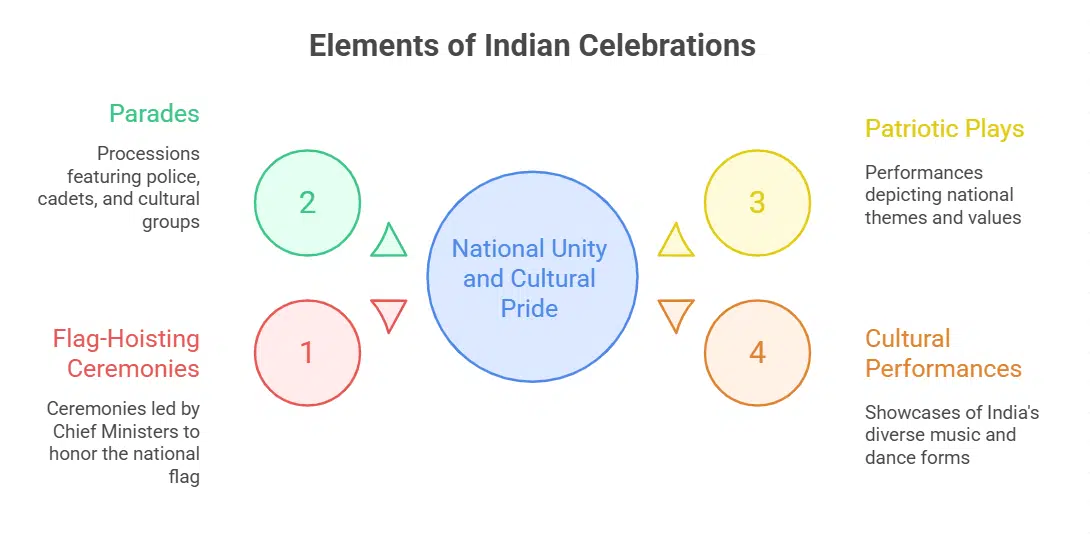
Across India’s states and Union Territories, similar celebrations take place in capital cities and district headquarters. Chief Ministers preside over flag-hoisting ceremonies, followed by parades featuring police, NCC cadets, schoolchildren, and cultural troupes.
Schools and colleges organize patriotic plays, poetry recitals, debates, and art competitions. Local communities host music and dance performances showcasing India’s diverse culture.
Cultural and Symbolic Importance
Independence Day brings out strong visual symbols of patriotism:
-
The Tricolour flies from rooftops, streets, and government buildings.
-
Patriotic songs like Vande Mataram and Ae Watan fill the air.
-
Markets overflow with flag-themed clothing, accessories, and decorations.
In recent years, the government and citizens embrace digital celebrations, with virtual competitions, online tribute events, and social media campaigns spreading patriotic messages globally.
Security and Preparations in 2025
Given the scale of celebrations, tight security arrangements are in place across major cities. In New Delhi, this includes:
-
Multi-layered security zones around the Red Fort
-
Deployment of National Security Guard (NSG) commandos and snipers
-
CCTV and drone surveillance
-
Facial recognition systems at entry points
-
Traffic diversions and public advisories for smooth movement
Similar measures are implemented in other state capitals to ensure peaceful celebrations.
Public Participation and Government Campaigns
Government initiatives like Fit India Movement, Digital India, and Make in India are highlighted during Independence Day speeches and events. Citizens take part in cleanliness drives, blood donation camps, and community service activities as part of the celebrations.
In rural areas, traditional fairs, folk performances, and sports competitions give the day a distinct local flavour, while in urban centres, high-rise buildings and public monuments are illuminated in saffron, white, and green lights.