

You have the foot traffic. People are walking through your doors, browsing your aisles, and interacting with your staff. But when you look at the end-of-day reports, the numbers don’t match the activity. The Average Transaction Value (ATV) is stagnant, and customers are leaving with just one or two items instead of a full cart. The problem usually isn’t your product or your pricing—it’s your geography.
If you want to increase basket size retail metrics efficiently, you don’t need a costly renovation or a new marketing consultant. You need to leverage the psychology of movement. The way a customer navigates your physical space dictates 80% of their purchasing decisions. In 2026, the smartest retailers are using “silent sellers”—strategic layout tweaks—to guide shoppers subconsciously toward buying more. By adjusting where products sit and how customers move, you can turn a browser into a heavy buyer.
Key Takeaways for 2026
-
Don’t sell at the door: Give customers space to “land” in the Decompression Zone.
-
Go Right: Put your highest margin winners on the front-right Power Wall.
-
Slow Down: Use tables and bins as speed bumps to stop the “highway effect.”
-
Group by Solution: Cross-merchandise based on how items are used, not what they are.
-
Widen the Path: Avoid the “Butt-Brush” effect to keep shoppers comfortable.
-
Work the Line: Use a serpentine queue to capture last-minute impulse buys.
The Science of Flow: Why Layout Dictates Revenue
Before we dive into the specific tweaks, it is crucial to understand why these changes work. Retail is not just about logistics; it is a behavioral science.
Your store layout acts as a “silent salesperson.” It guides the customer’s journey, dictates their pace, and influences where their eyes focus. When a store is poorly designed, it creates friction. Friction causes cognitive load—basically, it makes the shopper’s brain work too hard. When a customer is confused, crowded, or overwhelmed, their natural reaction is to buy only what they came for and leave immediately.
To increase basket size, retail success relies on removing that friction. The goal of the following strategies is to induce a state of “flow.” When a customer feels comfortable and guided, their guard comes down. They transition from “mission shoppers” (hunting for one specific thing) to “discovery shoppers” (open to browsing).
We are targeting two specific metrics with these changes:
-
UPT (Units Per Transaction): Encouraging the customer to add one more item to the pile.
-
Dwell Time: The amount of time a customer spends in-store. Studies consistently show a direct correlation: the longer they stay, the more they spend.
By manipulating the physical environment, you aren’t tricking the customer; you are making the shopping experience smoother, more logical, and more enjoyable. Here is how to shape that environment for maximum profit.
Here are 9 scientifically backed store layout tweaks that can lift your basket size overnight.
1. Clear the “Decompression Zone” (The Landing Strip)
The most common mistake independent retailers make is trying to sell the moment the automatic doors slide open. They clutter the entryway with sale signs, new arrivals, and aggressive displays. This is a fatal error.
When a customer walks from the parking lot (or the street) into your store, they are undergoing a physical and psychological transition. They are adjusting to the change in light, the change in temperature, and the shift in noise levels. During these first 5 to 15 feet—known as the Decompression Zone—they are essentially blind. They are in “flight” mode, not “browse” mode.
The Fix
Treat your entrance as a landing strip, not a sales floor. Keep the first 10 feet open, inviting, and clutter-free. This lowers the customer’s anxiety and allows them to mentally “land” in your store.
| Do This | Avoid This |
| Use warm lighting and a subtle signature scent. | Stacking “Sale” bins right at the door. |
| Offer a clear view of the department signs deep in the store. | Placing high-margin items where they will be ignored. |
| Have a greeter stand just past the zone, not in it. | Cluttering the walkway with narrow fixtures. |
Pro Tip: If you place your best merchandise in the Decompression Zone, you are effectively hiding it. Move that display 10 feet deeper into the store, and watch engagement rates double.
2. Capitalize on the “Right Turn” Bias
Human beings are creatures of habit, and one of the strongest retail habits is the “Right Turn Bias.” Research consistently shows that nearly 90% of customers in North America will subconsciously turn right upon entering a retail space. This makes the front-right section of your store the most valuable real estate you possess. This is your “Power Wall.”
The Fix
Do not waste your Power Wall on basics, clearance items, or the checkout counter. This area must be reserved for your high-impact inventory. It sets the tone for the entire shopping trip. If a customer sees premium, exciting items here, their brain is primed to perceive the rest of the store as high-value.
What to put on the Power Wall:
-
New Arrivals: Show them what is fresh.
-
High-Margin Seasonal Items: If it’s October, this is where the premium Halloween décor lives.
-
Statement Pieces: Items that stop people in their tracks and demand a closer look.
By front-loading the “win,” you encourage the shopper to grab a basket early. Once they are holding an item, they are statistically more likely to buy a second one to “justify” the trip.
3. Install “Speed Bumps” in Long Aisles
Have you ever noticed that in large grocery stores or big-box retailers, shoppers tend to race down long, empty aisles? This is called the “Highway Effect.” When a path is long and straight, we naturally speed up. The faster a customer walks, the fewer items they see. To increase basket size, retail experts suggest you must physically slow the customer down.
The Fix
You need to install visual and physical “speed bumps.” These are displays placed in the center of wide aisles or walkways that force the customer to pause and navigate around them.
Effective Speed Bumps:
-
Dump Bins: A messy bin of discounted socks or gadgets invites “treasure hunting.”
-
Curated Tables: A waist-high table featuring a “Staff Pick” selection.
-
Mannequins: In apparel, a styled mannequin in the middle of a walkway forces a shopper to stop and admire the outfit.
Why it works: Every time a customer stops moving their feet, they start moving their eyes. Speed bumps break the trance of walking and re-engage the shopping brain.
4. Master Cross-Merchandising (The “Solution” Strategy)
Traditional retail logic says to group items by category: shirts with shirts, pasta with pasta, lamps with lamps. While logical for inventory management, this is terrible for basket size. Customers rarely buy “categories”—they buy solutions.
Cross-merchandising is the art of grouping complementary products from different categories together. It reminds the customer of a need they didn’t realize they had.
The Fix
Look at your top-selling items and ask: “What does the customer use with this?”
| Primary Item | Cross-Merchandised Add-On | The Psychological Trigger |
| Gourmet Pasta | Premium Olive Oil & Parmesan Grater | “I want to make a complete, fancy dinner.” |
| Rain Coat | Umbrella & Waterproof Spray | “I need to be fully protected from the weather.” |
| Paint Can | Painter’s Tape, Brushes, Drop Cloth | “I don’t want to come back for forgotten tools.” |
| Yoga Mat | Water Bottle & Yoga Block | “I am committing to this new hobby.” |
By placing the solution next to the problem, you trigger an impulse buy that feels like a smart decision rather than an indulgence.
5. Eliminate the “Butt-Brush” Effect
This concept was coined by retail anthropologist Paco Underhill, and it remains one of the most critical factors in physical retail. The “Butt-Brush Effect” states that a shopper (especially a woman) will abandon a display if they are brushed from behind by another customer while looking at it.
If your aisles are too narrow or if you have placed a popular display in a high-traffic choke point, you are losing sales. It doesn’t matter how great the product is; if the customer feels their personal space is threatened, they will move on.
The Fix
-
Widen the Aisle: Ensure there is enough room for two carts to pass freely behind a browsing customer.
-
Move Hot Spots: If you have a display that attracts a crowd, do not place it near the entrance or a narrow hallway. Give it breathing room in an open part of the floor.
-
Lower the Fixtures: In tight spaces, lower fixtures improve sightlines and make the space feel less claustrophobic.
6. Strategic “Eye-Level” Placement
“Eye level is buy level.” You have likely heard the phrase, but are you applying it correctly? Shoppers are inherently lazy. They scan the shelf space that is easiest to see (about 4 to 5 feet high for adults) and ignore the rest unless they are on a specific mission.
The Fix
To increase basket size, retail stores must aggressively optimize their planograms (shelf layouts) based on profit margin, not just aesthetics.
-
Eye Level (The Bullseye): This is for your high-margin, high-impulse items. The stuff you want them to buy.
-
Touch Level (Waist High): This is for best-sellers that people naturally reach for.
-
Stoop Level (Bottom Shelf): This is for low-margin, destination items (like large bulk packs or generic brands). Customers will bend down for them because they need them, but they won’t impulse-buy them.
Crucial Exception: If you sell toys, cereal, or candy, “eye level” is 3 feet off the ground. You are marketing to the child, who will then market to the parent.
7. Create a “Serpentine” Walk to the Register
The checkout experience is the final hurdle. In a traditional “straight line” queue, customers stand bored, staring at their phones. This is dead time. Major retailers like TJ Maxx, Sephora, and Primark have mastered the “Serpentine Queue”—a winding, single line that snakes past shelves of small products before reaching the register.
The Fix
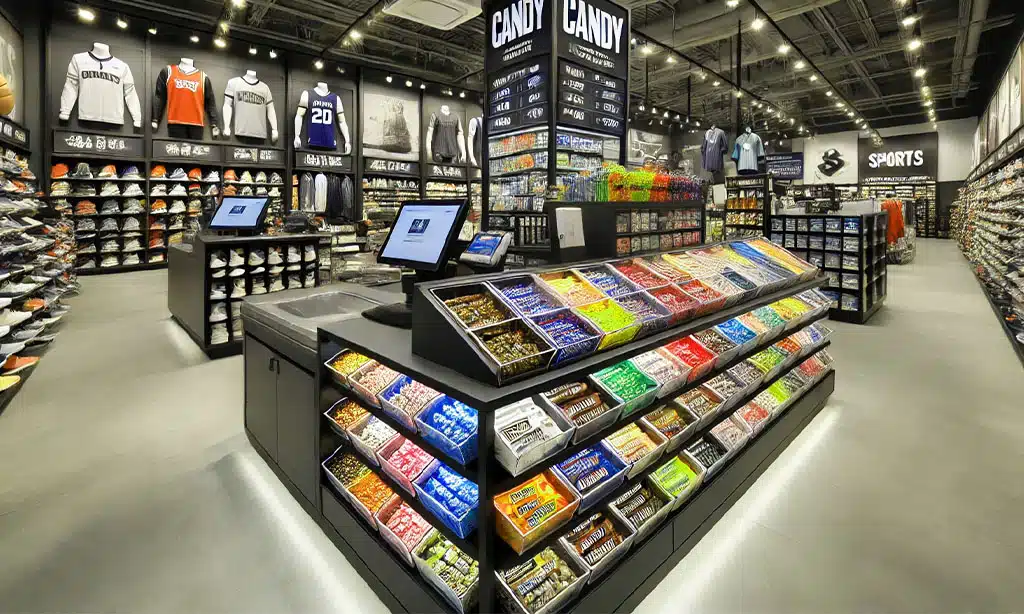
Turn your queue into a profit center. Use low shelving to create a winding path lined with “no-brainer” items.
What to stock in the Serpentine Queue:
-
Travel-sized toiletries.
-
Lip balms and hand sanitizers.
-
Single-serving snacks and drinks.
-
Fun, low-cost gadgets (cables, keychains).
-
Gift cards.
The Psychology: Once a customer is in line, they have already decided to spend money. Their “wallet is open.” A $3 add-on feels negligible at this stage. By occupying their attention with products, you also reduce the perceived wait time, making the line feel faster.
8. Draw Traffic Deep with “Sightlines”
If your store is deep, you likely suffer from “dead zones” in the back corners. Customers rarely walk to the back unless they are forced to. If they don’t walk the full floor, they see less than 50% of your inventory.
The Fix
You need a “Destination Magnet.” Place a high-demand, essential item at the furthest point from the entrance.
-
Grocery Stores: This is why milk and eggs are always in the back left corner.
-
Apparel Stores: Put the Clearance Rack or the Fitting Rooms in the back.
The Sightline Trick: Ensure your aisles are straight enough that a customer standing at the front can see the destination at the back. Use lighting to spotlight the back wall. If the back looks dark or cluttered, it signals “staff only” or “nothing to see here.” Light it up brighter than the front to draw them in like moths to a flame.
9. Refresh “Hot Spots” Every 2 Weeks
Your regular customers are your best source of recurring revenue, but they suffer from “store blindness.” After two or three visits, they stop seeing the displays that haven’t changed. They walk past them on autopilot.
The Fix
You don’t need new inventory to make the store look new; you just need to move the furniture. Identify your “Hot Spots”—the end caps, the entrance table, the speed bumps. Rotate the merchandise in these spots every 14 days.
The Rotation Strategy:
-
Take a product that is selling slowly on a standard shelf.
-
Move it to a “Hot Spot” end-cap.
-
Pair it with a new sign.
-
Watch it sell out.
By constantly churning your visual merchandising, you train your customers to scan the whole store because “something might be new.” This curiosity is the engine of increased basket size.
Bonus Strategy: The BOPIS Trap (Turning Pickups into Purchases)
By 2026, the line between online and offline shopping has blurred completely. A significant portion of your foot traffic is likely BOPIS (Buy Online, Pickup In-Store) customers.
Many retailers make the fatal mistake of placing the Pickup Counter right at the front entrance to be “convenient.” While this is nice for the customer, it is terrible for your basket size. It allows the shopper to run in, grab their bag, and leave without seeing a single other product.
The Fix
Treat your Pickup Counter like the “Dairy” section in a grocery store—move it to the back or the middle of the store.
-
The Path: Force the BOPIS customer to walk past your “Speed Bumps” and your “Power Wall” to get their package.
-
The Counter: Surround the pickup area with high-impulse, “add-on” items (batteries, socks, treats).
-
The Script: Train staff to say, “While you’re here, did you see the new [Item] we just unpacked?”
The Result: You turn a $0 service interaction into a potential $20 impulse add-on.
The Metrics Cheat Sheet: How to Measure Success
You can’t improve what you don’t measure. Before you start moving furniture, record your baseline numbers for these two specific metrics.
| Metric | Formula | Why it Matters |
| ATV (Average Transaction Value) | Total Sales ($) ÷ Number of Transactions | Tells you how much the average customer spends in one trip. |
| UPT (Units Per Transaction) | Total Items Sold ÷ Number of Transactions | Tells you if they are buying more items. This is your basket size indicator. |
The Goal: If your current UPT is 1.5, your goal with these layout tweaks is to get it to 1.8 or 2.0. That small decimal increase can equal thousands of dollars in annual revenue without acquiring a single new customer.
Frequently Asked Questions (FAQ)
1. How long does it take to see results from these layout tweaks?
Almost immediately. Strategies like clearing the Decompression Zone and setting up a Power Wall can show results in daily sales figures within 24 to 48 hours. Strategies like cross-merchandising may take a few weeks to fine-tune as you test which product pairings work best for your specific audience.
2. My store is very small (under 800 sq ft). Can I still use the “Serpentine Queue”?
In very small footprints, a full snake queue might not fit. However, you can adapt the principle by lining the immediate approach to the counter with small impulse baskets or vertical shelving. The goal is to ensure the customer is looking at the product, not empty space, while they wait to pay.
3. Does “Eye-Level” placement change for online stores?
In e-commerce, the “eye-level” equivalent is the “Above the Fold” area of your website (the screen area visible without scrolling). Just like physical retail, you should place your highest margin or best-selling items in the top row of your category pages to increase basket size retail metrics online.
4. How do I know if my aisles are too narrow (Butt-Brush Effect)?
The standard rule for ADA compliance in the US is a minimum of 36 inches, but for comfortable shopping, you should aim for 42–48 inches. A simple test: Have two staff members stand back-to-back in the aisle. If a third person cannot pass them easily, your aisle is too tight, and you are losing sales.
5. What is the best way to track if these changes are working?
Track two key metrics: UPT (Units Per Transaction) and ATV (Average Transaction Value). Most modern POS systems track these automatically. Check your UPT average for the month prior to the changes, then compare it week-by-week after implementing the tweaks. If UPT goes from 1.5 to 1.8, your layout is working.
Final Thoughts: Evolution Over Renovation
It is easy to fall into the trap of thinking that to change your sales numbers, you need to change your entire business—buy new inventory, launch a massive ad campaign, or remodel the building. You don’t need a sledgehammer; you just need a scalpel.
The most successful independent retailers understand that their store is a living, breathing ecosystem. It shouldn’t remain static. If you leave your layout untouched for months, you aren’t just boring your customers; you are training them to ignore you. Start small. Pick just one of these strategies—perhaps clearing the Decompression Zone or setting up a Power Wall—and test it for two weeks. Watch the metrics. If you see your Average Transaction Value (ATV) tick upward, move on to the next tweak.
The goal to increase basket size retail-wide is not a sprint; it is a game of continuous improvement. Your floor plan is your most powerful employee. Make sure it’s working as hard as you are.




























