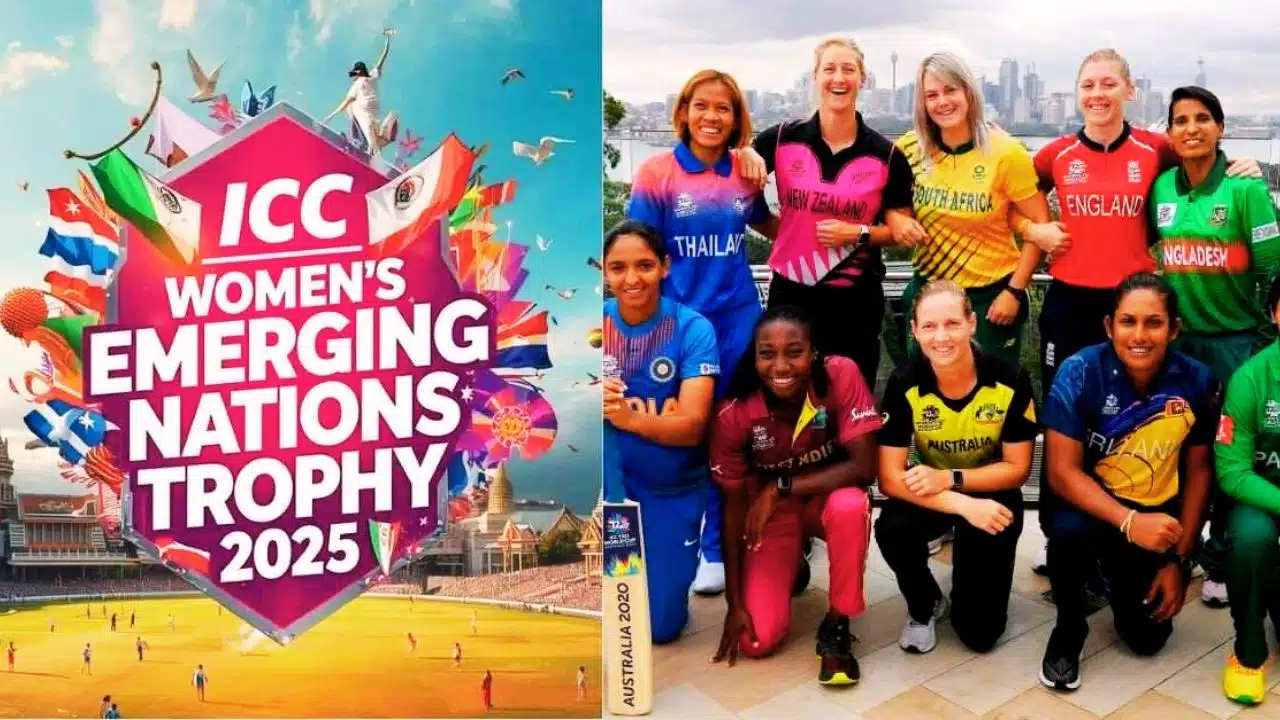
The International Cricket Council has launched a new ICC Women’s Emerging Nations Trophy, an eight-team global T20 tournament designed to accelerate the growth of women’s cricket among emerging and Associate member nations.
New tournament to boost emerging nations
The inaugural ICC Women’s Emerging Nations Trophy will be played in Bangkok, Thailand, from 20 to 30 November 2025, creating a dedicated global platform for some of the fastest‑improving women’s sides outside the full‑member elite. Positioned as part of a new three‑tier development pathway, the event is intended to provide sustained high‑performance exposure rather than one‑off qualifiers or regional events.
The tournament features eight Associate teams: hosts Thailand, Netherlands, Papua New Guinea, United Arab Emirates, Scotland, Namibia, Tanzania and Uganda, bringing together sides from four continents in one flagship competition. The line‑up includes all five women’s Associate teams with ODI status – Thailand, Netherlands, PNG, Scotland and UAE – supplemented by three of the highest‑ranked T20I Associates, Namibia, Tanzania and Uganda.
Format, venues and schedule
All eight teams will compete in a single round‑robin league, playing each other once, with the trophy to be decided on the final day of the competition on 30 November. The schedule comprises 28 T20 matches packed into an intensive 11‑day window, promising daily action and varied match‑ups for players and fans.
Matches will be split between two Bangkok venues: the Terdthai Cricket Ground and the Asian Institute of Technology Ground, both of which have become regular hubs for Associate and pathway cricket. The tournament opens with Thailand facing the Netherlands and Papua New Guinea taking on UAE, while other early fixtures include Namibia against Tanzania and Scotland versus Uganda.
Thailand lead the emerging pack
Thailand enter the competition as the highest‑ranked side, currently 11th in the ICC women’s T20I rankings and riding a nine‑match winning streak in completed games. Known for their disciplined bowling and sharp fielding, the hosts will look to leverage home conditions and recent form to set the standard for the rest of the field.
Their squad features a familiar core from recent global qualifiers, including experienced batters and all‑rounders who have previously troubled full‑member attacks. For Thailand, the trophy represents a chance not just to win silverware at home, but to underline their credentials as the leading Associate challenger in women’s cricket.
Diverse field from four continents
The presence of the Netherlands and Scotland gives Europe two strong contenders, both with established domestic structures and players who regularly feature in English and franchise systems. Papua New Guinea and UAE bring contrasting styles from the East Asia‑Pacific and Asian regions, having built competitive records in qualifying events without yet getting sustained exposure against a broad field of rivals.
From Africa, Namibia, Tanzania and Uganda have been rewarded for consistent progression up the T20I rankings, reflecting years of investment in grassroots and regional competition. Their inclusion ensures that African women’s cricket, often under‑represented in major tournaments outside South Africa and Zimbabwe, has a prominent stake in this new global event.
Part of a wider ICC women’s pathway
The ICC has positioned the Women’s Emerging Nations Trophy as one pillar of a broader expansion drive that follows the commercial and audience success of recent women’s global events. The new competition sits within a three‑tier high‑performance framework aimed at narrowing the gap between Associate members and the established top tier, particularly in the T20I format.
Alongside the Emerging Nations Trophy, ICC has confirmed plans for a Women’s Challenge Trophy from 2026, featuring top teams from each of the five development regions who are not in the Bangkok event, and a further eight‑team tournament from 2027 that will match leading Associates against higher‑ranked opposition. Together, these events are intended to create a clear ladder of opportunity, where consistent performances can translate into more fixtures, greater funding and eventual World Cup qualification prospects.
“Expanding the map of women’s cricket”
ICC officials have framed the launch as a strategic move to “promote and expand women’s cricket around the world” by taking marquee events into new markets and rewarding emerging programs with more meaningful fixtures. By clustering eight ambitious teams in one tournament, the governing body hopes to generate storylines, rivalries and role models that resonate in countries where women’s cricket is still fighting for visibility and resources.
The choice of Bangkok underscores that approach: Thailand has hosted multiple qualifiers and development events, and the women’s national team’s rise has become a case study for what can be achieved with targeted investment and structured pathways. Organisers also expect that staging the event in Southeast Asia will help stimulate regional interest, with neighbouring countries monitoring performances as they build their own women’s programmes.
A platform for future stars
For players, the Emerging Nations Trophy offers something that has often been missing from the Associate calendar: a guaranteed block of competitive, televised international cricket against a varied field, rather than sporadic tours and qualifiers. Young talents from all eight squads will have the chance to test themselves against unfamiliar attacks, adapt to different conditions and gain the sort of pressure experience that full‑member players routinely enjoy.
Analysts point out that strong showings in Bangkok could fast‑track players into franchise leagues or higher‑profile bilateral series, further blurring the lines between Associates and full members. With 28 games scheduled in just under two weeks, scouts and fans alike will have ample opportunity to spot emerging bowlers, power hitters and all‑rounders who could shape the next decade of the women’s game.
Growing the global women’s game
More broadly, the Women’s Emerging Nations Trophy arrives at a moment when women’s cricket is enjoying rapid growth in participation, broadcast reach and commercial interest. By redistributing some of that momentum to nations outside the traditional power base, the ICC is betting that the women’s game can avoid the bottlenecks seen in earlier eras of men’s cricket, where opportunities were concentrated among a handful of teams.
If successful, the tournament could become a permanent fixture on the global calendar, with Bangkok 2025 remembered as the starting point for a new generation of international contenders. For Thailand, Netherlands, PNG, UAE, Scotland, Namibia, Tanzania and Uganda, the message is clear: the world stage is no longer reserved for others – this time, it belongs to them.