The United States Department of Homeland Security (DHS) has carried out what it described as the most extensive single-site enforcement action in its history. On Thursday, September 4, 2025, federal agents detained nearly 475 individuals at the Hyundai-LG Energy Solution joint venture battery plant located in Ellabell, Bryan County, Georgia, just outside Savannah.
The enforcement operation was led by ICE Homeland Security Investigations (HSI) and supported by multiple federal and local law enforcement partners. Authorities said the action followed a multi-month criminal investigation into allegations of unlawful employment practices and other serious federal crimes taking place at the facility.
Nature of the Operation
Officials emphasized that this enforcement was not a simple immigration sweep. Instead, it was the outcome of a long and detailed investigation authorized through a judicial search warrant. The process reportedly involved months of intelligence gathering, surveillance, and coordination with multiple agencies before agents moved in on Thursday.
Once inside the facility, agents detained hundreds of workers, most of whom were identified as South Korean nationals. Many of them were suspected of being in violation of U.S. immigration and labor laws, including individuals who had overstayed visas, entered on non-work visas, or arrived through the visa waiver program, which prohibits employment.
Those detained were transferred to the ICE detention facility in Folkston, Georgia, where they are being processed. As of now, no formal charges have been filed, but DHS confirmed that the criminal investigation is ongoing.
The Hyundai–LG Battery Facility
The Ellabell site is part of Hyundai Motor Group Metaplant America (HMGMA), a $7.6 billion electric vehicle complex. The facility was announced in 2022 and became operational in October 2024. The sprawling campus includes Hyundai’s electric vehicle assembly plant and an adjacent battery plant, which is a joint venture between Hyundai Motor Group and LG Energy Solution.
The battery facility, still under construction at the time of the raid, was intended to support Hyundai’s ambitious EV production goals in the U.S. The project has been described as one of the largest industrial investments in Georgia’s history, expected to create thousands of jobs in the coming years.
Following the raid, construction work at the battery plant has been temporarily halted, although production at the nearby EV assembly lines remains unaffected.
Hyundai and LG’s Response
Hyundai stated that based on its internal knowledge, none of the workers detained were directly employed by Hyundai Motor Company itself. The company emphasized that it complies with all relevant laws wherever it operates and is currently reviewing the employment practices of its contractors and subcontractors who were responsible for staffing the battery facility.
LG Energy Solution, Hyundai’s partner in the battery joint venture, confirmed its cooperation with U.S. investigators. However, the company did not specify how many of the detained workers were connected directly to LG contracts.
Both companies have pledged to work with authorities to ensure all legal and regulatory standards are being followed at the site.
Diplomatic Reactions from South Korea
The raid has caused diplomatic unease between Washington and Seoul. South Korea, one of the closest U.S. allies in Asia and a major investor in American manufacturing, expressed strong concern.
The South Korean Foreign Ministry publicly stressed that the economic activities of its companies in the United States, as well as the rights and safety of its citizens, should not be unfairly affected during U.S. enforcement actions. Officials in Seoul dispatched diplomats to Atlanta and Washington to monitor the situation and provide support for detained nationals.
This comes at a delicate time in U.S.–South Korea relations. In July 2025, South Korea pledged nearly $350 billion in investments in U.S. projects, including major funding commitments from Hyundai. In return, President Donald Trump agreed to reduce threatened tariffs on South Korean imports from 25% down to 15%. However, Hyundai’s profits have already been impacted by earlier rounds of tariffs, and the raid could add new tension to trade and investment ties.
Political Context in the U.S.
The Biden administration had previously emphasized building strong alliances with South Korea, particularly in the fields of semiconductors, clean energy, and electric vehicles. However, under the current Trump administration, the focus has shifted toward domestic industrial revival paired with strict enforcement of immigration laws.
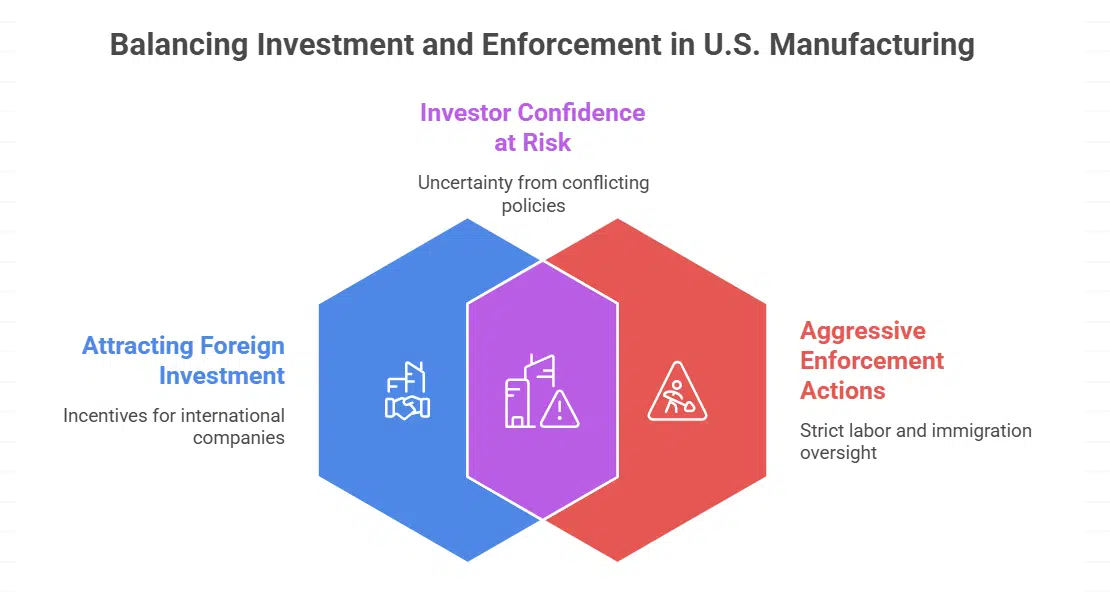
Analysts point out that the raid at Hyundai’s Georgia site highlights the competing goals of the Trump administration: attracting foreign investment to support U.S. manufacturing while simultaneously pursuing aggressive enforcement against what it sees as unlawful employment practices.
Some critics have warned that such high-profile raids risk undermining confidence among international investors, particularly in industries where multinational corporations rely heavily on complex webs of contractors and global labor mobility.
What Comes Next
The legal process surrounding this enforcement is still in early stages. DHS has confirmed that:
-
The investigation into employment practices and possible federal crimes is continuing.
-
Workers detained will be held pending further review of their immigration or labor status.
-
The companies involved are under scrutiny, though no corporate charges have been filed.
Meanwhile, construction delays at the Hyundai–LG battery facility may slow down Hyundai’s broader EV rollout plans in the U.S. The company had targeted the Georgia Metaplant to become a central hub for its North American electric vehicle production.
Key Facts at a Glance
| Category | Details |
|---|---|
| Date of Operation | September 4, 2025 |
| Location | Hyundai–LG battery plant, Ellabell, Georgia |
| Number Detained | ~475 workers |
| Nationality | Majority South Korean |
| Investigation Focus | Unlawful employment practices and federal crimes |
| Legal Status | No charges filed yet; investigation ongoing |
| Detention Site | ICE facility in Folkston, Georgia |
| Project Background | $7.6B Hyundai Metaplant with battery joint venture by LG |
| Company Position | Detainees not directly employed by Hyundai |
| Diplomatic Response | South Korea expressed regret and deployed diplomats |
| Political Context | U.S. balancing foreign investment with immigration enforcement |
The raid at the Hyundai-LG battery facility in Georgia marks a historic moment in U.S. law enforcement, both in terms of its scale and its potential international repercussions. While the immediate focus is on alleged labor violations and unlawful employment, the broader consequences could affect Hyundai’s U.S. operations, South Korea–U.S. trade relations, and the future of foreign investment in American manufacturing projects.
The investigation is ongoing, and much remains uncertain—including whether any companies or contractors will face criminal charges. What is clear is that this operation has already become a flashpoint in the intersection of immigration enforcement, industrial policy, and international diplomacy.