
Starting a business from scratch feels like climbing a mountain with no gear. But it does not have to be that way. I have seen countless entrepreneurs struggle with high overheads, hiring headaches, and massive initial investments. That is where learning how to start a white-label agency changes everything. This model lets you sell expert digital services like search engine optimization, web design, or paid ads under your own brand name, while a hidden third-party partner actually does the heavy lifting. You manage the client relationships and pocket the margins. The technical experts stay behind the scenes doing the daily grind. It is one of the smartest ways to launch a profitable business today because you absolutely bypass the need to hire expensive in-house talent right out of the gate.
In this comprehensive guide, I will walk you through exactly how you can build, launch, and scale this business model successfully. We will cover everything from choosing the perfect niche to finding reliable fulfilment partners who make you look like an absolute industry genius to your clients. The digital marketing space is booming right now, and businesses everywhere need help ranking on Google or running their social media. By operating as a reseller, you get to focus all your energy on sales and customer service. Let us break down the exact steps to get this off the ground.
1. Identifying Your Agency Niche and Core Services
You cannot sell everything to everyone and expect to stand out. When you launch, you need a hyper-focused target market so your messaging cuts through the noise. Picking a specific industry or service lets you position yourself as an authority rather than just another generic vendor. This sharp focus makes your marketing efforts cheaper and your sales pitches much more convincing. Let us look at how you narrow this down.
Selecting Highly Profitable Digital Offerings
The first major decision you make involves deciding what exactly you will sell. Will it be search engine optimization for local plumbers? Will you offer social media management for ecommerce brands? When you figure out how to start a white-label agency, your service menu dictates your partner choices. The riches really are in the niches. If you try to be a full-service operation on day one, you risk spreading yourself too thin and confusing your prospects. I suggest picking one or two core services with high recurring revenue potential. Search engine optimisation and pay-per-click advertising are brilliant starting points because clients pay for them monthly. This creates a predictable, stable cash flow for your business. You also need to look at market trends. Right now, there is a massive demand for local SEO and short-form video content management. Once you dominate one specific sector and build a solid reputation, you can easily bolt on new services later.
Before we dive into the summary, here is a breakdown of the most popular service categories you can offer right now.
| Service Category | Typical Monthly Margin | Market Demand | Client Retention Potential |
| Search Engine Optimisation | 50% to 70% | Extremely High | Long-term |
| Pay-Per-Click Advertising | 40% to 60% | High | Medium to Long-term |
| Website Development | 30% to 50% | High | Short-term |
| Social Media Management | 40% to 50% | Medium | Medium-term |
-
Best for: Founders who want to establish a strong, authoritative market presence quickly without high overheads.
-
Why We Chose It: Focusing on a distinct niche reduces initial competition and allows for much better resource allocation during the early stages.
-
Things to consider: You must ensure there is enough market demand and adequate profit margins within your chosen niche to sustain long-term growth.
2. Vetting and Securing the Right Partners
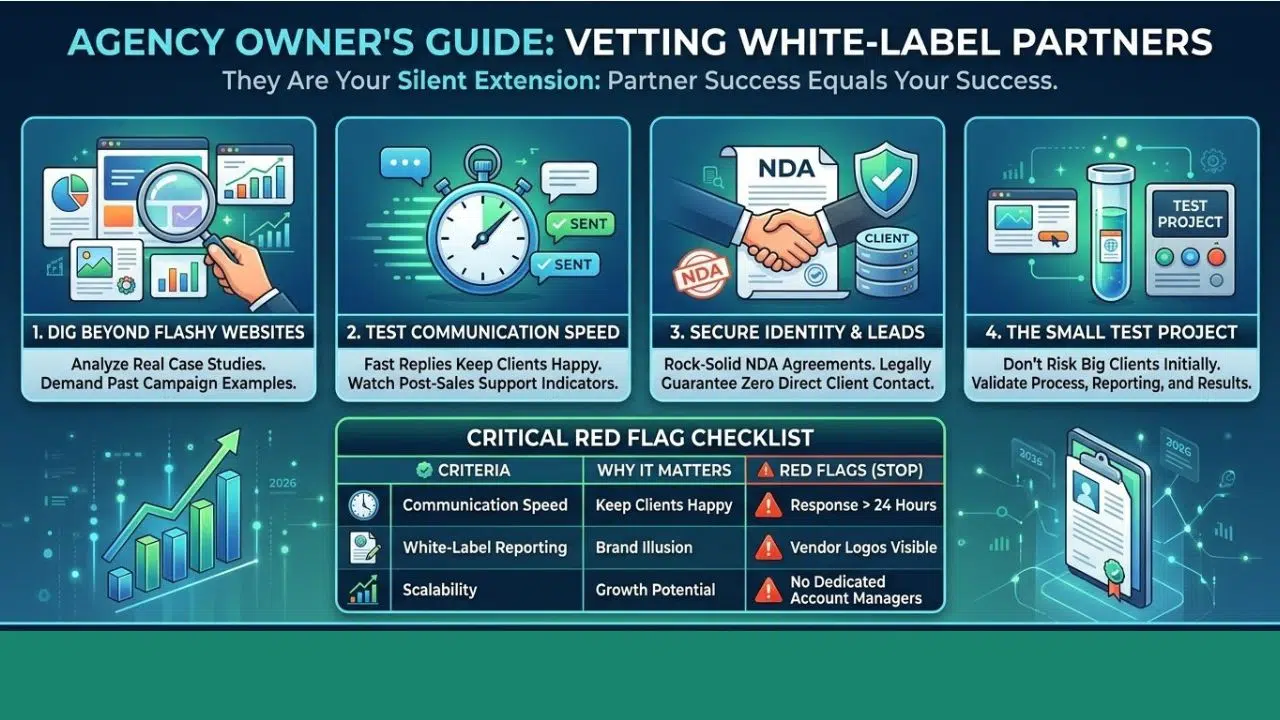
Your agency is only as good as the people fulfilling the work. If your partner drops the ball, your client blames you, not them. This means you must be incredibly strict when choosing who will handle your deliverables. You need a team that acts as a seamless, silent extension of your own brand. Finding them takes a bit of digging.
Evaluating Technical Service Providers
The most critical operational step in figuring out how to start a white-label agency is your vendor selection. You have to look beyond flashy websites and dig into their actual case studies. Ask them for real examples of past campaigns. Look at their reporting dashboards carefully. Will those reports have your logo on them, or will the vendor’s name accidentally slip through and ruin the illusion? I always recommend doing a small test project with a new partner before handing over your biggest client. Check their communication speed over a few days. If they take three days to reply to a simple email during the sales process, imagine how bad they will be when a client website crashes on a Friday night. You also need rock-solid non-disclosure agreements. Your partner must legally agree never to contact your clients directly. Transparency in pricing is another huge factor to check. You need to know exactly what they charge so you can calculate your retail prices accurately without unexpected fees eating into your profits.
Let us review the main criteria you should evaluate when comparing different fulfilment partners for your agency.
| Evaluation Criteria | Why It Matters | Red Flags to Watch Out For |
| Communication Speed | Fast replies keep clients happy | Taking more than 24 hours to respond |
| White-Label Reporting | Ensures your brand stays front and centre | Vendor logos hidden in the report footers |
| Scalability | They need to grow as you acquire more clients | Lack of dedicated account managers |
| NDA Agreements | Protects your hard-earned client list | Refusal to sign confidentiality paperwork |
-
Best for: Ensuring consistent, high-quality service delivery that keeps your clients satisfied and loyal to your brand.
-
Why We Chose It: A reliable partner acts as your backbone, meaning their operational success directly translates to your financial success.
-
Things to consider: Look for partners who offer transparent communication, straightforward pricing without hidden fees, and a proven track record of meeting strict deadlines.
3. Developing a Profitable Pricing Strategy
Pricing your services is a delicate balancing act. Charge too much, and you lose prospects to cheaper competitors. Charge too little, and you destroy your profit margins after paying your vendors. You need a model that reflects the value you bring to the table while ensuring your cash flow remains healthy. Let us break down how to price effectively.
Structuring Your Margins and Retainer Packages
Many new owners make the mistake of simply taking the vendor’s cost and slapping a tiny markup on it. That is a quick recipe for disaster. You have to account for your own software, marketing costs, and the time you spend managing the account. I recommend aiming for a gross margin of at least fifty to seventy percent on any outsourced service. For example, if your partner charges you five hundred pounds for an optimisation package, you should be charging your client anywhere from one thousand to fifteen hundred pounds. The best way to present this is through tiered retainer packages.
Give your prospects three clear options like basic, standard, and premium. This simplifies the buying process and anchors their financial expectations. It also shifts the sales conversation from whether they should hire you to which package they should choose. Value-based pricing is another fantastic route, where you charge based on the return on investment you generate rather than the manual hours worked.
Here is a simple framework to help you structure your monthly service retainers for maximum profitability.
| Pricing Tier | Suggested Markup | Target Client Profile | Included Extras |
| Basic Package | 50% | Local start-ups and small businesses | Monthly email report |
| Standard Package | 75% | Established regional companies | Bi-weekly strategy calls |
| Premium Package | 100%+ | Enterprise or high-growth brands | Custom dashboards and daily support |
-
Best for: Maintaining a healthy cash flow while providing scalable options for different client budgets and needs.
-
Why We Chose It: Creating tiered service packages simplifies the sales process and gives prospects clear, predictable financial options.
-
Things to consider: Always factor in your own operational costs, software subscriptions, and the time spent managing the relationship when calculating your final retail price.
4. Building Your Agency Brand Identity
Since you are not doing the technical work, your brand is essentially the main product you are selling. Clients are buying into your expertise, your communication style, and your promise of real business results. Creating a professional and trustworthy image is non-negotiable if you want to charge premium prices. Your branding needs to look polished from day one.
Crafting a Trustworthy Online Presence
When people search for how to start a white-label agency, they often overlook the massive importance of their own website. Your site is your digital storefront. It needs to clearly state who you help and exactly what problems you solve for them. Avoid heavy industry jargon. Speak directly to the business owner’s pain points. If you sell lead generation, talk about how you fill their calendar with qualified prospects, not about the technicalities of Google’s search algorithms.
You also need heavy social proof. Even if you are brand new, you can leverage the case studies provided by your fulfilment partners. Because you are reselling their work, you can ethically use their past results to showcase what your partnership can achieve. Just make sure the case studies are anonymised properly. Consistency across your LinkedIn profile, your email signature, and your proposal templates builds massive trust with hesitant buyers.
This table outlines the essential branding assets you need to have in place before you start pitching to clients.
| Brand Asset | Primary Function | Key Requirement |
| Agency Website | Acts as your central conversion hub | Fast loading with clear calls to action |
| Proposal Templates | Closes deals and outlines scope of work | Professional design matching your colours |
| LinkedIn Profile | Builds personal authority and networks | Optimised headline focusing on client results |
| Case Studies | Provides necessary social proof | Data-driven results showing clear returns |
-
Best for: New agencies that need to look established, professional, and trustworthy right out of the gate.
-
Why We Chose It: A strong brand identity justifies premium pricing and makes the sales process significantly smoother.
-
Things to consider: Ensure all your client-facing documents, from invoices to monthly reports, carry your logo and match your agency’s exact colour scheme.
5. Client Acquisition and Lead Generation
A beautiful website and a great fulfilment partner mean absolutely nothing if you do not have clients paying you every month. Lead generation is the absolute lifeblood of your new business. You have to be proactive and aggressive in getting your name in front of decision-makers. Waiting for people to find you organically simply takes too long.
Executing Inbound and Outbound Marketing Strategies
Getting your first five clients requires serious hustle. I always tell people learning how to start a white-label agency to focus heavily on direct outreach initially. LinkedIn is a goldmine for business-to-business sales. You can search for specific job titles, like marketing directors or small business owners, and send them highly personalised connection requests. Do not pitch immediately. Start a normal conversation, offer a free audit of their current website, and provide genuine upfront value. Cold email also works incredibly well if your messaging is highly targeted. On the inbound side, you should be creating content that answers your target market’s specific questions.
Write blog posts about industry trends, record short videos explaining marketing concepts, and post them consistently. Networking at local business events or joining your local chamber of commerce can also yield fantastic warm leads. Remember, your main goal is to book discovery calls. Once you get them on a video chat, you can uncover their pain points and pitch.
Let us compare the most effective methods for bringing new clients into your agency pipeline quickly.
| Acquisition Channel | Time to See Results | Cost Requirement | Best Strategy to Use |
| LinkedIn Outreach | Fast | Low | Personalised messaging and free audits |
| Cold Emailing | Fast | Low | Highly targeted industry-specific lists |
| Content Marketing | Slow | Low to Medium | Educational blog posts and case studies |
| Local Networking | Medium | Low | Attending specific trade shows and events |
-
Best for: Founders ready to launch their brand aggressively and start generating immediate revenue from new accounts.
-
Why We Chose It: Proactive lead generation guarantees you are not waiting around for luck, putting the growth of your business entirely in your own hands.
-
Things to consider: Always track your outreach metrics so you know exactly how many emails or messages it takes to book a single sales call.
6. Managing Client Relationships and Retention
Winning a client is exciting, but keeping them paying you month after month is where real wealth is built. High client turnover will destroy your profitability because acquiring new business is very expensive. You need to focus heavily on communication, expectation management, and demonstrating continuous value. You are the face of the operation.
Streamlining Communication and Reporting
The most common reason clients fire agencies is a total lack of communication. Even if the backend partner is getting great results, the client will leave if they feel ignored. You need to act as a highly strategic account manager. This means taking the complex, technical data provided by your white-label partner and translating it into plain English for your client. Set up a regular, predictable communication rhythm. I suggest a quick weekly email update and a comprehensive monthly review call. During these calls, do not just read numbers off a spreadsheet. Tell a story about what those numbers actually mean for their bottom line. Did organic traffic go up? Explain how that translates to more foot traffic in their physical store. Use automated reporting software that pulls data directly from dashboards and slaps your logo on top. This saves you hours of manual copy-and-pasting while making you look incredibly professional.
Here is a recommended communication schedule to keep your clients happy, informed, and engaged with your services.
| Communication Type | Frequency | Main Objective |
| Quick Status Update | Weekly | Reassure the client that work is progressing |
| Detailed Performance Report | Monthly | Showcase hard data, returns, and metrics |
| Strategy Review Call | Quarterly | Discuss bigger business goals and upsell services |
| Milestone Celebration | Ad-hoc | Build personal rapport and emotional connection |
-
Best for: Building a stable, resilient business supported by predictable and long-lasting recurring revenue streams.
-
Why We Chose It: Retaining an existing client is historically much cheaper and easier than spending marketing dollars to acquire a brand new one.
-
Things to consider: Schedule regular review meetings to discuss campaign performance, gather feedback, and identify opportunities to offer additional services.
7. Scaling Operations with the Right Software
As your client roster grows, relying on sticky notes and messy spreadsheets will lead to missed deadlines and massive stress. You have to build robust systems early on. Investing in the right technology stack automates the boring admin work and keeps your communication with both clients and partners perfectly organised. Efficiency equals high profitability.
Implementing Agency Management Tools
To run a tight ship, you need software that connects your internal processes effortlessly. A solid project management tool is the very first thing you should set up. Platforms like Asana or ClickUp allow you to track every single deliverable, assign tasks, and set strict deadlines. When your partner finishes a task, they update it in the system, and you get notified instantly. Next, you need a reliable financial stack. Invoicing software like Xero or Stripe makes it easy to set up automated recurring subscriptions. The last thing you want is to be chasing clients for manual bank transfers every thirty days. Finally, invest in a dedicated client portal or reporting dashboard. Tools like AgencyAnalytics let you integrate all your marketing channels into one clean, white-labelled interface. Your clients can log in at any time to see their results, which drastically cuts down on the number of panicked emails you receive.
This table highlights the core software categories you need to run your operations without dropping the ball.
| Software Category | Core Function | Popular Industry Options |
| Project Management | Tracking task progress and deadlines | ClickUp, Monday, Asana |
| Automated Billing | Collecting monthly recurring payments | Stripe, Xero, QuickBooks |
| Client Reporting | Generating branded performance dashboards | AgencyAnalytics, Databox, Swydo |
| Team Communication | Quick chats with your vendors | Slack, Microsoft Teams, Google Chat |
-
Best for: Agency owners who want to grow past their first ten clients without working eighty hours a week.
-
Why We Chose It: The right tools automate repetitive administrative tasks, freeing up your time to focus heavily on high-level sales and strategy.
-
Things to consider: Do not buy too much software on day one; start with the basics and only upgrade when your manual processes become a bottleneck.