Developers often feel like they are shooting in the dark when picking a new site. Machine learning models use hyperlocal data to show where housing demand will peak. You will learn how to tap data analytics, geospatial heat maps, and AI for smarter choices.
Read on.
Key Takeaways
- Developers feed GPS metadata and smart-sensor foot-traffic signals into AI models for site picks. An Emerald City app forecasted three-year rent per square foot with over 90% accuracy and captured 60% of rent swings.
- Location intelligence platforms cluster mobile and Wi-Fi data to flag zones with 50,000 monthly visits and identify blocks yielding 10% higher rental returns than nearby areas.
- Teams use tools like Unacast, Apache Spark, TensorFlow, and ArcGIS to merge GPS logs, shape files, U.S. Census demographics, and spending patterns. A Seattle rent model linked 60% of rent shifts to nearby restaurant counts.
- Predictive analytics and real-time feeds boost logistics and planning. A shipping operation cut idle time by 30%, and emergency dispatchers cut response time by 25% using live movement data.
- Firms invest 60% of project effort in data cleaning and merging to ensure accuracy. They guard privacy under GDPR, encrypt geotagged feeds, and integrate diverse sources for reliable location insights.
How Big Data Provides Actionable Location Insights
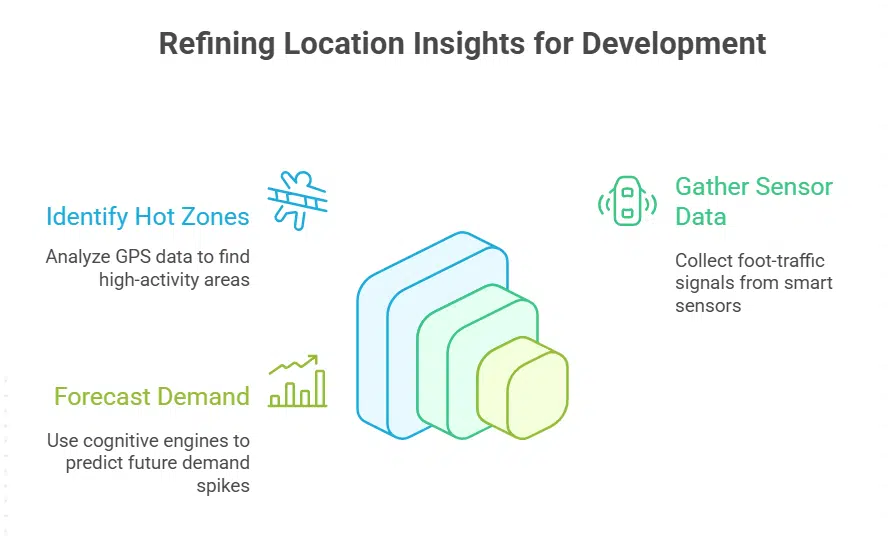
GPS metadata sketches hot zones in sharp detail, letting developers skip messy guesswork and score prime sites. Smart sensors feed cognitive engines with foot-traffic signals, and those trend forecasts show where demand will spike next.
Hyper-accurate geospatial data for site selection
Developers use hyper-accurate geospatial data, with latitude and longitude points and shape files, to map footfall trends, visitor counts, peak times, and movement patterns. Data flows into tools like Unacast for foot traffic analytics, revealing visitor types and revisit frequency.
Next comes trade area analysis, which draws drive-time and walking-distance rings around each point, targeting catchment zones. Demographic and psychographic profiles emerge from U.S. Census and STI PopStats, sorting age, gender, income, and education and linking to consumer behavior.
Big data and location intelligence tools spot site candidates that match top performers by comparing traffic metrics and spending datasets like STI Spending Patterns. Analysts run predictive analytics to gauge potential property values and forecast local market share.
That slashes guesswork like a hot knife through butter and boosts ROI with a data-driven approach.
Predictive analytics for future market trends
Machine learning algorithms sift macro and hyperlocal forecasts, spotting rent trends before they emerge, like a crystal ball. An Emerald City app mapped three-year rent per square foot for rental units with over 90% accuracy.
It even weighed proximity to top-rated restaurants and clothing shops, capturing 60% of rent swings. Predictive models test property futures, they flag assets likely to stay strong in a cooling market.
Big data analytics compare ROI on upgrades with broker forecasts, guiding price splits and launch timing. Urban planners tap location intelligence to chart traffic and service demand, they pinpoint low-competition spots near transit and amenities.
This data-driven insight boosts planning precision and sharpens customer experience.
Identifying high-demand areas through consumer behavior analysis
Sensors collect mobile and traffic data from smartphones, GPS devices, and wi-fi hotspots. AI-driven clustering spots hot spots across a city. Location intelligence platforms use predictive analytics and geospatial analysis to define trade areas.
They track travel patterns and foot traffic to pick zones that draw 50,000 monthly visits on average. This method cuts risk for real estate investors and retailers.
Marketers layer demographic information and psychographic details like age, income, and spending habits. Clustering algorithms group similar consumers. They forecast demand shifts so planners can pick high-growth spots.
This approach flags blocks with 10 percent higher rental returns within the same zip code than neighbors. Retail businesses boost ROI with this real-time data and predictive-model insights.
Applications of Big Data in Location-Based Decision-Making
Machine learning tools and geospatial sentiment analysis sift through mountains of social media chatter, GPS logs, and sensor feeds, so developers can zero in on hot spots. City planners and brand teams use these insights to pick residential zones, set shop fronts, and map delivery paths like seasoned pros.
Real estate development and urban planning
Big data gives planners a hyperlocal view of traffic patterns and service demand for new roads, parks, and transit hubs. Asset managers use location intelligence to spot undervalued blocks in rising neighborhoods.
Neural nets and geospatial analytics crunch real-time data from sensors and social chatter to predict crime risks or flood zones, and GDPR compliance shields user info. These insights help set the right residential to commercial mix and price points based on local demand.
Urban analysts then build predictive models to guide infrastructure investment as communities grow.
Optimizing retail store placement
Retailers use foot traffic trends and demographic analytics to pick busy corners, not empty streets. Trade area analysis paints a map of shoppers who live or work nearby. Competitors and complementary outlets get a quick study too, so teams steer clear of ghost towns.
Brands tap cloud-based location intelligence and deep learning models for sharper insights.
Franchisers study high-demand pockets to place new outlets, cutting guesswork. They benchmark top sites against weaker stores to spot success factors. Demographics and consumer spending charts shape long-term growth estimates.
This data-driven approach boosts return on investment and meets customer preferences.
Enhancing infrastructure and logistics planning
Big data drives smarter route maps. Analysts merge real-time drive times from GPS, NFC, and Beacons into location intelligence models. A shipping team shaved 30% off idle time. Machine learning flags slow links in a warehouse line.
Decision makers use predictive analysis to forecast rush hours. Drones zoom past traffic jams. Driverless cars map fresh lanes with location analytics. Ride sharing logs guide trucks around blockages in supply chains.
City planners tap traffic, transit, and police call records. They see which roads crack under rush. Spatial analytics layers community needs data. That reveals where to build a new bridge.
Live movement data steers crews toward faulty pipes before they burst. Emergency dispatchers rely on live maps to cut response time by 25%.
Tools and Technologies Leveraging Big Data for Location Analysis
Teams link Apache Spark, TensorFlow and ArcGIS with GPS feeds, social media APIs and survey logs to pinpoint hot spots fast—keep reading to learn more.
AI and machine learning for smarter predictions
Artificial intelligence steers data-driven forecasts. Engineers feed big data such as satellite scans, census stats, and credit files into a cluster computing tool. It reached over 90% accuracy in predicting rent prices in Seattle.
Underwriters and research teams use these math models in portfolio reviews and underwriting workflows. They match data-driven outputs with broker forecasts to sharpen site selection and price estimates.
Neural networks run scenario tests on buy or sell options in high-growth or declining zones. They flag risks and guide smarter investment strategies. Real-time data pumps into machine-learning models to boost location intelligence and property valuation.
Predictive modeling cuts costs, refines marketing campaigns, and boosts return on investments.
Companies collect geotagged tweets and Instagram posts to map positive and negative chatter, then feed that into mapping software, advanced analytics engines and machine learning. They merge review sentiment scores with street coordinates to track public mood in real time.
Business intelligence tools with spatial analytics paint heat maps of social buzz. Real-time data flags spikes in local mentions, showing which blocks buzz with excitement or suffer low ratings.
Analysts pin review stars, comment scores and foot traffic into layered maps. This fusion of sentiment and map data delivers clear location intelligence.
Developers use these big data signals like a weather vane for site selection. They tag social emotion with crime stats and weather feeds inside a secure Hadoop cluster. Dashboards from BI suites let planners slice data by demographics, customer preferences or socioeconomic tiers.
The workflow obeys GDPR compliance and uses role-based access control to guard data security. This data-driven approach cuts risks, refines marketing strategies and speeds up real estate analytics.
It feels like a local guide whispering tips on where to build next.
Multi-source data aggregation for enhanced accuracy
Real estate firms pull big data from multiple sources to boost data accuracy. They tap GPS logs, crime stats, consumer spending and customer behavior records. A Seattle rent model linked 60% of rent shifts to nontraditional entries like restaurant counts.
Software for geocoding and mapping merges latitude, longitude and shape files. They pour it into advanced analytics and machine learning like a chef adding spices.
Data prep and cleansing keep the information tight, trimming errors before analysis. Analysts combine internal records, weather feeds and IoT device logs. This mix drives location intelligence, drive-time mapping, segmentation and resource availability checks.
Stakeholders use these insights for risk assessment, investment analysis and strategic planning. They guard data privacy and follow GDPR compliance to boost data security.
Benefits of Using Big Data for Developers

Developers cut risks with real-time data feeds and AI-driven predictive analytics, powering precise location intelligence. Teams sharpen site choices and boost ROI using cloud data warehouses and GIS software.
Reduced risks in property investments
Advanced analytics harness big data streams to spot assets that hold value in slow markets. It mines detailed crime maps, flood risk layers, and transit proximity to flag future hazards.
Forecasting applications blend rent and occupancy trends with historic records to slash guesswork. Underwriting teams apply precise location intelligence in every deal, boosting risk management.
Real estate analytics validates data accuracy and meets GDPR compliance.
Predictive modeling runs multiple scenarios to prep for market swings. Location analytics tracks early signs of neighborhood shifts, giving teams a head start. Benchmarking new sites against proven ones helps curb losses.
Firms that skip these tools risk falling behind rivals. Robust data security keeps investor information safe.
Smarter decision-making for long-term planning
Big data feeds GIS layers and IoT signals to drive site selection for long-term planning. Real estate firms use quantitative and qualitative data analysis to set clear site criteria.
Location intelligence spots ideal customers and high-growth areas for sustainable expansion. This data-driven approach ties to business goals and price segmentation for lasting profit.
Predictive analytics and machine learning guide infrastructure investment and resource allocation over years. Teams of data scientists, engineers, and business translators align analytics with strategic objectives.
Governance steps track impact, uphold data security, and meet GDPR compliance. This method boosts real estate analytics, customer engagement, and competitive intelligence.
Cost-effective and efficient resource allocation
Developers harness spatial analytics and location intelligence in BI control panels to pick sites with strong demand and high ROI. This cuts search costs and speeds site selection for franchises and new businesses.
Firms channel budgets to top zones based on customer preferences.
Tools feed drive-time and demographic data into neural networks for precise distribution planning. That merges logistics, manufacturing, and real-time data flows in one view. The process boosts real estate analytics for portfolio management and guides property upgrades.
Challenges in Utilizing Big Data for Location Analysis
Sloppy sensor readings can sink your site maps like a hull breach, and they wreck the value of your analytics system. Data privacy law can slip behind your pipelines and spook any map visualization dashboard.
Data accuracy and quality control
Teams handle big data from maps, sensors, and customer systems. Data preparation often takes 60% of project effort and 40% of the budget. Core tasks include cleansing and merging ERP feeds, social feeds, and IoT device logs.
GIS platforms and spatial engines map latitude, longitude, and shape files for precise location intelligence. Real-time data and predictive analytics hinge on high data accuracy.
Engineers use scripting languages and big data frameworks to automate cleaning tasks. They build data pipelines that flag outliers and sync internal records with external sources. They apply machine learning to spot duplicates and fill gaps.
They focus on high-value cases first, keeping tight quality control logs. Good data management cuts wrong site picks and lifts returns by 10% or more.
Privacy and security concerns
Companies face rules under the European Union’s general data protection regulation. They must secure geotagged social media posts and customer address data. It demands rigorous data security and regular audits.
Big data can expose personal patterns, for example revealing popular routes from cellphone pings. A breach can harm brand image and trigger hefty fines. Connected sensors and mobile applications feed real-time data streams that hackers target.
Decision-makers weigh security gaps in data-driven approaches. Encryption, multi-factor safeguards, and threat hunts protect location intelligence. Policy updates cover new sources like machine learning feeds and sentiment streams.
Real estate firms hire cyber experts to guard customer preferences. Data engineers audit updates to keep data accuracy high. Auditors run drills and compliance tests to stay ahead of rules.
Integration of diverse data sources
Developers pull media feeds, IoT signals, traffic logs and SQL databases into robust ETL pipelines. Teams spin up data lake storage and data processing engines to blend batch loads with real-time data.
Big data demands stretch systems, and aligning all formats takes extra care. Inconsistent records and missing fields can hurt data accuracy and location intelligence.
Leaders appoint a Chief Data Officer and a Chief Technology Officer, to set big data operating models and data security plans. Cross-functional teams mix analysts, engineers, and business leads in agile sprints, so they meet gdpr compliance and market needs.
Experts pick top real estate analytics use cases first, to tame complexity, and drive advanced analytics pilots. Many groups stall when incompatible sources block scaling beyond prototypes.
Future Opportunities in Location-Based Analytics
Smart sensors, AI models, and real-time data will power next-gen site picks, boosting your edge—read on to catch the wave.
Real-time decision-making with AI advancements
AI advancements accelerate exponentially, boosting real-time decision-making. Digitalization, mobility, and IoT adoption feed big data platforms with real-time data. A streaming platform catches GPS and Beacon feeds and refines movement and demand tracking.
Cloud data platforms host advanced analytics, and meet GDPR compliance and data security rules. Location intelligence and geospatial analytics help agencies improve emergency response and smooth traffic flow.
Predictive AI models run instant scenario analysis for property investments and resource planning. Developers track customer preferences and market shifts as they happen.
Smarter investment strategies through predictive modeling
Predictive models help firms use big data for location intelligence and real estate analytics. They generate data-driven investment strategies by scanning market trends. AI-driven analytics support sophisticated portfolio reviews and risk assessments.
Firms compare model outputs with broker forecasts to boost accuracy. Model alerts drive dynamic buy or sell calls as markets shift. Portfolio managers spot undervalued or rising hotspots fast.
Underwriters tap predictive analytics for smarter capital allocation. They test property mix and pricing plans before projects start. These insights cut risks and speed approvals. Teams use machine learning platforms and cloud data warehouses for data engineering.
Real-time data feeds from IoT devices power these models. This tight data security meets GDPR compliance in the European Union.
Enhanced customer experience with personalized solutions
Customer experiences improve as firms tap advanced analytics on real time data from location based services. Spatial clustering segments users by movement patterns, so brands send targeted offers that match customer preferences.
A ride-hailing app mixed big data with location intelligence to cut wait times and tweak pricing. Machine learning libraries and mapping platforms power those insights and boost loyalty.
Teams mine foot traffic and local events data to tweak in store layouts and add services for each neighborhood. They layer spatial clustering with survey feedback to craft spot-on marketing.
Start-ups, retail chains and real estate firms roll out new amenities that reflect local tastes and stay within gdpr compliance and data security rules. Personalized solutions based on movement and behavior data set brands apart in a crowded market.
Takeaways
Developers now tap big data to find prime sites fast. Smart forecast algorithms spot trends before they show up on maps. Geo mapping tools reveal foot traffic and local demand in real time.
Data science models crunch sales figures and property values to guide choices. Mixing artificial intelligence and real-time feeds powers site plans with confidence.
FAQs
1. What is big data and how does it help developers pick the best spot?
Big data gathers huge records from sales, sensors, and social feeds. In the digital economy, advanced analytics and machine learning on real-time data give a first mover edge. It spots areas with growth before rivals.
2. How does location intelligence boost market decisions?
Location intelligence merges maps, demographics, market intelligence, and customer preferences. It even checks transport apps for travel trends. This lets teams choose a spot that hits the target market.
3. Does data security and european union’s general data protection regulation (gdpr) slow site selection?
Data security locks down personal facts, and gdpr sets clear rules. Teams build steps to follow these rules, which can add time but keep data safe. Trust grows when privacy stays solid.
4. How do real estate analytics and a data-driven approach shape pricing?
Real estate analytics reviews past deals, home values, and data from companies. A data-driven approach uses that knowledge to set fair, fast real estate pricing. It cuts guesswork out of the deal.
5. Why are customer preferences and the target demographic key?
Customer preferences show what folks want, from shop styles to price points. Developers map social trends and transport rides to learn who shops where. This links the site to the chosen audience.
6. Can this tech aid hiring and design work?
Yes. Analyzing data helps direct the hiring process to areas with top talent. Teams apply learning technologies to sift resumes and set up user-friendly interface design on mobile OS. This ramps up work speed and cuts waste.