Hey there, are you worried about hackers sneaking into your online world? Well, cyber threats are growing fast, and artificial intelligence, or AI, is stepping up to fight them. In this blog, I’ll show you 10 cool ways AI is making cybersecurity work on its own to keep you safe.
Stick around, it’s gonna be neat!
Key Takeaways
- AI boosts cybersecurity with real-time threat detection, handling millions of daily attacks.
- Tools like Microsoft Security Copilot, launched in 2023, cost $4 per SCU per hour and rank alerts fast.
- Companies like Darktrace, started in 2013, offer independent threat response for networks.
- SparkCognition, valued at $1.4 billion in 2022, leads in predictive security scanning.
- Sift Science, founded in 2011, processes 1 trillion events yearly to stop fraud.
AI-Powered Threat Detection
AI is changing the game in spotting cyber threats, folks. Imagine a guard dog that never sleeps, sniffing out danger before it even gets close. That’s what AI-powered threat detection does.
It creates baselines for normal behavior, catching any odd moves right away. Businesses face millions of cyber attacks daily, way too many for old-school defenses to handle. With AI, we’re talking real-time threat detection that keeps up with the bad guys.
Attackers now use artificial intelligence to craft sneaky phishing emails and mutating malware, making things tougher. But guess what? AI fights back by analyzing file traits to spot malware, even zero-day threats no one’s seen before.
Tools like Security Information and Event Management systems, or SIEM for short, team up with machine learning models to flag risks fast. It’s like having a super-smart detective on your side, guarding your network security 24/7.
Autonomous Threat Analysis
Hey there, folks, let’s talk about something really neat in cybersecurity, autonomous threat analysis. Imagine having a brilliant friend who’s always alert, constantly on the lookout for risks.
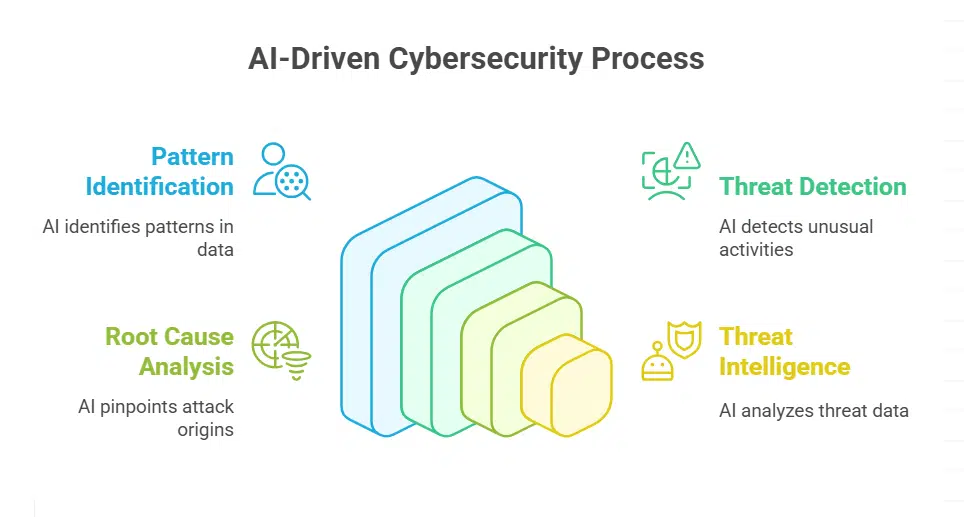
That’s the role AI plays here. It sifts through massive amounts of data at lightning speed. Through automated analysis, it identifies patterns in these enormous security datasets.
This accelerates threat detection like a sports car speeding through clear roads. No more delays waiting for humans to spot every tiny hint. AI takes on the tough work, ensuring your systems stay more secure.
Now, envision a crafty intruder attempting to sneak into your home. AI’s behavioral analysis acts like a watchful protector detecting unusual activities. It identifies compromised accounts or internal risks before they cause serious damage.
Additionally, it employs root cause analysis to pinpoint the origin of attacks. On top of that, AI absorbs threat intelligence data, analyzing patterns to outpace cyber criminals. It’s like having a foresight tool for cyber risks, helping to halt harmful actions before they escalate.
Automated Incident Response Systems
Take a look, everyone, automated incident response systems are transforming cybersecurity. With AI leading the way, these solutions detect cyber threats instantly and respond swiftly.
They don’t just stand by; they separate compromised systems, block malicious IPs, and even apply patches to close vulnerabilities. It’s like having an incredibly intelligent guard dog that alerts and acts before issues escalate.
There’s no delay waiting for human intervention, which preserves critical time.
When it comes to speed, AI-driven tools like Microsoft Security Copilot, introduced in 2023, are creating a significant impact. Priced at $4 per SCU per hour, this valuable asset assists in ranking alerts and proposing solutions for incidents.
Think of a companion who not only alerts you to risks but also provides the precise resource to address them. Also, companies like Darktrace, a key player since 2013, deliver independent threat response that secures networks.
These systems confront data breaches and malware detection directly, serving as your primary shield in the challenging landscape of cyber threats.
User and Entity Behavior Analytics (UEBA)
Hey there, readers, let’s talk about an interesting topic in cybersecurity, known as User and Entity Behavior Analytics, or UEBA for short. Think of having a clever companion who observes how everyone behaves online, catching anything unusual immediately.
That’s UEBA! It establishes standard patterns for users and systems, similar to recognizing your friend’s typical coffee choice. If something seems wrong, like an odd login time, it marks that as a potential risk.
This aids in detecting insider threats, those hidden dangers from inside a company, by identifying unusual shifts in behavior.
Now, imagine this as a vigilant guard dog, detecting issues before they become problems. UEBA employs AI to monitor user actions for any suspicious activity, greatly improving security.
On the other hand, it can raise privacy concerns since it constantly tracks online activities. Yet, by quickly identifying irregularities, it protects against cyber risks, such as unauthorized access, using methods like behavioral analytics.
Pretty impressive, right?
AI-Driven Vulnerability Scanning and Management
Let’s chat about how AI is changing the game in vulnerability scanning and management, folks. Picture your computer system as a big house with lots of doors and windows. Some might be cracked open, just waiting for a sneaky thief, or in this case, a cyber threat, to slip through.
AI steps in like a super-smart guard dog, sniffing out those weak spots fast. It uses clever tricks like predictive analytics to figure out which holes need fixing first, based on past data and current threat trends.
This isn’t just a random guess; it prioritizes patching to stop attacks before they even start. Cool, right?
Now, think about how much time this saves. Companies like SparkCognition, valued at a whopping $1.4 billion in 2022, are leading the charge with their sharp tools for predictive security.
Their tech, along with enhanced vulnerability scanning, hooks right into existing systems, making everything work together smoothly. Plus, it’s not just about finding flaws; AI also helps with patch management, so your digital house stays locked tight.
And take Vectra AI, started back in 2012, which brings awesome skills in threat detection to the table. With AI handling vulnerability management and network security, you’ve got a solid shield against cyber threats, keeping your data safe without breaking a sweat.
Phishing Detection Through Machine Learning
Hey there, readers, let’s talk about how machine learning is transforming the way we detect phishing attacks. Imagine receiving an email that seems legitimate, but something doesn’t feel right.
That’s where AI comes in, acting like a vigilant protector identifying threats. It screens emails and examines URLs to intercept deceptive phishing attempts before they can trap you.
This technology processes vast amounts of data, recognizing phishing trends that might escape human notice. Pretty impressive, isn’t it?
Now, take a look at tools like Tessian, launched in 2013, which are at the forefront of email security. For around $5 per user each month, they provide anomaly detection to halt spear phishing right away.
Their AI continuously adapts, refining phishing detection models to counter the newest tactics scammers use. So, with machine learning as our ally, those pesky phishing emails have little hope against intelligent cybersecurity.
Fraud Detection and Prevention with AI
Fraud detection is getting a major boost from artificial intelligence (AI), and it’s changing the game for keeping our money safe. Picture AI as a super-smart guard dog, sniffing out weird patterns in transactions that might slip past human eyes.
It monitors tons of data, spotting subtle hints of fraud with machine learning models. For instance, Sift Science, a company started in 2011, handles a whopping 1 trillion events each year to catch fraud before it hits.
That’s a huge number, right?
Think of AI as your personal fraud fighter, always on duty. It checks identities using cool tricks like facial recognition and biometrics, making sure it’s really you making that purchase.
Plus, it’s sharp enough to prevent big financial losses by catching cyber threats early. With AI in cybersecurity, those sneaky fraud attempts don’t stand a chance against proactive defense and real-time threat detection.
How awesome is that?
Integration of AI in Threat Intelligence Platforms
Hey there, readers, let’s chat about how artificial intelligence is shaking things up in threat intelligence platforms. Imagine AI as a super-smart detective, always on the case.
It ingests and analyzes threat intelligence data to spot trends before they turn into big problems. This isn’t just guesswork; it’s a sharp tool that sifts through tons of info in real-time.
With AI, platforms can predict cyber threats faster than a speeding bullet. It’s like having a crystal ball, but way more accurate. Plus, the system learns from every new piece of data, getting smarter day by day.
Now, dig this, security measures get updated on their own thanks to AI’s quick thinking. Think of it as a guard dog that never sleeps, always ready to bark at danger. Based on fresh intelligence, AI tweaks defenses to keep cyber-threats at bay.
Tools like CyberX, snapped up by Microsoft in 2020, show how this works, especially in industrial cybersecurity. They focus on real-time threat prediction and adaptive responses to tackle risks head-on.
So, with AI powering threat hunting and network security, you’ve got a solid shield against sneaky attacks.
AI-Enhanced Security Operations Center (SOC) Efficiency
AI is changing the game for Security Operations Centers, folks. Imagine your SOC as a busy kitchen, with chefs juggling a dozen dishes at once. Now, toss in AI as the speedy sous-chef, handling the grunt work like chopping onions, or in this case, sorting through endless alerts.
It prioritizes alerts to cut down on fatigue, making sure analysts focus on real threats, not false alarms. Plus, AI processes data at lightning speed, optimizing SOC resources so your team isn’t drowning in noise.
It’s like having an extra set of hands during the dinner rush.
Take incident triage, for example. AI jumps in to assist, slashing response times by sorting out what’s urgent and what can wait. Tools like LogRhythm, started back in 2003, play a big role here with their SIEM solutions and compliance automation, kicking off at about $20,000 a year.
This kind of tech, paired with machine learning models, boosts threat detection and streamlines security information and event management. So, your SOC isn’t just reacting; it’s staying ahead of cyber threats with a sharper, faster edge.
Autonomous Endpoint Security Solutions

Hey there, readers, let’s talk about something exciting in the field of cybersecurity. Autonomous endpoint security solutions are making huge strides with the power of artificial intelligence (AI).
These tools, such as those from Deep Instinct, protect your devices with real-time threat prevention. Think of a vigilant guard dog that never rests, detecting danger before it even approaches.
Priced between $50 and $75 per endpoint each year, Deep Instinct provides strong defense against cunning cyberattacks. It’s like having a dedicated protector for every laptop or phone in your network.
Now, imagine this system operating independently. AI-driven endpoint security doesn’t just remain idle; it actively tracks and blocks threats without requiring human intervention.
Sophisticated attacks have no chance against this unwavering protection. With constant monitoring and malware detection, these solutions ensure your data remains secure from risks.
It’s almost like a miracle, but it’s genuine technology, folks, keeping your endpoints safe around the clock.
Network Traffic Analysis and Monitoring with AI
Let’s chat about how AI is changing the game in network traffic analysis. Imagine your network as a busy highway, with data zooming back and forth like cars. Now, AI acts like a super-smart traffic cop, spotting odd patterns or slowdowns in real time.
It enhances network security by keeping an eye on every bit of data flowing through. Tools powered by artificial intelligence, like those from Vectra AI, excel at threat detection and monitoring.
They catch sneaky cyber threats before they cause big trouble. How cool is that?
Think of AI as your trusty sidekick in keeping networks safe. It identifies anomalies in traffic patterns, almost like noticing a strange car weaving through lanes. With real-time threat detection, AI tools from companies like Vectra AI give full coverage for network security.
They scan for malicious behavior hiding in the data stream. Plus, integrating AI into network monitoring means nothing slips through the cracks. Isn’t it amazing how tech can guard our digital highways so well?
AI-Assisted IoT Security Management
Hey there, readers, let’s talk about how artificial intelligence is stepping up to guard our connected world of IoT devices. Think of your smart fridge, security cameras, or even industrial sensors, all chatting online.
AI jumps in to spot threats fast, keeping these gadgets safe from cyber crooks. It watches for odd behavior, like a camera suddenly sending weird data, and flags it before trouble starts.
This kind of IoT security management, powered by AI, is a game-changer for homes and businesses alike.
Now, picture AI as a tireless watchdog over critical infrastructure and industrial systems. It doesn’t just monitor IoT devices; it also tackles risks in real-time with sharp threat detection.
Whether it’s a factory sensor or a city’s power grid, AI-driven platforms sniff out dangers and act to block cyber threats. This smart approach beefs up cloud security too, making sure no weak link gets overlooked.
Stick around, and see how this tech keeps our digital lives locked tight!
Automated Penetration Testing Tools
Folks, let’s talk about an exciting development in cybersecurity with automated penetration testing tools. These innovative systems, powered by AI, work like digital investigators, detecting weak points in your network before malicious actors can exploit them.
They don’t just remain idle; they actively mimic cyberattacks to evaluate the strength of your defenses. Think of them as a training opponent, launching simulated strikes to test your ability to evade them.
With AI in cybersecurity fueling these tools, they identify vulnerabilities with impressive precision, protecting you from genuine dangers.
Now, envision this system operating around the clock. Automated testing tools provide ongoing security assessments, always vigilant even while you rest. They enhance vulnerability management by identifying issues quicker than any person could.
It’s like having an unyielding watchdog that never rests, ensuring your data remains secure. Plus, AI streamlines penetration testing so effectively that it minimizes mistakes, keeping your systems protected from cyber risks.
How impressive is that?
Data Loss Prevention Through AI Algorithms
Hey there, readers, let’s chat about how AI algorithms are changing the game in data loss prevention. Imagine your sensitive information as a treasure chest, and AI is the sharp-eyed guard watching over it.
These smart tools keep an eye on your data in real time, spotting any sneaky attempts to access it without permission. They don’t just sit back; they actively monitor every move across digital systems.
With AI, potential data breaches get flagged before they even happen. It’s like having a trusty watchdog that never sleeps, always ready to bark at intruders.
Now, think of AI as a super-smart detective for your digital world. It identifies unauthorized access faster than you can say “cyber threat.” By using machine learning, these systems learn what’s normal and what’s fishy, catching odd behavior right away.
They protect sensitive data across all kinds of platforms, from the cloud to your office servers. Tools powered by artificial intelligence, like advanced data protection software, act as a shield, keeping your info safe.
Isn’t it neat how tech can be your best buddy in fighting cyber risks?
The Role of AI in Cybersecurity Training and Awareness
AI is transforming cybersecurity training and awareness, everyone. It creates customized programs that suit your needs perfectly. Imagine learning through simulations of real-world cyber threats, such as phishing attacks or malware detection.
These tools let you experience the intensity of a cyber battle, without any real danger. Plus, AI-driven platforms consistently provide updates, ensuring you’re always aware of the latest strategies to stay protected.
Isn’t it impressive how AI enhances cybersecurity awareness? It doesn’t just educate; it hones your skills with continuous lessons. Think of it as a mentor who never stops supporting you.
With regular training updates, these systems help you identify risks like insider threats or deceptive spam. So, engage in learning with AI, and see your security stance improve every day.
Ethical Considerations in Autonomous Cybersecurity Systems
Hey there, readers, let’s talk about a crucial topic in AI and cybersecurity. Ethical concerns arise when machines begin making significant decisions independently, especially in safeguarding us from cyber threats.
Think about bias in training data; it can distort results and lead to unfair outcomes. Picture a system incorrectly flagging innocent users simply because the data it was trained on had hidden biases.
That’s a genuine issue, and it undermines confidence in these tools.
Now, think about the challenges with accountability issues. If an AI fails in threat detection or incident response, who is held responsible? Transparency is another obstacle; a lack of it causes people to question AI systems.
Thankfully, measures like the European AI Act and NIST AI Risk Management Framework are directly addressing these risks. They’re establishing guidelines to ensure AI in cybersecurity remains fair and secure, so we can depend on technology without concern.
Takeaways
Wow, what a ride through the wild world of AI in cybersecurity! We’ve seen how artificial intelligence transforms threat detection and automates incident response with lightning speed.
It’s like having a tireless guard dog sniffing out cyber dangers. Pretty cool, right? So, let’s keep cheering for these smart tools as they shield our digital lives!
FAQs on How AI Is Automating Cybersecurity
1. How is AI making cybersecurity more self-reliant these days?
Man, AI in cybersecurity is like a trusty guard dog, always on the lookout. It automates threat detection and incident response, slashing the time it takes to spot cyber threats. With tools like real-time threat detection and security information and event management (SIEM), it’s got your back before trouble even knocks.
2. Can AI really stop phishing attacks on its own?
Heck yeah, AI-based phishing detection is a game-changer. It uses machine learning models to sniff out spear-phishing and dodgy emails through email filtering, saving you from clicking that shady link.
3. What’s the deal with AI and endpoint security?
Picture AI as a bouncer at the club of your devices; it’s all about endpoint protection. It handles endpoint security by automating malware detection and anomaly detection, keeping your gadgets safe from sneaky intruders. Plus, with network traffic analysis, it watches every move on your system like a hawk.
4. How does AI help with insider threats, you ask?
Well, let’s just say AI is like a detective with a magnifying glass, using user and entity behavior analytics (UEBA) and behavioral analytics to spot insider threats. It digs into patterns with natural language processing (NLP) and deep learning to flag odd moves before they hurt your security posture.
5. Is AI smart enough for vulnerability management?
You bet! AI takes on vulnerability scanning and patch management like a pro, finding weak spots in your network security or cloud security faster than you can say “hack.” It ties into proactive defense, using threat intelligence to keep sensitive data protection tight.
6. What’s this buzz about generative AI in cybersecurity trends?
Listen up, generative AI, along with large language models (LLMs), is shaking things up in areas like fraud detection and dark web monitoring. It’s not just a fancy tool; it crafts smarter threat prevention strategies and boosts security awareness training. But, hey, we still need human oversight in AI to dodge pitfalls like bias in AI or data poisoning messing with our defenses.