The idea of producing all the energy your home needs sounds simple: install solar panels, add a big battery, and stop paying utility bills. In reality, home energy independence sits on a spectrum. Some households aim for fewer outages and lower bills. Others want full off-grid living, where the house runs without a utility connection.
In 2026, the question is no longer “Is off-grid living possible?” It is. The real question is: Is off-grid living feasible for the average homeowner who still wants comfort, reliability, and predictable costs? The answer depends on where you live, your energy habits, your budget, and how much complexity you are willing to manage.
This guide breaks down what home energy independence means in 2026, how off-grid systems work, what they cost, the practical trade-offs, and which option makes the most sense for most readers today.
What Does Home Energy Independence Really Mean in 2026?
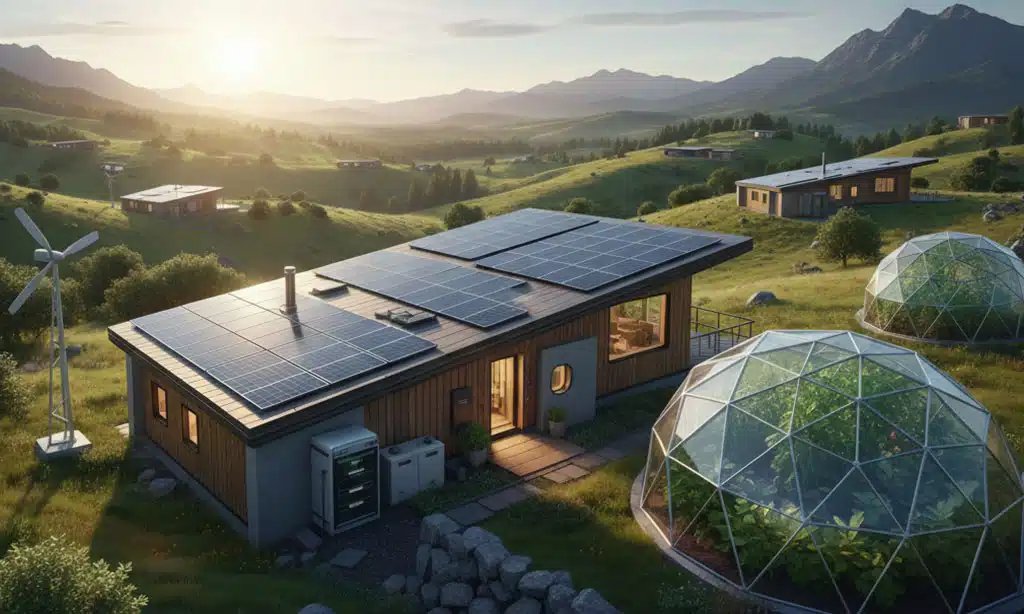
Home energy independence is often used as a catch-all phrase, but it can mean very different things.
Some homeowners want to:
- Cut electricity bills and reduce exposure to rising rates
- Keep the lights on during blackouts
- Reduce carbon footprint
- Power a home in a remote area where grid connection is expensive or unreliable
Others want:
- Full independence, where the home stays powered year-round without any grid connection
In 2026, more people are exploring energy independence because of a mix of factors: higher peak rates, more extreme weather, concern about outages, and better home energy technology. But feasibility depends on picking the right level of independence for your situation.
Energy Independence vs Off-Grid Living
Energy independence usually means your home can produce most of its electricity and can keep running during outages. In many cases, this is grid-tied solar plus battery backup, sometimes with a generator for emergencies.
Off-grid living means your home is not connected to the utility grid at all. Your system must generate, store, and manage electricity every day of the year, including during bad weather and seasonal dips.
A helpful way to think about it:
| Level | Setup | What It Delivers | Who It Fits |
| Partial independence | Solar (grid-tied) | Lower bills | Most homeowners |
| Resilient independence | Solar + battery (grid-tied) | Lower bills + backup power | Outage-prone areas |
| Near off-grid | Solar + large battery + generator (grid-optional) | High self-reliance | Rural homes, energy hobbyists |
| Full off-grid | Solar + very large battery + backup + load control | No utility connection | Remote properties, dedicated off-grid lifestyle |
For most households in 2026, the best “home energy independence” strategy is not full off-grid. It is a resilient hybrid system designed for your local risks and costs.
Why 2026 Is a Turning Point
Several trends make 2026 a major moment for off-grid living feasibility and home energy independence:
- Better batteries and smarter controls: Home energy systems are increasingly able to manage loads automatically and protect battery health.
- More flexible energy use: People are learning to shift heavy loads (like EV charging, laundry, water heating) to solar hours.
- More demand for resilience: Outages and weather disruptions push homeowners to value backup power more than ever.
- More real-world learning: There is now a large base of homeowners who have lived with solar + batteries for years, so best practices are clearer.
But a turning point does not mean a universal “yes.” It means options are clearer: you can choose full off-grid living, or you can build a home energy independence plan that gives you most of the benefits with fewer trade-offs.
How Off-Grid Energy Systems Work Today
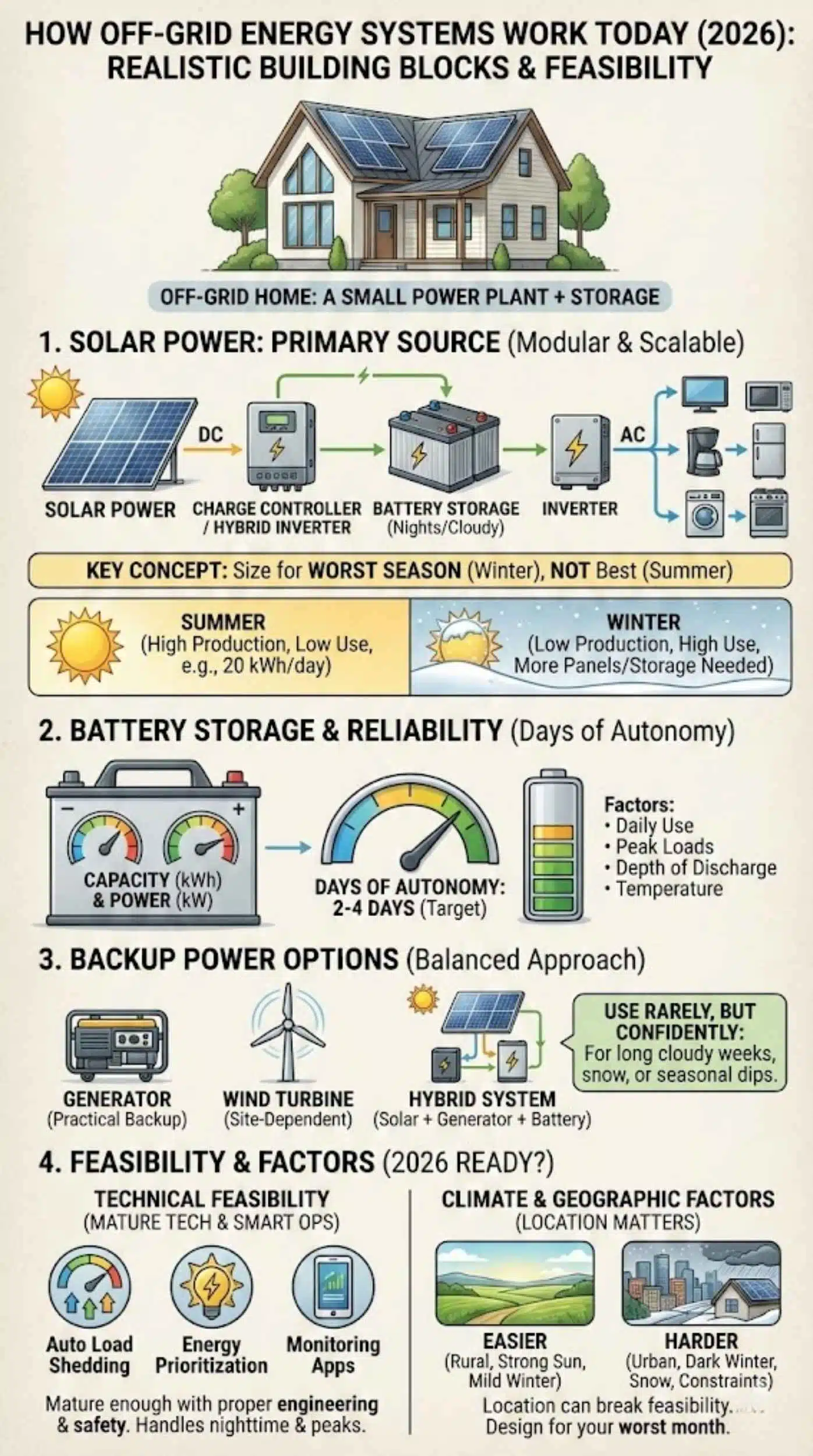
An off-grid home is a small power plant plus a storage facility. It must create electricity, store it, convert it to usable household power, and protect itself during surges or heavy demand. The system also needs a plan for days when solar production drops.
Here are the key building blocks.
Solar Power as the Primary Energy Source
Most off-grid homes rely on solar because it is modular, scalable, and widely available. In a typical setup:
- Solar panels generate DC electricity
- A charge controller or hybrid inverter manages charging
- Batteries store energy for nights and cloudy periods
- An inverter supplies AC power to your home
In 2026, solar is still the foundation for most off-grid living setups because it is often the most practical renewable option for a single household.
Key design concept: solar must be sized for the worst season, not the best. Many new off-grid owners size based on summer production and then struggle in winter.
Actionable planning tips:
- Estimate your daily use in kWh (kilowatt-hours)
- Identify winter production in your location (lower sun hours)
- Plan for at least one “bad weather stretch” scenario
- Use energy efficiency upgrades to reduce your required system size
Real-world example:
- A home uses 20 kWh/day in summer.
- In winter, solar production can drop sharply.
- Without adjustments, the same home may need significantly more panels and storage to stay off-grid year-round.
Battery Storage and Energy Reliability
Batteries are what make off-grid living feasible. They keep the home running when solar is not producing. Battery sizing depends on:
- Your daily energy use
- Your peak power needs (what runs at the same time)
- How many “days of autonomy” you want (how long you can last without new solar input)
Days of autonomy is a core off-grid concept. Many off-grid homes aim for 2–4 days. More than that can become expensive fast.
Battery planning considerations:
- Capacity (kWh): how much energy you can store
- Power output (kW): how much you can deliver at once
- Depth of discharge: how much you can safely use without shortening battery life
- Temperature management: batteries perform differently in cold and heat
In 2026, many homeowners focus on batteries as both a resilience tool and a cost-control tool, especially when paired with solar.
Backup Power Options
Even a well-designed solar + battery system can face challenging periods: long cloudy weeks, snow cover, smoke events, or seasonal dips. That is why many off-grid living setups include backup power.
Common backup options:
- Generator: often the most practical backup
- Wind: useful in windy regions, but site-dependent
- Hybrid systems: solar + generator + battery is common
Practical truth:
- Full off-grid living without any backup is possible in some climates, but it raises risk and typically requires oversizing solar and batteries.
A balanced approach is:
- Design solar + battery for most days
- Use backup power rarely, but confidently, when needed
Is Off-Grid Living Technically Feasible in 2026?
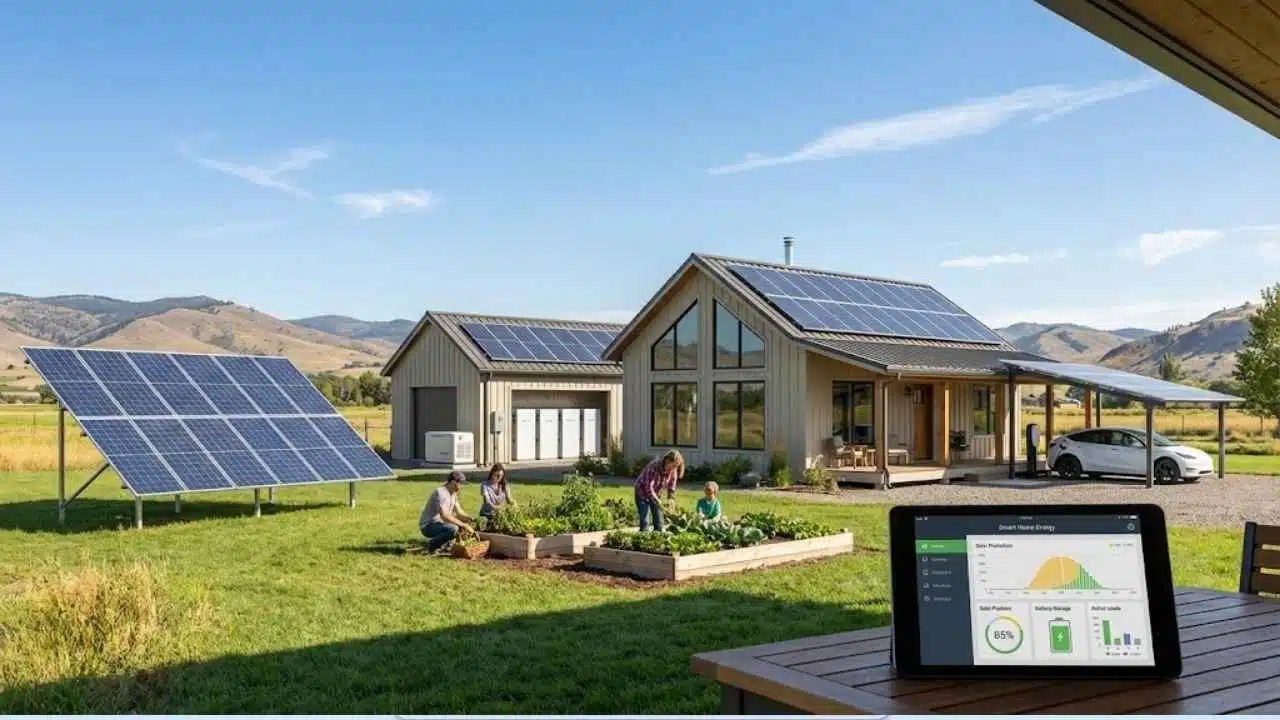
Yes, off-grid living is technically feasible in 2026. The bigger question is how feasible it is for your lifestyle and location without constant compromises.
A technically feasible system must handle:
- Nighttime energy use
- Peak loads (like cooking, HVAC, pumps)
- Seasonal variation
- Extended low-sun periods
- Maintenance and troubleshooting
Technology Readiness
In 2026, off-grid technology is mature enough for reliable use if designed correctly. What matters most is system engineering:
- Proper solar sizing for winter
- Battery storage sized for realistic autonomy needs
- Load management to avoid overdraw
- Backup plan for bad-weather periods
- High-quality installation and safety compliance
Modern systems also allow smarter operation:
- Automatic load shedding (non-critical loads shut off)
- Energy prioritization (fridge, lights, well pump first)
- Better monitoring apps and alerts
This makes full off-grid living more achievable than it used to be, especially for people willing to adapt.
Climate and Geographic Factors
Location can make or break off-grid living feasibility.
Off-grid is easier when:
- You have strong sun hours for much of the year
- Winters are mild or sunny
- You have space for enough panels
- Your home is efficient and well-insulated
Off-grid is harder when:
- You have long, dark winters
- Cloudy seasons last weeks
- Heavy snow covers panels
- Cooling demand is extreme (hot climates)
- Heating depends on electricity (electric resistance heat is a challenge)
Actionable steps:
- Look up average sun hours by month for your area
- Identify your “worst month” for solar production
- Design your system around the worst month, not the average month
Urban vs Rural Feasibility
Rural off-grid living is often more feasible because:
- More land for panels
- Fewer zoning constraints
- Easier generator use
- Remote areas may have costly grid connection
Urban off-grid living is often limited by:
- Roof space
- Shading from buildings
- Noise restrictions for backup generators
- Rules on disconnecting from utilities
In cities, the more practical version of home energy independence is usually grid-tied solar + battery backup, not full disconnection.
Cost Breakdown of Going Off-Grid in 2026
The cost of off-grid living depends on system size, energy habits, climate, and the level of comfort you want. A small cabin with a mini fridge and LED lighting is one thing. A full-size home with HVAC, electric cooking, and an EV is another.
Below is a practical way to think about off-grid costs: you are paying up front for a private power system that must perform in the worst conditions.
Upfront Installation Costs
A full off-grid home system typically includes:
- Solar panels
- Inverter (often hybrid)
- Battery storage
- Electrical upgrades and safety components
- Backup generator (common)
- Installation labor, permits, and inspections
Cost drivers include:
- Battery size (often the biggest driver)
- Roof vs ground mount (ground mounts can cost more but allow better performance)
- Need for trenching, wiring, and electrical panel upgrades
- Backup system complexity
A planning table to estimate components:
| Component | What It Does | Typical Cost Driver |
| Solar array | Generates daily energy | Size + mounting type |
| Battery bank | Stores energy for nights/bad weather | Capacity + power output |
| Inverter/charger | Converts DC to AC and manages charging | Peak load capacity |
| Balance of system | Wiring, breakers, mounts, safety | Code requirements |
| Backup generator | Covers extended shortages | Fuel type + size |
| Monitoring/controls | Tracks and automates energy use | Smart features |
If you are researching off-grid living 2026 costs, a key takeaway is that a comfortable full off-grid setup is usually a major investment. Many homeowners find that “near off-grid” (grid-tied + batteries) gets most benefits with lower complexity.
Ongoing Maintenance and Replacement Costs
Off-grid living replaces a utility bill with:
- Equipment upkeep
- Battery replacement planning
- Generator servicing (if used)
- Occasional repairs
What to expect:
- Solar panels are relatively low maintenance but still need cleaning and inspection
- Inverters and electronics can require replacement over time
- Batteries gradually lose capacity and eventually need replacement
- Backup generators need fuel and periodic servicing
Tip:
- Build a “system maintenance fund” the same way you would budget for roof repairs or HVAC replacement.
Long-Term Savings vs Grid Dependency
Some homeowners go off-grid to save money. This can work in specific cases, especially where grid connection is extremely expensive or unreliable. But for many households, full off-grid is not the cheapest path.
Off-grid tends to make more financial sense when:
- Extending grid power to your property is very expensive
- Local utility rates are high and rising
- You value outage protection highly
- You can reduce your energy needs through efficiency upgrades
If you are mainly looking for cost savings, the strongest value path in 2026 is often:
- Improve efficiency first
- Add solar
- Add battery backup if outages or peak rates justify it
Legal, Regulatory, and Insurance Considerations
Off-grid living feasibility is not only about technology and cost. Rules matter, and they vary widely by location. Some places allow utility disconnection with few requirements. Others restrict it or require specific compliance steps.
Is Off-Grid Living Legal Everywhere?
In many regions, you can live off-grid, but you may still need to meet:
- Building codes
- Electrical code standards
- Health and sanitation requirements
- Local zoning rules
- Permit requirements for solar and electrical work
Common friction points:
- Restrictions on disconnecting from the utility
- Minimum utility connection rules in certain developments
- Requirements for backup power or safety shutoffs
- Permit complexity for larger systems
Actionable step:
- Before buying equipment, contact your local permitting office or a licensed installer familiar with your area’s rules.
Insurance and Financing Challenges
Off-grid homes can be harder to insure or finance if they are outside typical underwriting assumptions.
Potential issues:
- Insurers may ask about backup power and fire safety
- Mortgage lenders may prefer grid-connected homes
- DIY systems can complicate inspections and coverage
Ways to reduce friction:
- Use certified components
- Document system design and inspections
- Work with licensed professionals where required
- Ensure code compliance and keep records
Pros and Cons of Off-Grid Living in 2026
Off-grid living has clear benefits, but it also has real trade-offs. The feasibility depends on whether the benefits match your priorities.
Key Advantages
Off-grid living can offer:
- Resilience: your home can keep running during outages
- Control: you manage your energy production and storage
- Predictability: you reduce exposure to utility rate swings
- Sustainability: lower emissions if designed around renewables
- Remote living access: enables homes where grid access is difficult
Practical example:
- In areas with frequent outages, a well-designed off-grid or near off-grid system can keep essentials running: refrigeration, lights, communication, and water pumping.
Major Drawbacks
Off-grid living also brings:
- Higher upfront cost: especially for batteries and backup planning
- Lifestyle adjustments: you must think about energy use
- System management: monitoring, maintenance, occasional troubleshooting
- Seasonal stress: winter or cloudy seasons require planning
- Risk of shortfall: poor design can lead to outages at home
A simple reality:
- With grid power, you rarely think about energy.
- Off-grid, energy becomes a daily part of decision-making unless your system is oversized.
Off-Grid vs Grid-Tied With Battery Backup
Many people searching “home energy independence” are actually looking for the best solution to reduce bills and avoid outages. That is often not full off-grid. It is a grid-tied system with battery backup.
Reliability Comparison
Off-grid reliability depends on your system design and your habits. If you under-size solar or batteries, you can run out of power.
Grid-tied + battery reliability benefits from two sources:
- Your solar and battery system
- The utility grid when needed
For most readers, this hybrid approach offers:
- High reliability with fewer compromises
- Smaller battery needs (because the grid acts as backup)
- Less need for generator use
Cost and Convenience Comparison
Here is a practical comparison:
| Feature | Full Off-Grid | Grid-Tied + Battery Backup |
| Upfront cost | Usually higher | Often lower for similar comfort |
| Complexity | Higher | Lower |
| Lifestyle changes | Often required | Minimal |
| Backup during long cloudy periods | Must be planned | Grid helps |
| Best for | Remote, dedicated off-grid | Most homeowners |
Which Option Fits Most Homeowners in 2026?
For most people in 2026, the most feasible form of home energy independence is:
- Grid-tied solar + battery backup
- Optional generator in high-risk outage regions
- Efficiency upgrades to reduce system size and cost
Full off-grid living is feasible, but it is most practical for those who:
- Live remotely
- Accept some lifestyle constraints
- Enjoy system management
- Have a strong reason to disconnect
Who Should Consider Off-Grid Living in 2026?
Off-grid living is not “one-size-fits-all.” It fits certain situations extremely well.
Off-grid living is a strong match for:
- Remote properties where grid connection is expensive
- Areas with unreliable grids and long outages
- Homes with efficient design (good insulation, efficient appliances)
- People comfortable with planning and maintenance
- Households with flexible energy habits
Off-grid living is often a poor match for:
- High energy homes with minimal efficiency upgrades
- Heavy electric heating without alternative heating
- Urban homes with limited solar space and strict rules
- People who want “set it and forget it” energy
Actionable checklist before you commit:
- Audit your energy use (monthly and daily)
- Identify your worst-season solar potential
- Decide your comfort level with backup generator use
- Price out both: full off-grid vs grid-tied + batteries
- Confirm local code, permits, and insurance requirements
Final Verdict: Is Home Energy Independence Realistic in 2026?
Home energy independence is realistic in 2026, but the most feasible version for most readers is not full disconnection. It is a smart hybrid strategy: reduce energy use, produce power with solar, store it with batteries, and keep the grid (or a generator) as backup.
Full off-grid living is feasible in 2026 when the home is designed for it and the owner accepts the trade-offs. It works best in remote areas, in homes with strong efficiency, and for people who want the lifestyle.