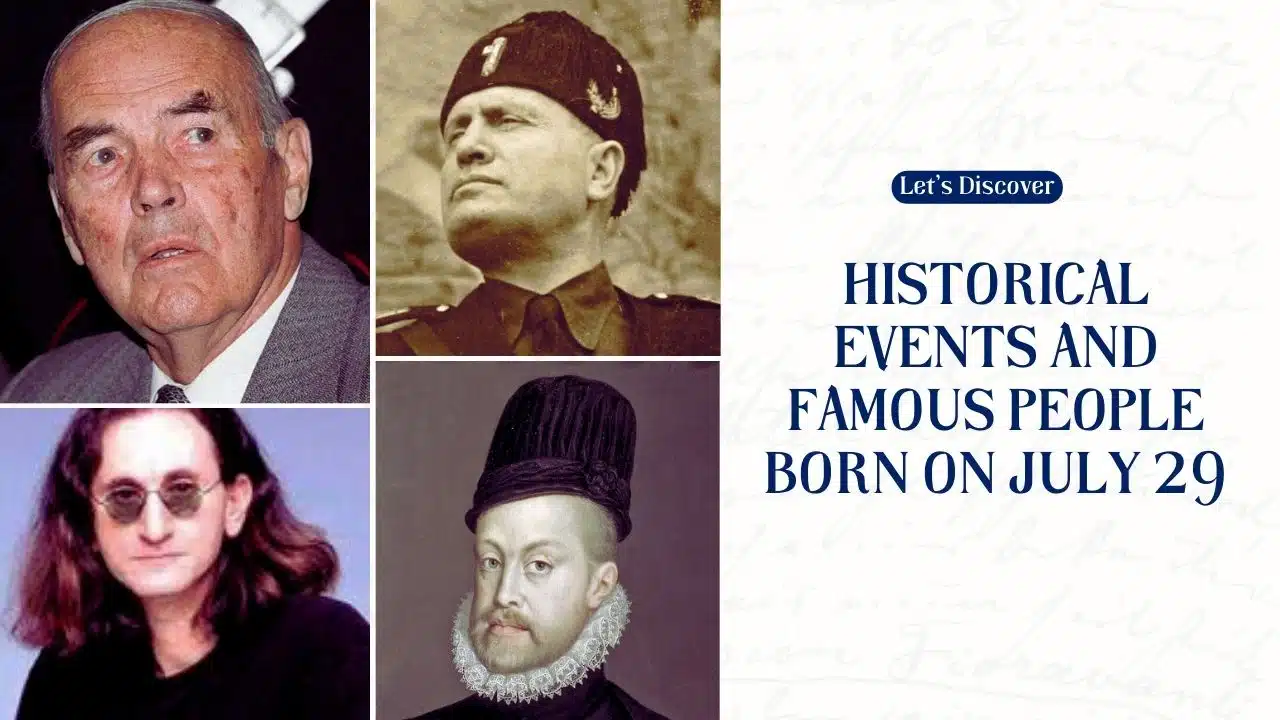
July 29 is a day that has seen many important events throughout history. It’s also the birthday of several famous people who have made a big impact on the world. In this article, we’ll learn about five important events that happened on July 29 and five famous people who were born on this day. These events and people have helped shape our world in different ways.
Historical Events on July 29
A. 1279: Japan Beheads Emissaries from Kublai Khan
In 1279, something very serious happened between Japan and the Mongol Empire. Kublai Khan, the ruler of the Mongols, sent five messengers to Japan. But instead of talking with them, the Japanese cut off their heads. This was a very big deal.
At this time, the Mongols were very powerful. They had already taken over China and wanted Japan to give them money and follow their rules. But Japan didn’t want to do this. They were proud of their own way of life and didn’t want to change.
By killing Kublai Khan’s messengers, Japan was saying a very strong “no” to the Mongols. This made Kublai Khan very angry. He decided to attack Japan with a big army. This led to two big battles in 1274 and 1281. Both times, Japan was saved by big storms that destroyed many Mongol ships. Japanese people later called these storms “kamikaze,” which means “divine wind.”
This event shows how Japan wanted to stay independent. It also led to some big fights between Japan and the Mongols. These fights helped shape Japan’s history and how they saw themselves as a country.
B. 1579: King Philip II Arrests Plotters

On July 29, 1579, King Philip II of Spain did something very important. He arrested two people who he thought were planning against him. These people were Antonio Perez and the Princess of Eboli.
King Philip II was a very powerful king. He ruled over a big empire that included parts of Europe and America. But even powerful kings can have enemies. Antonio Perez was the king’s secretary, a very important job. The Princess of Eboli was a rich and powerful woman.
The king thought these two were working together to go against him. He was worried they might try to take away some of his power. So, he decided to arrest them before they could do anything.
This event shows us that even kings had to be careful about people close to them. It also tells us that politics in Spain at this time could be very tricky and dangerous. People with a lot of power, like Antonio Perez and the Princess of Eboli, could lose everything if the king didn’t trust them.
C. 1884: Founding of Society of Independent Artists in Paris
On July 29, 1884, a group of artists in Paris started something new and exciting. They created the Society of Independent Artists. The people who started this group were Albert Dubois-Pillet, Odilon Redon, Georges Seurat, and Paul Signac.
Paris in the late 1800s was a very important place for art. Many artists lived and worked there. But some artists felt that the usual way of showing art wasn’t fair. They thought that some good artists weren’t getting a chance to show their work.
The Society of Independent Artists wanted to change this. They had a big idea: anyone could show their art in their exhibitions. There would be no judges to say if the art was good enough or not. This was very different from other art shows at the time.
This new way of doing things helped many artists who were trying new ideas in their art. It gave them a place to show their work to people. Some of these artists, like Georges Seurat, became very famous later.
The Society of Independent Artists was important because it helped change how people thought about art. It showed that there were many different ways to make good art, not just one right way. This idea is still important in art today.
D. 1921: Adolf Hitler Becomes Leader of the Nazi Party
On July 29, 1921, Adolf Hitler became the leader of the National Socialist German Workers Party, also known as the Nazi Party. This was a very important event that would change the course of history.
Hitler joined the Nazi Party in 1919, just after World War I. Germany had lost the war and many people were unhappy. Hitler was good at speaking and making people believe in his ideas. He quickly became an important person in the party.
When Hitler became the leader, he started to change the party. He made it focus more on his ideas about race and nationalism. He said that Germany’s problems were caused by other groups of people, especially Jewish people. These ideas were wrong and very harmful.
Under Hitler’s leadership, the Nazi Party grew bigger and more powerful. In 1933, Hitler became the leader of Germany. He turned the country into a dictatorship, which means he had all the power. This led to World War II and the Holocaust, where millions of people were killed.
Hitler’s rise to power on this day in 1921 was the start of a very dark time in history. It shows how dangerous it can be when people believe in ideas that hate other groups of people.
E. 1987: Creation of Ben & Jerry’s Cherry Garcia Ice Cream
On a much lighter note, July 29, 1987, saw the creation of a new ice cream flavor that would become very popular. Ben & Jerry’s, a famous ice cream company, agreed with Jerry Garcia to make a new flavor called Cherry Garcia.
Ben & Jerry’s started in 1978 in Vermont. They became known for making ice cream with fun names and interesting flavors. Jerry Garcia was the lead guitarist of the Grateful Dead, a popular rock band.
Cherry Garcia was cherry ice cream with cherries and chocolate flakes in it. It was named as a play on Jerry Garcia’s name. This was one of the first times an ice cream flavor was named after a rock star.
The creation of Cherry Garcia shows how food companies were starting to use pop culture in their products. It also shows how Ben & Jerry’s was good at coming up with new and fun ideas for ice cream. Cherry Garcia became one of their most popular flavors and is still sold today.
Famous Birthdays on July 29
A. Walter Hunt (1796-1859)
Walter Hunt was an American inventor born on July 29, 1796, in New York. He is best known for inventing the safety pin in 1849. Hunt created the safety pin to pay off a $15 debt. He sold the rights to his invention for $400, which would be worth much more today.
Hunt also worked on many other inventions. He helped develop early versions of the sewing machine, though he didn’t patent his design. He also invented a type of fountain pen and a rope-making machine.
Hunt’s inventions show how one person’s ideas can make life easier for many people. The safety pin, which we still use today, is a good example of a simple but very useful invention.
| Fact | Information |
|---|---|
| Born | July 29, 1796 |
| Died | June 8, 1859 |
| Known for | Inventing the safety pin |
| Other inventions | Early sewing machine, fountain pen, rope-making machine |
| Legacy | Contributed to everyday conveniences we still use |
B. Benito Mussolini (1883-1945)
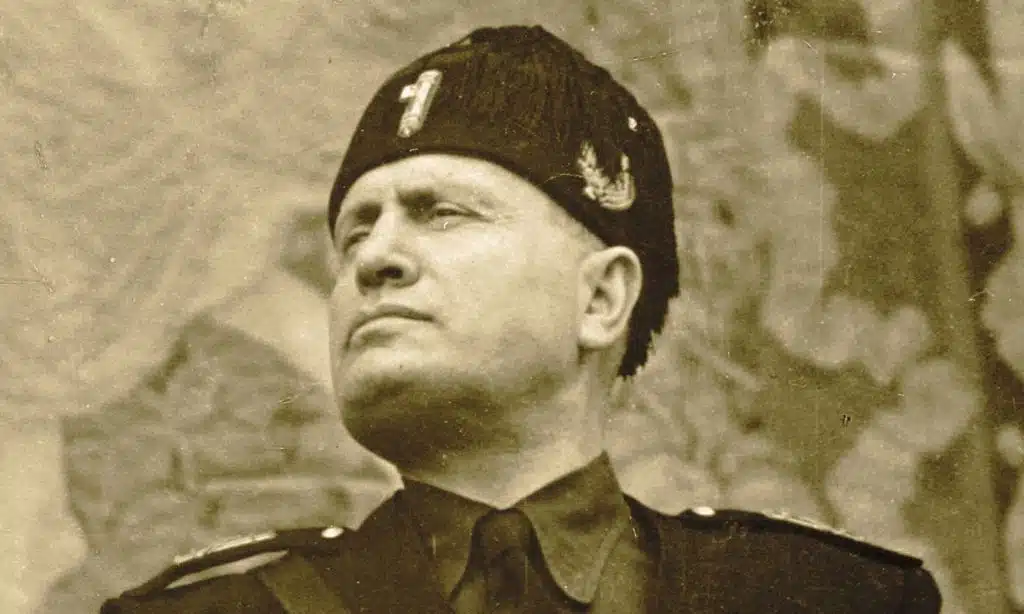
Benito Mussolini was born on July 29, 1883, in Italy. He became the leader of Italy and ruled as a dictator from 1922 to 1943. Mussolini started the Fascist movement, which believed in very strong government control and nationalism.
Mussolini came to power after World War I when many people in Italy were unhappy. He promised to make Italy strong and important again. At first, some people liked his ideas, but his rule became very harsh and took away people’s freedoms.
During World War II, Mussolini joined with Nazi Germany. This decision led to Italy’s defeat in the war. In 1943, Mussolini lost power, and in 1945, he was killed by Italian partisans.
Mussolini’s rule is remembered as a dark time in Italy’s history. It shows the dangers of giving too much power to one person or group.
| Fact | Information |
|---|---|
| Born | July 29, 1883 |
| Died | April 28, 1945 |
| Known for | Fascist dictator of Italy |
| Time in power | 1922-1943 |
| Legacy | Negative example of authoritarian rule |
C. Erich Priebke (1913-2013)
Erich Priebke was born on July 29, 1913, in Germany. He was a Nazi SS officer during World War II. Priebke is known for his role in a terrible event called the Ardeatine massacre, which happened in Rome in 1944.
In this massacre, 335 Italian civilians were killed by Nazi forces. This was done as revenge for an attack on German soldiers. Priebke admitted to being part of this massacre.
After the war, Priebke escaped to Argentina. He lived there for many years before being found and brought back to Italy for trial in 1996. He was found guilty for his part in the massacre and spent the rest of his life under house arrest.
Priebke’s story is a reminder of the terrible things that happened during World War II and the long process of bringing people to justice for war crimes.
| Fact | Information |
|---|---|
| Born | July 29, 1913 |
| Died | October 11, 2013 |
| Known for | Nazi SS officer involved in Ardeatine massacre |
| Trial | Found guilty in 1996 |
| Legacy | Example of pursuit of justice for WWII crimes |
D. Ted Lindsay (1925-2019)
Ted Lindsay was born on July 29, 1925, in Canada. He was a famous ice hockey player who played in the National Hockey League (NHL) for 17 seasons, mostly with the Detroit Red Wings.
Lindsay was known for being a tough player who could also score many goals. He won the Art Ross Trophy in 1950 for scoring the most points in the NHL. He also helped the Detroit Red Wings win the Stanley Cup (the biggest prize in hockey) four times.
But Lindsay is also remembered for something he did off the ice. He helped start the NHL Players Association. This group works to protect the rights of hockey players and make sure they are treated fairly.
Lindsay’s actions both on and off the ice made him an important figure in hockey history. He showed that athletes could be both great players and leaders in making their sport better.
| Fact | Information |
|---|---|
| Born | July 29, 1925 |
| Died | March 4, 2019 |
| Known for | NHL hockey player, helped form NHL Players Association |
| Team | Mostly Detroit Red Wings |
| Awards | Art Ross Trophy (1950), 4 Stanley Cups |
E. Geddy Lee (b. 1953)
Geddy Lee was born on July 29, 1953, in Toronto, Canada. He is best known as the lead singer and bassist of the rock band Rush. Lee has been making music for over 40 years and is considered one of the best bass players in rock music.
Rush, the band Lee is part of, is known for their complex music and thoughtful lyrics. Some of their famous songs include “Tom Sawyer,” “The Trees,” and “New World Man.” Lee’s high-pitched singing voice and skill on the bass guitar are big parts of Rush’s unique sound.
Lee has won many awards for his music and has influenced many other musicians. He shows how someone can keep making great music for a long time and always try new things.
| Fact | Information |
|---|---|
| Born | July 29, 1953 |
| Known for | Lead singer and bassist of Rush |
| Famous songs | “Tom Sawyer,” “The Trees,” “New World Man” |
| Career span | Over 40 years |
| Legacy | Considered one of the best rock bassists |
Takeaways
July 29 has been a day of many important events and notable births throughout history. From big political decisions like Japan’s defiance of the Mongol Empire to cultural milestones like the founding of the Society of Independent Artists, this day has seen moments that shaped nations and changed how we think about art.
The people born on this day have also left their mark on the world. Some, like Walter Hunt, made our everyday lives easier with their inventions. Others, like Benito Mussolini, serve as important lessons from history. We also see how people like Ted Lindsay and Geddy Lee have influenced sports and music.
Looking at all these events and people shows us how one day can connect to so many different parts of history and culture. It reminds us that every day has the potential to be the start of something important or the birthday of someone who might change the world.
References:
1. Rossabi, M. (1988). Khubilai Khan: His Life and Times. University of California Press.
2. Kamen, H. (1997). Philip of Spain. Yale University Press.
3. Rewald, J. (1986). The History of Impressionism. Harry N. Abrams.
4. Kershaw, I. (2008). Hitler: A Biography. W. W. Norton & Company.
5. Cohen, B., & Greenfield, J. (1997). Ben & Jerry’s Double Dip. Simon & Schuster.
6. Kassabova, K. (2017). Border: A Journey to the Edge of Europe. Graywolf Press.
7. Smith, D. M. (1983). Mussolini: A Biography. Vintage Books.
8. Steinacher, G. (2011). Nazis on the Run. Oxford University Press.
9. Cruise, D., & Griffiths, A. (1991). Net Worth: Exploding the Myths of Pro Hockey. Prentice Hall Canada.
10. Peart, N. (2004). Traveling Music: The Soundtrack to My Life and Times. ECW Press.