
If you’ve opened your latest water bill and thought, “Why am I getting a high water bill all of a sudden?” you’re not alone. Across the U.S., millions of households see unexplained spikes in their bills every year — sometimes with no obvious leak, no major lifestyle change, and no warning from the utility company.
Part of the problem is that most people only look at the dollar amount, not the actual usage. Another part is that many of the biggest water wasters in a home are quiet, hidden, and incredibly easy to ignore. A toilet that runs “just a little” or a sprinkler that sprays the sidewalk can silently waste hundreds or thousands of gallons a month.
The good news? Most causes of unusually high water bills are identifiable and fixable. Once you know where to look, you can track down the real culprits, cut waste, and bring your bill back under control.
Let’s walk through 12 real causes of high water bills Americans don’t realize, plus simple steps to spot and solve them.
At a Glance: 12 Hidden Reasons You are Getting a High Water Bill
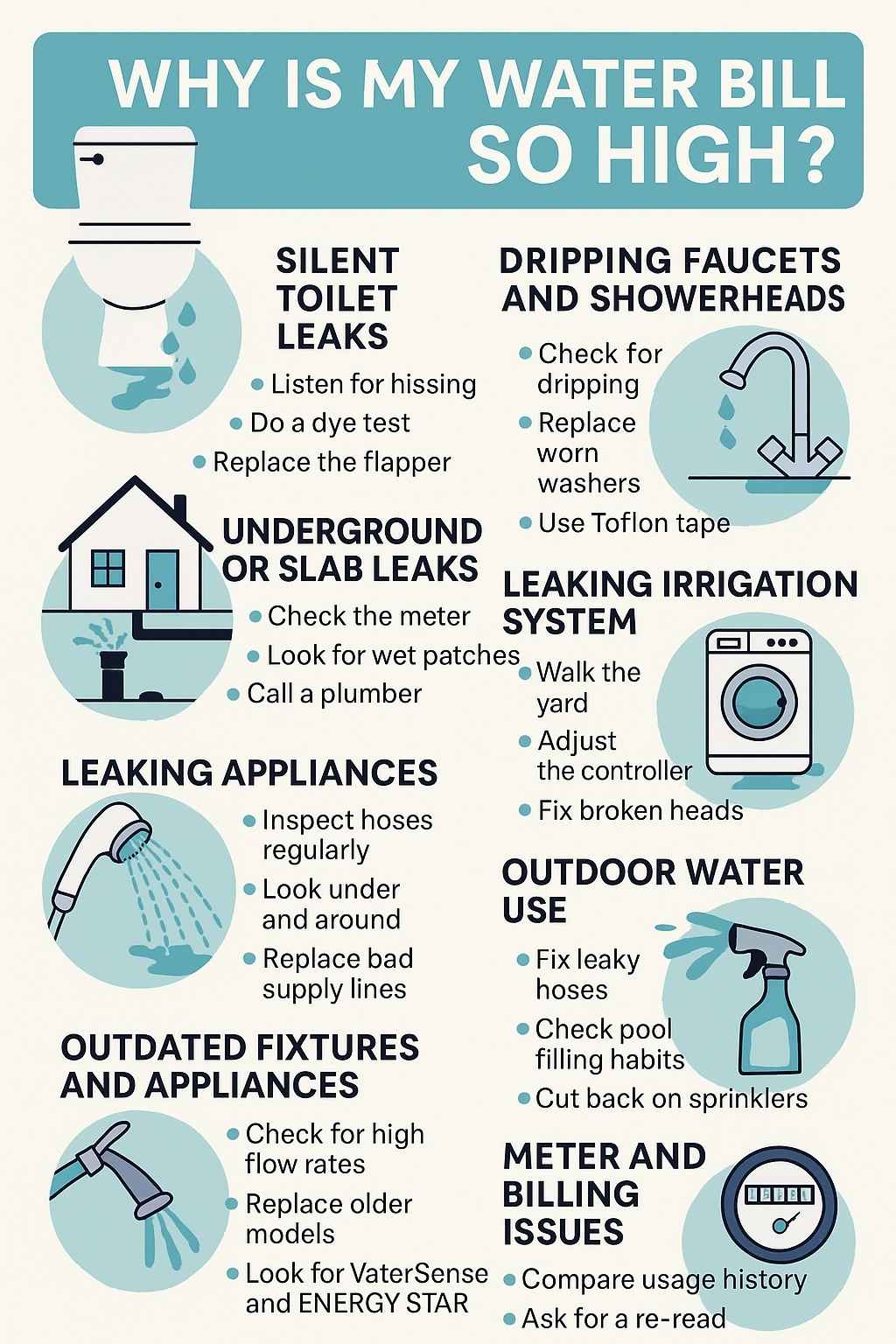
If you’re trying to quickly pinpoint why your water bill is so high, these are the most common hidden culprits:
- Silent toilet leaks
- Dripping faucets and showerheads
- Underground or slab leaks in your service line
- Leaky or overwatering irrigation systems
- Quiet appliance leaks (washer, dishwasher, fridge line)
- A leaking or overworking water heater
- Water softeners and filters are regenerating too often
- Old, water-guzzling fixtures and appliances
- Lifestyle changes at home, you didn’t connect to the bill
- Outdoor hoses, pools, and backyard water habits
- Meter errors, estimated bills, and rate hikes
- Aging infrastructure and “your side vs. city side” leaks
Let’s start with the basics: how your bill actually works, and what counts as “normal” versus suspicious.
How Water Bills Really Work – So You Can Spot a Problem
Before you can answer “why is my water bill so high?”, it helps to understand what you’re looking at.
Most U.S. utilities charge for water using:
- A base service fee (just to be connected)
- A usage fee, based on gallons or cubic feet
- Sometimes, tiered pricing, where higher usage is charged at a higher rate
Many people only glance at the total amount due, but the key number is your usage. That’s what tells you whether you truly used more water or whether something else changed.
Like:
- A rate increase
- A change in fees or taxes
- A different billing period length
A smart first move is to grab your last 6–12 bills and compare:
- Usage this month vs. same month last year
- Usage this month vs. the last few months
- Not just dollars, but units of water (gallons or cubic feet)
If your usage is up sharply but nothing in your routine has changed, that’s a sign you’re dealing with one of the hidden causes below.
1. Silent Toilet Leaks – The 01 Hidden Water Waster
When homeowners ask, “Why is my water bill so high all of a sudden?” one of the first places professionals look is the toilet.
Toilets can leak in ways that are almost completely silent:
- A worn or warped flapper that doesn’t seal properly
- A fill valve that doesn’t shut off all the way
- The tank water level is set too high, so it’s constantly running into the overflow tube
Even a small, slow leak can waste hundreds of gallons a month. A more serious leak can waste thousands.
How to spot it
- Listen near the tank: do you hear a faint hiss or trickling sound even when no one has flushed?
- Lift the tank lid: Is water running into the overflow tube?
- Try the food coloring test:
- Put a few drops of food coloring in the tank.
- Wait 15–20 minutes without flushing.
- If colored water appears in the bowl, you leak.
What to do
- Replace the flapper (inexpensive and easy).
- Adjust or replace the fill valve.
- If the toilet is very old and uses a lot of water per flush, consider replacing it with a modern, high-efficiency model.
2. Dripping Faucets and Showerheads That Never Fully Turn Off
It’s easy to ignore a drip — until you see the impact on your bill.
A faucet that drips once every second can waste over 2,000 gallons per year. Multiply that by several sinks or a leaky showerhead, and it’s suddenly a real reason your water bill is unusually high.
How to spot it
- Check every faucet and showerhead in the house, including:
-
-
- Guest bathrooms
- Basement sinks
- Laundry room sinks
-
- Look not just for obvious streams, but for:
-
- Slow, steady drips
- Damp or stained areas under cabinets
What to do
- Tighten or replace faucet handles and cartridges.
- Replace worn washers and O-rings.
- Remove mineral buildup.
- Use Teflon tape on threads if there’s a small leak at the connection.
These are generally low-cost repairs that can noticeably lower a high water bill.
3. Underground or Slab Leaks You Can’t See
Sometimes, the answer to “why is my water bill so high with no visible leak?” is that the leak is happening where you can’t see it: underground.
This can include:
- A leak in the water service line between the meter and the house
- A leak in pipes running under a concrete slab foundation
Because the water soaks into the ground or under the foundation, there may be no obvious indoor signs — even though thousands of gallons are slipping away.
Signs of an underground or slab leak
- Your water meter’s low-flow indicator spins even when all taps and appliances are off
- Wet, soggy, or unusually green patches in the yard
- Cracks in walls or floors that worsen over time
- Warm spots on the floor (if hot water is leaking)
What to do
- Perform a meter test:
-
- Turn off all water in the house.
- Check the meter.
- If it’s still moving, you likely have a leak.
- Call a licensed plumber with leak detection equipment.
- Ask your utility whether you may qualify for a leak adjustment on your bill once the repair is documented.
4. Irrigation System Leaks and Overwatering
Irrigation systems are another major reason water bills suddenly spike, especially in warm climates.
Common issues include:
- Broken or misaligned sprinkler heads
- Underground irrigation line leaks
- Controllers programmed for summer watering schedules all year
- Systems that run in the middle of the night, so no one sees the waste
How to spot it
- Walk your yard right after the system runs:
-
-
- Look for areas with pooling water or soggy soil
- Check for water spraying onto sidewalks, driveways, or the street
-
- Open the irrigation control panel:
-
- Are you watering more days than necessary?
- Are zones running for longer than recommended?
What to do
- Adjust the controller to match the season and your climate.
- Repair or replace damaged sprinkler heads.
- Have a professional inspect the system if you suspect underground leaks.
- Consider adding a rain or moisture sensor so the system doesn’t run when it isn’t needed.
5. Quiet Appliance Leaks – Washer, Dishwasher, and Fridge Lines
Modern homes often have multiple water-using appliances.
Any of them can become a quiet culprit behind a mysterious high water bill.
- Washing machines
- Dishwashers
- Refrigerators with ice makers and water dispensers
Leaks may be small and slow, but they run for long periods and can soak into floors and walls, making them hard to spot at first.
Signs of appliance leaks
- Musty smells around the appliance
- Warped or buckling flooring nearby
- Dampness under or behind the unit
- Sudden increase in the number of loads of laundry or dishwasher cycles
What to do
- Inspect hoses and connections at least once or twice a year.
- Replace old or brittle supply lines with new, reinforced ones.
- If you see signs of damage, call a plumber or appliance technician before the problem grows.
6. A Leaking or Overworking Water Heater
A water heater can waste water in several ways:
- A dripping drain valve
- A leaking temperature and pressure (T&P) relief valve
- Corrosion or cracks in the tank
- Excess sediment buildup causes the heater to work harder
Over time, even small leaks can add up and quietly push your bill higher.
Signs of a water heater problem
- Dampness around the base of the unit
- Rust or mineral streaks down the side
- A discharge pipe that drips regularly
- Popping or rumbling noises from sediment buildup
What to do
- Tighten or replace faulty valves if that’s the source.
- Flush the tank periodically to remove sediment (if the manufacturer recommends it).
- If the tank itself is leaking or heavily corroded, it’s usually time to replace the unit.
A failing water heater is not only a water waste issue, but also an energy and safety concern.
7. Water Softeners and Filters Regenerating Too Often
If your home has a water softener or whole-house filtration system, it may be part of the answer to why your water bill is suddenly so high.
These systems often:
- Regenerate or backwash on a timer, not based on actual usage
- Use a significant amount of water with each regeneration cycle
- Can malfunction, getting stuck in a partial cycle
Signs your softener or filter is wasting water
- The system seems to run or drain more frequently than usual
- You hear it backwashing at odd times
- Higher water bills without obvious household changes
What to do
- Check the programming: make sure regeneration frequency matches your household size and local water hardness.
- Inspect for stuck valves or signs of constant draining.
- Have a professional service the system if it’s old or hasn’t been inspected in years.
8. Old, Water-Guzzling Fixtures and Appliances
Sometimes your water bill isn’t high because of a leak. It’s high because your home still uses outdated, inefficient fixtures.
Examples:
- Old toilets that use 3.5 gallons per flush or more
- Older top-loading washing machines
- Non–low-flow showers and faucets
Modern WaterSense fixtures and ENERGY STAR appliances are designed to use less water dramatically while still doing the same job — or even better.
How older fixtures affect your bill
- Every flush, every shower, every load of laundry draws more water than necessary
- Over a month or a year, that difference is huge
- You pay more for both water and, often, for heating it
What to do
- Check the gallons per flush (GPF) on your toilets.
- Check the gallons per minute (GPM) rating on faucets and showerheads.
- Consider replacing the worst offenders first:
-
- The oldest toilet
- The washing machine
- Any showerhead with a noticeably strong, high-volume flow
Upgrading doesn’t just answer “why is my water bill so high?”—it can permanently lower it.
9. Lifestyle Changes at Home You Didn’t Connect to the Bill
Sometimes the explanation is simple, but easy to overlook.
Your water use — and your bill — will climb if:
- Kids are home for the summer or holidays
- You take in a long-term guest or new roommate
- A family member starts working from home
- Someone adds daily workouts and extra showers
These changes may feel “normal,” so you might not think of them when your water bill is unexpectedly high.
What to do
- Compare your household occupancy and routines month by month.
- Look at water usage per day or per person, not just the bill total.
- If more people are using water, look for savings in:
- Shorter showers
- Full loads in washers and dishwashers
- Turning off the tap while brushing teeth or shaving
10. Outdoor Hoses, Pools, and Backyard Water Habits
Outdoor water use is a major cause of seasonally high water bills in many parts of the U.S.
Common outdoor culprits include:
- Filling or topping up a pool or hot tub
- Running sprinklers and hoses for lawn or garden care
- Washing cars, patios, and driveways frequently
- Leaving a hose or spigot slightly open
- Check hose bibs and outdoor faucets for drips or leaks.
- Pay attention to how often you:
- Fill the pool
- Use sprinklers or manual watering
- Wash vehicles or outdoor surfaces
What to do
- Use pool covers to reduce evaporation.
- Fix or replace leaky hose bibs and connectors.
- Limit car and patio washing, or use more efficient methods.
If your water bill is much higher in summer, outdoor use is a likely factor.
11. Meter Errors, Estimated Bills, and Rate Hikes
Not every high bill is your fault. Sometimes the underlying issue is on the billing side, not the plumbing side.
Three common scenarios:
- Meter reading errors – A manual read may be off, especially if the meter is hard to access.
- Estimated billing – Some utilities estimate usage when they can’t read a meter, then “true up” later.
- Rate increases – Your usage may be steady, but the price per unit of water has gone up.
These situations can easily lead a homeowner to ask, “Why is my water bill so high when I haven’t changed anything?”
What to do
- Compare the usage units (not dollars) on your latest bills.
- Check your utility’s website or bill insert for any rate changes.
- Call the utility and ask:
- Whether your bill was estimated
- Whether they can do a re-read or test your meter
If there’s a significant discrepancy, you may be able to get an adjustment.
12. Aging Infrastructure and “Your Side vs. City Side” Leaks
In many American cities, water pipes are old and under strain. Leaks can occur on either side of the property line.
The tricky part is understanding who is responsible:
- Typically, the city is responsible up to a certain point, often at or near the meter.
- The homeowner is responsible for the line from the meter to the house and all indoor plumbing.
If a leak occurs just past that point, it can cause a very high water bill, and you may be the one required to fix it — even if the leak is in the yard or underground.
What to do
- Ask your utility to clearly explain the responsibility line.
- If they identify a leak on your side, get written documentation; some utilities:
-
- Offer partial bill forgiveness for one-time leaks
- Have hardship or leak adjustment programs after you show proof of repair
Simple DIY Leak Check: A Step-by-Step Guide
If you’re staring at a sudden spike in your water bill and don’t know where to start, use this quick process:
Step 1: Check the meter
-
- Turn off all taps and water-using appliances.
- Make sure toilets aren’t being flushed.
- Go to the water meter: If the low-flow indicator or dial is moving, water is running somewhere.
Step 2: Rule out toilets
- Do the food coloring test on each toilet.
- Listen for running or trickling in the tanks.
- Repair any leaks you find and repeat the meter test.
Step 3: Inspect visible fixtures
- Check all faucets, showerheads, hose bibs, and appliances.
- Look for drips, puddles, stains, or dampness.
Step 4: Consider hidden leaks
- If the meter still moves and you see no obvious leak:
-
- Walk your yard for soggy spots.
- Notice any unusual warm spots on floors.
- Consider calling a plumber for leak detection.
This simple approach can often turn the vague question “Why is my water bill so high?” into a specific issue you can address.
What Is a “Normal” Water Bill for an American Household?
There’s no single “right” number because water costs and usage vary widely. But understanding general patterns helps you decide if your bill is truly high.
Typical usage patterns:
- Many American households use tens of thousands of gallons per year, often around a few hundred gallons per day for a family.
- Larger families, big yards, and hot climates can push that number higher.
How to tell if your bill is really high
Compare your per-month usage to: Last year’s same month and your city’s average, if available
Look for:
- Steady climbs over several months
- Sudden spikes from one bill to the next
If your usage is far above similar months in previous years, it’s worth investigating.
When to Call a Plumber vs. When to Call the City
You don’t have to solve every problem alone. Knowing who to call can save time and money.
Call a licensed plumber if:
- The meter indicates a leak, but you can’t find it
- You suspect a slab leak or an underground leak on your property
- Toilets keep running even after basic repairs
- Your water heater or softener appears to be leaking or malfunctioning
A professional can perform specialized tests and give you a written report, which is often helpful if you seek a bill adjustment.
Call the city or utility if:
- Your bill is unusually high, but your usage habits haven’t changed
- You think the meter reading is incorrect
- You want to know if there has been a rate increase
- There’s visible water in the street or near the main line
Ask whether they:
- Offer free leak inspections or meter tests
- Provide leak forgiveness or partial credits after repairs
FAQs: Quick Answers to Common High Water Bill Questions
Why is my water bill suddenly so high?
A sudden spike often points to:
- A toilet or faucet leak
- An irrigation system problem
- An underground or slab leak
- A major one-time use, like filling a pool
- A meter error or rate change
Start by checking your meter, toilets, and visible fixtures, then move on to irrigation and hidden leaks.
Why is my water bill so high with no visible leak?
If you don’t see any drips or puddles, the problem may be:
- A silent toilet leak
- A small leak in an appliance hose
- A hidden underground line leak
- A water softener that’s regenerating too often
Use the meter test to confirm whether water is running when everything appears off.
Can a small leak really double my water bill?
Yes. A steady, slow leak running 24/7 can waste thousands of gallons a month. Because it happens quietly over time, you may not notice until your bill jumps.
How long does it take for a leak to show up on my water bill?
Most utilities bill monthly or every other month. A leak that starts right after your last reading might go unnoticed until the next cycle — so a problem that’s only a few weeks old can still cause a surprisingly high water bill.
What’s the fastest way to lower my water bill this month?
- Fix any obvious leaks (especially toilets and faucets).
- Shorten showers and run full loads in the washer and dishwasher.
- Dial back irrigation schedules and check for broken sprinkler heads.
- Look at your meter regularly to catch new leaks early.
Take Back Control of Your Water Bill
A high water bill doesn’t have to stay a mystery. Once you understand the real reasons behind why your water bill is so high, you can move from guessing to taking action.
Start with:
- A quick meter check
- A careful look at toilets, faucets, and appliances
- A review of your irrigation and outdoor use
Then, if needed, bring in your utility or a professional plumber to locate hidden leaks and help you fix them.
Small steps — like repairing a silent toilet leak or adjusting a sprinkler schedule — can translate into real savings month after month. And instead of dreading the next envelope from the utility, you’ll know you’ve done what you can to keep both water usage and costs under control.