
Ever feel like you are grinding for XP in a game, putting in hours of effort, but your level bar just won’t budge? This all the time in the tech and gaming world. You work hard. You try again. Yet, the results stay the same. This is where the popular “Growth Mindset” Myth or idea often hits a glitch. The concept claims that believing you can improve is the key to success. It sounds great on paper.
Teachers love it. CEOs love it. I see it constantly in developer manifestos and game design logic. But here is the catch: Recent data shows that this “magic pill” might actually be hurting progress. Some studies even suggest that poorly taught growth mindset lessons can set students back by months.
If you think effort alone is the answer, you might be playing a rigged game. Real success requires more than just grit; it needs the right cheat codes—strategy, resources, and system awareness. Walk you through why “just believing” isn’t enough and show you the exact upgrades you need for your own operating system.
What Is a Growth Mindset?
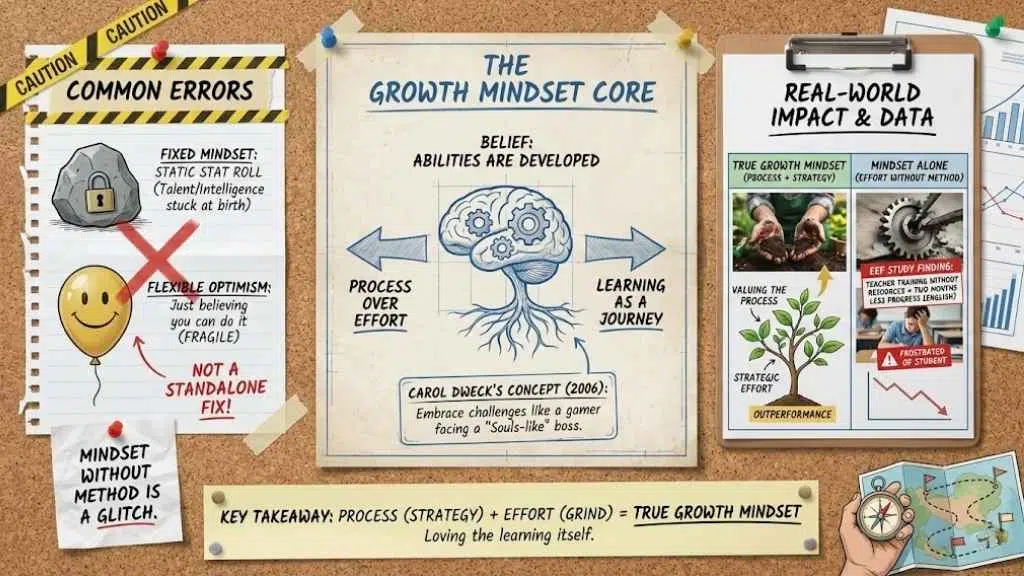
At its core, a growth mindset is the belief that your basic abilities can be developed through dedication and hard work. It is the opposite of a “fixed mindset,” where you assume your talent or intelligence is a static stat roll you are stuck with at birth.
Psychologist Carol Dweck popularized this concept in her 2006 book, Mindset: The New Psychology of Success. She argued that students who embrace challenges—like a gamer tackling a “Souls-like” boss—outperform those who give up easily.
However, this definition often gets corrupted in the real world.
“The most common error is confusing growth mindset with flexible optimism. It is not just about believing you can do it; it is about loving the process of learning itself.” — Standard Definition Analysis
The problem arises when schools or companies treat it as a standalone fix. A major study by the Education Endowment Foundation (EEF) revealed a shocking statistic: in one trial where teachers received growth mindset training without adequate student resources, pupils actually made two months less progress in English compared to the control group.
This data proves that mindset without method is just a glitch in the system. A true growth mindset values the process (the strategy), not just the effort (the grind).
The Appeal of the Growth Mindset Concept
Why did this idea go viral? Because it feels like a universal patch for human potential. We want to believe that if we just try harder, we can unlock any achievement.
In the corporate world, this shift has been massive. Satya Nadella, the CEO of Microsoft, famously transformed the company culture from “know-it-alls” to “learn-it-alls.” Since he implemented this growth-focused philosophy in 2014, Microsoft’s market cap skyrocketed from around $300 billion to over $2.5 trillion. That is the kind of ROI that makes everyone pay attention.
But there is a fine line between healthy growth and toxic positivity. In gaming, we call it the difference between “fair difficulty” and “artificial difficulty.”
| Healthy Growth Mindset | Toxic “Grind” Mindset |
|---|---|
| “I need a better strategy to beat this level.” | “I just need to play faster and harder.” |
| Values feedback and patch notes. | Ignores warnings and repeats mistakes. |
| Acknowledges system bugs (inequality). | Blames the player for every loss. |
The appeal is dangerous when it masks the lack of resources. If a student—or an employee—is failing because they lack the right tools, telling them to “adopt a growth mindset” is like telling a gamer to win a match with a broken controller.
Common Myths About Growth Mindset
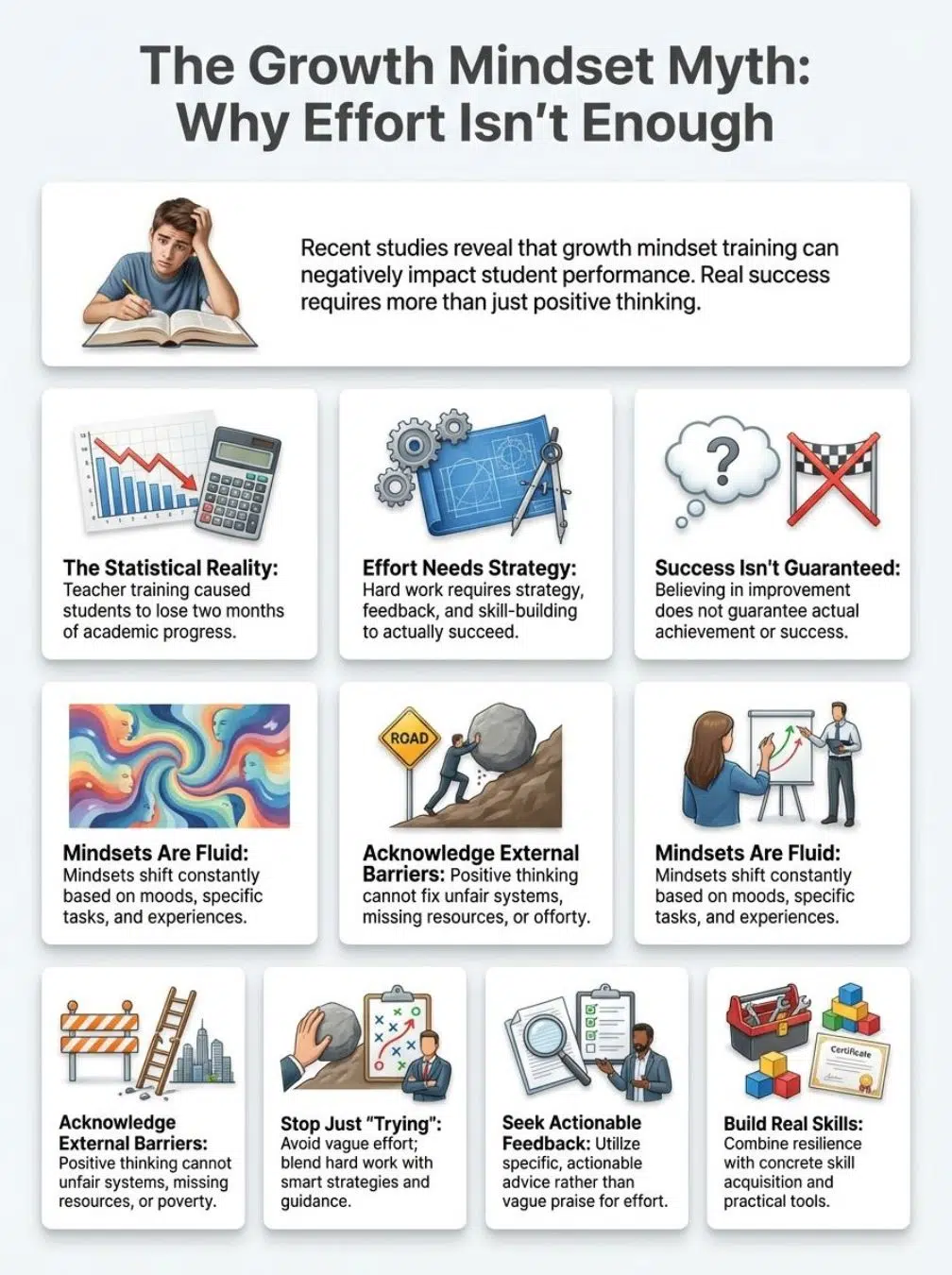
You have likely heard the buzzwords, but the reality is often different. Let’s debug the most common myths that keep people stuck.
Myth #1: It’s all about effort
This is the most damaging misconception. Hard work is useless if your strategy is flawed. If you are running into a wall, running harder won’t open a door.
Carol Dweck herself coined the term “False Growth Mindset” to describe this. It happens when educators or managers praise effort even when the outcome is poor and no learning took place. This is “participation trophy” logic.
Real growth requires what researchers call “deliberate practice.” You don’t just “try”; you analyze your error logs, adjust your inputs, and execute a new plan.
Myth #2: A growth mindset guarantees success
Many believe that the right attitude is a golden ticket. The data says otherwise. A massive meta-analysis by Sisk et al. (2018) examined over 270 studies and found the correlation between growth mindset and academic achievement was extremely weak (r = 0.10).
That is a statistically tiny effect. It means that while mindset helps, it is a very small piece of a much larger puzzle involving resources, talent, and environment.
Myth #3: You either have it or you don’t
We tend to label people as “Fixed” or “Growth” types, like selecting a character class in an RPG. In reality, everyone exists on a continuum.
You might have a growth mindset about your gaming skills (believing you can master Elden Ring) but a fixed mindset about math (“I’m just not a numbers person”). Dweck clarifies that we all have “fixed mindset triggers”—specific situations that make us defensive or insecure.
Myth #4: A growth mindset applies to every skill
There are hardware limits. No matter how much I believe in my ability to fly, I cannot flap my arms and take off. Biology and physics set hard caps.
The myth suggests that anyone can become anything. This ignores natural aptitude. While anyone can improve at coding or basketball, not everyone can become the next Steve Wozniak or LeBron James. Ignoring these limits leads to burnout, not breakthroughs.
Why the Science Behind Growth Mindset Is Controversial
The scientific community has started to push back against the hype. The “Replication Crisis” in psychology has hit mindset theory hard, questioning if the results are as robust as we once thought.
Limited impact on academic performance
We mentioned the EEF study earlier, but it bears repeating. When interventions fail to produce results—or worse, lead to a drop in performance—we must question the method.
Research by “Timothy Bates” at the University of Edinburgh found that the effects of mindset interventions are often non-existent once you control for other factors like intelligence and personality. Hard work helps, but it cannot override a lack of foundational skills or poor instruction.
Overgeneralization of results
A study that works in a small lab at Stanford doesn’t always scale to a public school in Chicago. The context matters.
- The Lab vs. Reality: In controlled environments, encouraging words work. In chaotic real-world settings, they get drowned out.
- The “Effect Size” Problem: The Sisk (2018) study showed that the average impact of mindset interventions on grades was nearly zero for typical students.
Misinterpretation of principles
Teachers and managers often weaponize the concept. Instead of teaching strategy, they use “growth mindset” as a way to shift blame onto the learner.
If a student fails, the system can say, “You just didn’t have a growth mindset,” rather than asking, “Did we teach this effectively?” This creates a cycle of guilt rather than a path to improvement.
The Risks of Overemphasizing Growth Mindset
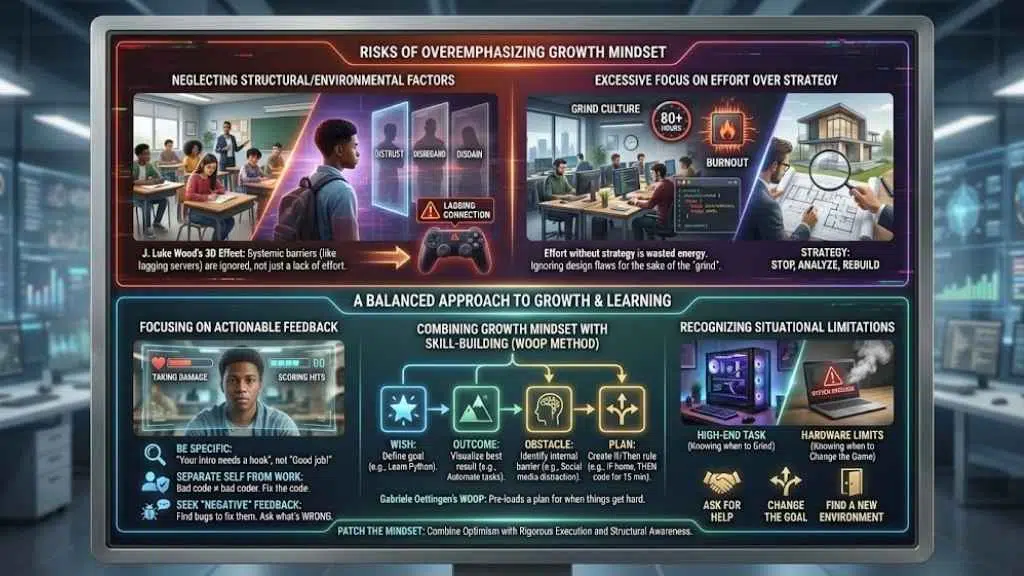
Focusing only on the mental game can blind us to the physical barriers in the level design.
Neglecting structural and environmental factors
This is where the critique gets serious. J. Luke Wood, a professor at San Diego State University, argues that telling students of color to just “have a growth mindset” can be a form of gaslighting. He describes a “3D Effect”—Distrust, Disregard, and Disdain—that these students face from educators.
If a student is facing systemic bias (the “Distrust”), simply telling them to have more grit ignores the reality of their environment. It’s like telling a player to “git gud” when the game server is lagging. The effort isn’t the problem; the infrastructure is.
Excessive focus on effort over strategy
When we glorify the “grind,” we encourage burnout. I see this in tech crunch culture all the time.
Developers work 80-hour weeks (effort) to fix a buggy product that was fundamentally flawed in the design phase (strategy). A true growth mindset would stop the grind, analyze the architecture, and rebuild the system. Effort without strategy is just wasted energy.
A Balanced Approach to Growth and Learning
So, do we delete the growth mindset concept? No. We patch it. We need to combine optimism with rigorous execution.
Focusing on actionable feedback
Feedback is the HUD (Heads-Up Display) of real life. It shows you where you are taking damage and where you are scoring hits.
For feedback to work, it must be actionable. Don’t tell yourself “I need to do better.” Tell yourself, “I need to fix the syntax error in line 40.”
- Be Specific: Vague praise (“Good job!”) is useless. Specific critique (“Your introduction needs a stronger hook”) is valuable.
- Separate Self from Work: A coding error doesn’t mean you are a bad coder; it means the code is bad. Fix the code.
- Seek “Negative” Feedback: In game testing, we look for bugs. In life, ask people to tell you what is wrong so you can fix it.
Combining growth mindset with skill-building
You need a framework that connects your wish to a plan. The best tool for this is the WOOP Method, developed by psychologist Gabriele Oettingen.
- Wish: Define a specific, challenging goal. (e.g., “I want to learn Python.”)
- Outcome: Visualize the best result. (e.g., “I will automate my boring data entry tasks.”)
- Obstacle: Identify the internal thing holding you back. (e.g., “I get distracted by social media after work.”)
- Plan: Create an “If/Then” rule. (e.g., “If I get home from work, then I will immediately open my code editor for 15 minutes.”)
This method doesn’t just rely on hope; it pre-loads a script for when things get hard.
Recognizing situational limitations
Finally, know your hardware limits. If you are trying to run a high-end game on a budget laptop, you will crash. Similarly, recognize when you need outside help.
If you are struggling because of a lack of money, time, or support, the answer isn’t always “try harder.” It might be “ask for help,” “change the goal,” or “find a new environment.” True resilience is knowing when to grind and when to change the game entirely.
Final Thoughts
The Growth Mindset is not a myth, but the way we use it is often mythical. Believing in yourself is the starting line, not the finish line. As we have seen, blind faith in effort can actually set you back—whether it is the “two months lost” in the classroom or the burnout of a crunch-time developer.
You need to upgrade your approach. Swap out “I just need to try harder” for “I need a better strategy.” Use tools like WOOP to build a bridge between your goals and your reality. And never forget that sometimes, the game is bugged, and calling it out is the smartest move you can make. Real growth isn’t about ignoring your limits. It’s about understanding them so you can break through them efficiently.