You know the feeling. You walk through a downtown corridor on a mid-July afternoon, and the heat radiating off the concrete feels intense enough to bake bread. It is the classic “urban heat island” effect, where our cities turn into ovens because we have paved over everything that used to breathe.
But recently, I have noticed a shift. Look up in cities like Chicago, Seattle, or New York, and you will see the gray retreating. Developers and city planners are finally realizing that nature is not just decoration. It is infrastructure.
This is where green roofs and living walls come in. They are not just about making a building look good for a brochure. From what I have seen in the field, they are practical, hardworking systems that solve real problems like stormwater flooding and skyrocketing energy bills. In this guide, I will walk you through exactly how these systems work, the data behind their benefits, and the specific installation factors you need to consider before you greenlight a project.
Let’s look at how you can turn that unused vertical and horizontal space into an asset.
What Are Green Roofs and Living Walls?
At their core, these are engineered systems that allow vegetation to grow on building surfaces that would otherwise be barren. While they share a mission—bringing life back to the concrete jungle—they function very differently structurally and hydraulically.
Definition and Key Features
A green roof is essentially a contained ecosystem built on top of a human-made structure. It is not just “dirt on a roof.” It is a precise layering of high-quality waterproofing, a root repellent system, drainage mats, and a specialized lightweight growing medium. For example, the massive 2.5-acre green roof at the Javits Center in New York City acts as a sanctuary for area wildlife while absorbing millions of gallons of rainwater annually.
Living walls, often called vertical gardens, are more complex. They defy gravity. These are panels of plants grown vertically, either attached to the building facade or standing as independent structures. A famous example is the Amazon Spheres in Seattle, where the “The Canyon” living wall spans 4,000 square feet and hosts over 25,000 plants. These systems require active irrigation and specialized support to keep plants alive without soil depth.
Both systems work as natural shields. They cool the air through evapotranspiration, absorb noise from busy streets, and filter pollutants like Particulate Matter (PM2.5) out of the air you breathe.
Differences Between Green Roofs and Living Walls
While both add greenery, the logistics of installing them are night and day. If you are trying to decide which route to take, this comparison of 2025 market standards will help clarify the choice.
| Feature | Green Roofs | Living Walls |
|---|---|---|
| Location | Flat or slightly sloped rooftops (typically 2% to 30% slope). | Vertical interior or exterior walls. |
| Estimated Cost (US) | $10 – $30 per sq. ft. (Extensive) $25 – $50+ per sq. ft. (Intensive) |
$100 – $175+ per sq. ft. (Installation is significantly more labor-intensive). |
| Maintenance Needs | Low to Moderate. (Approx. $0.50 – $1.00/sq. ft. per year). | High. Requires regular pruning and irrigation checks (Approx. $10 – $20/sq. ft. per year). |
| Main Functions | Stormwater management (retains 50-80% of rainfall), insulation, and roof membrane protection. | Visual impact, air purification, and noise reduction (dampens sound transfer). |
| Structural Load | 15 – 30 lbs/sq. ft. (Extensive) 80+ lbs/sq. ft. (Intensive) |
Requires reinforced wall anchors to support saturated weight (approx. 10-15 lbs/sq. ft. vertical load). |
| Ecological Impact | Creates nesting ground for ground-nesting birds and pollinators. | Supports insects and biodiversity in vertical “canyons.” |
Environmental Benefits of Green Roofs and Living Walls
The aesthetic upgrade is obvious, but the environmental performance is where the real value lies. These systems act as a buffer between your building and the elements, providing services that mechanical systems simply cannot match.
Improved Air Quality
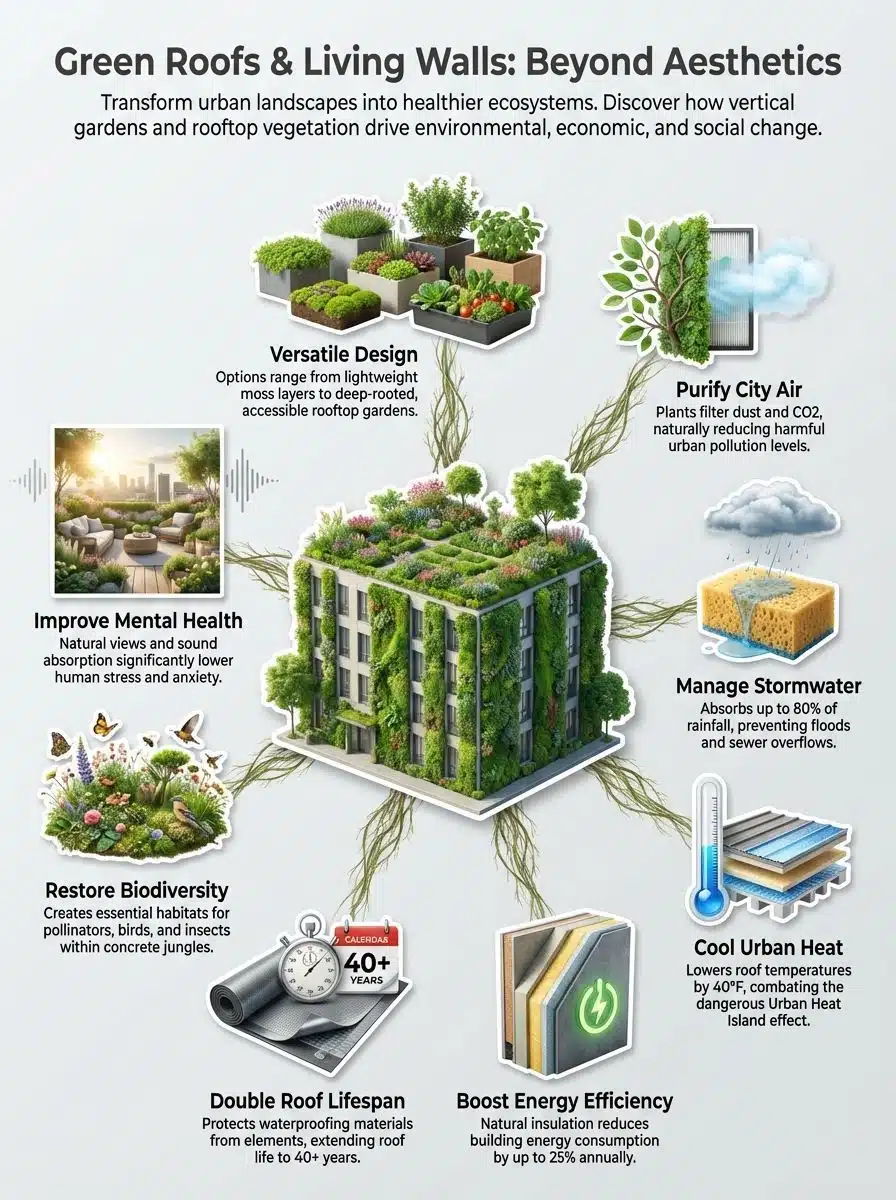
Cities are often choked with dust and exhaust. Plants are a natural filter. Research shows that living walls can reduce particulate matter (PM2.5) levels by up to 60% in the immediate street canyon. The leaves trap dust particles, while the plants absorb carbon dioxide and release oxygen.
In high-traffic areas, this is critical. A study involving green infrastructure near highways found that vegetation barriers could reduce air pollution concentration significantly for nearby residents. Roots and soil microbes also break down certain airborne toxins, turning your building envelope into an active air purifier.
Stormwater Management
This is arguably the biggest driver for green roofs in the US right now. In cities with combined sewer systems, like New York and Philadelphia, heavy rains cause sewage to overflow into waterways. A green roof acts like a sponge.
According to the EPA and GSA, a well-designed green roof can retain 50% to 80% of annual rainfall. It holds this water in the growing medium and releases it slowly through evaporation. This prevents the “flash flood” effect that overwhelms city drains. It is so effective that many municipalities offer tax credits or grant funding specifically for this benefit.
Reduction of Urban Heat Island Effect
Traditional black tar roofs can reach temperatures of 150°F or higher on a summer day. They absorb that heat and radiate it back into the city at night, keeping neighborhoods dangerously hot.
Green roofs flip this dynamic. By shading the roof surface and cooling the air through evapotranspiration, they can keep rooftop temperatures 30 to 40 degrees cooler than conventional roofs. If adopted widely, this could lower ambient city temperatures by up to 5°F, massive news for climate adaptation strategies.
Economic Advantages
I always tell clients to look past the initial sticker price. When you factor in the lifecycle costs, green infrastructure often pays for itself by protecting the building and lowering operating expenses.
Energy Efficiency and Reduced Heating/Cooling Costs
Think of a green roof as a thick winter blanket for your building. In the summer, it prevents solar heat from transferring inside. In the winter, it traps heat. The National Research Council of Canada found that an extensive green roof reduced the daily energy demand for air conditioning by over 75%.
For a typical 2-3 story building, this translates to noticeable savings on utility bills. You are not just saving money. You are also reducing the load on your HVAC equipment, which means it will likely last longer before needing replacement.
Extended Lifespan of Building Roofing Materials
This is the hidden ROI that most people miss. UV radiation and extreme temperature fluctuations are what destroy a roof membrane. A standard roof expands and contracts all day, eventually cracking and leaking after 15 to 20 years.
A green roof covers that membrane completely. It stays at a relatively constant temperature, protected from the sun and physical damage. The GSA estimates that green roofs can last 40 years or more—effectively double the life of a traditional roof. When you calculate the cost of not having to replace your roof in 2040, the math starts to look very good.
Social and Aesthetic Impacts
Beyond the spreadsheets, these installations change how people feel about a space. There is a reason tech companies like Amazon and Google are installing massive living walls in their headquarters.
Enhanced Urban Biodiversity
We are losing habitat at an alarming rate, but rooftops can help bridge the gap. In San Francisco, the SFMOMA living wall utilizes 21 native plant species specifically to support local pollinators. These spaces become “stepping stones” for bees, butterflies (like the migrating Monarch), and birds to move safely across the city.
Even a small rooftop garden adds to this network. By choosing native plants like milkweed or sedum, you are directly supporting the local food web.
Mental Health and Well-being Boost
We have an innate connection to nature called “biophilia.” Studies have consistently shown that looking at greenery lowers cortisol levels (stress) and improves concentration. In an office setting, visible greenery can increase productivity by 15%.
It acts as a visual break. Instead of staring at a brick wall, you are watching leaves rustle or flowers bloom. It absorbs noise, too, making the acoustic environment of a bustling city more bearable.
Improved Visual Appeal of Buildings
Let’s be honest: concrete is boring. A living wall turns a facade into a work of art. The “GardenHouse” in Beverly Hills is a prime example, looking more like a hillside village than a residential block. This curb appeal translates to higher property values. Tenants are willing to pay a premium for buildings that offer access to green space and cleaner air.
Types of Green Roofs
One size does not fit all. The industry classifies green roofs into three main categories based on soil depth and maintenance needs.
Extensive Green Roofs
This is the workhorse of the industry. Extensive roofs have a shallow growing medium, usually just 2 to 6 inches deep. They are designed to be lightweight (15-30 lbs/sq. ft.) and low maintenance.
- Best For: Large commercial roofs, retrofits on older buildings, and stormwater management.
- Plant Choice: Tough, drought-resistant plants like Sedum, succulents, and mosses.
- Maintenance: Minimal. Usually requires weeding and inspection once or twice a year.
Because they are lighter and cheaper to install ($10-$30/sq. ft.), these make up the majority of green roofs in the US. They are not meant for walking on, but they do an excellent job of protecting the roof and holding rainwater.
Intensive Green Roofs
If you want a park on your roof, this is it. Intensive roofs have deep soil (6 inches to several feet) and can support lawns, shrubs, and even small trees.
- Best For: Amenity spaces, rooftop bars, and high-end residential buildings where people will access the roof.
- Plant Choice: Almost anything, including perennials, grasses, and trees.
- Maintenance: High. It requires irrigation, mowing, and regular gardening just like a park on the ground.
The trade-off is weight and cost. You need a building capable of supporting 80 to 150+ lbs/sq. ft., and installation costs can easily exceed $50 per square foot.
Semi-Intensive Green Roofs
As the name suggests, this is the middle ground. With soil depths of 6 to 10 inches, you can grow a wider variety of plants than an extensive roof without the massive structural weight of an intensive one.
“Semi-intensive roofs are often the ‘Goldilocks’ solution for clients who want visible biodiversity—like wildflowers and ornamental grasses—without the heavy maintenance of a full garden.”
These systems are perfect for visible roofs that are not necessarily for public access but need to look lush and vibrant year-round. They offer better stormwater retention than extensive roofs and better biodiversity potential.
Key Considerations for Implementation
Before you order a single plant, you need to do your homework. I have seen projects stalled because these foundational steps were skipped.
Structural Requirements
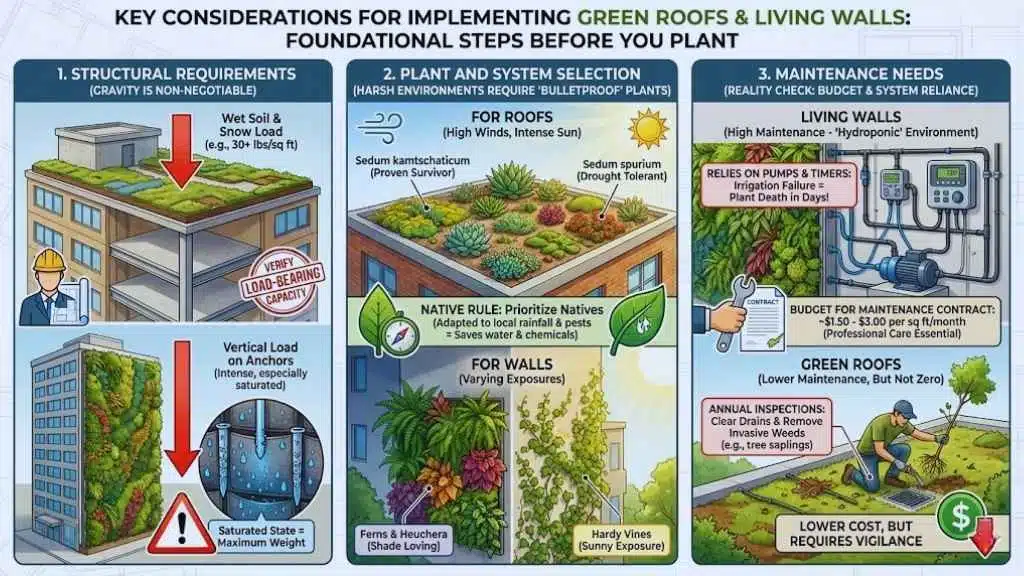
Gravity is non-negotiable. Wet soil is heavy, and snow is even heavier. You must hire a structural engineer to verify your building’s load-bearing capacity. For a simple extensive roof, you might need to support an additional 30 pounds per square foot. For a living wall, the vertical load on the anchors is intense, especially when the felt or soil pockets are fully saturated.
Plant and System Selection
You cannot just plant whatever you like. The roof of a 10-story building is a harsh environment with high winds and intense sun. You need “bulletproof” plants.
- For Roofs: Stick to Sedum varieties (like Sedum kamtschaticum or Sedum spurium) which are proven survivors in US climates.
- For Walls: Ferns and Heuchera work well in shade, while hardy vines are better for sunny exposures.
- Native Rule: Always prioritize natives. They are adapted to your local rainfall and pests, saving you money on water and chemicals.
Maintenance Needs
Here is the reality check: living walls are high maintenance. Unlike a green roof that can largely take care of itself, a living wall creates a “hydroponic” environment that relies on pumps and timers. If the irrigation fails, the plants can die in days.
Budget for a maintenance contract. For a living wall, expect to pay around $1.50 to $3.00 per square foot per month for professional care. Green roofs are much cheaper to maintain, but they still need annual inspections to clear drains and remove invasive weeds (like tree saplings dropped by birds).
Final Thoughts
Green roofs and living walls are powerful tools that do more than just beautify our skyline. They cool our cities, clean our air, and manage the stormwater that threatens our infrastructure. Whether you are looking at a simple Sedum mat to extend your roof’s life or a lush living wall to transform a lobby, the technology is proven and ready.
Start by checking your local incentives—cities like New York and Washington D.C. have programs that can help offset the cost. Then, consult with a structural engineer to see what is possible for your building. The transition from gray to green is easier than you think, and the payoff lasts for decades.