Why is this significant right now? In a volatile 2026 economic landscape, CBRE Investment Management’s decision to maintain steady monthly distributions for its flagship real estate and infrastructure funds (IGR and MEGI) acts as a critical stabilizing signal.
It underscores a broader market bifurcation where “green” and sustainable assets are proving to be the primary drivers of resilient income, separating high-quality ESG-compliant portfolios from the “brown” assets increasingly at risk of obsolescence.
Key Takeaways
- Distribution Stability: CBRE’s Global Real Estate Income Fund (IGR) and Global Infrastructure Megatrends Term Fund (MEGI) declared consistent monthly distributions for Q1 2026 ($0.06 and $0.125/share respectively), defying fears of income compression.
- The “Green Premium” is Real: Sustainable funds outperformed traditional counterparts in 2H 2025, driven by regulatory tailwinds and tenant demand for energy-efficient buildings.
- Interest Rate Pivot: The stabilizing payouts reflect optimism surrounding recent Federal Reserve rate cuts, which are expected to lower borrowing costs and boost REIT valuations in 2026.
- Liquidity Focus: Fund managers are increasingly utilizing “liquidity solutions” like NAV financing to maintain payouts without forced asset sales, a trend defining 2026 fund management.
The Evolution of Sustainable Income: How We Got Here
To understand the weight of CBRE’s January 2026 announcement, we must look at the turbulence of the preceding 24 months. The period from 2024 to early 2025 was defined by aggressive interest rate hikes that disproportionately punished real estate investment trusts (REITs). High borrowing costs compressed capitalization rates (cap rates), eroding property values and threatening dividend sustainability.
However, a divergence emerged. Funds heavily weighted toward “future-proof” assets—green office buildings, data centers with renewable energy sourcing, and resilient infrastructure—maintained occupancy and rental growth. By late 2025, a clear “Brown Discount” had settled over older, non-compliant properties, while “Green” assets commanded premium valuations.2 CBRE’s ability to declare steady distributions in January 2026 is not just a financial calculation; it is a validation of a strategy that prioritizes high-quality, ESG-aligned real assets that can weather macro-economic storms.
The Strategic Resilience of Green Funds
1. The Stability Signal in a Polarized Market
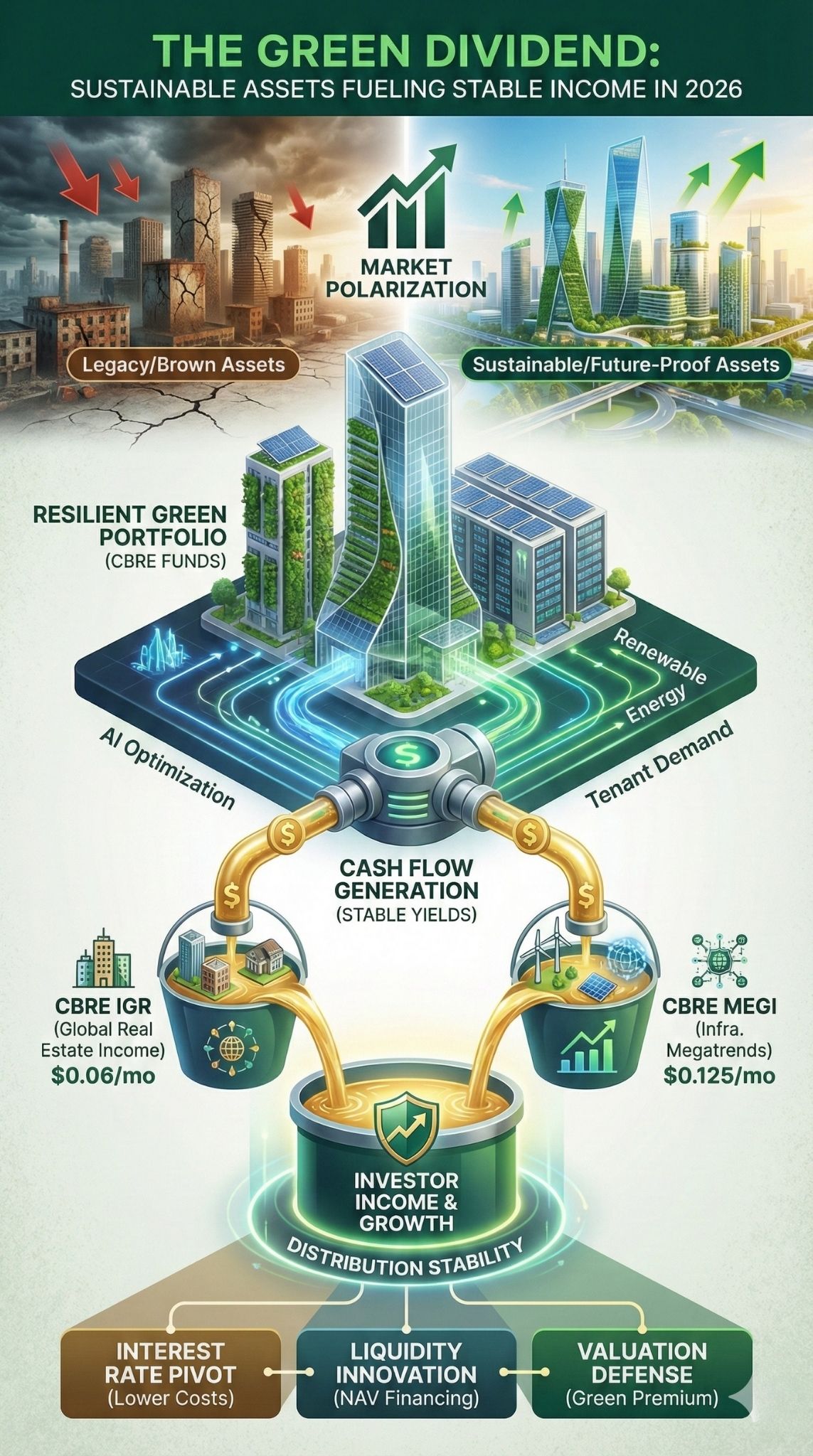
The declaration of a $0.06 per share monthly distribution for the CBRE Global Real Estate Income Fund (IGR) and $0.125 for the Infrastructure Megatrends Fund (MEGI) offers a “safe harbor” narrative to investors.3 In 2026, the real estate market is characterized by fundraising polarization. Capital is concentrating among top-tier managers who can demonstrate liquidity and operational resilience.
By maintaining these payouts, CBRE is signaling that its underlying portfolio—rich in data centers, logistics, and next-gen infrastructure—is generating sufficient cash flow. This contrasts sharply with mid-market funds that are currently struggling with redemption queues and forcing asset firesales.
2. The “Green” Imperative: From Niche to Survival
The term “Green Real Estate Fund” has morphed from a marketing label to a strict financial classification. European regulations (SFDR) and global tenant mandates mean that Class B and C office spaces (often older, energy-inefficient buildings) are becoming “stranded assets.”
- Tenant Demand: Top-tier tenants (tech, finance) now require net-zero buildings for their own compliance reporting.
- Valuation Defense: Green certifications (LEED Platinum, BREEAM) are acting as a floor for asset values, preventing the drastic write-downs seen in the broader commercial office sector.
CBRE’s MEGI fund, specifically focused on “Megatrends” like decarbonization and digital infrastructure, exemplifies this. Its payouts are supported by the steady, inflation-linked cash flows of renewable energy assets and power grids, which are far less cyclical than traditional commercial leases.
3. The Macro Pivot: Interest Rates & 2026 Optimism
The backdrop to this news is the Federal Reserve’s dovish turn. With two rate cuts recorded in late 2025 and more expected in 2026, the cost of leverage for real estate funds is falling.4 This creates a “double boost” for funds like IGR:
- Lower Interest Expense: enhancing distributable cash flow.
- Yield Compression: As bond yields fall, the 11-15% annualized yield offered by these funds becomes increasingly attractive, driving price appreciation in the fund shares themselves.
Data & Visualization: The 2026 Real Estate Landscape
To visualize the divergence in the market, the following tables break down the distribution specifics and the broader “Winners vs. Losers” dynamic in the current real estate economy.
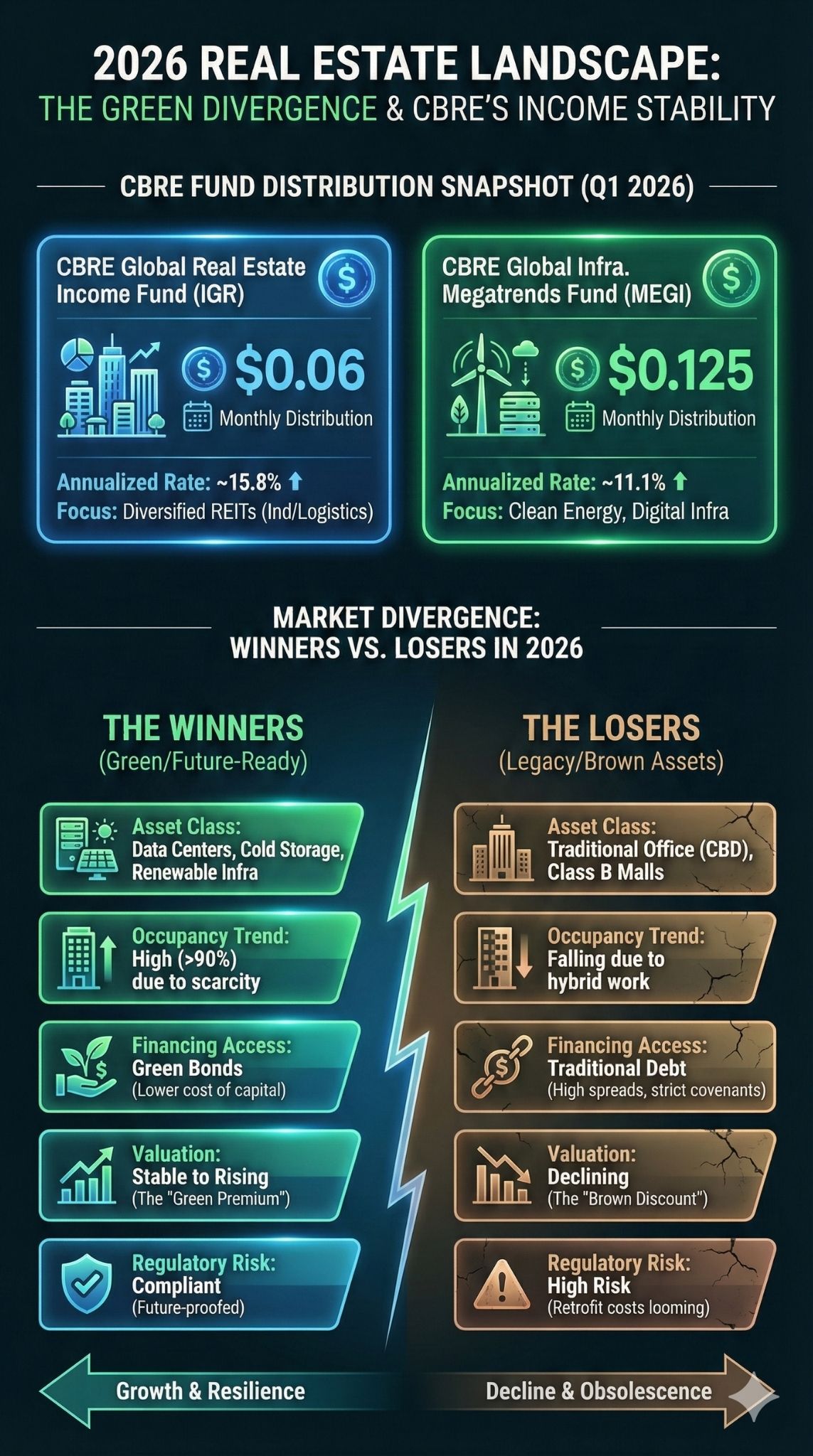
CBRE Fund Distribution Schedule (Q1 2026):
A snapshot of the income stability declared in the recent announcement.
| Fund Name | Ticker | Distribution per Share (Monthly) | Annualized Rate (Est.) | Primary Focus |
| Global Real Estate Income Fund5 | IGR6 | $0.067 | ~15.8%8 | Diversified REITs (Ind/Logistics)9 |
| Global Infra. Megatrends Fund | MEGI | $0.125 | ~11.1% | Clean Energy, Digital Infra |
Annualized rates based on closing prices as of early Jan 2026. Note that yields move inversely to share price.
Market Divergence – Winners vs. Losers in 2026:
Why “Green” strategies are outperforming traditional approaches.
| Feature | The Winners (Green/Future-Ready) | The Losers (Legacy/Brown Assets) |
| Asset Class | Data Centers, Cold Storage, Renewable Infra | Traditional Office (CBD), Class B Malls |
| Occupancy Trend | High (>90%) due to scarcity of quality supply | Falling due to hybrid work & inefficiency |
| Financing Access | Green Bonds: Lower cost of capital | Traditional Debt: High spreads, strict covenants |
| Valuation | Stable to Rising (The “Green Premium”) | Declining (The “Brown Discount”) |
| Regulatory Risk | Compliant (Future-proofed) | High Risk (Retrofit costs looming) |
Expert Perspectives: The Bull vs. Bear Case
The Bull Case: The “Great Rebound” Analysts at firms like Morgan Stanley and PwC suggest that 2026 is the year of the “Real Estate Rebound.” They argue that the correction in property values has bottomed out. As evidenced by the “Sustainable Reality” reports, sustainable funds have already begun to outperform traditional funds by over 300 basis points in median returns. Experts believe that as capital floods back into the market seeking yield, it will funnel almost exclusively into ESG-compliant vehicles, driving a sharp repricing of funds like IGR.
The Bear Case: The “Refinancing Wall” Conversely, cautious voices warn that the industry still faces a massive “refinancing wall” of commercial mortgage-backed securities (CMBS) maturing in 2026. While funds like CBRE’s are well-managed, the broader market turmoil could cause contagion. If widespread defaults hit the “brown” office sector, it could dampen sentiment for all real estate equities, regardless of their green credentials. Furthermore, geopolitical instability (deglobalization) remains a top concern for 70% of industry leaders, potentially disrupting cross-border capital flows.10
Future Outlook: What Comes Next?
Looking ahead to the remainder of 2026 and into 2027, three major trends will define the trajectory of these funds:
- Liquidity Innovation: Expect to see more “semi-liquid” structures and the use of NAV financing. Managers will borrow against the net asset value of their portfolios to pay distributions rather than selling assets in a recovering market. This allows them to hold “green” assets until their full value is realized.
- The AI Integration: Real estate funds will increasingly disclose how Artificial Intelligence is being used to optimize energy efficiency in their portfolios. “AI-ready” buildings will become a new asset sub-class, commanding the highest rents.
- Consolidation: The polarization mentioned earlier will lead to M&A. Large, well-capitalized players (like CBRE IM) may acquire smaller, distressed funds that hold good assets but lack the balance sheet to sustain them.
Next Milestone to Watch: Keep a close eye on the Q2 2026 distribution announcements in April. An increase in the payout would signal that the “Green Premium” has fully transitioned from valuation defense to cash-flow offense.