In the freelance world, “Project Manager” is a loaded term. To one client, it means setting up a Trello board and reminding the team to post on Instagram. To another, it means mitigating risk on a $2 million software migration while managing six stakeholders. This discrepancy leads to the most common question I get from freelancers in 2026: “Do I need the prestigious PMP, or is the practical Google Project Management Certificate enough?”
The answer directly impacts your bank account. Choosing the right certification can be the difference between charging $40/hour as a virtual assistant and $150/hour as a strategic consultant. But choosing the wrong one can mean wasting months of study time on theory that your clients will never pay for.
In this guide, we will break down the Google Project Management Certificate vs PMP debate specifically for the freelance economy. We’ll look at the latest 2026 exam updates, the “hidden” stacking strategy, and which badge actually gets you hired on Upwork and LinkedIn.
Key Takeaways
- Google Cert: Practical, Tool-focused (Asana/Trello), Best for VAs/OBMs. Cost: ~$200 total.
- PMP: Strategic, Methodology-focused (Risk/Scope), Best for Enterprise Consultants. Cost: ~$1,000+ total.
- The “Stack”: Use the Google Cert to fulfill the PMP’s 35-hour education requirement.
- 2026 Update: Watch out for the PMP exam change in July 2026; aim to pass before then if possible.
- Income: PMP freelancers typically earn 30-40% more, but require years of proof to get certified.
At a Glance: The Freelancer’s Cheat Sheet
If you are in a rush to decide, here is the verdict based on current market data and freelance rate benchmarks.
| Feature | Google Project Management Certificate | PMP (Project Management Professional) |
| Best For | The Implementer: VAs, OBMs, Marketing Coordinators, and “Doers.” | The Consultant: Interim PMs, Enterprise Consultants, and Strategy Leads. |
| Cost (2025/26) | Low: ~$39–$49/month (Coursera subscription). | High: ~$405–$575 (Exam) + ~$300–$2,000 (Prep materials). |
| Time to Complete | Fast: 3–6 months (often faster if dedicated). | Slow: 3+ months of rigorous study + application audit. |
| Prerequisites | None. | Strict: 36–60 months of verified experience + 35 hours of education. |
| Freelance Value | Practical: Teaches you how to use tools (Asana, Trello) and run meetings. | Strategic: Proves you can manage budgets, risk, and governance. |
The Verdict:
- Choose Google if you want to start billing clients now and need practical skills to organize small teams.
- Choose PMP if you have years of experience and want to break into high-ticket corporate consulting.
The Google Project Management Certificate: The “Practical” Choice
Updated for 2025/2026, the Google Project Management Certificate remains the best entry point for freelancers who want to hit the ground running. It is hosted on Coursera and is less about academic theory and more about doing the work.
The Curriculum: What You Actually Learn
The program consists of six courses that take you from “What is a project?” to “How do I close a contract?”
- Foundations of Project Management: The basics of scope, time, and budget.
- Project Initiation: How to start a project (Charters and goals).
- Project Planning: Risk management and scheduling.
- Project Execution: Tracking, quality, and continuous improvement.
- Agile Project Management: Scrum, sprints, and flexibility (Crucial for tech freelancers).
- Capstone: A real-world project you can put in your portfolio.
2026 Update: The AI Advantage
Google has aggressively updated the curriculum to include AI for Project Management. As a freelancer, this is a goldmine. You learn how to use tools like Gemini or ChatGPT to:
- Draft project charters in seconds.
- Generate risk assessment matrices automatically.
- Summarize hour-long client meetings into 3 bullet points.
Why It Wins for Freelancers
- Tool Proficiency: The course teaches you software like Asana, Trello, and Google Sheets. Small business clients (YouTubers, agencies, startups) live in these tools. They don’t care if you know the “Critical Path Method” formula; they care if you can clean up their ClickUp workspace.
- Low Barrier to Entry: You can finish this in 3 weeks if you binge-watch the content. It instantly adds a “Certified” badge to your Upwork profile, which helps with the algorithm.
The PMP (Project Management Professional): The “Gold Standard”
The PMP is issued by the Project Management Institute (PMI) and is recognized globally. It is not a course; it is an examination of your competency.
The Prerequisites (The Gatekeeper)
Unlike Google, you cannot just sign up. You must prove you have:
- A 4-year degree AND 36 months of leading projects.
- OR a High School Diploma AND 60 months of leading projects.
- PLUS 35 hours of formal project management education (More on this later).
Critical Alert: The July 2026 Exam Change
If you are reading this in early 2026, pay attention. The PMP exam is undergoing a major shift in July 2026.
- Current Exam: ~50% Agile/Hybrid and ~50% Predictive.
- New 2026 Standard: Will heavily increase the weight of Business Environment (from 8% to ~26%). This means you need to know more about organizational strategy, compliance, and value delivery, not just “managing the team.”
Why It Wins for Freelancers
- The “Consultant” Rate: PMP holders generally command 30-40% higher rates.
- Gatekeeping: Large enterprises (Fortune 500s) and government agencies often have compliance rules that require the lead PM to be PMP certified. If you want a $10,000/month retainer to manage a corporate rollout, the PMP is your ticket in.
- Methodology Mastery: It proves you can speak the language of “Waterfall” (Construction, Manufacturing) and “Agile” (Software).
Which One Earns You More Money? [The ROI Calculation]
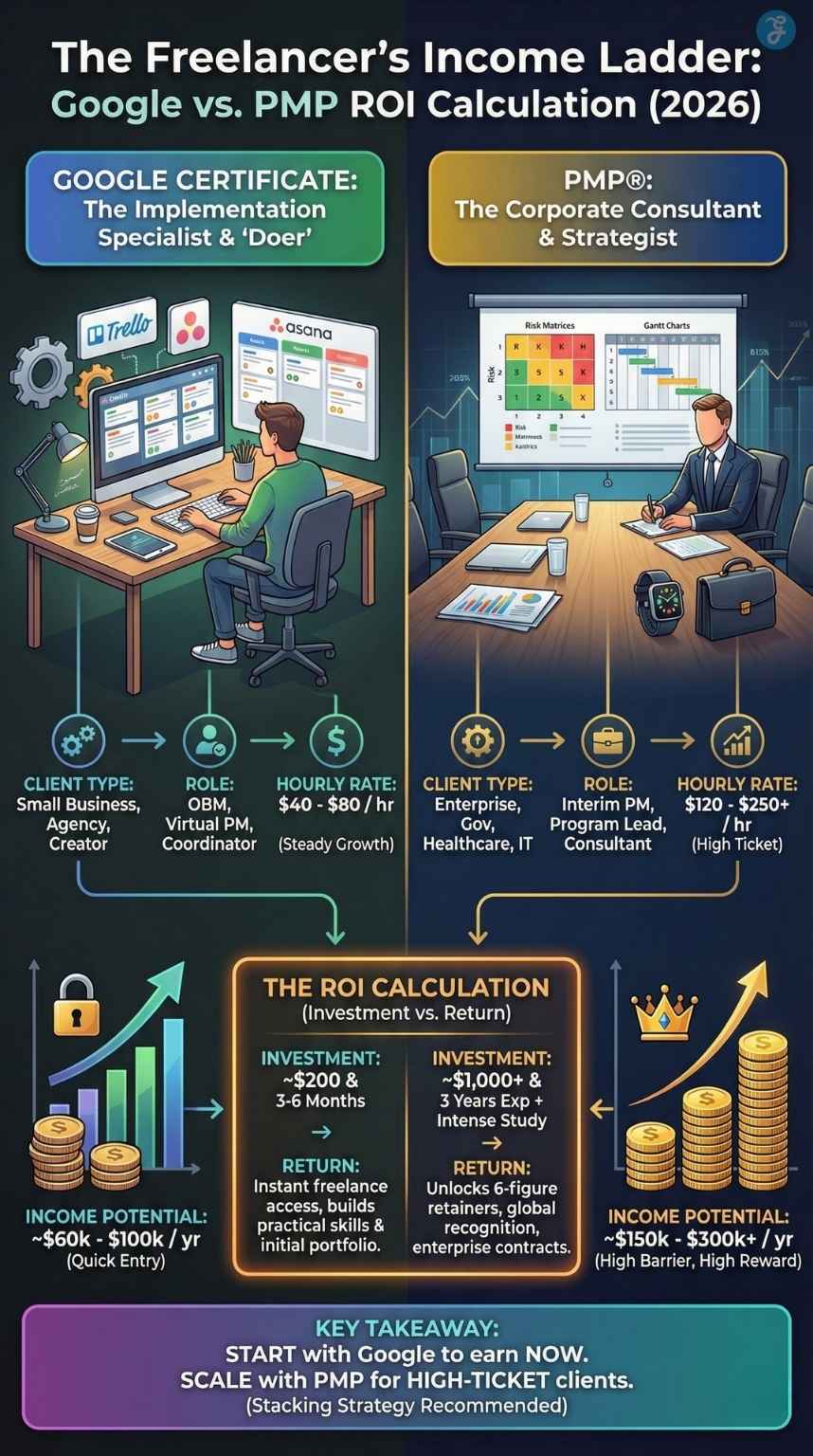
Let’s look at two realistic freelancer scenarios to see where the money is.
Scenario A: The Implementation Specialist (Google Cert)
- Client: A digital marketing agency doing $50k/month.
- The Problem: “Our team is messy. We miss deadlines. Our Slack is a nightmare.”
- Your Solution: You come in, set up a ClickUp dashboard, create SOPs, and run the daily stand-up meeting.
- Rate: $40 – $80/hour.
- Verdict: Google Certificate Wins. This client would be confused by PMP terminology. They just want order. The Google Cert gives you the exact skills to fix their mess quickly.
Scenario B: The Corporate Consultant (PMP)
- Client: A mid-sized healthcare company merging with another firm.
- The Problem: “We need to integrate two IT systems without violating HIPAA compliance. Budget is $1.5M.”
- Your Solution: You build a risk management plan, manage a team of 15 developers, and report progress to the C-Suite.
- Rate: $120 – $250/hour (or a hefty fixed project fee).
- Verdict: PMP Wins. You cannot handle this project with just Trello skills. You need the rigorous risk and stakeholder management frameworks taught in the PMP.
Niche-Specific Verdicts: One Size Does Not Fit All
“Project Management” is too broad. Your specific freelance niche dictates which badge carries weight.
1. Creative & Marketing Freelancers
Social Media Managers, Web Designers, Content Agencies
- Winner: Google Certificate.
- Why: These clients value speed and agility. They use Asana, Monday.com, and Slack. A PMP often signals “bureaucracy” to a creative agency. They fear you’ll bury them in paperwork. The Google Cert signals, “I can organize this mess without killing the creative vibe.”
2. Tech & Software Development
Dev Shops, SaaS Startups, App Builds
- Winner: It’s a Tie (but consider Agile).
- Why: Google’s Agile module is good, but if you are managing developers, they respect the CSM (Certified ScrumMaster) or PMP more. If you choose Google, you must supplement it with real technical knowledge of Jira and GitHub.
3. Construction, Engineering & Healthcare
Physical Products, Compliance, Government
- Winner: PMP (Mandatory).
- Why: These industries run on “Waterfall” methodology. A mistake here costs lives or millions in lawsuits, not just a delayed Instagram post. Clients will not hire a freelancer without a PMP for these roles.
The Secret “Stacking” Strategy
Here is the strategy most freelancers miss. You don’t have to choose one or the other. You can use one to get the other.
Remember the PMP prerequisite of 35 contact hours of education? The Google Project Management Certificate counts for those 35 hours.
The Roadmap to $150/hr:
- Step 1: Take the Google Certificate ($39/mo). Learn the basics and the tools.
- Step 2: Start freelancing as a “Project Coordinator” or “Virtual Project Manager.” Charge $40-$60/hr.
- Step 3: Document every single hour you work. You need to build up that 36-month experience requirement.
- Step 4: Once you have the experience, use your Google Cert as your “35 hours of education” proof to apply for the PMP.
- Step 5: Get your PMP, rebrand as a “Project Consultant,” and double your rates.
This path allows you to earn while you learn, rather than waiting years to be “qualified.”
The Hidden “Maintenance” Costs [Time & Money]
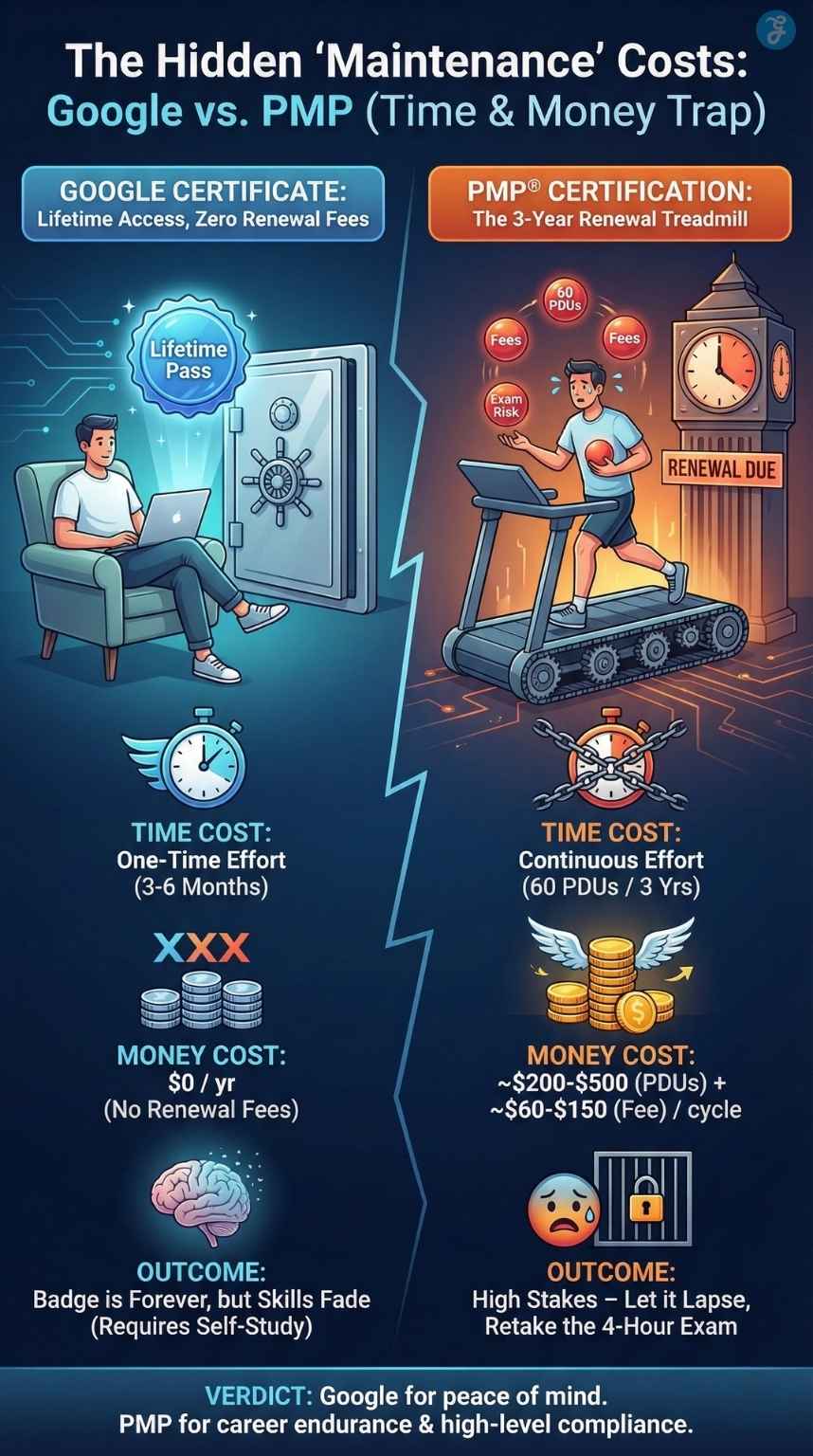
Freelancers often look at the upfront price tag but forget the “subscription cost” of keeping a certification active. This is where the difference between Google and PMP becomes painful for solo workers.
PMP: The 3-Year Treadmill
The PMP is not a “one-and-done” achievement. To keep your PMP active, you must earn 60 Professional Development Units (PDUs) every three years.
- The Cost: While you can find free webinars, many PMP holders end up paying $200–$500 every cycle for courses to get these credits quickly.
- The Renewal Fee: You must pay PMI $60–$150 just to renew the paperwork.
- The Trap: If you let it lapse, you have to retake the grueling 4-hour exam. For a busy freelancer juggling 5 clients, this administrative burden is significant.
Google Certificate: Lifetime Access
- The Benefit: As of 2026, the Google Project Management Certificate does not expire. Once you earn it, you own the badge forever.
- The Catch: While the certificate doesn’t expire, the skills do. Since it’s based on software tools, the content (like the AI modules) may become outdated in 2-3 years. However, you won’t lose your badge or have to pay a renewal fee.
Verdict: If you hate paperwork and recurring fees, Google is the winner.
Soft Skills & Remote Management: The Missing Link
While certifications are great, 2026 has brought a new demand: Remote Leadership.
- Google’s course excels here. It has modules specifically on communicating effectively in a digital world—how to write emails that get read, how to present over Zoom, and how to manage “async” teams.
- The PMP focuses more on governance. It assumes you know how to talk to people and focuses on what you should say to control the project scope.
For a freelancer working with remote clients across time zones, the “soft skills” emphasis of the Google program is often more immediately applicable to retaining clients.
How to “Sell” the Certificate on Upwork & LinkedIn
Getting the certificate is step one. Displaying it correctly is step two. Most freelancers bury their certifications at the bottom of their profile, where no one looks. Here is the 2026 strategy to get noticed:
On Upwork:
- Don’t just use the “Certifications” section: Upwork’s algorithm reads this, but clients rarely scroll down that far.
- The “Portfolio” Hack: Create a Portfolio Item dedicated to your certification.
- Image: Upload a screenshot of your certificate or a case study from the course.
- Title: “Certified Project Management Framework & Methodology.”
- Description: “This is the exact 5-step framework I use to manage projects, based on my Google/PMI certification. It includes Risk Assessment, Gantt Charting, and Sprint Planning.”
- Why this works: It puts your certification in the visual part of your profile, making it impossible to miss.
On LinkedIn:
- The Headline Update: Don’t just write “Project Manager.” Write: “PMP® Certified Project Consultant” or “Google Certified Project Manager | Asana & Notion Expert.”
- The “Featured” Section: Upload your certificate as a PDF in your Featured section so it is the first thing a lead sees.
The “Portfolio Paradox”: Proving Skills Without Breaking NDAs
The biggest hurdle for freelance Project Managers is the Non-Disclosure Agreement (NDA). You manage sensitive budgets and product launches, so you can’t just upload your last client’s project plan to your portfolio.
So, how do you prove you can do the job?
1. The “Sanitized” Case Study
Take a real project you managed, but change the names and data.
- Real: “Managed $5M budget for Nike’s Summer Shoe Launch.”
- Sanitized: “Managed $5M budget for Tier-1 Retail Product Launch (NDA Protected).”
- Focus on the Process: Show how you solved a delay, not what the product was. “We faced a 3-week supply chain delay. I implemented a crash schedule (fast-tracking) to recover 2 weeks.”
2. The “Fictional” Project (Google Capstone)
This is a huge advantage of the Google Certificate. The final course is a Capstone project where you build a full portfolio for a fictional company.
- Because it’s fictional, you own the IP.
- You can show every document—Charter, Budget, Risk Log, Email Communication—publicly.
Pro Tip: For new freelancers, this fictional portfolio is often better than a redacted real one because the client can actually read the details of your writing style.
What Should You Choose
If you are a freelancer who wants to offer implementation services, setting up tools, organizing teams, and acting as an Online Business Manager, the Google Project Management Certificate is your best ROI. It is affordable, modern, and respected by the types of clients who hire freelancers quickly.
If you are a seasoned professional looking to exit the corporate world and return as a high-paid consultant, the PMP is non-negotiable. It is the badge of authority that justifies premium retainers and allows you to sit at the table with executives.
Your Next Winning Move
Don’t let the PMP’s high barrier to entry paralyze you. Start with Google. Use the Capstone to land your first three clients. Then, let the revenue from those clients pay for your PMP training. In the freelance game, “learning while earning” is the only strategy that makes sense.
Final Thought: The “Badge” vs. The “Builder”
Ultimately, a client doesn’t hire a piece of paper; they hire the confidence that you can deliver. In Google Project Management Certificate vs PMP:
The Google Project Management Certificate gives you the Leverage of Speed. It helps you build a “sanitized” portfolio instantly, speak the language of modern tools (AI, Asana), and enter the market debt-free. It trains you to be a Builder who gets things moving.
The PMP gives you the Leverage of Authority. It justifies the high-ticket retainers and allows you to command rooms full of executives. It trains you to be a Guardian who protects the investment.