

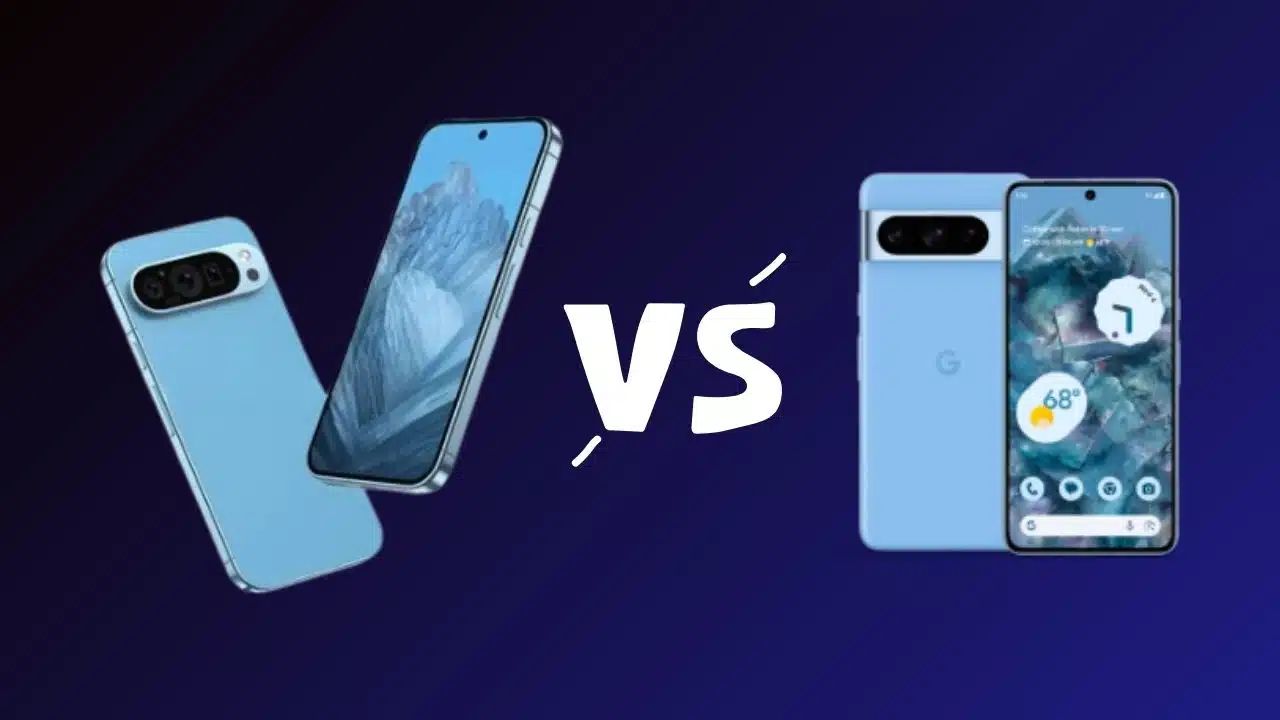
The smartphone industry continues to evolve rapidly, with each new release attempting to outshine the previous models. Google’s Pixel series has been at the forefront of this evolution, particularly with its most recent launches. This article provides a comprehensive comparison of the Google Pixel 9 Pro and Pixel 8 Pro, focusing on their design, performance, camera capabilities, battery life, software, and overall value.
Google Pixel 9 Pro vs. Pixel 8 Pro: Rumored Specifications
|
Feature |
Google Pixel 8 Pro |
Google Pixel 9 Pro |
|
Display |
6.7 inches, QHD+ resolution |
6.7 inches, QHD+ resolution, improved energy efficiency |
|
Refresh Rate |
120 Hz |
120 Hz |
|
Processor |
Google Tensor G2 |
Google Tensor G3 |
|
RAM |
Up to 12GB |
Up to 16GB |
|
Storage Options |
128GB, 256GB |
128GB, 256GB, 512GB |
|
Rear Cameras |
Triple-camera setup |
Advanced triple-camera setup with improved sensors |
|
Front Camera |
High-resolution sensor |
Enhanced high-resolution sensor |
|
Battery |
Large capacity, fast charging |
Larger capacity, more efficient charging |
|
Software |
Android 12 |
Android 13, with extended update support |
|
Connectivity |
5G, Wi-Fi 6, and Bluetooth 5.2 |
5G, Wi-Fi 6E, Bluetooth 5.2, UWB |
|
Special Features |
Fingerprint sensor, Face unlock |
Improved fingerprint sensor, Face unlock, and advanced AI features |
|
Build |
Aluminum frame, Gorilla Glass Victus |
Aluminum frame, Gorilla Glass Victus, more ergonomic design |
|
Price |
It starts at approximately $899 |
Expected to start at $999 |
Design and Build
When comparing the Google Pixel 9 Pro and Pixel 8 Pro, the design changes may seem subtle but are significant. The Pixel 9 Pro continues with the design ethos of its predecessor but refines it further. The build quality remains premium, with both models sporting an aluminum frame and Gorilla Glass Victus for enhanced durability. However, the Pixel 9 Pro introduces a slightly more streamlined design with thinner bezels and a more ergonomic curvature to the edges, improving one-handed use.
Display Quality
The display technology sees incremental improvements in the Google Pixel 9 Pro. While the Pixel 8 Pro offered a 6.7-inch QHD+ display, the Pixel 9 Pro enhanced color accuracy and brightness. Both devices support a 120Hz refresh rate, ensuring smooth scrolling and a dynamic viewing experience. However, the Pixel 9 Pro’s display is touted to be more energy-efficient, which contributes positively to battery life.
Performance and Hardware
In terms of performance, both the Google Pixel 9 Pro and Pixel 8 Pro are equipped with Google’s custom Tensor chip, but the Pixel 9 Pro comes with the updated Tensor G3 chip. This new chip provides better efficiency and performance optimizations, particularly in AI-driven tasks and computational photography. The Pixel 9 Pro also offers more RAM options and potentially more storage, catering to power users who need their devices to multitask more effectively.
Battery Life
Battery performance is crucial in the Google Pixel 9 Pro vs Pixel 8 Pro comparison. Both models feature robust battery capacities, but the Pixel 9 Pro has a slight edge due to its more efficient processor and display technology. This allows the Pixel 9 Pro to offer longer battery life on a single charge, which is a significant advantage for users who are often on the move and depend on their phone’s endurance.
Camera System
Google Pixels are renowned for their camera capabilities, and comparing the Google Pixel 9 Pro vs Pixel 8 Pro in this regard is particularly interesting. While both models feature advanced camera systems, the Pixel 9 Pro introduces new sensor technology and advanced computational photography algorithms. The Pixel 9 Pro’s camera setup is designed to offer better low-light performance, more detailed images, and more accurate color reproduction. Additionally, the video capabilities have been enhanced in the Pixel 9 Pro, making it a more versatile device for multimedia creation.
Software and Features
Both the Google Pixel 9 Pro and Pixel 8 Pro run on Android, but the Pixel 9 Pro will launch with the latest version and continue to receive updates for a longer period of time. Google’s commitment to providing at least three years of OS and security updates means that the Pixel 9 Pro will benefit from newer Android features for a longer time compared to the Pixel 8 Pro. Furthermore, the Pixel 9 Pro comes with several exclusive software features, like advanced voice recognition and more robust on-device AI tasks, which leverage the capabilities of the Tensor G3 chip. Additionally, you can also read about- Google Pixel 8 Pro vs Pixel 7 Pro.
Ecosystems and Connectivity
Google’s ecosystem integration is seamless across both devices, with excellent support for Google Assistant, Google Photos, and other services. However, the Pixel 9 Pro enhances connectivity options with better support for Wi-Fi 6E, 5G, and UWB (Ultra-Wideband). These improvements make the Pixel 9 Pro a better choice for users who value fast and reliable internet connectivity and device pairing.
Price and Availability
In assessing the Google Pixel 9 Pro vs Pixel 8 Pro, the price plays a crucial role. The Pixel 9 Pro is expected to be priced higher than its predecessor, reflecting the upgrades in hardware and features. However, for potential buyers, the investment in the Pixel 9 Pro could be justified by its longer lifespan, better performance, and enhanced camera capabilities.
Conclusion
The comparison between the Google Pixel 9 Pro and Pixel 8 Pro highlights significant improvements in the newer model, spanning across performance, camera technology, battery life, and software enhancements. For users looking to upgrade from the Pixel 8 Pro or other older models, the Pixel 9 Pro offers a compelling package that balances cutting-edge technology with reliable performance. As the smartphone market continues to evolve, the Pixel 9 Pro sets a high standard for what users can expect from premium devices in terms of innovation and user experience.






















