
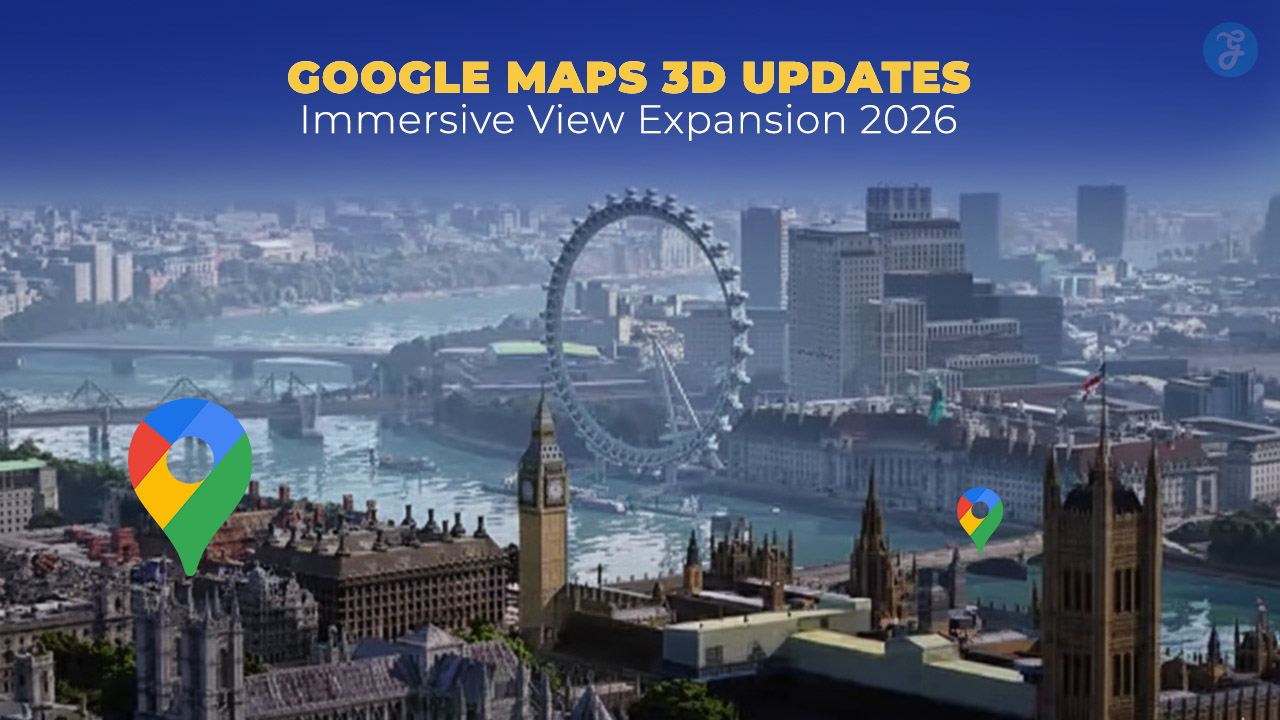
Google’s push to bring Google Maps Immersive View to dozens more cities is not cosmetic. It is a bet that 3D digital twins will become the interface for travel, commerce, and city operations, right as spatial computing rebounds. That shift changes who controls “where” data, and who profits.
How We Got Here
Google Maps has spent two decades turning messy geography into a product people trust in the most fragile moment of everyday life: the moment you are lost. That trust is now a competitive moat. Google has said more than 2 billion people use Maps each month, and that it makes over 100 million map updates every day by combining AI that analyzes billions of images with local partners and community input.
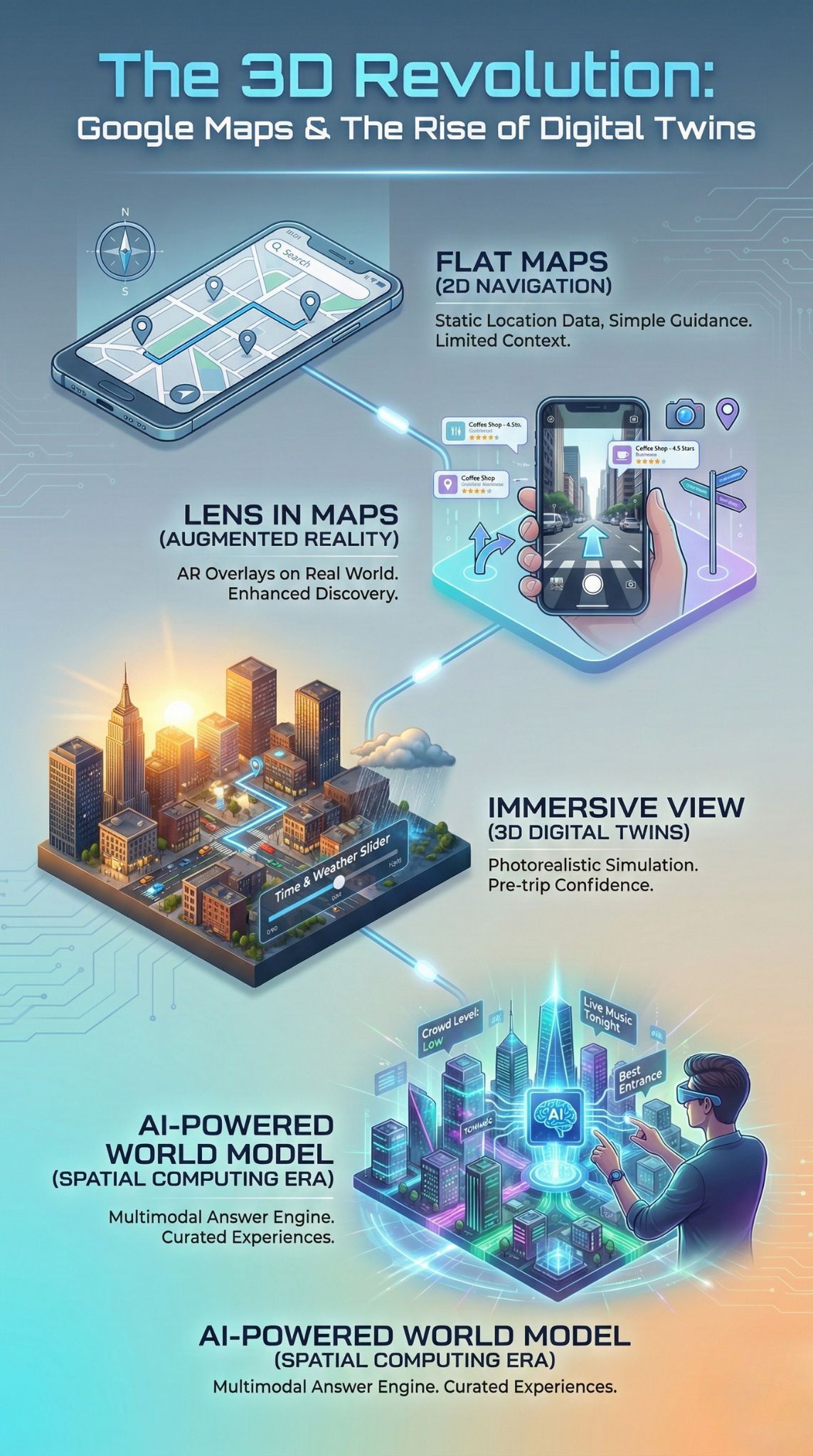
Immersive View is best understood as the next phase of that same mission. Instead of asking you to translate a flat map into the real world, it tries to bring the real world into the map. Google previewed the concept at I/O 2022, then began rolling it out in early 2023, positioning it as a new way to explore a place that fuses Street View and aerial imagery into a digital model and overlays conditions like weather, traffic, and busyness.
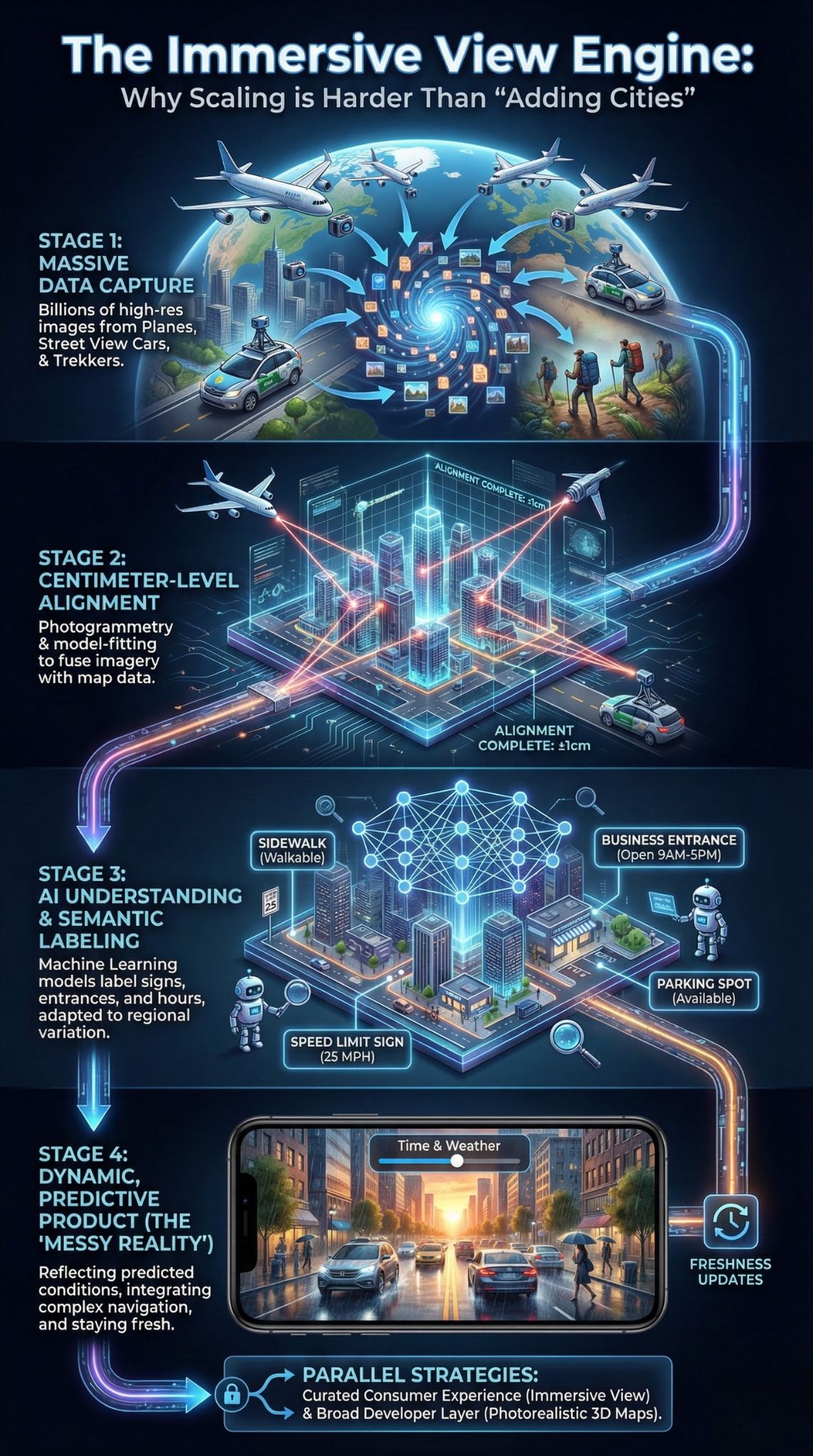
The engineering story matters because it hints at why expansion is strategically significant and why it is not trivial to scale. For Immersive View for routes, Google describes assembling billions of high-resolution images from planes, Street View cars, and Trekkers, aligning imagery and map data within centimeters, then using machine learning to label elements like sidewalks, street signs, speed-limit signs, entrances, and business hours.
This is also where the “50 new cities” framing appears in Google’s broader immersive push. In October 2023, Google said its AR feature “Lens in Maps” was coming to more than 50 new cities, while Immersive View for routes began rolling out in 15 cities and the broader Immersive View experience continued widening. Then on October 31, 2024, Google said Immersive View for places would expand to 150 cities globally, alongside Gemini-powered discovery and Q&A features.
A simple way to read the current expansion cycle is that Google is industrializing “presence” in Maps. It is moving from showing you where something is to helping you feel what it is like to be there, before you go.
| Milestone | What Shipped | Why It Mattered |
| 2022 to early 2023 | Immersive View concept to initial rollout | Reframed Maps as a “digital twin” interface, not just a navigation tool |
| Feb 2023 | Immersive View described as fusing Street View and aerial imagery using modern 3D reconstruction | Introduced a more cinematic, simulation-like approach to consumer mapping |
| Oct 2023 | Lens in Maps expands to 50+ cities; Immersive View for routes starts in 15 cities | Added the street-level AR layer and route previews, turning exploration into an “experience” |
| Oct 2024 | Immersive View for places expands to 150 cities; Gemini layers added | Shifted Maps toward an AI assistant that answers questions and curates plans |
| 2024–2025 (platform track) | Photorealistic 3D maps expands across web and native mobile SDKs | Broadened the developer ecosystem for 3D location experiences |
Key Statistics That Explain Why This Matters Now
- Google has said Maps provides over 20 billion kilometers of directions every day, meaning any UX change is a change in how the world moves.
- Google has said 2+ billion people use Maps monthly and it makes 100+ million updates daily, forming the “freshness” foundation for AI and immersive views.
- Google said Immersive View for places would expand to 150 cities globally as of October 31, 2024 (the latest explicit city-count it published in a dedicated Maps update post).
- Industry forecasts point to a rebound in spatial interfaces: Reuters reported IDC projections that AR/VR headset shipments could rise from 6.7 million (2024) to 22.9 million (2028), with 2025 projected to jump 41.4%.
- Deloitte cites market estimates forecasting the digital twin market growing from roughly $13B (2023) to $259B (2032), a macro tailwind for “world models” like Immersive View.
From Maps To “World Models”: The Real Strategic Bet Behind Immersive View
Immersive View is not just a new feature. It is a strategic position in an emerging stack: the “world model” layer that many AI and spatial computing products need. When Google describes fusing imagery into a digital model and layering predicted conditions like weather and traffic, it is effectively saying Maps is becoming a simulation environment, not a static database.
That matters because AI is moving from text-first assistance to multimodal assistance. In a text-first world, location search is “best ramen near me.” In a multimodal world, it becomes “show me what this neighborhood feels like at 7 p.m., whether parking will be painful, whether it is crowded, and whether the walk from the garage to the entrance is confusing.” Google’s Immersive View messaging explicitly leans into this, highlighting that you can preview what a place and route will be like at the day and time you plan to visit.
The deeper implication is that immersive mapping changes how humans build confidence. Traditional maps ask you to mentally simulate the trip. Immersive View tries to simulate the trip for you. That reduces uncertainty, and reduced uncertainty is a profit engine in travel and local commerce. People spend more when they feel confident.
Gemini Turns Maps Into An Answer Engine, Not A Search Box
The 3D expansion is arriving alongside a more consequential shift: Google is remaking Maps as an AI-guided interface for intent. In its October 31, 2024 update, Google introduced Gemini-curated “inspiration,” review summaries, and the ability to ask questions about a place—grounded, it said, in trusted data about hundreds of millions of places and ongoing community contributions.
This matters because the economic value of Maps is not only in navigation. It is in the last mile of decision-making: which restaurant, which store, which hotel, which route, and which stop along the way. If Gemini can compress thousands of reviews into a single useful summary and answer “is it quiet” with context, Maps starts to behave less like a utility and more like a concierge.
Immersive View complements that shift by giving the concierge a visual language. When AI recommendations are paired with photorealistic previews, the product becomes stickier. It is harder to leave a map that helps you decide, not just arrive.
| UX Layer | What It Does | What It Replaces |
| Gemini-curated ideas | Suggests collections like “live music” or “speakeasies” | General web search and scattered listicles |
| Review summaries and Q&A | Converts reviews into answers with context | Reading dozens of reviews manually |
| Immersive View previews | Shows visual, condition-aware context | Guesswork, Street View hopping, and separate weather checks |
A reasonable counterpoint is that AI layers can erode trust if they hallucinate or oversimplify. Google’s answer (at least publicly) has been to emphasize grounding and freshness. In October 2024 reporting, Google Maps leadership stressed the scale of daily updates and the need for outputs to be “fresh and factual,” an implicit admission that trust is the whole game when a map becomes an answer engine.
The Expansion Is Also A Commerce Move: 3D As The Next Local Shelf
Immersive View’s city expansion can look like a travel feature, but it also creates a new kind of storefront. In a flat map, local businesses compete through pins, photos, ratings, and ads. In an immersive map, they compete through “vibe,” entrances, walkability, visibility from the street, and what your arrival feels like.
This is not theoretical. Google has described Immersive View as a way to glide down to street level to explore nearby restaurants and even peek inside to understand the vibe before booking. That is a pre-transaction moment where commerce happens.
If 3D previews reduce uncertainty, they can increase conversion for categories where ambiguity is costly:
- Restaurants and nightlife, where atmosphere matters
- Attractions and stadiums, where entry points and crowding matter
- Retail districts, where parking and walking routes matter
- Campuses and event venues, where navigation anxiety is real
The likely “losers” are not consumers. They are intermediaries. Anything that previously monetized trip planning, “best of” discovery, or neighborhood context faces pressure when Maps becomes a richer planning surface.
| Stakeholder | Likely Upside | Likely Downside |
| Travelers and locals | Lower uncertainty, faster decisions, fewer wrong turns | Risk of over-reliance on AI summaries |
| Local businesses | More qualified intent, richer discovery context | Higher bar for reputation and visuals |
| Publishers and travel list sites | Some referral traffic from Maps surfaces | Disintermediation as Maps answers more questions directly |
| Competing map apps | Clear UX pressure to match immersion | Costly data and compute requirements |
| Cities and venues | Reduced visitor friction, better wayfinding | Privacy and governance concerns around imagery and analytics |
Under The Hood: Why Scaling Immersive View Is Harder Than “Adding Cities”
The phrase “expands to new cities” hides the messy reality of what must be true for a city to feel reliable in 3D.
Google’s own behind-the-scenes descriptions read like a supply chain. First, capture: planes, Street View cars, Trekkers, and other sources. Then alignment: photogrammetry and model-fitting that lines up imagery with map data within centimeters. Then understanding: models that label signs, sidewalks, entrances, and business hours, trained on millions of photos and adapted to regional variation.
Only after that does the city become product-ready, and even then the product is not a static render. It is a view that can reflect predicted conditions, integrate navigation details like parking and complex turns, and stay fresh as the city changes.
That complexity explains why Google has two parallel 3D strategies:
- A curated consumer Immersive View experience that expands more cautiously
- A broader developer-facing photorealistic 3D layer that already covers far more places
Google Maps Platform has said its Photorealistic 3D Maps coverage spans 2,500+ cities in 50+ countries through APIs, and it extended 3D Maps into native mobile SDKs for Android and iOS in 2025.
In other words, Google can provide 3D geometry at scale, but the consumer Immersive View experience adds additional requirements: condition layers, UX polish, and a promise that it helps real people make better decisions.
| 3D Product Track | Scale | Primary Users | What Makes It Different |
| Immersive View (consumer) | 150 cities disclosed (Oct 2024) | Everyday travelers | Condition layers, trip planning UX, narrative exploration |
| Photorealistic 3D Maps and Tiles (platform) | 2,500+ cities (APIs) | Developers, enterprises | Broad coverage for apps, digital twins, visualization |
Digital Twins Are Becoming City Infrastructure, Not A Tech Demo
Immersive View’s city-by-city growth aligns with a broader shift: cities and companies are treating digital replicas as operational tools.
Reuters reported that more than 500 cities could be using some form of digital twin technology by 2025 (citing ABI Research) and that digital twins could help save $280 billion by 2030 through better planning and management. Separately, McKinsey’s smart cities analysis argued that digital applications can improve some quality-of-life indicators by 10–30%, with modeled examples that include shaving average commutes by 15–20% and reducing greenhouse-gas emissions by 10–15%.
This is where Google’s mapping stack becomes more than consumer convenience. If a city already relies on digital twins for resilience or planning, a consumer-grade “city model” in the world’s most-used navigation app can start to influence expectations. Over time, residents may begin to assume that:
- route guidance includes micro-context, not just turns
- arrivals include entrance-level detail, not just addresses
- planning includes crowding, weather, and event conditions by default
The World Economic Forum’s work on digital twin cities emphasizes collaboration and governance, which is a polite way of saying: data power without governance becomes political quickly.
So the expansion story is also a governance story. As immersive mapping becomes normalized, debates over imagery rights, data sharing, surveillance concerns, and equitable access intensify. Cities that feel “under-modeled” could argue they are digitally left behind, while richly modeled cities may worry about overexposure.
Regulation And Data Access: The Quiet Constraint On Immersive Expansion
Immersive mapping depends on data pipelines and platform permissions. In Europe, that increasingly intersects with regulatory constraints.
Google Maps Platform documentation notes that European Economic Area developer terms apply as of July 8, 2025 and that certain content from specific map tile services will no longer be returned under those EEA terms.
Even without litigating the details, the direction is clear: location data is becoming regulated infrastructure.
That creates two implications for Immersive View expansion:
- Google must engineer product consistency under region-specific terms and data limitations
- the competitive moat may widen, because smaller players often lack the legal, policy, and compliance machinery to maintain global coverage under fragmented rules
A skeptical view is that regulation could slow immersive rollout by limiting what can be shown or reused. A more optimistic view is that clearer rules could increase trust and accelerate adoption. Both can be true depending on implementation.
The Look Ahead: What Comes Next
Predictions should be treated as probabilities, not promises, but several milestones look more likely than not given the direction of the product and the market signals.
More Cities, But Also More “Categories.” Google is already adding categories like college campuses to Immersive View, which hints that the next expansion wave may be less about raw city count and more about high-value environments like stadium districts, transit hubs, tourist corridors, and complex venues where anxiety is highest.
A Convergence With Spatial Computing Hardware. IDC projections reported by Reuters suggest a multi-year ramp in AR/VR devices, driven by AI and lower costs. If that happens, Immersive View becomes not just a planning feature on a phone, but a core content layer for camera-first, heads-up navigation.
Developers Will Build The “Immersive Web” On Google’s Tiles. The platform track is moving quickly: 3D Maps for web and then native mobile SDKs. The likely result is a surge of enterprise digital twins, retail experiences, tourism previews, and logistics tools that use Google’s 3D canvas as a default layer.
Higher Expectations For Trust, Not Just Wow. Google’s public messaging suggests it knows immersive plus AI raises the cost of mistakes. If the map starts answering questions and simulating decisions, small inaccuracies become reputational risk. That pushes the whole product toward rigorous grounding, stronger transparency, and more careful rollout pacing.
The Biggest Long-Term Consequence: Maps Becomes A Negotiation Layer. When the map becomes a digital twin, it is no longer a passive reference. It becomes a place where businesses compete, cities communicate policy, and consumers form perceptions. Over time, “where” becomes less about coordinates and more about curated, simulated context. That is why the expansion of Immersive View is not a feature story. It is a power story.