
In a bold move to cement its role in shaping India’s digital and AI-driven future, Google unveiled a series of major artificial intelligence initiatives at its flagship developer conference, Google I/O Connect India 2025, held in Bengaluru. The company outlined its vision to localise core AI services, empower Indian developers, and collaborate with startups and academia to build AI solutions rooted in Indian needs and realities.
From bringing powerful AI models like Gemini 2.5 Flash to Indian data centers to launching a training program for local game developers, Google’s strategy aims to foster a self-reliant and globally competitive AI ecosystem in the country.
Gemini 2.5 Flash Localised for India: Lower Latency, Higher Potential
The headline announcement was the localisation of Gemini 2.5 Flash, a lightweight yet powerful version of Google’s generative AI model, Gemini. By hosting this model directly on India-based servers, Google promises faster AI performance, reduced latency, and greater compliance with local data and privacy regulations—particularly important for highly regulated sectors like:
- Healthcare, where real-time AI support can assist with diagnostics and patient services
- Finance, where data security and real-time insights are crucial for fraud detection and risk modeling
- Governance, where digital public services depend on both speed and accuracy
This step significantly enhances the usability of AI applications for Indian developers and businesses, especially those working with sensitive or large-scale datasets.
Celebrating India’s Developer Ecosystem
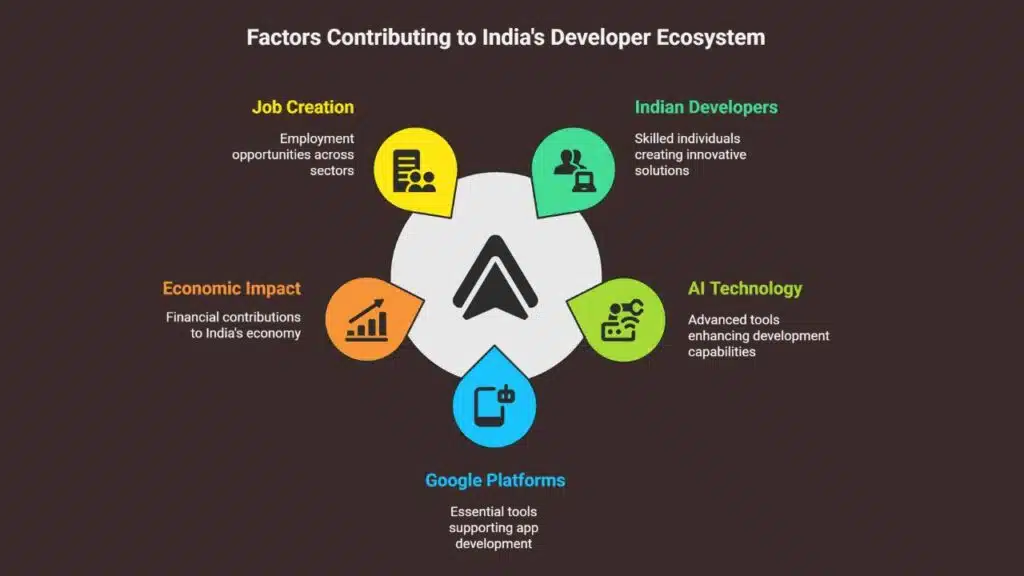
During the keynote, Manish Gupta, Senior Director for India and APAC at Google DeepMind, emphasized the global impact of India’s developer community:
“Indian developers are literally writing the next chapter of India’s success story,” he said. “They’re using AI to build real-world solutions that serve not just India, but global users as well.”
Backing this statement with data, Google revealed that the Android and Google Play ecosystems contributed ₹4 lakh crore (approximately $48 billion) to India’s economy in 2024, creating 3.5 million jobs across sectors. These numbers underscore the economic significance of mobile and app development in India, supported in large part by Google’s platforms and tools.
Developer Tools: Smarter, Faster App Building with Firebase and Agentic AI
To further fuel developer productivity, Google announced new agentic AI capabilities and pre-optimized templates within Firebase Studio, Google’s all-in-one platform for web and mobile app development.
These tools allow developers to:
- Automate code generation
- Integrate AI-based decision-making into apps
- Build and deploy full-stack AI-powered applications faster and with fewer resources
- Use prebuilt templates to reduce time-to-market for startups
This is a major leap for small teams or startups who lack large engineering resources but want to leverage cutting-edge AI capabilities in their applications.
Big Boost to Location-Based Services: India-Specific Enhancements for Google Maps
In a significant move for app developers working with maps and location data, Google introduced India-specific pricing for Google Maps UI components. This is aimed at lowering development costs for Indian startups and apps that rely heavily on location-based features.
Additionally, Google is now providing access to over 250 million mapped global places through its Places API, further enhanced with:
- AI-generated summaries of each location
- Local context tailored to Indian users
- Easier integration of dynamic content into travel, commerce, and delivery apps
These tools can transform how businesses like e-commerce, ride-hailing, logistics, and travel services engage with customers through location intelligence.
Make-in-India AI: Google Partners with Indian Startups and IIT Bombay
Reinforcing its commitment to Make-in-India AI development, Google announced collaborations with three Indian startups selected under the India AI Mission:
- Sarvam – Known for “Sarvam-Translate,” an AI-powered tool offering Indian language translations, the startup exemplifies how India’s linguistic diversity can benefit from AI.
- Soket AI – Innovating in enterprise AI and conversational models tailored to Indian use cases.
- Gnani.ai – Specialising in speech recognition and NLP, catering to India’s multilingual user base.
Google is also partnering with the BharatGen project at IIT Bombay to advance ASR (automatic speech recognition) and TTS (text-to-speech) models in Indic languages. These models will help bridge the digital divide by enabling access to technology in languages beyond English and Hindi—such as Bengali, Tamil, Marathi, Telugu, and others.
This move comes at a time when digital inclusion and accessibility are top national priorities, with over 500 million Indians expected to use local language content online by 2030.
Game Development in Focus: New Training Program Launched with Unity and GDAI
Recognizing India’s growing influence in the global gaming market, Google has teamed up with Unity and the Game Developers Association of India (GDAI) to launch the ‘Google Play x Unity Game Developer Training’ initiative.
Here are some highlights of the program:
- Aimed at 500 Indian developers in the first phase
- Offers over 30 hours of structured training
- Covers various game development roles—design, coding, monetisation, user testing, and more
- Available through blended learning (online and workshop-based)
India has one of the world’s fastest-growing mobile gaming markets. This program not only boosts developer skills, but also enhances game quality and innovation, preparing developers for global publishing success via Google Play.
Gen AI Exchange Hackathon: Innovation in Action
Google also hosted the Gen AI Exchange Hackathon during the Bengaluru event—designed to showcase how developers are using Google’s AI tools to tackle real-world challenges.
Participants included rising Indian startups such as:
- Sarvam (translation and NLP)
- InVideo (video creation using Gen AI)
- Glance (lock screen content and discovery platform)
- Nykaa (AI in beauty tech and product personalization)
These companies demonstrated functional products built using Google’s AI stack, offering everything from content automation and real-time recommendations to hyperlocal discovery and language processing.
A Milestone Moment for India’s AI Future
Google’s announcements at the I/O Connect India 2025 are not just updates—they represent a strategic investment in India’s future as a global AI hub.
From:
- Localising cutting-edge AI models
- Supporting Indic language development
- Training next-gen game developers
- Boosting app-building tools and Maps integration
- To supporting local startups with real-world applications
—Google is aligning its global technology vision with India’s developmental goals.
With the largest pool of young tech talent, a thriving startup culture, and a rapidly digitizing economy, India stands poised to become a world leader in responsible and inclusive AI innovation—and Google wants to be at the heart of that journey.
The Information is Collected from The Economic Times and MSN.