
Let us tell you about our friend Jake. He owns a small HVAC company in Denver. For years, his Google Ads brought in a steady stream of calls, enough to keep his team busy and his family comfortable. Then, last summer, something changed. His cost per lead doubled almost overnight. The phone stopped ringing as much. When he called me frustrated, asking if Google Ads still worked,We gave him the hard truth:
“They do work, just not the way you’ve been running them.”
The game changed when Google fully embraced AI. The strategies that worked in 2020 don’t cut it anymore. But here’s what most small business owners don’t realize: This shift actually creates huge opportunities for those willing to adapt.
How Google Ads Have Changed Forever
Remember when running google ads management services meant manually selecting keywords, writing a few ad variations, and setting fixed bids? Those days are gone. Google’s AI now handles most of that for you, for better or worse. The new system is like handing your ad budget to a very smart but slightly unpredictable assistant. It automatically adjusts your bids across millions of auctions, tests different ad combinations, and even decides where to show your ads across Google’s entire network.
This sounds great in theory. Who wouldn’t want AI optimizing their campaigns 24/7? But here’s where business owners like Jake get burned:
AI only works well when you give it the right inputs.
We’ve seen two types of advertisers fail spectacularly in this new environment. First, there are the old-school marketers who refuse to change, still trying to micromanage every keyword bid while ignoring the AI tools. Then there are the beginners who just click “recommended settings” and hope for the best.
The winners? They’re the ones who understand how to guide the AI while letting it do what it does best.
The Three Types of Businesses Crushing It Right Now
After working with dozens of advertisers through this transition, I’ve noticed three types of businesses that consistently succeed with AI-powered Google Ads.
First are the local service businesses, plumbers, electricians, roofers. They’re thriving because Google’s AI loves high-intent searches like “emergency AC repair near me.” These businesses get their ads shown not just in search results, but in Google Maps, AI Overview answers, and even voice search responses.
Then there are e-commerce stores with strong product data. The AI thrives when it can analyze which products people view, what they add to cart, and what they eventually buy. One skateboard shop owner we worked with saw his revenue jump 220% after switching to AI-optimized shopping campaigns.
Finally, there are B2B companies with long sales cycles. The new AI can track leads across devices for months, adjusting bids based on which visitors are most likely to eventually become customers. A commercial cleaning company used this to reduce their cost per lead by nearly 40%.
Five Costly Mistakes You Can’t Afford to Make
Now let’s talk about how businesses waste money in this new environment. The most common mistake we see is using broad match keywords without proper negative keywords. Where “plumber” might have worked before, now the AI will happily spend your budget on useless searches like “how to become a plumber” unless you tell it otherwise.
Another budget killer is sending all traffic to your homepage. The AI rewards relevance, so an ad about “water heater repair” that links directly to your water heater service page will convert dramatically better than one sending people to your generic homepage.
Perhaps the most painful mistake is ignoring audience signals. The AI works best when you tell it who your ideal customers are, their demographics, interests, and online behaviors. Without this guidance, it’s like sending a real estate agent to find you a house without telling them your budget or preferred neighborhoods.
Landing page optimization has also become non-negotiable. If your page converts at 1% while a simple variant converts at 3%, you’re essentially paying three times more for each lead. I’ve seen businesses save thousands just by running simple A/B tests.
Running ads without the proper tracking of conversions is like driving blindfolded. The AI has to be aware of what is a “win” for your business regardless of whether it’s a telephone contact, form filling or an online purchase. Without this information it won’t be able to optimize efficiently.
The New Rules for AI-Optimized Advertising
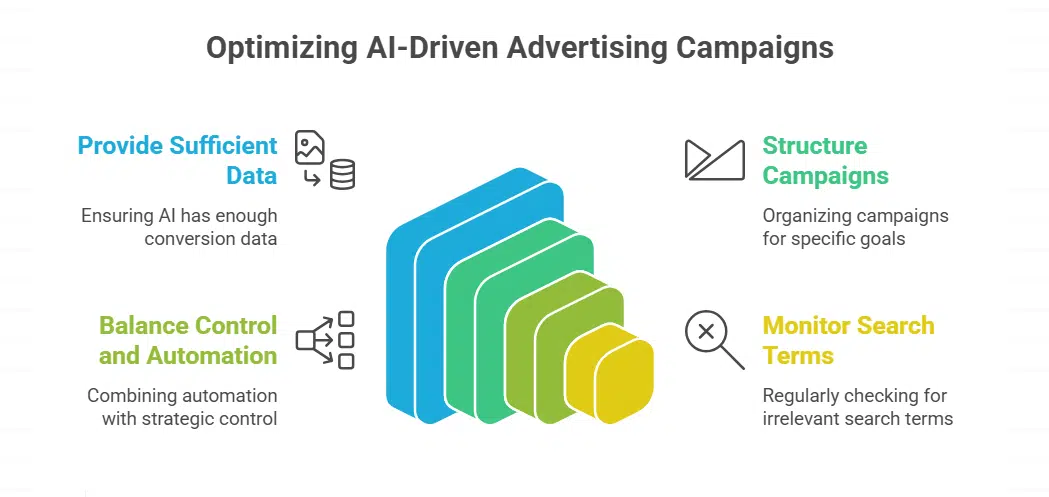
How do you create campaigns that perform in the new digital world? First, you must provide the AI with sufficient information. In general it is recommended to have at least 30 conversions per campaign in order for the AI to function effectively. When it comes to expensive items, where purchases aren’t frequent offline tracking of conversions becomes vital.
Campaign structure is more important than ever before. If you’d grouped everything in one place, today you require separate campaigns for various products or services. AI is most effective when it is focused on specific goals rather than trying to optimize everything all at once.
The ideal situation is to find an equilibrium between control and automation. While you must absolutely employ intelligent bidding strategies, such as “Maximize Conversions,” you must still set goals for items like the target CPA and ROAS. Even with all the automated processes however, it’s still important to check your search terms frequently to spot any non-relevant search terms that slip through.
What’s Coming Next in AI Advertising
Three developments are likely to alter the game further. Voice search ads will be important as more people use digital assistants to locate solutions. Imagine someone calling their smart speaker to find an electrician. The businesses who are optimized for these types of inquiries will receive the calls.
AI-generated ads are already in use to some extent, Google automatically generates headlines and descriptions. However, soon we’ll see complete videos crafted from images of products and descriptions.
Perhaps the most important thing is that predictive targeting allows advertisers to reach out to people before they search. The AI can detect patterns that indicate that someone might require a service within the next few years. For instance, advertising for divorce lawyers to someone who is researching marital issues.
Conclusion
Here’s the truth: Google Ads aren’t going away. If anything, they’re becoming more powerful. But the businesses that succeed will be those that adapt to working with AI rather than fighting against it. The key is understanding that while the AI handles execution, you still need to provide strategy. You need to know your numbers, understand your customers, and continually test and optimize.
So if your ads aren’t performing like they used to, don’t give up. Instead, take a hard look at whether you’re playing by the new rules. Because when you do, you’ll find there’s never been a better time to get high-quality leads through Google Ads.
The question isn’t whether Google Ads still work, it’s whether you’re willing to work with how they operate today. For business owners ready to adapt, the opportunities are massive. Those who cling to outdated methods? They’ll keep wondering why the phone stopped ringing.