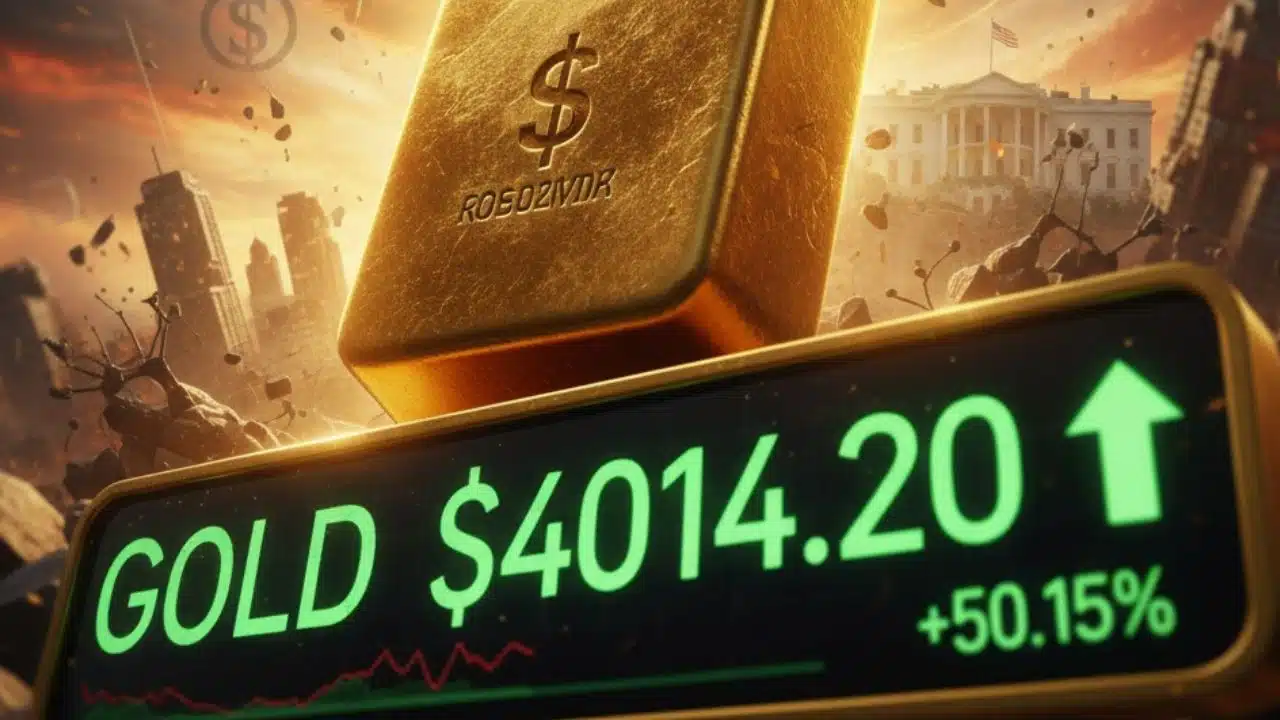
Gold futures surged past the historic $4,000 per troy ounce milestone for the first time ever on Tuesday, October 7, 2025, as a perfect storm of economic uncertainty, geopolitical tension, and a potential U.S. government shutdown sent investors scrambling for safe-haven assets. The unprecedented rally reflects deep-seated anxiety in global markets, cementing the precious metal’s role as a critical barometer of financial instability.
The New York spot gold price reached a record high of $4,014 per troy ounce on Tuesday morning before settling slightly. The move represents a dramatic climb of approximately 50% since the beginning of 2025, when prices hovered around $2,670 per ounce. The surge signals a significant shift in investor sentiment, driven by fears of inflation, a weakening U.S. dollar, and a dovish turn from the Federal Reserve.
Key Facts & Quick Takes
- Historic Milestone: Gold futures in New York surpassed $4,000 per troy ounce on the morning of Tuesday, October 7, 2025, reaching an all-time high of $4,014.
- Primary Drivers: The rally is fueled by a combination of factors including the risk of a U.S. government shutdown, expectations of further Federal Reserve interest rate cuts, a weaker U.S. dollar, and persistent geopolitical tensions in Europe and the Middle East.
- Staggering Year-to-Date Gains: The precious metal has seen its price increase by approximately 47-50% since January 2025, marking one of its most significant annual rises in decades.
- Central Bank Buying Spree: Global central banks have continued to be major buyers of gold throughout 2024 and 2025, diversifying their reserves away from the U.S. dollar and adding structural support to the market.
- Bullish Forecasts: Major financial institutions have upgraded their price targets, with Goldman Sachs now forecasting gold could reach $4,900 per ounce by the end of 2026.
Context: The Perfect Storm for a Gold Rally
The surge to $4,000 is not a sudden spike but the culmination of pressures that have been building for over a year. A confluence of macroeconomic and geopolitical factors has created an environment where gold’s traditional role as a store of value and a hedge against uncertainty has come to the forefront.
Monetary Policy and a Weaker Dollar
A primary catalyst has been the shift in monetary policy from the U.S. Federal Reserve. The central bank initiated its first rate cut in nine months at its September 2025 meeting, lowering the federal funds rate by 25 basis points to a range of 4.0% to 4.25% (Federal Reserve), With markets pricing in at least two more cuts before the end of the year, the appeal of non-yielding assets like gold has soared.
Lower interest rates reduce the opportunity cost of holding gold, which pays no dividend or interest. This policy shift, combined with renewed trade war fears following the imposition of new tariffs by the Trump administration, has put significant downward pressure on the U.S. dollar. As gold is priced in dollars, a weaker greenback makes it cheaper for holders of other currencies, further boosting global demand.
Geopolitical Instability and Safe-Haven Demand
Persistent geopolitical tensions have also played a crucial role. The ongoing conflicts in Ukraine and the Middle East continue to fuel investor anxiety. The freezing of approximately $300 billion in Russian foreign holdings at the war’s onset in 2022 was a “trigger point,” according to analysts, prompting a wave of de-dollarization efforts by other nations.
This trend is evident in the robust purchasing of gold by central banks. According to J.P. Morgan Research, central banks are forecasted to buy around 900 tonnes of gold in 2025, continuing a multi-year trend of bolstering their reserves with the precious metal (J.P. Morgan). This steady, large-scale demand provides a high floor for gold prices.
“The gold rally started in 2022,” one analyst stated, noting the “trigger point” occurred when Western allies froze Russian foreign holdings. This has led many nations to reconsider their reliance on the U.S. dollar.
Latest Data & Statistics
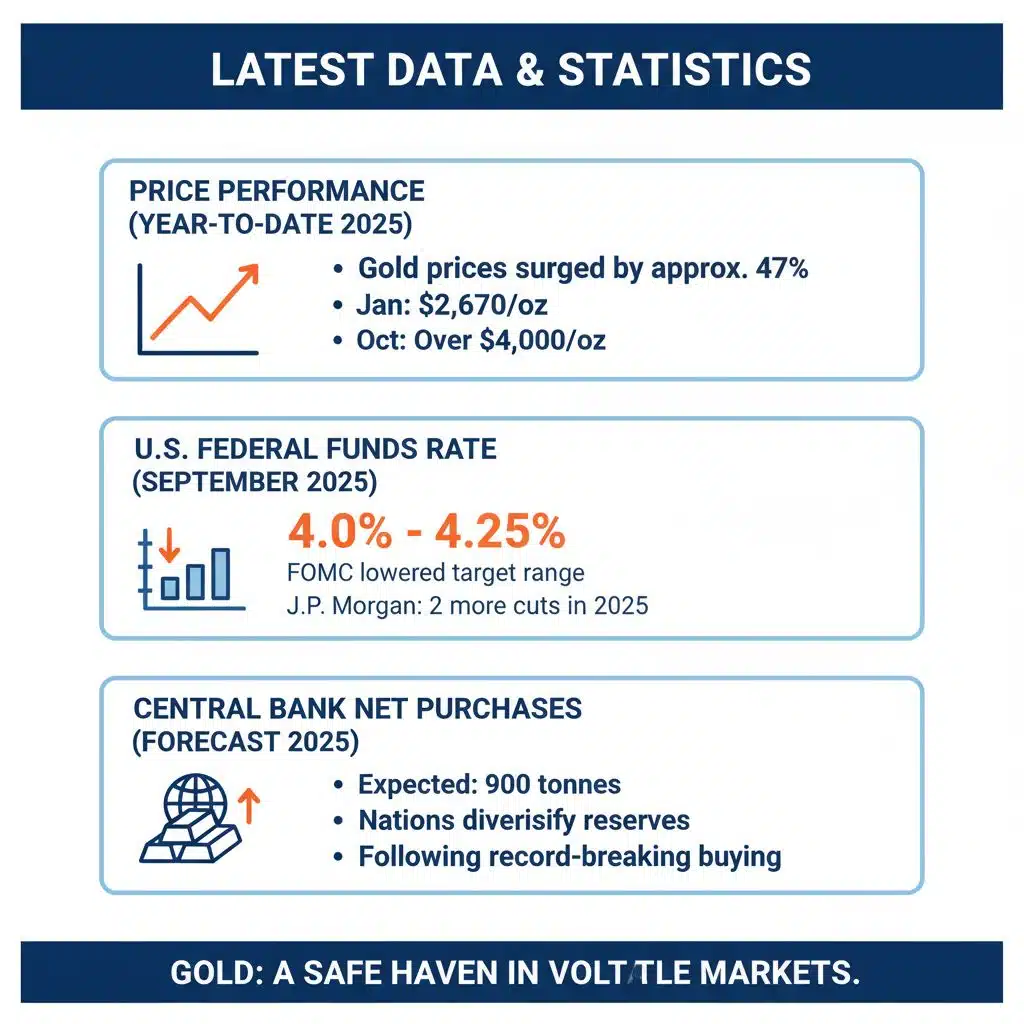
- Price Performance (Year-to-Date 2025): Gold prices have surged by approximately 47% from the beginning of 2025 through early October. The price has climbed from roughly $2,670/oz in January to over $4,000/oz.
- U.S. Federal Funds Rate (September 2025): The Federal Open Market Committee (FOMC) lowered the target range for the federal funds rate to 4.0% – 4.25%. J.P. Morgan analysts expect two more cuts in 2025.
- Central Bank Net Purchases (Forecast 2025): Central banks are expected to purchase a net total of approximately 900 tonnes of gold in 2025. This follows several years of record-breaking buying as nations diversify their foreign exchange reserves.
Official Responses & Expert Analysis
The immediate trigger for crossing the $4,000 threshold appears to be the looming threat of a U.S. government shutdown. With no agreement on spending plans, the government could shut down in early October, potentially delaying crucial economic data releases and injecting further uncertainty into the markets.
Peter Grant, vice-president and senior metals strategist at Zaner Metals, described the situation as being driven by “ongoing safe-haven flows stemming in part from the government shutdown and no real indication that it is likely to be resolved in the immediate term here”.
Looking ahead, major financial institutions remain overwhelmingly bullish. Goldman Sachs recently made headlines by significantly raising its December 2026 gold price forecast from $4,300 to $4,900 per ounce. The investment bank cited sustained central bank demand and a resurgence in Western investor interest through exchange-traded funds (ETFs) as key drivers for its optimistic outlook.
Impact on People and Markets
The record-breaking price of gold has widespread implications. For consumers, it translates directly to higher costs for jewelry and other goods containing gold. For investors who have held gold, it represents a significant gain and a validation of their strategy to hedge against economic risk.
The surge also affects national economies. For gold-producing nations, it means higher revenues. For central banks, the rising value of their gold reserves strengthens their balance sheets. The sustained rally has also boosted the performance of gold mining stocks and related ETFs, which have seen record inflows in recent months.
What to Watch Next
The trajectory of gold prices in the coming weeks will depend on several key factors:
- U.S. Government Shutdown: A prolonged shutdown is likely to provide further upward momentum for gold.
- Federal Reserve Actions: The upcoming FOMC meetings on October 28-29 will be closely watched. Any signaling of more aggressive rate cuts could push gold even higher, while a more hawkish tone could trigger a temporary pullback.
- Geopolitical Developments: Any escalation or de-escalation of conflicts in key regions will directly impact safe-haven demand.
- Profit-Taking: Having crossed the significant psychological barrier of $4,000, the market may see some profit-taking, which could lead to short-term volatility.
Gold’s breach of the $4,000 barrier is more than just a new record; it is a stark reflection of a global economic and political landscape fraught with uncertainty. It underscores a growing lack of faith in traditional financial systems and fiat currencies. While the immediate path may see some volatility, the underlying structural drivers—de-dollarization, persistent geopolitical risk, and expectations of looser monetary policy—suggest that the era of historically high gold prices may be here to stay.