
For nearly two decades, the defining philosophy of the internet was “borderless connectivity.” The cloud was an ethereal, global commons where data flowed seamlessly from San Francisco to Singapore, indifferent to national boundaries. In 2026, that era has officially ended. We have entered the age of the Geopatriation shift.
Identified by Gartner as the Top 10 Strategic Technology Trend for 2026, “Geopatriation” is not merely a buzzword; it is a fundamental restructuring of the global IT landscape. It refers to the strategic, deliberate relocation of digital workloads, data, and AI operations away from global, hyperscale public clouds and into localized, jurisdictionally distinct infrastructure.
Exploring the geopolitical triggers, the new “Sovereign Stack” architecture, and the critical decisions CIOs must make today to survive the “Splinternet.”
The End of the “Global Cloud”
In the early 2020s, companies optimized for latency and cost. If a server in Virginia were cheaper and faster, a German bank would use it. Today, companies optimize for Jurisdictional Sovereignty. The risk that a foreign government could legally compel a cloud provider to seize data, or that a trade war could result in “digital sanctions” (disconnecting a nation from global cloud services), has become the primary driver of IT strategy.
Key Statistics for 2026:
- 75% Adoption: Gartner predicts that by 2030, 75% of enterprises in Europe and the Middle East will geopatriate their workloads (up from less than 5% in 2025).
- The “Sovereignty Tax”: Geopatriated workloads currently cost 20-30% more than equivalent global public cloud instances due to the loss of economies of scale.
- Strategic Priority: 61% of Western European and APAC CIOs now cite “Geopolitical Risk” as a higher priority than “Cost Optimization” for their cloud architecture.
The “Why Now?” – Three Drivers of the 2026 Shift

While data privacy laws like GDPR (2018) laid the regulatory groundwork, three specific “shocks” in late 2024 and 2025 turned compliance into an existential operational imperative.
1. The “Kill Switch” Fear & Weaponized Interdependence
In 2026, nations no longer view cloud infrastructure as a neutral utility—they view it as a vector for warfare. The expansion of “digital sanctions” in recent global conflicts demonstrated that a nation relying on foreign cloud providers effectively hands its adversaries a “kill switch” for its economy.
- The Scenario: If Country A imposes sanctions on Country B, Country A could legally force its cloud giants (who host Country B’s banking or energy grids) to suspend service.
- The Reaction: This fear has driven the “Onshoring” of IT. Just as the US CHIPS Act sought to domesticate semiconductor manufacturing, the EU Cloud Resiliency Framework and India’s Data Centre Incentives (Budget 2026) aim to domesticate data processing.
2. The Rise of “AI Nationalism”
The explosion of Agentic AI (autonomous software agents) has created a new class of risk. Data is no longer just “storage”; it is the raw material for national intelligence.
- Data Gravity: Nations are increasingly resistant to having their cultural, linguistic, or industrial data used to train a generic model owned by a foreign tech giant. France, India, and Japan have all launched initiatives to build “Sovereign LLMs” (Large Language Models) trained exclusively on local data, hosted on local infrastructure.
- The DSLM Shift: Gartner’s #5 trend for 2026, Domain-Specific Language Models (DSLMs), reinforces this. Instead of one massive global model (like GPT-5), enterprises are deploying thousands of smaller, specialized models that sit locally within their own borders to protect IP.
3. The Regulatory Cliff: DORA & NIS2
In Europe, the theoretical became enforceable in 2025/2026.
- DORA (Digital Operational Resilience Act): Financial institutions must now prove they can survive a disconnect from global providers. They must have an “Exit Strategy” that guarantees business continuity if their primary US-based cloud goes dark.
- NIS2 Directive: This expanded strict cybersecurity and sovereignty requirements to essential sectors like energy, transport, and health, effectively mandating local control for critical infrastructure.
The Architecture of 2026: The “Sovereign Stack”
Geopatriation is not a binary choice between “Public Cloud” and “On-Premise.” In 2026, a nuanced “Spectrum of Sovereignty“ has emerged, allowing organizations to balance risk and cost.
Level 1: Data Residency (The “Geography” Solution)
Your data physically sits in a server in Frankfurt or Mumbai, but the control plane (the software managing the server) is still run from the US or China.
- Use Case: Non-critical data, retail inventory, media streaming.
- Verdict: In 2026, this is considered “Sovereignty Lite” and is insufficient for regulated industries.
Level 2: Operational Sovereignty (The “Personnel” Solution)
The hardware and software may be American (e.g., Microsoft Azure or AWS), but the facility is operated exclusively by nationals of the host country. Foreign support staff cannot remotely access the data, even for debugging.
- Implementation: The “Trusted Partner” model.
- Germany: Microsoft Cloud for Sovereignty operated by T-Systems.
- France: Google Distributed Cloud operated by Orange.
- India: Hyperscaler partnerships with Reliance Jio or Tata.
- Use Case: Public sector, healthcare, insurance.
Level 3: Legal/Immunity Sovereignty (The “Air-Gap” Solution)
A fully isolated environment where the cloud provider is a local legal entity, immune to extraterritorial laws like the US CLOUD Act. These environments are often “Air-Gapped” (physically disconnected from the public internet).
- Technology Enabler: Confidential Computing<span style=”font-weight: 400;”> (Gartner Trend 3). This technology encrypts data while it is being processed (in use), not just at rest. It allows companies to run sensitive calculations on untrusted hardware without the cloud provider ever being able to see the raw data.
- Use Case: Defense, national intelligence, critical energy infrastructure.
Feature Level 1: Data Residency Level 2: Operational Sovereignty Level 3: Legal Immunity (Geopatriation) Primary Goal Low Latency / Basic Compliance Prevent Foreign Access / Support National Security / Total Isolation Physical Location Local (e.g., Frankfurt) Local (e.g., Frankfurt) Local (e.g., Berlin Govt Bunker) Control Plane Global (Managed from US/China) Local (Managed by EU nationals) Local (Air-gapped / Local Code) Foreign Access Possible (via US CLOUD Act) Restricted (Technical Barriers) Impossible (Legal & Physical Barriers) Update Speed Instant (Day 0 of release) Delayed (3-6 months) Frozen/Slow (12+ months) Typical User Retail, Media, Gaming Banks, Healthcare, Insurance Defense, Intelligence, Grid Ops Cost Multiplier 1.0x (Standard Base Rate) 1.2x – 1.4x 1.5x – 2.0x+
Regional Deep Dive: The Global Patchwork
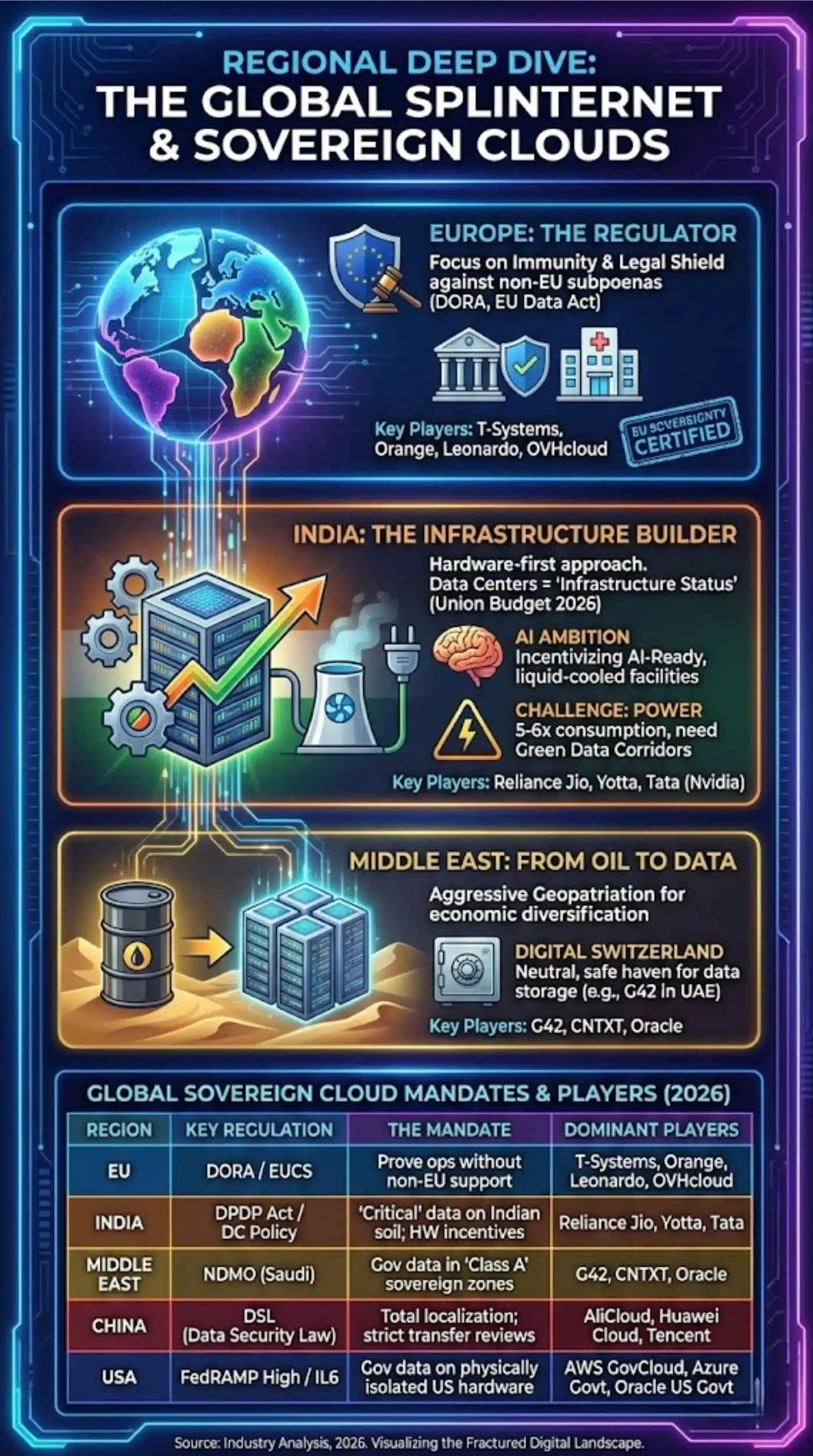
The “World Wide Web” is fracturing into a “Splinternet” of federated regional clouds.
Europe: The Regulator
Europe remains the epicenter of Geopatriation. The EU Data Act and DORA have effectively outlawed the use of non-sovereign clouds for banking and health. The focus here is on “Immunity”—ensuring European data cannot be subpoenaed by US courts.
India: The Infrastructure Builder
As highlighted in the Union Budget 2026, India has taken a hardware-first approach.
- Infrastructure Status: Data centers have been granted “Infrastructure Status” (on par with highways and airports), unlocking easier credit and faster approvals.
- The AI Ambition: India views data centers as the engine room for its AI ambitions. The government is heavily incentivizing “AI-Ready” data centers that use liquid cooling and sustainable power to support sovereign AI model training.
- The Challenge: Power. AI racks consume 5-6x more power than traditional servers, putting immense strain on India’s grid and necessitating “Green Data Corridors.”
Middle East: From Oil to Data
Saudi Arabia and the UAE are aggressively geopatriating data to diversify their economies. They are funding massive sovereign clouds (like G42 in the UAE) to ensure they become the “Digital Switzerland” of the Middle East—a neutral, safe haven for data storage.
| Region | Key 2026 Regulation | The Mandate | Dominant Sovereign Players/Partners |
| European Union | DORA / EUCS (Certification Scheme) | Banks must prove they can operate without non-EU support. | T-Systems (Germany), Orange (France), Leonardo (Italy), OVHcloud. |
| India | DPDP Act / Data Centre Policy 2026 | “Critical” data cannot leave Indian soil; Hardware incentives. | Reliance Jio, Yotta, Tata Communications (Partnering with Nvidia). |
| Middle East | National Data Management (NDMO) | Gov data must be hosted in “Class A” sovereign zones. | G42 (UAE), CNTXT (Saudi Arabia – Google Partner), Oracle. |
| China | DSL (Data Security Law) | Total localization; strict cross-border transfer reviews. | AliCloud, Huawei Cloud, Tencent (State-backed infrastructure). |
| USA | FedRAMP High / IL6 | Government data must be on physically isolated US-only hardware. | AWS GovCloud, Azure Government, Oracle US Govt Cloud. |
Strategic Challenges: The Costs of Sovereignty
While Geopatriation solves legal risks, it introduces significant business challenges that CIOs must manage.
1. The “Innovation Lag”
This is the most painful trade-off. Global hyperscalers roll out their cutting-edge features (like the latest reasoning agents or quantum simulations) to their primary US regions first.
- The Delay: Sovereign clouds, which require rigorous code sanitization and local vetting, often receive these updates on a 6-to-12-month lag.
- The Dilemma: Companies must choose: Do you want your data safe (Sovereign) or smart (Latest AI)?
2. The “Sovereignty Tax”
Fragmenting infrastructure destroys economies of scale.
- Cost: A geopatriated workload costs 20-30% more than a global public cloud workload.
- Hardware Scarcity: Access to the latest Nvidia GPUs is often prioritized for the massive global clusters, leaving smaller sovereign clouds fighting for allocation.
| Metric | Global Public Cloud (AWS/Azure/Google – Standard) | Sovereign Cloud (Partnerships/Neoclouds) | The 2026 Reality |
| AI Capabilities | Cutting Edge: Access to GPT-5 level models immediately. | Lagging: Access to sanitized models 6-9 months later. | CIOs must choose: “Smart” vs. “Safe.” |
| Scalability | Infinite: Burst into any region globally. | Finite: Limited by local hardware availability. | Hardware rationing is common in sovereign zones. |
| Cost Efficiency | High (Economies of Scale). | Low (Duplicated Infrastructure). | Expect a 20-30% premium for sovereign instances. |
| Compliance | Risk: Vulnerable to extraterritorial subpoenas (US/China). | Secure: Protected by local jurisdiction laws only. | Mandatory for “Crown Jewel” data (IP/Citizen Data). |
| Resilience | Shared Risk: A global config error can take down the region. | Isolated: “Air-gapped” from global outages. | Sovereign clouds survived the major 2025 outages unscathed. |
3. The Talent Gap: “SovOps”
A new discipline is emerging: SovOps (Sovereign Operations).
- Developers must now learn how to build applications that are “location-aware.” An app can no longer simply call an API; it must first check which jurisdiction it is running in and which APIs are legally permissible to use.
- Finding engineers who understand both Kubernetes and International Data Law is the biggest hiring bottleneck of 2026.
Future Outlook: Beyond 2026
Where does this trend go next?
- Federated AI: To solve the “Innovation Lag,” the industry will move toward Federated Learning. Instead of moving data to a central AI model, the model travels to the data. It learns locally and sends only the insights back, preserving sovereignty.
- The “Clean Cloud” Standard: We may see the emergence of a “WTO for Data”—a global standard for “Clean Clouds” that are certified as neutral and safe, allowing for a partial reconnection of the Splinternet.
Action Plan for Business Leaders
- Audit Your “Crown Jewels”: Do not geopatriate everything. Identify the 10-15% of data that is critical IP or regulated. Keep the rest on the cheap global cloud.
- Demand “Portability”: Ensure your applications are built on open standards (containers, open-source AI) so you can move them between Sovereign and Global clouds without rewriting code.
- Invest in “SovOps”: Train your platform engineering teams on policy-as-code tools that automatically enforce geographic restrictions.
Final Words: The End of Neutrality
The “Geopatriation” shift of 2026 marks the definitive end of the internet’s innocent era. For thirty years, we operated under the assumption that digital space was neutral ground—a place where code superseded culture and connectivity ignored conflict. That assumption has been retired.
We are witnessing the “Great Realignment” of IT infrastructure. The priorities of the C-Suite have flipped: Resilience has replaced Efficiency. The question is no longer “Where is the cheapest place to process this data?” but rather “Whose flag flies over the server?”
For business leaders, the challenge of the next decade is not technical, but navigational. You must now steer your organizations through a “Splinternet” where data, like people, needs a passport to travel. The winners will be those who accept this fragmentation not as a temporary glitch, but as the new permanent architecture of the global economy.