Geoeconomic Confrontation 2026 has officially displaced armed conflict and climate disasters to become the singular, defining threat of our time, according to the newly released World Economic Forum (WEF) Global Risks Report 2026. We have exited the post-Cold War era of globalization and entered what analysts are calling the “Age of Competition”, a volatile period where the tools of economics are no longer used just for prosperity, but as weapons of statecraft.
For decades, the global operating system was built on the premise that economic integration prevents war. The theory was simple: countries that trade with each other do not fight each other. In 2026, that theory has been inverted. Today, trade is the fight. From the semiconductor blockades in East Asia to the weaponization of the US dollar and the critical mineral export bans in the Global South, the global economy has been Balkanized.
This analysis provides a comprehensive deep-dive into the WEF’s findings, examining the triggers, the data, and the catastrophic ripple effects of this new global posture. We will explore how “multipolarity without multilateralism” is reshaping everything from your investment portfolio to the stability of national borders.
The Age of Competition: The End of the Post-War Order
The headline of the 2026 Davos summit is stark: 18% of global leaders now identify geoeconomic confrontation as the risk most likely to trigger a societal collapse in the next two years. This is not a distant forecast; it is the immediate reality.
The Death of “Davos Man”
For thirty years, the “Davos Man”, the archetype of the globalist elite, preached a borderless world. In 2026, that ideal is dead. It has been replaced by a hardened realism. The WEF report characterizes the current landscape as a “geopolitical recession,” where the institutions designed to mediate disputes, the WTO, the UN, and the IMF, have been rendered impotent by the very powers that created them.
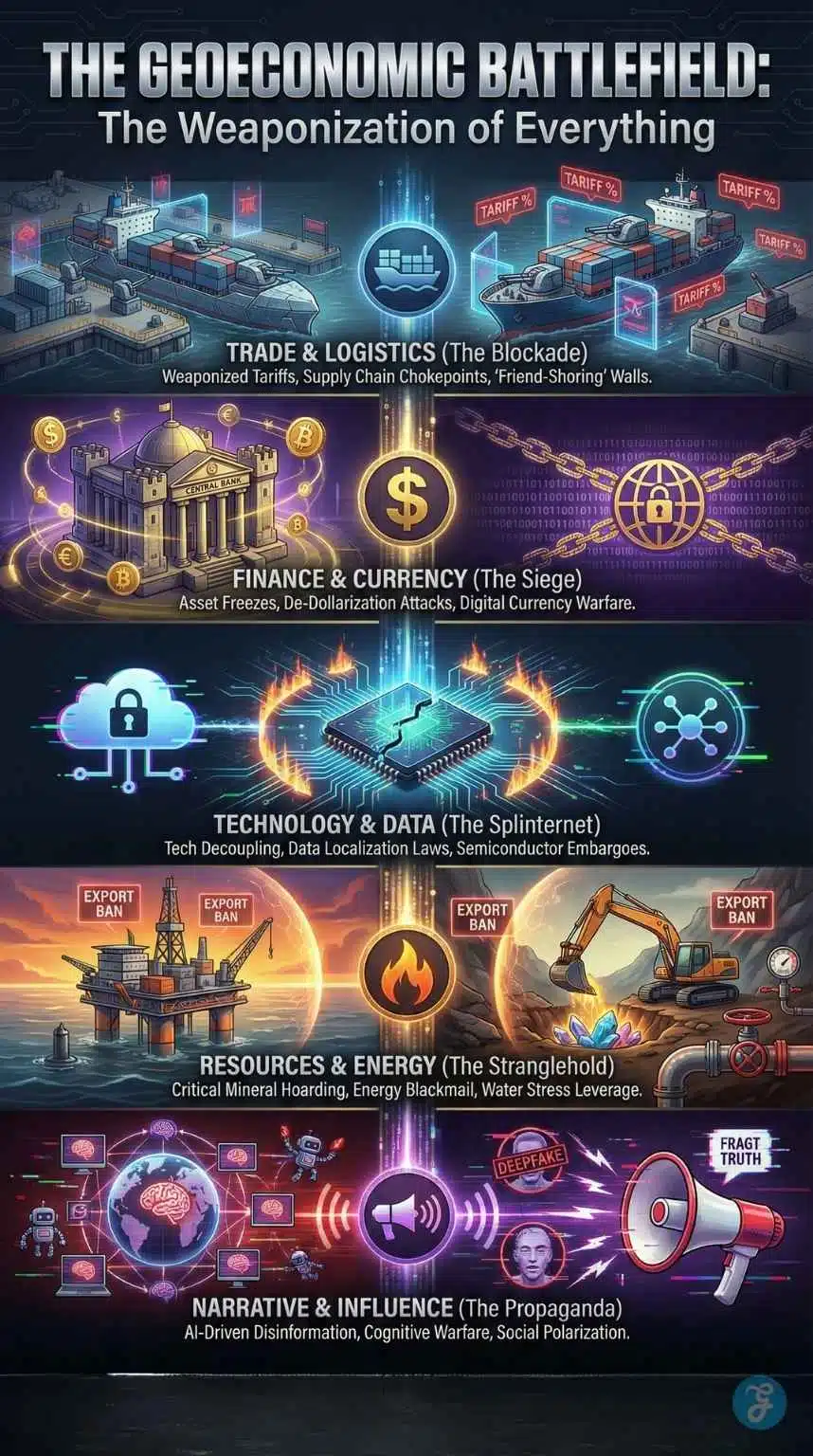
The definition of Geoeconomic Confrontation 2026 goes beyond traditional trade wars (like the tariff skirmishes of 2018). It refers to the systemic weaponization of economic interconnectedness. It includes:
- Sanctions and Embargoes: Used not just to punish, but to obliterate opposing economies.
- Investment Screening: Blocking foreign capital on “national security” grounds.
- Technological Decoupling: The “Splinternet” and the bifurcation of 6G standards.
- Currency Warfare: The active effort to de-dollarize or weaponize payment systems like SWIFT.
The Thesis of Fragmentation
The central thesis of this new era is that efficiency is no longer the primary goal of the global economy; security is. Nations are willingly sacrificing GDP growth, accepting higher inflation, and disrupting established supply chains to achieve strategic autonomy.
As we analyze the fallout, one thing is clear: the confrontation is asymmetric. It is not just the US versus China. It is the North versus the South, the energy-rich versus the energy-poor, and the “Digital Sovereigns” versus the “Data Colonies.” The fragmentation is total.
The Data Landscape: Inside the WEF Global Risks Report 2026
To understand the severity of the threat, we must look at the data. The Global Risks Report 2026 is not just a survey; it is a barometer of global anxiety.
The Rankings: A Meteoric Rise
In 2024 and 2025, “Cost of Living” and “Extreme Weather” dominated the charts. This year, Geoeconomic Confrontation climbed 8 positions to take the #1 spot. This is the fastest rise of any risk in the report’s history.
- Geoeconomic Confrontation
- Misinformation/Disinformation
- Societal Polarization
- Extreme Weather Events
- Interstate Armed Conflict
The fact that economic confrontation ranks higher than armed conflict is telling. It suggests that leaders believe the next great war will be fought not with ballistics, but with banks, blockades, and bytes.
Top 5 Global Risks 2026 [Snapshot]
| Rank | Risk Category | Primary Driver | Global Impact |
| #1 | Geoeconomic Confrontation | Weaponization of trade, sanctions, & tech decoupling. | Fragmentation of global markets; “just-in-case” supply chains. |
| #2 | Misinformation & Disinformation | AI-generated content & state-sponsored propaganda. | Erosion of trust; domestic instability; polarized elections. |
| #3 | Societal Polarization | Economic inequality & ideological divides. | Civil unrest, strikes, and paralysis of political systems. |
| #4 | Cyber Insecurity | Attacks on critical infrastructure (power, finance). | Disruption of services; data theft; potential for physical damage. |
| #5 | Interstate Armed Conflict | Territorial disputes & proxy wars. | Regional instability; humanitarian crises; disrupted energy flows. |
Sentiment Analysis: The Storm Ahead
The outlook from the 1,500 experts surveyed is overwhelmingly grim.
- 50% anticipate a “turbulent or stormy” global outlook for the next two years.
- 57% believe this turbulence will persist for the next decade.
- Only 1% see a return to “calm” stability.
This data point, the “1% optimism,” is a shocking indictment of the current geopolitical climate. It indicates a total loss of faith in diplomatic solutions.
The “Risk Nexus”
Geoeconomic confrontation does not exist in a vacuum. It acts as a “force multiplier” for other risks.
- The Disinformation Link (#2 Risk): As nations engage in economic warfare, they must justify the pain (higher prices, lost jobs) to their citizens. This requires a domestic propaganda machine. We are seeing a surge in state-sponsored narratives blaming “foreign economic aggressors” for domestic failures, fueling xenophobia and nationalism.
- The Polarization Link (#3 Risk): Economic warfare creates winners and losers. In 2026, we are seeing the hollowing out of the middle class in export-dependent nations (like Germany and South Korea), leading to massive strikes and the rise of populist, anti-trade political parties.
The Drivers: Triggers of the 2026 Confrontation
What caused this shift? The report and independent analysts point to a clash of two distinct grand strategies: the American “Godfathering” and the Chinese “Silk Doctrine.”
The “Godfathering” Strategy
The United States, particularly under the resurgence of “America First” policies in the 2026 landscape, has adopted a strategy analysts call “Godfathering.” This approach demands absolute loyalty from allies in exchange for security guarantees and market access.
- The Ultimatum: Allies are increasingly forced to choose: integrate with the US industrial base or face exclusion. This was vividly displayed in the recent Greenland Dispute, where the US “defense takeover” proposal effectively sidelined Danish sovereignty, framing it as a necessary measure for North American security against Russian and Chinese Arctic encroachment.
- Protectionism as Policy: The era of free trade is over in Washington. The new ethos is “Make it here, or pay to bring it here.” This has alienated traditional partners in the EU, who now face the same tariffs as adversaries if they do not align with US standards on digital tax and carbon adjustments.
The “Silk Doctrine” Evolution
Conversely, Beijing has evolved its Belt and Road Initiative into the “Silk Doctrine.” Recognizing that Western markets are closing, China has pivoted to dominating the means of production for the future economy.
- Critical Infrastructure: Instead of just building roads, China is now focusing on controlling the “nodes” of the global economy, ports, 6G grids, and lithium processing facilities in the Global South.
- The Global South Pivot: Facing EU and US barriers, China has aggressively courted the “non-aligned” world, Brazil, South Africa, Indonesia, offering technology transfers and infrastructure without the “moral strings” attached by Western loans.
Resource Nationalism
The third driver is the scramble for resources. In 2026, commodities are national security assets.
- The Mineral Ban: Following the US lead, nations like Indonesia and Zimbabwe have implemented total bans on the export of raw critical minerals (nickel, lithium). They now demand that processing happen domestically. This “beneficiation” policy is driving up costs for Western tech companies and sparking trade disputes at the WTO.
- Food as a Weapon: With the “Winter Siege” in Ukraine entering its fifth year and climate change disrupting harvests, grain exports have become a diplomatic lever. Russia’s manipulation of wheat supplies to African nations continues to buy it diplomatic cover at the UN.
Global Flashpoints: Where Economics Meets Conflict
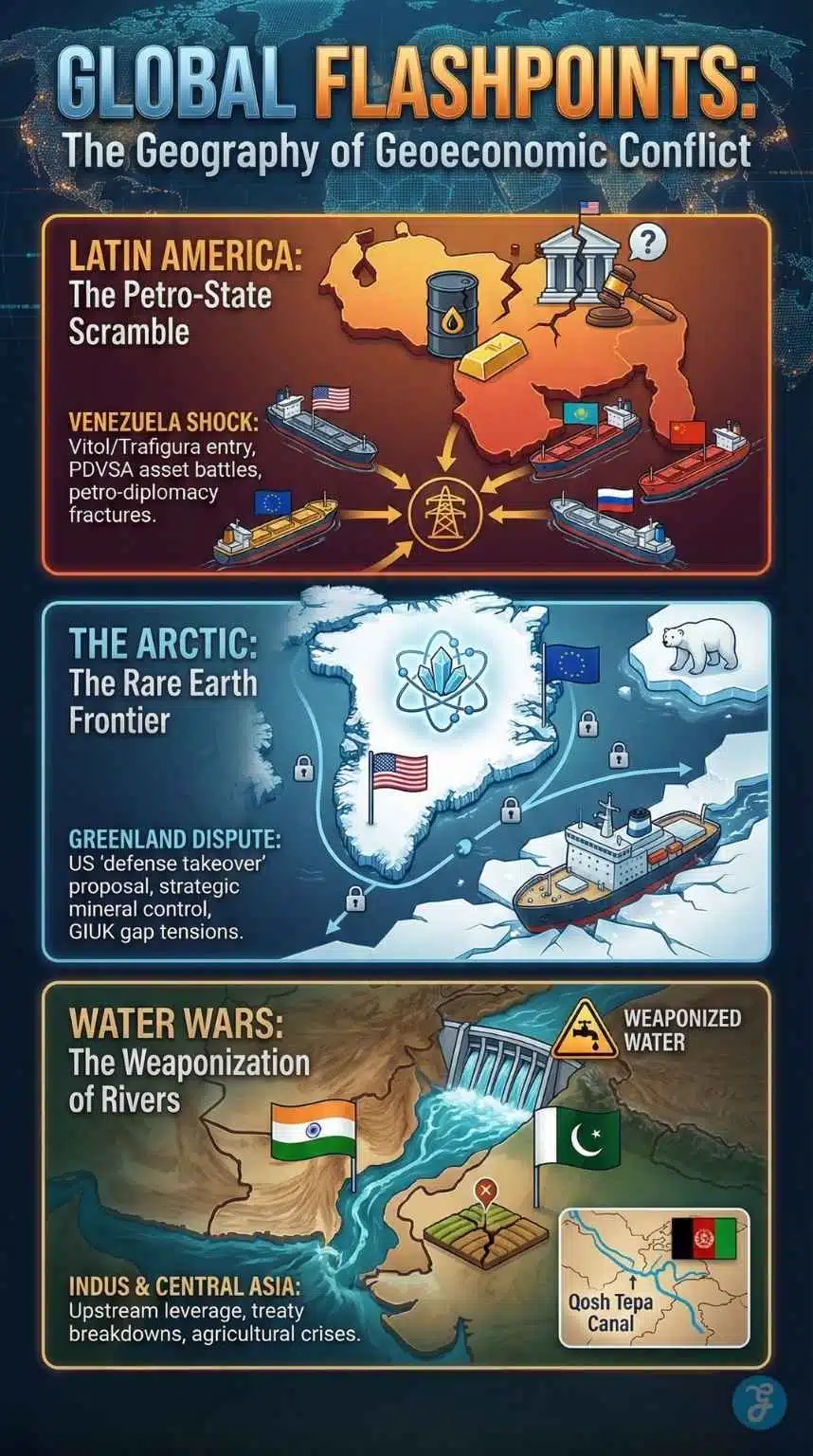
The abstract concept of “Geoeconomic Confrontation 2026” is manifesting in specific, violent, and chaotic flashpoints around the globe.
Latin America: The Venezuela Shock
The most significant geoeconomic event of early 2026 has been the upheaval in Venezuela. The ousting of Nicolás Maduro has triggered a chaotic “gold rush” for the world’s largest oil reserves.
- The Corporate Entry: Western energy traders, notably Vitol and Trafigura, have immediately entered the market, navigating a fragile security situation to secure contracts. This is not just business; it is geostrategy. The West is desperate to bring Venezuelan heavy crude online to offset the loss of Russian barrels and stabilize global prices.
- The Geopolitical Tussle: This move has infuriated Moscow and Beijing, who held significant debts against the Maduro regime. The struggle for control over PDVSA (the state oil company) is now a proxy economic war, with legal battles over asset seizures likely to clog international courts for a decade.
The Arctic: The Greenland Crisis
The Arctic has long been considered a “zone of peace,” but 2026 has shattered that illusion. The US proposal for a “defense takeover” of Greenland, citing the need to secure the GIUK gap and rare earth deposits, has sparked a diplomatic crisis within NATO.
- The Economic Angle: This is not just about missiles; it is about mining. Greenland holds some of the world’s largest undeveloped deposits of neodymium and dysprosium, essential for EVs and fighter jets. The US move is a direct attempt to preempt Chinese mining interests that had been courting the Nuuk government.
- EU Retaliation: The European Union, fearing the loss of strategic autonomy in its own backyard, has threatened “counter-measures” against US tech firms if European sovereign rights in the Arctic are ignored.
Water Wars: The Hidden Front
The WEF report ominously warns of “weaponized water.” As climate stress intensifies, upstream nations are building dams not just for power, but for leverage.
- The Indus Powder Keg: Tensions between India and Pakistan have spiked over new hydroelectric projects on the Chenab and Jhelum rivers. With the 1960 Indus Waters Treaty effectively frayed, water flow is being used as a tool of coercion.
- The Qosh Tepa Canal: In Central Asia, the Taliban’s completion of the Qosh Tepa Canal is diverting massive amounts of water from the Amu Darya, threatening the cotton economies of Uzbekistan and Turkmenistan. This has turned water into a primary driver of regional economic conflict.
The Rise of the “Transactional Powers”
In the vacuum left by the fracturing of the US-China duopoly, a new bloc of power brokers has emerged. The WEF report highlights the ascent of the “Transactional Powers”, specifically Brazil, India, Indonesia, Saudi Arabia, South Africa, and Turkey.
Unlike during the Cold War, these “Swing States” are refusing to align permanently with either the “Blue Bloc” (West) or the “Red Bloc” (East). Instead, they are leveraging their geoeconomic weight to extract concessions from both.
- The “Table, Not the Menu” Doctrine: As highlighted by analysts at the Davos summit, these nations have adopted a maxim: “If you are not at the table, you are on the menu.” They are aggressively asserting their own national interests.
- Strategic Ambiguity: Saudi Arabia, for instance, continues to sell oil in Yuan to China while negotiating defense pacts with Washington. India navigates Western tech partnerships while maintaining its refusal to condemn Russian energy exports. In 2026, this “strategic ambiguity” is no longer seen as fence-sitting; it is the most profitable diplomatic strategy available.
The New Geopolitical Blocs [Who Stands Where?]
A visual breakdown of the complex alliances mentioned in the text.
| Bloc | Key Nations | Economic Strategy | Key 2026 Objective |
| The Blue Bloc | USA, UK, EU, Japan, Australia, Canada | “Friend-Shoring” | Decouple from adversarial dependencies; secure critical supply chains (chips, defense). |
| The Red Bloc | China, Russia, Iran, North Korea | “The Silk Doctrine” | Build a parallel economic order (non-dollar trade); dominate manufacturing & infrastructure. |
| The Transactional Powers | India, Saudi Arabia, Brazil, Turkey, Indonesia | “Multi-Alignment” | Play both sides to maximize national gain; refuse permanent alignment; extract concessions. |
The Economic Fallout: “The Weaponization of Everything”
What does this mean for the global economy? The era of “just-in-time” efficiency is being replaced by “just-in-case” redundancy, and the costs are staggering.
Trade Fragmentation and the WTO’s Demise
The World Trade Organization (WTO) is functionally paralyzed. The dispute settlement mechanism is broken, and nations are openly flouting rules.
- Global Trade Growth: UNCTAD projects global trade growth will plummet to 2.2% in 2026, down from 3.8% the previous year. This slowdown is not cyclical; it is structural.
- Friend-Shoring: We are seeing the crystallization of trade into three distinct blocs:
- The Blue Bloc: US, UK, Japan, Australia (The G7 core).
- The Red Bloc: China, Russia, Iran, North Korea.
- The Grey Zone: The “Transactional Powers” (India, Saudi Arabia, Turkey, Brazil) that play both sides.
The Asset Bubble Risk [Rank #18]
A critical finding in the WEF report is the jump in “Asset Bubble Bursts” to the #18 risk spot.
- The Mechanism: Geoeconomic confrontation creates inflation (due to tariffs and supply shocks). Central banks must keep interest rates higher for longer to fight this inflation. High rates + high global debt + slow growth = a recipe for defaults.
- The Trigger: A major sovereign default in an emerging market (potentially Pakistan or Egypt) or a commercial real estate collapse in a major financial hub could trigger a contagion event that global markets cannot absorb.
The AI Multiplier: Algorithmic Economic Warfare
While Geoeconomic Confrontation is the primary driver of risk, Artificial Intelligence has become its unpredictable accelerant. The WEF report notes a shocking statistic: concerns over “Adverse Outcomes of AI” have jumped from 30th place to 5th place in the long-term risk horizon, the fastest rise of any risk category in history.
- The AI Asset Bubble: The report warns that the geoeconomic war is fueling a desperate “AI Arms Race,” leading to massive, speculative capital flows into unproven AI infrastructure. With 40% of leaders fearing an AI-driven asset bubble burst in 2026, the tech sector, once the engine of growth, is now viewed as a potential source of systemic contagion.
- Automated Disinformation: In the context of economic warfare, AI is being used to conduct “narrative attacks.” We are seeing the deployment of autonomous bot swarms designed to crash specific stocks, spread rumors of bank runs, or delegitimize the currency of rival nations. In 2026, a market crash may not be triggered by a bad earnings report, but by a deepfake CEO announcement.
Inflation 2.0: The Supply Shock Era
We are entering a period of “Structural Inflation.” Unlike the monetary inflation of 2021-2022, this is driven by the physical cost of doing business in a hostile world.
- Shipping Costs: With the Red Sea permanently unsafe and the Panama Canal restricted by drought, shipping insurance premiums have skyrocketed.
- Compliance Tax: Companies are spending billions on compliance, tracking supply chains to ensure no forced labor, no sanctioned entities, and no “conflict minerals.” These costs are passed directly to the consumer.
For investors and corporations, the playbook has changed. The old rules of “growth at all costs” are dangerous. The new rule is “survival through diversification.”
The “Safe Haven” Rush: Gold at $4,700
The financial markets are already pricing in the catastrophe. Gold has shattered records, trading past $4,700 per ounce in January 2026.
- De-Dollarization Hedge: Central banks, particularly in the Global South, are buying gold at a record pace to diversify their reserves away from the US dollar, fearing they could be the next target of sanctions (like Russia in 2022).
- The Crypto Factor: Bitcoin and decentralized finance (DeFi) are increasingly viewed as “insurance” against state seizure. In a world of capital controls and frozen assets, censorship-resistant money has a premium use case.
Corporate Strategy: The Geopolitical Risk Officer
The C-Suite has a new power player: the Chief Geopolitical Risk Officer. Companies like Apple, Tesla, and Siemens are restructuring their operations.
- China+N Strategy: It is no longer enough to have a “China Plus One” strategy. Companies are moving to “China Plus Three” (India, Vietnam, Mexico) to create redundant supply webs.
- The “Split Stack”: Tech companies are preparing to run two completely separate ecosystems: one for the Western internet and one for the authoritarian internet, with firewalls between them to prevent data leakage and regulatory fines.
The compliance burden is immense. The US “Foreign Direct Product Rule” (FDPR) means that if a product contains even a tiny percentage of US technology, the US claims jurisdiction over where it can be sold. This extraterritorial reach is a minefield for multinationals, forcing them to “de-Americanize” their supply chains to sell to China, or “de-Sinicize” to sell to the US.
Future Outlook: The 10-Year Horizon
Is this a temporary storm, or the new climate? The WEF report suggests the latter.
The Pessimistic Consensus
68% of experts expect a “multipolar or fragmented order” to dominate the next decade. This suggests that the current tensions will not resolve; they will calcify. We are building the walls of a new Cold War, one that is more complex and dangerous because of the deep economic integration that still exists.
The Environmental Casualty
The greatest victim of Geoeconomic Confrontation 2026 may be the planet itself.
- Green Trade Wars: The EU’s Carbon Border Adjustment Mechanism (CBAM) and the US Inflation Reduction Act (IRA) have triggered a subsidy war. Instead of collaborating on green tech, nations are fighting over it.
- The Solar Blockade: New trade barriers imposed by the EU on Chinese wind and solar components (Jan 15, 2026) will slow down the energy transition. By making green tech more expensive through tariffs, the global fight against climate change is being sacrificed on the altar of geopolitical competition.
The Human Cost: Demographic Bifurcation
Underlying the trade wars is a deeper, structural collision described by the WEF as “Demographic Bifurcation.”
- The Aging North: The “Blue Bloc” (G7 nations) is facing a demographic winter, with shrinking workforces and exploding pension obligations. They need immigration to survive economically, but are politically paralyzed by anti-migration sentiment.
- The Young South: Conversely, the “Global South” is experiencing a youth boom but lacks the job creation to support it due to the very trade barriers the North is erecting.
- The Collision: This imbalance is creating a “pressure cooker” effect. As geoeconomic confrontation stifles global growth, the lack of opportunity in the South is driving unprecedented waves of “economic survival migration.” The 2026 report warns that if trade barriers continue to rise, we will see not just “caravans,” but the structural displacement of millions, turning border security into the ultimate economic battleground.
Final Words: The New Normal
The “Geoeconomic Confrontation 2026” is not a glitch; it is a feature of the new world order. The 2026 Global Risks Report serves as a wake-up call that the logic of the market, efficiency, speed, and low cost has been overruled by the logic of the state, power, security, and control.
For the average citizen, this means a world of higher prices, restricted travel, and persistent uncertainty. For the investor, it means the end of passive indexing and the return of active risk management. And for global leaders, it presents a terrifying paradox: to secure their nations, they are taking steps that make the world collectively more dangerous.
As we look toward the rest of 2026, the question is not whether the confrontation will end, but whether it can be contained before the economic warfare turns kinetic. In the “Age of Competition,” the line between a trade war and a real war is becoming dangerously thin.