Gaming has evolved beyond entertainment to become a powerful tool for cognitive enhancement. Over the years, extensive research has highlighted how gaming-and-cognitive-skills are deeply interconnected.
Many modern games push the brain to develop memory, problem-solving skills, spatial awareness, and multitasking abilities.
This article will explore the science behind how video games can improve various cognitive functions and provide actionable insights backed by studies.
Understanding the Science Behind Gaming and Brain Function
Gaming is not just about fun and entertainment; it also has profound effects on the brain. Research has shown that playing video games can significantly enhance cognitive skills, helping players develop better memory, attention, and problem-solving abilities. Whether it’s action-packed shooters or strategic puzzle games, each type of gaming engages different areas of the brain, leading to long-term cognitive benefits.
How Gaming Affects Brain Plasticity
Gaming is more than just a source of entertainment—it actively reshapes the brain. Engaging with different game genres can significantly impact cognitive abilities by strengthening neural connections. Whether it’s action-packed challenges that enhance decision-making or strategy games that boost problem-solving skills, gaming-and-cognitive-skills are closely linked through the process of brain plasticity.
- Neuroplasticity refers to the brain’s ability to reorganize itself by forming new neural connections.
- Complex and strategic games stimulate brain plasticity, leading to improvements in memory, reasoning, and decision-making skills.
- MRI scans show that regular gaming can lead to structural changes in key brain areas associated with learning and adaptation.
Key Brain Regions Affected by Gaming
| Brain Region | Function | Impact of Gaming |
| Hippocampus | Memory & Learning | Increased gray matter improves recall |
| Prefrontal Cortex | Decision-Making | Enhances logical reasoning and focus |
| Cerebellum | Motor Control | Improves coordination and reaction time |
Gaming and Cognitive Load Management
Gaming-and-cognitive-skills are deeply tied to how efficiently the brain manages multiple information streams. Video games challenge players to juggle various tasks, process information rapidly, and make split-second decisions, all of which contribute to cognitive load management.
By engaging in complex gaming scenarios, players enhance their ability to filter distractions, prioritize information, and adapt to dynamic environments.
- Video games require players to process multiple streams of information simultaneously, aiding cognitive load management.
- Research indicates that gamers exhibit superior attention management, faster reaction times, and better problem-solving abilities compared to non-gamers.
Comparison of Cognitive Load Processing in Gamers vs. Non-Gamers
| Cognitive Skill | Gamers | Non-Gamers |
| Attention Span | Higher | Lower |
| Task-Switching | Faster | Slower |
| Problem-Solving Speed | Improved | Average |
Key Cognitive Benefits of Playing Video Games
Gaming-and-cognitive-skills are widely studied due to their impact on brain functions. Researchers have found that different types of games help improve various cognitive abilities, such as memory retention, problem-solving, attention span, and motor skills.
Video games act as a form of mental exercise, helping to develop cognitive functions similarly to traditional brain-training exercises.
Whether it’s strategy games sharpening decision-making or action games boosting reaction times, the benefits of gaming are diverse and scientifically supported.
Improved Visual Processing and Attention
Gaming-and-cognitive-skills are closely linked to visual perception and processing abilities. Many video games require players to rapidly analyze and react to complex visual stimuli, leading to improved pattern recognition, faster response times, and heightened awareness. These enhancements are particularly evident in fast-paced action games, where players must constantly monitor multiple elements on the screen, track moving objects, and make split-second decisions.
How Action Games Sharpen Visual Attention
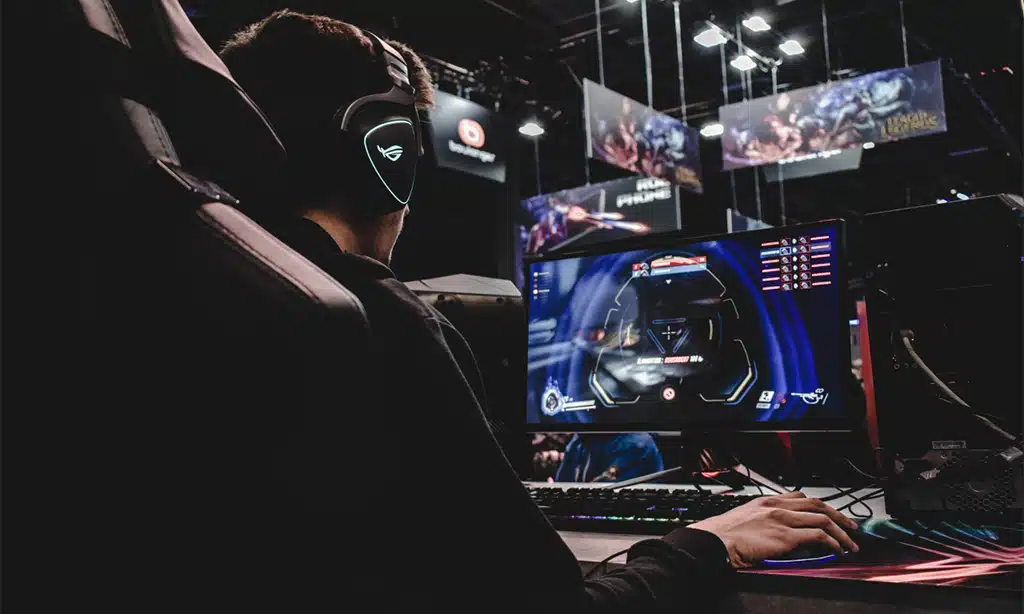
- Action-packed video games require players to track multiple moving objects, improving peripheral vision and selective attention.
- Studies confirm that first-person shooter (FPS) games enhance the ability to identify and respond to visual stimuli quickly.
Impact of Action Games on Visual Skills
| Skill Improved | Gaming Benefit |
| Peripheral Vision | Better object tracking |
| Reaction Time | Faster response to stimuli |
| Focus & Attention | Improved sustained attention |
Boosting Hand-Eye Coordination
- Gaming enhances motor skills by requiring precise hand movements and real-time reactions.
- Professions such as surgery and aviation have benefited from individuals with gaming backgrounds due to their improved coordination.
Strengthened Problem-Solving and Critical Thinking Skills
Gaming-and-cognitive-skills are deeply interconnected when it comes to problem-solving and critical thinking. Video games provide immersive environments that challenge players to analyze situations, strategize solutions, and adapt to new obstacles in real time.
Engaging in these mentally stimulating activities strengthens cognitive flexibility, decision-making, and logical reasoning, all of which are valuable in real-world applications.
How Strategy and Puzzle Games Train the Brain
- Strategy games encourage planning, resource management, and critical thinking, which translate to real-life skills.
- Chess-based and role-playing games (RPGs) help anticipate multiple outcomes and enhance logical reasoning.
Cognitive Benefits of Strategy and Puzzle Games
| Game Genre | Cognitive Benefit |
| Strategy | Enhances planning and foresight |
| Puzzle | Boosts logic and analytical thinking |
| Role-Playing | Improves decision-making |
Decision-Making and Risk Assessment in Gaming
Gaming-and-cognitive-skills play a vital role in enhancing decision-making abilities. Many games require players to assess risks, anticipate consequences, and make quick yet strategic choices. These skills are transferable to real-world situations, such as business decision-making, crisis management, and even medical diagnostics.
Games that simulate real-life risk scenarios, such as FPS and MOBA games, help train players to evaluate consequences effectively, boosting their ability to handle high-pressure situations in everyday life.
- FPS and multiplayer online battle arena (MOBA) games require quick yet calculated decisions, honing strategic thinking.
Enhanced Memory and Learning Abilities
Gaming-and-cognitive-skills are essential when it comes to enhancing memory and learning abilities. Video games stimulate different areas of the brain responsible for memory retention, recall, and cognitive processing.
Whether engaging in complex role-playing games (RPGs) that require tracking multiple objectives or puzzle games that challenge logical thinking, gaming has been shown to strengthen both short-term and long-term memory functions.
Strengthening Short-Term and Long-Term Memory
- Memory-enhancing games such as Sudoku and digital brain-training games improve cognitive retention.
Impact of Different Game Genres on Memory Functions
| Game Type | Memory Type Improved |
| Adventure | Long-term memory |
| Puzzles | Short-term memory |
| RPGs | Working memory |
Educational Games and Their Role in Cognitive Growth
- Gamification in learning improves retention and engagement.
- Apps like Duolingo, Brain Age, and Lumosity showcase how gaming can enhance learning and problem-solving.
Development of Mental Flexibility and Multitasking Skills
Gaming-and-cognitive-skills are closely linked to mental flexibility and multitasking abilities. Many video games require players to seamlessly switch between different tasks, objectives, and challenges, improving their cognitive adaptability.
These skills are not only beneficial in gaming scenarios but also translate into real-world applications, such as workplace efficiency and academic performance.
How Gamers Learn to Switch Tasks Effectively
- Action and real-time strategy (RTS) games require players to juggle multiple objectives simultaneously, boosting cognitive flexibility.
Real-world applications of Gaming-Enhanced Multitasking
| Profession | Cognitive Skill Improved |
| Surgeon | Precision & multitasking |
| Air Traffic Controller | Rapid decision-making |
| Engineer | Problem-solving |
Gaming-and-cognitive-skills are strongly linked to spatial awareness and navigation abilities. Video games, particularly open-world and puzzle-based genres, challenge players to navigate complex environments, improving their ability to process spatial information.
Research suggests that individuals who regularly engage with such games develop better mental mapping skills, which can be beneficial in real-world scenarios like driving, architecture, and engineering.
The Connection Between Gaming and 3D Spatial Cognition
- Open-world and navigation-heavy games improve a player’s ability to understand and manipulate 3D spaces.
- Research suggests that gamers outperform non-gamers in spatial navigation tasks.
Spatial Cognition Benefits from Different Game Genres
| Game Genre | Spatial Skill Enhanced |
| Open-World | Navigational skills |
| Puzzle | Mental rotation |
| FPS | Spatial awareness |
Mechanisms Behind Cognitive Enhancement Through Gaming
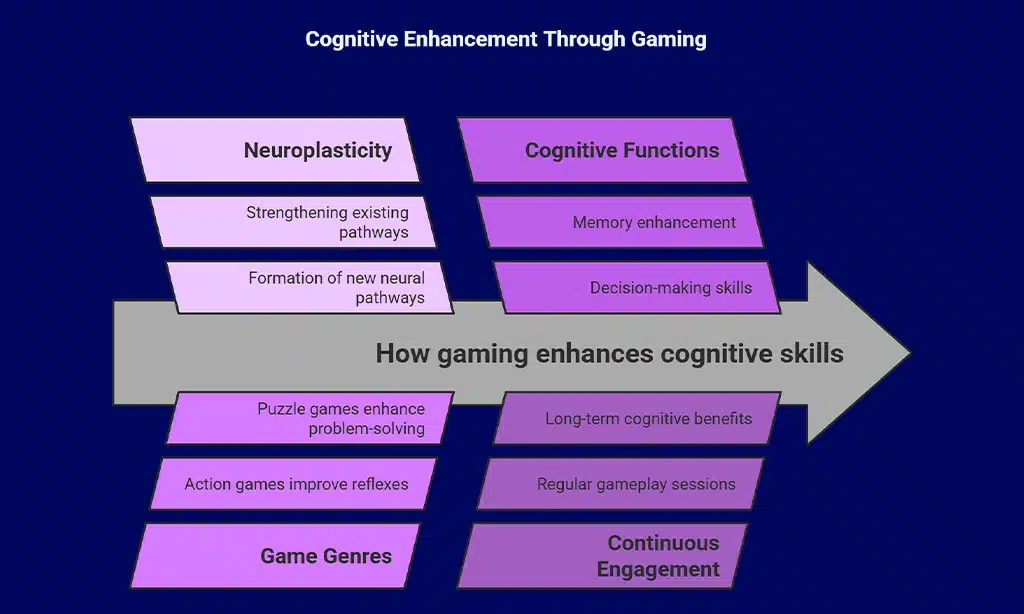
Gaming-and-cognitive-skills have a profound impact on the brain’s ability to adapt and evolve. Video games stimulate various cognitive functions, enhancing memory, decision-making, and spatial reasoning through continuous engagement.
Researchers have discovered that different game genres can contribute to neuroplasticity, promoting the formation of new neural pathways and strengthening existing ones.
The Impact of Neuroplasticity and Brain Growth
- Studies confirm that regular gaming leads to increased gray matter volume in critical cognitive areas.
- MRI scans reveal significant structural differences in the brains of avid gamers.
Dopamine and the Reward System in Gaming
- Gaming triggers dopamine release, reinforcing learning, motivation, and reward-based memory.
Comparison of Dopamine Response in Gamers vs. Non-Gamers
| Brain Function | Gamers | Non-Gamers |
| Dopamine Release | Higher | Lower |
| Reward Sensitivity | Increased | Average |
Stress Reduction and Its Role in Cognitive Performance
- Casual and immersive games lower cortisol levels, reducing stress and anxiety.
- Studies show a strong link between gaming and emotional resilience.
Addressing Common Myths and Concerns About Gaming
Gaming-and-cognitive-skills have been widely studied, leading to debates about their positive and negative impacts. While gaming offers various cognitive benefits, concerns persist regarding its potential downsides.
Understanding the balance between healthy gaming habits and excessive gameplay is essential for maximizing its advantages while minimizing risks.
Does Excessive Gaming Have Negative Effects??
- While gaming offers cognitive benefits, excessive play can lead to addiction and social isolation.
- Setting time limits and engaging in a balanced lifestyle is key to healthy gaming habits.
Cognitive Benefits of Gaming Across Different Age Groups
- Gaming provides cognitive benefits across all age demographics, from children to seniors.
Cognitive Benefits of Gaming by Age Group
| Age Group | Key Benefits |
| Children | Learning & creativity |
| Adults | Problem-solving & decision-making |
| Seniors | Memory retention & mental agility |
Takeaways
Gaming-and-cognitive-skills are deeply interconnected, with research confirming that gaming enhances visual perception, problem-solving, memory, multitasking, and spatial awareness. While moderation is key, strategic and well-designed games can be valuable tools for cognitive development.
As gaming technology advances, further research will continue to uncover new cognitive benefits, reinforcing the idea that gaming is not just entertainment but also a powerful brain-training tool.