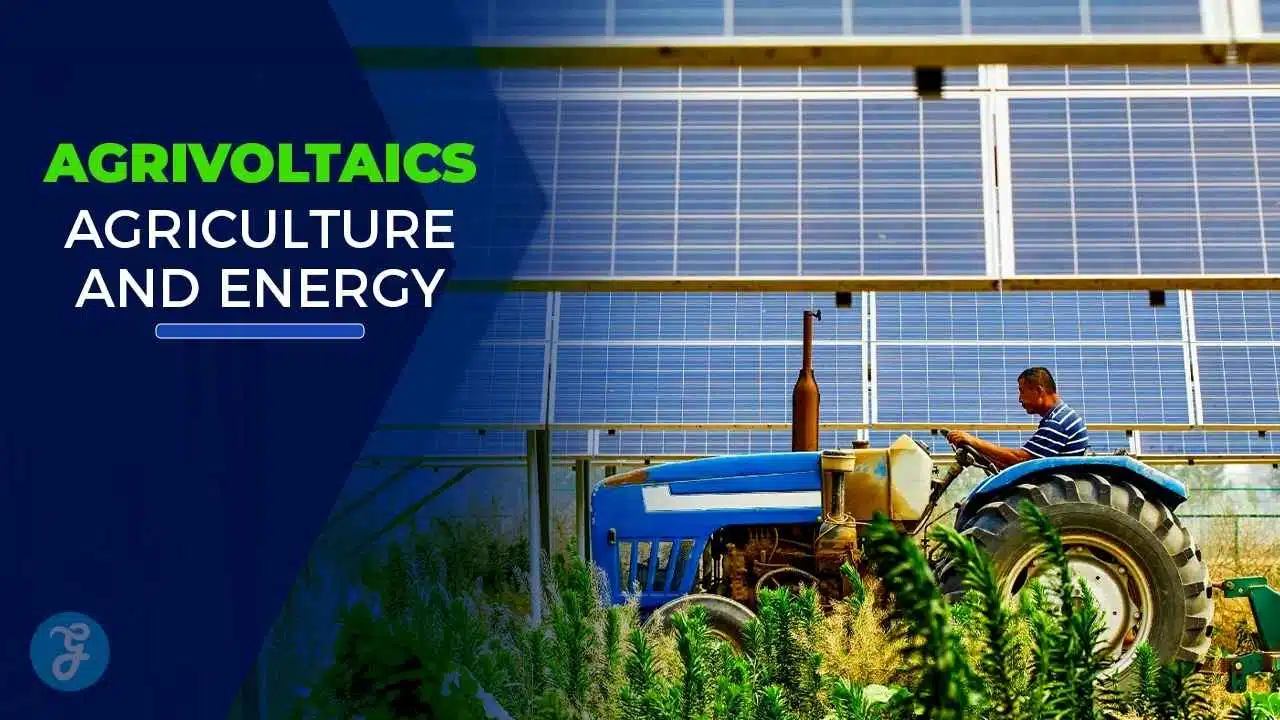
As the global population surges toward 8.5 billion, the competition for arable land has reached a fever pitch, forcing a confrontation between food security and the transition to renewable energy. Fortunately, the Future of Agrivoltaics in Sustainable Farming offers a revolutionary middle ground where energy production and agriculture are no longer rivals but synergistic partners.
In 2026, agrivoltaics, also known as dual-use solar or agri-PV, has evolved from a fringe experiment into a sophisticated, multi-billion-dollar industry. By harvesting both sunlight for electricity and the soil for produce on the same plot, farmers are discovering that they can significantly increase land-use efficiency while protecting crops from the increasingly volatile climate.
Key Takeaways: Why Agrivoltaics is the 2026 Standard
- Land Use Efficiency: Increases the total productivity of a single hectare by up to 60% to 70% by stacking energy and food production.
- Climate Resilience: Acts as a physical and thermal shield, protecting sensitive crops from the extreme weather patterns of the mid-2020s.
- Economic Stability: Provides a recession-proof, weather-proof revenue stream through electricity sales.
- Water Conservation: Reduces soil evaporation rates by nearly half, making farming viable in increasingly arid climates.
- Technological Maturity: 2026 marks the arrival of AI-driven, bifacial, and vertical systems that eliminate the “shading conflict” of older designs.
The Science of Symbiosis: Understanding the Microclimate Effect
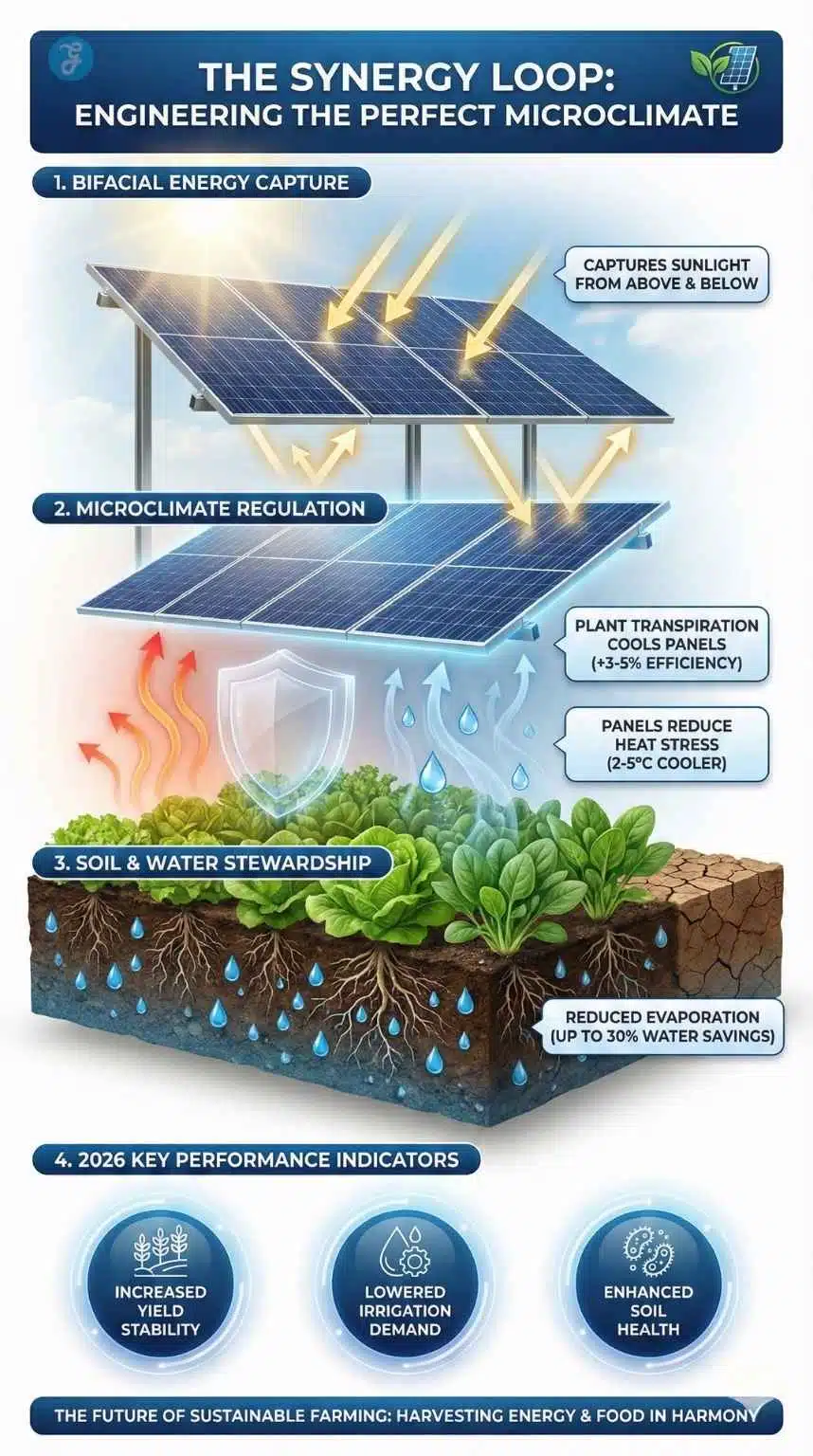
The core of the Future of Agrivoltaics in Sustainable Farming lies in a scientific phenomenon known as the “Efficiency Loop.” Traditionally, it was believed that placing solar panels over crops would inevitably stunt growth due to shading. However, modern research into Photosynthetically Active Radiation (PAR) has revealed that many crops reach a “light saturation point.” Beyond this point, extra sunlight doesn’t help the plant grow; instead, it causes heat stress and increases water demand.
Agrivoltaic systems are engineered to harvest the excess light that plants cannot use. By providing partial shade, the panels lower the ambient temperature beneath them by 2°C to 5°C. This reduction in heat stress allows the plants to focus their energy on biomass production rather than survival. Simultaneously, a fascinating cooling effect occurs for the technology itself.
As plants breathe (a process called transpiration), they release moisture into the air. This moisture cools the surrounding atmosphere, which in turn cools the solar panels above. Since PV panels lose efficiency as they heat up, this natural “refrigeration” can boost electricity generation by up to 3-5% compared to traditional ground-mounted solar farms.
Table 1: The Synergistic Benefits of Agrivoltaics
| Feature | Impact on Agriculture | Impact on Energy Production |
| Partial Shading | Reduces heat stress and sun-scorch on tender leaves. | Captures excess light that plants cannot process. |
| Evapotranspiration | Retains soil moisture; reduces irrigation needs by up to 50%. | Cool solar cells, increasing electrical conversion efficiency. |
| Physical Barrier | Protects crops from hail, heavy rain, and extreme frost. | Elevated structures allow for better airflow under the modules. |
| Microclimate | Moderates temperature extremes (warmer nights, cooler days). | A consistent operating environment extends panel lifespan. |
Technological Frontiers in 2026: AI and Bifacial Innovation
The technological landscape of agrivoltaics has shifted dramatically over the last two years. We have moved past simple fixed-tilt structures to Dynamic Agrivoltaic Systems that act as “intelligent canopies.”
AI-Driven Smart Tracking
In 2026, the most advanced farms utilize AI-driven solar trackers. These systems do not just follow the sun to maximize electricity; they are programmed with “Crop-Priority Algorithms.” For example, during a particularly dry spell, the AI might tilt the panels to provide maximum shade to the soil to preserve moisture. Conversely, during the early morning hours when plants need light most for photosynthesis, the trackers rotate to a “transparency mode,” allowing direct sunlight to reach the field.
Bifacial Modules and Vertical Arrays
The adoption of Bifacial Solar Modules, panels that generate power from both sides, has become the industry standard for sustainable farming. These modules capture direct sunlight from the sky and reflected light from the ground and crops.
A significant trend in 2026 is the rise of Vertical Bifacial Arrays. These panels are installed like fences, running North-South. This layout provides two energy peaks (morning and evening) while leaving the space between the rows completely open for large-scale agricultural machinery like harvesters and tractors. This “Solar Fence” model has proven particularly popular in dairy and livestock farming, where the panels double as windbreaks and shade for grazing animals.
Precision Monitoring: Drones and IoT in the Shadow
The Future of Agrivoltaics in Sustainable Farming is now being managed by a fleet of autonomous sensors. Since light and moisture vary significantly under a solar canopy, 2026 farms utilize Drone-Based Multispectral Imaging to monitor crop health. These drones fly beneath the panels, measuring chlorophyll levels and leaf water potential in real-time.
Integrated IoT (Internet of Things) systems then adjust the horizontal single-axis trackers based on this data. If a specific section of the field shows signs of “light hunger,” the panels tilt to allow more penetration. If another section is too dry, the panels flatten to maximize shade and lock in soil moisture. This level of “Precision Agrisolar” ensures that every square meter of the field is performing at its biological peak.
Material Science Breakthroughs: Semi-Transparent and Organic PV
The most significant material breakthrough entering 2026 is the commercialization of Wavelength-Selective Semi-Transparent Solar Cells. Traditional panels are opaque, but new Organic Photovoltaics (OPV) and Perovskite thin-films are now engineered to be “spectrally selective.”
These advanced modules allow the blue and red light spectrums, the exact wavelengths required for photosynthesis, to pass through to the plants while absorbing the green and infrared light to generate electricity. This eliminates the “shade trade-off” entirely. In greenhouse applications, this technology has allowed for 100% crop yields while simultaneously generating enough power to run the greenhouse’s climate control systems, effectively creating a “zero-energy” food production facility.
Crop Performance: What Thrives Under the Sun-Catchers?
Not all crops are created equal in an agrivoltaic environment. Selecting the right “partner crop” is essential for maximizing the Future of Agrivoltaics in Sustainable Farming.
The “Shade-Happy” Champions
Leafy greens and brassicas have shown remarkable results. In many 2025-2026 field trials, crops like spinach, kale, and lettuce produced 20-40% higher yields under solar panels compared to open fields. The filtered light prevents the leaves from becoming bitter or “bolting” too early, resulting in a higher-quality commercial product.
Root Vegetables and Resilience
Root crops like potatoes, carrots, and radishes benefit significantly from the increased soil moisture retention. Because the ground doesn’t bake under the midday sun, the soil remains friable (loose), which is critical for root expansion.
The Surprise Success of Sun-Lovers
Interestingly, even “sun-loving” crops like tomatoes and peppers have shown success in arid regions. While they might see a minor decrease in total biomass in temperate climates, in hot zones (like the Southwestern USA or Southern Europe), the protection from extreme UV radiation prevents “fruit drop” and sun-scorch, leading to more consistent and marketable harvests.
Table 2: Crop Suitability and Yield Impact
| Crop Category | Example Crops | Yield Impact (Average) | Key Reason for Change |
| Leafy Greens | Lettuce, Spinach, Kale | +15% to +40% | Reduced heat stress and slower bolting. |
| Fruiting Veg | Tomatoes, Peppers | -5% to +10% | Improved quality in hot climates; slight delay in ripening. |
| Root Crops | Potatoes, Carrots | +5% to +15% | Better soil moisture and cooler root zones. |
| Vineyard/Fruit | Grapes, Berries | Stable / Higher Quality | Protection from hail and extreme UV. |
| Grains | Wheat, Corn | -10% to -20% | These crops have very high light requirements. |
The Economic Blueprint: Financial Resilience for Modern Farmers
One of the most compelling arguments for the Future of Agrivoltaics in Sustainable Farming is the stabilization of farm income. Agriculture is notoriously volatile, subject to the whims of weather and global market fluctuations. Agrivoltaics introduces a “second crop”—electricity—that provides a guaranteed, steady revenue stream.
Dual-Stream Revenue
In 2026, many farmers are moving toward “Power Purchase Agreements” (PPAs). By leasing their “air rights” to solar developers or investing in their own systems, they create a financial hedge. If a drought ruins the corn crop, the excess sun that killed the plants actually generates record amounts of solar revenue. This “Climate Insurance” is becoming a requirement for securing agricultural loans in many jurisdictions.
2026 Incentive Programs
Governments worldwide have recognized that agrivoltaics is a key to meeting Net-Zero targets without sacrificing food production. In 2026, we see:
- Tax Credits: Enhanced investment tax credits (ITC) specifically for “Dual-Use” land.
- Carbon Farming Credits: Farmers earn credits not just for the energy produced, but for the carbon sequestered in the healthier, moisture-rich soil under the panels.
- Reduced Water Costs: In arid regions, the 30-50% reduction in irrigation needs translates directly into thousands of dollars in annual savings.
The Social Licensing and Public Perception Shift
While traditional utility-scale solar farms often face “NIMBY” (Not In My Backyard) resistance due to the perceived loss of pastoral landscapes, the Future of Agrivoltaics in Sustainable Farming is enjoying a surge in public approval. Recent 2025-2026 surveys indicate that over 81% of rural residents are more likely to support solar developments if they integrate active agriculture.
This “Social License to Operate” is a critical value-add for developers. By preserving the “farming character” of a region, agrivoltaic projects bypass many of the aesthetic and emotional objections that stall traditional projects. Furthermore, these sites are becoming community landmarks, functioning as “Educational Agri-Hubs” where local schools and universities study the intersection of tech and nature.
The Social License: Public Perception & Community Impact
One of the most significant yet overlooked advantages of agrivoltaic systems is the “social license to operate.” Unlike traditional solar developments that often face local opposition, agrivoltaics bridges the gap between industrial progress and rural preservation.
| Comparison Factor | Traditional Utility-Scale Solar | Modern Agrivoltaic Systems (Agri-PV) |
| Community Perception | Often stigmatized as “Industrial Blight,”; viewed as a sterile takeover of the natural landscape. | Celebrated as “Climate-Smart Farming,”; seen as a progressive evolution of traditional agriculture. |
| Land & Heritage | Perceived as a loss of agricultural legacy, the land is effectively “retired” from its historical purpose. | Viewed as the preservation of farming roots; allows multi-generational farms to remain viable and active. |
| Economic Depth | Generates temporary construction jobs; offers minimal long-term local employment after the build. | Supports permanent hybrid roles; requires both ongoing agricultural labor and technical PV maintenance. |
| Recreational Value | Zero availability; sites are typically fenced-off, high-security industrial zones with no public access. | High potential; enables educational “agri-tourism,” farm-to-table tours, and community research hubs. |
| Biodiversity Impact | Often results in mono-culture grass or gravel; offers limited habitat for local wildlife. | Acts as a pollinator sanctuary; shade creates diverse micro-habitats for bees, butterflies, and native flora. |
Environmental Stewardship: Soil Health and Biodiversity
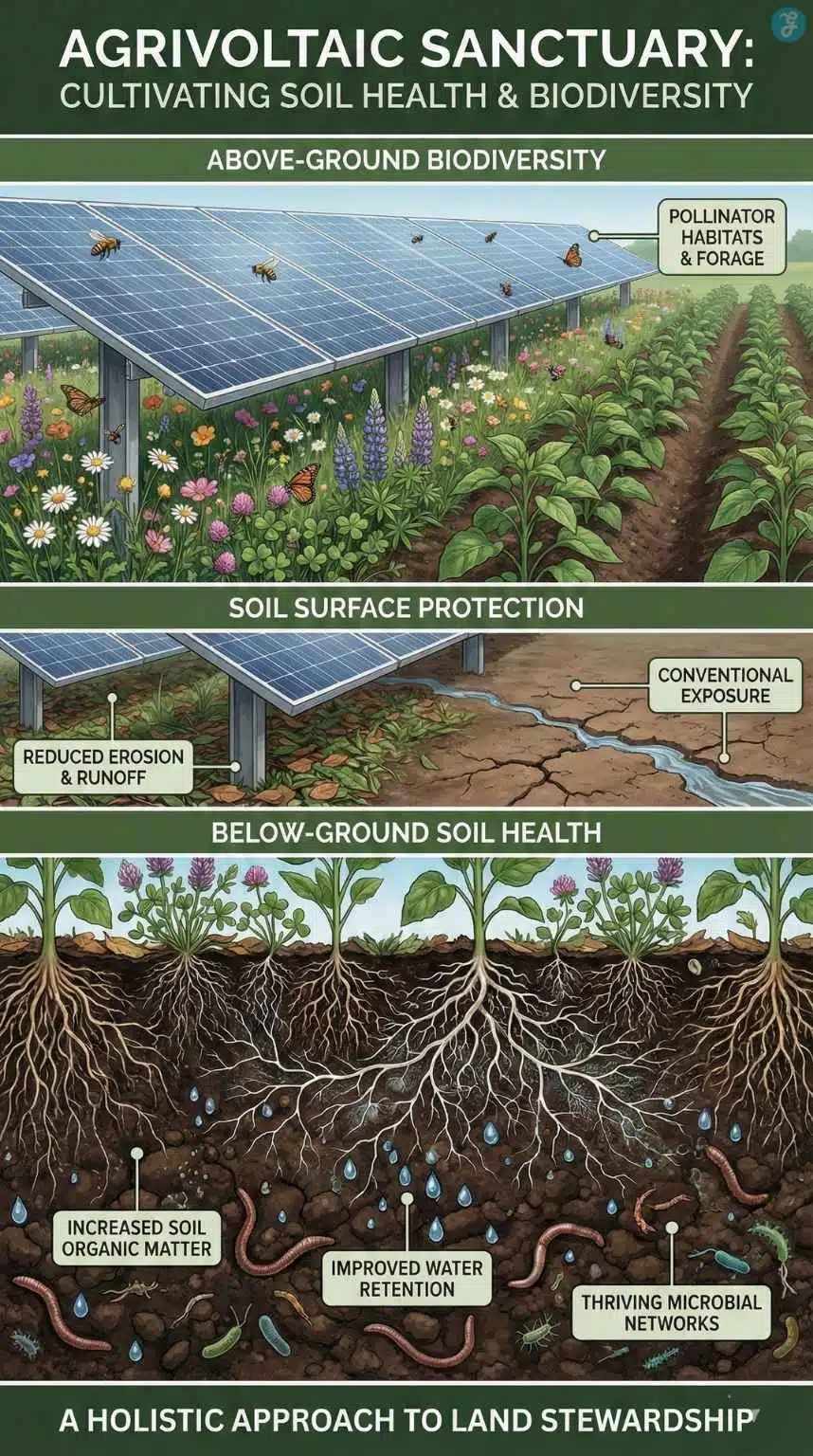
Beyond energy and food, agrivoltaics serves as a massive tool for environmental restoration. The Future of Agrivoltaics in Sustainable Farming is inextricably linked to the “Food-Energy-Water Nexus.”
Reversing Desertification
In regions like the Gobi Desert and parts of sub-Saharan Africa, agrivoltaic systems are being used for “Land Rejuvenation.” The panels act as windbreaks, preventing topsoil erosion. By shading the ground, they allow pioneer plant species to take root in areas that were previously too harsh. Recent 2025 studies have shown that soil organic carbon (SOC) levels under agrivoltaic arrays can increase by 10-15% within just three years of installation.
Pollinator Sanctuaries
There is a growing movement to pair agrivoltaics with “Pollinator-Friendly” ground cover. Instead of traditional crops, some landowners plant native wildflowers under the panels. This creates a sanctuary for bees and butterflies, which are essential for the surrounding agriculture. These “Solar Pollinator Habitats” have been found to increase the yields of nearby traditional farms by improving pollination services.
Global Adoption: Case Studies from 2025-2026
The global map of agrivoltaics is expanding rapidly as nations refine their regulatory frameworks.
Europe: The APER Law in France
France has become a world leader thanks to the APER Law (Acceleration of Renewable Energy). This legislation mandates that all agrivoltaic projects must provide a direct service to the farm, such as protection against climate hazards or improved animal welfare. Projects that merely “hide” solar panels in a field without agricultural benefit are banned, ensuring that food production remains the priority.
Asia: India’s KUSUM Scheme Success
In India, the KUSUM scheme reached a milestone in 2026, solarizing over 2 million irrigation pumps. By integrating solar panels directly over the fields that the pumps serve, Indian farmers have achieved energy independence, allowing them to irrigate at night and sell excess power during the day, effectively doubling their annual income.
North America: The Rise of “Jack’s Solar Garden” Model
In the United States, the “Community Agrivoltaics” model has taken off. Projects like Jack’s Solar Garden in Colorado have inspired hundreds of similar sites where local communities can buy “shares” of the solar energy while purchasing the organic produce grown beneath the panels.
The integration of solar infrastructure into active agricultural land introduces complexities that go beyond simple construction. These challenges range from the “hard” costs of engineering to the “soft” hurdles of local zoning and social acceptance.
1. High Initial Capital Expenditure (CAPEX)
The most immediate barrier to the Future of Agrivoltaics in Sustainable Farming is the upfront cost. Unlike standard ground-mounted solar, agrivoltaic systems require:
- Reinforced Mounting: Taller structures (to allow for machinery) require significantly more steel and deeper foundations to withstand wind loads.
- Specialized Tracking: Sophisticated AI-driven trackers are more expensive than fixed-tilt systems.
- Labor Costs: Installing panels high above the ground or in vertical configurations requires specialized equipment and longer labor hours.
In 2026, while the ROI is proven, the “entry fee” for a farmer to transition remains 25% to 40% higher than traditional solar, often necessitating complex financing or government subsidies that are not yet universal.
2. Technical and Machinery Constraints
Standard industrial agriculture relies on massive machinery, tractors, combines, and sprayers that require significant turning radii and vertical clearance.
- Navigation Issues: Even with elevated panels, the presence of steel posts creates “obstacle courses” for farmers.
- Machine Damage: There is a persistent risk of heavy machinery colliding with support structures, leading to expensive repairs for both the farm equipment and the solar array.
- The “Dead Zone” Problem: The area immediately surrounding the support posts often cannot be reached by automated harvesters, leading to small patches of unharvested crops or requiring manual labor, which drives up operational costs.
3. Regulatory and Zoning Complexities
The legal classification of land is a major hurdle. In many regions, land is strictly zoned as either “Agricultural” or “Industrial/Commercial.”
- Tax Implications: In some jurisdictions, installing solar panels triggers a reclassification of the land to “Industrial,” which can result in a massive spike in property taxes, wiping out the profit from energy sales.
- Permitting Lag: Because agrivoltaics is a “hybrid” use, permitting offices often don’t have a clear framework for approval, leading to years of bureaucratic delays.
Table 3: Barriers vs. 2026 Emerging Solutions
| Key Challenge | Specific Bottleneck | 2026 Innovation / Solution |
| Financial | High upfront installation costs. | “Agrisolar Leasing” models, where developers pay for infrastructure. |
| Logistics | Machinery cannot fit between/under rows. | Development of narrow-profile, autonomous electric “Ag-Bots.” |
| Grid Access | Remote farms lack high-voltage connections. | Long-duration battery storage and microgrid technology. |
| Knowledge Gap | Lack of data on specific regional crop yields. | Digital Twin simulations that predict yield before planting. |
| Legal | Zoning laws don’t recognize “dual-use.” | New “Agricultural Preservation” solar credits (e.g., French APER law). |
4. Crop-Specific Yield Variations
As noted in earlier sections, not all crops thrive under panels. While we have seen success with leafy greens, “sun-hungry” C4 plants like corn and sugarcane can see yield reductions of up to 20%. For a farmer whose entire supply chain and equipment are optimized for corn, switching to lettuce or berries to accommodate solar panels represents a massive and risky business pivot. This “biological limit” means agrivoltaics is not yet a “one-size-fits-all” solution for every staple crop.
5. Grid Integration in Rural Areas
The Future of Agrivoltaics in Sustainable Farming is often physically located in remote, rural areas where the local electrical grid was never designed to handle large-scale energy injections.
- Interconnection Costs: A farmer may find that while their land is perfect for solar, the nearest substation is 10 miles away. The cost of running high-voltage lines can be prohibitive.
- Curtailment: In areas with high solar density, the grid can become “clogged” during peak sun hours, forcing the system to shut off and wasting potential energy.
Final Thought: Harvesting a Resilient Future
As we navigate the complexities of 2026, it is clear that the Future of Agrivoltaics in Sustainable Farming is no longer a choice between two industries but a masterclass in land-use synergy. By harvesting the sun twice, once for energy and once for life, we are building a world where food security and renewable power are inextricably linked.
Agrivoltaics transforms the farm from a simple plot of soil into a high-tech resilience hub, ensuring that our agricultural heritage survives the climate challenges of tomorrow while powering the green grids of today.