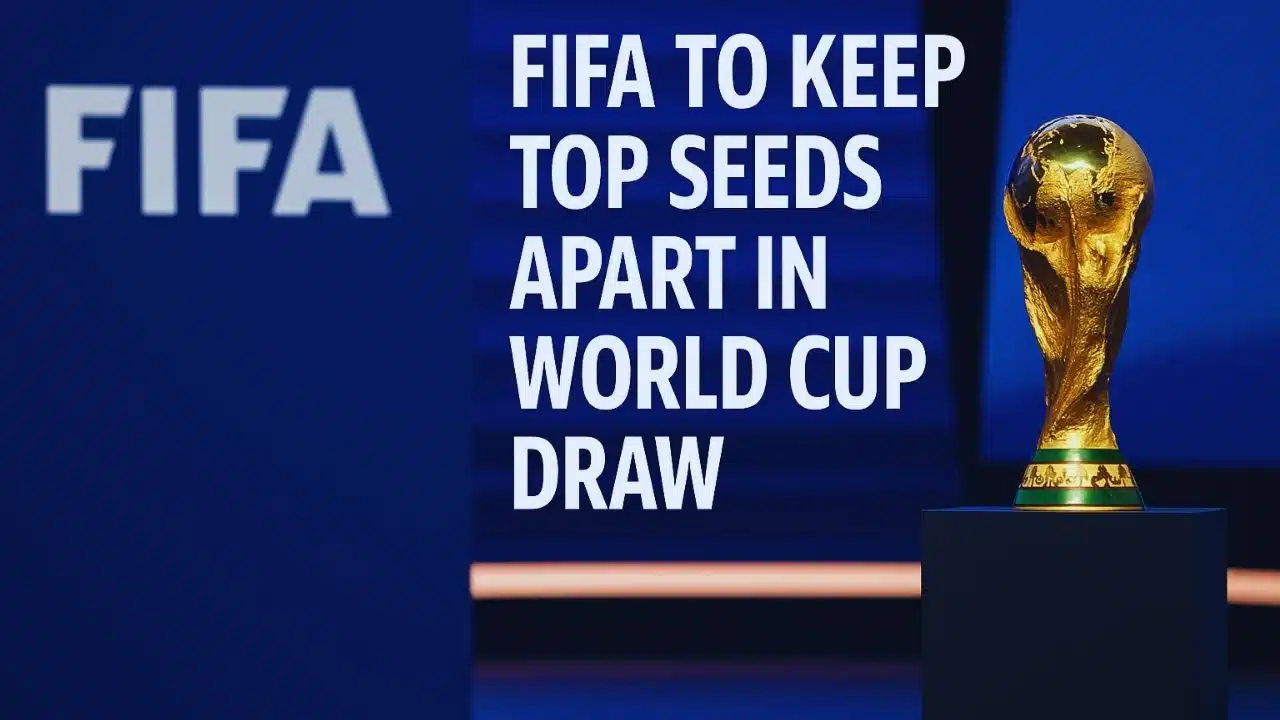
FIFA has confirmed a historic change to the upcoming World Cup draw procedure, ensuring that the top four seeded nations cannot meet each other until the latter stages of the competition. This marks the first time in the tournament’s history that such a system has been implemented, reflecting a deliberate effort by world football’s governing body to balance the draw, increase competitive fairness, and preserve the possibility of high-profile matches in the semi-finals and final. According to FIFA’s updated seeding arrangement, Spain, Argentina, France, and England will be treated differently from all other qualified nations, giving them a distinct placement within the knockout bracket—provided they win their groups.
Under this new approach, Spain, ranked as the number one seed, will be strategically paired opposite Argentina, seeded second. Their paths through the knockout stages are designed so that they cannot cross until the semi-final stage. Similarly, France, the third seed, will be placed on the other side of the bracket opposite England, the fourth seed. In practical terms, this ensures that England will not face Spain or Argentina until the semi-finals, while France could not meet either of those sides until the final itself, assuming each of the four teams finishes at the top of their group. This reshaped structure is inspired by seeding formats used in other major tournaments such as Wimbledon’s tennis championships and the revamped Champions League system, where top performers are deliberately kept apart in paired brackets to avoid early clashes.
FIFA has explained that this change is designed to prevent early elimination of the highest-ranked teams, which could affect global viewership and tournament momentum. High-stakes matchups featuring elite footballing nations typically draw some of the largest worldwide audiences, and ensuring those potential clashes occur during later rounds reinforces the tournament’s commercial and sporting appeal. It also echoes FIFA’s approach used during the expanded Club World Cup earlier this year, where rankings determined by a similar system influenced placement and bracket integrity.
Recent football history further shows why FIFA’s structural adjustments carry significance. France knocked England out of the 2022 World Cup with a narrow 2–1 win in the quarter-finals, a match widely regarded as one of the fiercest contests of the tournament. Spain, meanwhile, defeated England in the Euro 2024 final, intensifying anticipation surrounding future meetings between these elite teams. FIFA’s new system aims to maintain these storylines and rivalries without risking their early collision during the first knockout rounds.
Beyond the handling of top seeds, FIFA has also released the breakdown of the four pots that will determine group placements for the World Cup draw, scheduled to take place on Friday, 5 December at 17:00 GMT. The pots structure the 12 groups that will form the expanded tournament format. Scotland will occupy a place in pot three, while several tournament debutants have also been distributed across the pots. Uzbekistan appears in pot three as a first-time World Cup participant, while Jordan, Cape Verde, and Curaçao, all of whom have qualified for their first World Cup, are grouped into pot four. Pot four will also include the six qualifiers emerging from the inter-confederation play-offs, a list that could potentially include Wales, Northern Ireland, or the Republic of Ireland depending on play-off outcomes.
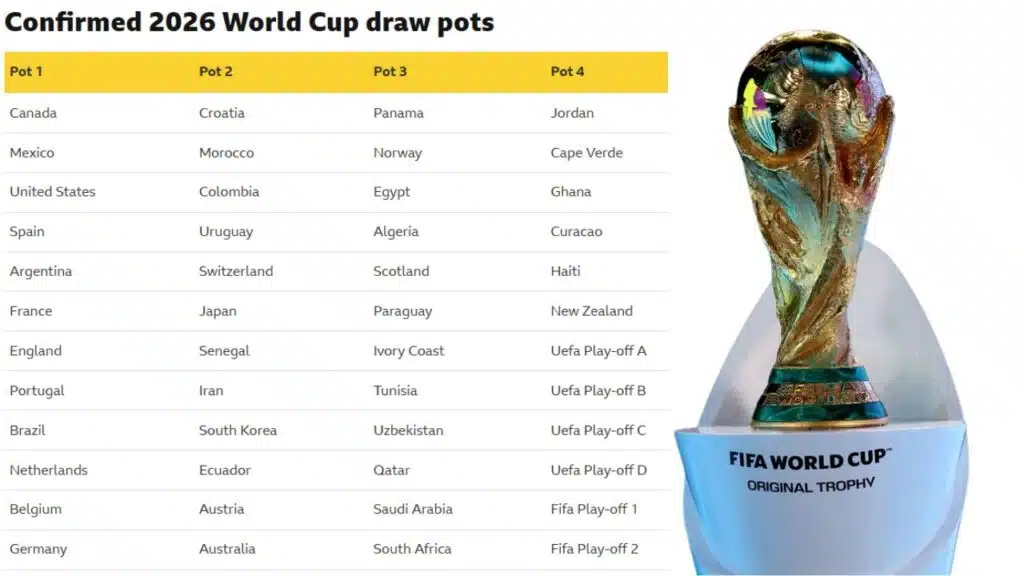
The draw procedure will begin with pot one, where the highest-ranked teams and the hosts are located. Co-hosts Mexico, Canada, and the United States will each have specially marked balls featuring their national flags to distinguish them from other pot one nations. Their positions are predetermined within the groups, with Mexico assigned to Group A1, Canada to B1, and the United States to D1, ensuring they play all their group-stage matches on home soil. As each pot one team is selected, they are placed into the closest available group in alphabetical order, and FIFA’s automated draw system ensures that the top four seeds are correctly positioned in opposite halves of the bracket according to their designated pairings.
Once the pot one placements are complete, the draw will move to pot two, followed by pot three and pot four. A notable procedural change from previous tournaments is that teams will no longer be drawn into specific match positions within each group. Only the seeded nations will occupy the number-one position in their respective groups. Instead, FIFA will use a predetermined random grid to assign all unseeded countries to their internal group positions, which determines who plays whom and in what order during the group stage. According to FIFA, this adjustment is intended to reduce delays, minimize confusion, and introduce greater efficiency into the draw ceremony.
Traditional confederation rules remain in full effect to maintain diversity in the group stages. No group is allowed to contain more than one nation from the same confederation, with the exception of UEFA due to its larger number of qualified teams. Because there are sixteen European sides competing for spots within twelve groups, four groups will necessarily contain two European nations. For all other confederations, such as the AFC, CAF, CONMEBOL, Concacaf, and the OFC, these geographic restrictions ensure a mix of teams and discourage early intra-confederation matchups.
The inter-confederation play-off teams face particularly narrow placement options due to these restrictions. Pathway One, which features New Caledonia, Jamaica, and DR Congo, cannot be drawn into any group that includes a nation from Concacaf or Africa, limiting their possible group destinations considerably. Pathway Two, comprised of Bolivia, Suriname, and Iraq, must avoid any group containing teams from South America, Concacaf, or Asia. These constraints ensure that confederation balance is maintained across all twelve groups and that no team encounters regional rivals prematurely.
An additional element of the draw concerns match scheduling. The dates and sequence of group-stage matches will be revealed immediately once the draw is complete, giving teams, supporters, and broadcasters a clear picture of the tournament’s early schedule. However, the specific stadium assignments and kick-off times will not be released until the following day, Saturday, 6 December. Organizers will confirm which host cities—from Mexico’s iconic venues to Canada’s and the United States’ modern stadiums—will stage each fixture based on logistical considerations, anticipated crowd sizes, and operational planning.
This expanded draw format reflects the World Cup’s continued evolution in scale and complexity. With more teams, more cities, and more logistical factors in play than in past tournaments, FIFA is seeking to ensure fairness and narrative drama while managing the global expectations that now accompany football’s most-watched event. The deliberate separation of top seeds underscores the governing body’s intention to shape marquee matchups, preserve balance across the expanded 12-group structure, and enhance the spectacle of the knockout rounds. As anticipation builds toward the December draw, teams and fans alike will be watching closely to see how these new procedures shape the path to football’s biggest prize.