

Ever wonder how a tiny island nation managed to shake up the entire Cold War? Back in 1959, Fidel Castro’s revolution in Cuba changed everything. His partnership with the Soviet Union turned Cuba into ground zero for one of the most dangerous nuclear standoffs in history.
The story of how Castro’s decisions pushed President John F. Kennedy and Soviet Premier Nikita Khrushchev to the brink of nuclear war still fascinates people today. From the failed Bay of Pigs invasion to the tense 13 days of the Cuban Missile Crisis, Castro’s moves kept two superpowers guessing.
Let me walk you through exactly how one revolutionary leader from a small Caribbean island ended up changing the course of global politics.
Key Takeaways
- Castro seized power in January 1959 and quickly turned Cuba into a one-party communist state, with revolutionary tribunals executing between 500 and 600 Batista supporters by May 1959
- After the U.S. trade embargo hit in October 1960, Cuba turned to the Soviet Union for help, receiving $100 million in initial trade credits and eventually averaging $4.3 billion in annual aid by the late 1980s
- The Bay of Pigs invasion in April 1961 was a total disaster, with 114 Cuban exiles killed and about 1,189 captured within just three days
- The Cuban Missile Crisis in October 1962 brought the world dangerously close to nuclear war when Soviet nuclear warheads secretly arrived in Cuba
- When the Soviet Union collapsed in 1991, Cuba lost its economic lifeline and entered the “Special Period,” with GDP dropping by nearly 35% between 1989 and 1993
Fidel Castro and the Cuban Revolution
Fidel Castro and his rebels didn’t just overthrow a dictator. They completely rewired Cuban society from the ground up. What started as a guerrilla campaign in the mountains of eastern Cuba ended with a total transformation of the island.
What was the Cuban Revolution about?
The revolution aimed to break the stranglehold that wealthy landowners, American corporations, and a corrupt government had over Cuba. Castro’s forces wanted to redistribute wealth and power to ordinary Cubans who had been left behind.
When Castro took control, he moved fast. New agrarian reform laws capped farm sizes at 993 acres. Foreign ownership of Cuban land? Gone. About 15% of the nation’s wealth got redistributed to more than 200,000 poor peasants who had been working the land for years without owning it.
The new government became a one-party communist state built on Marxist-Leninist ideology. By May 1959, revolutionary courts had already executed between 500 and 600 people linked to Batista’s regime, according to historical records.
Castro set up Committees for the Defense of the Revolution in neighborhoods across Cuba starting in September 1960. These grassroots organizations kept tabs on everything. Within a short time, one out of every three Cubans participated. That number eventually soared to eight out of ten citizens, creating a massive surveillance network.
How did Castro rise to power in 1959?
Fulgencio Batista’s 1952 coup made a lot of Cubans angry. Castro saw his chance and formed “The Movement” to push back against the dictatorship.
His first big move was the July 26, 1953, attack on the Moncada Barracks. It failed spectacularly. Police arrested Castro and sentenced him to 15 years, but he walked free in May 1955 after Batista granted amnesty.
Castro didn’t waste time feeling sorry for himself. He fled to Mexico and built the 26th of July Movement with help from an Argentine doctor named Che Guevara.
On November 25, 1956, Castro and 81 other rebels sailed from Mexico aboard the Granma yacht. They landed under heavy fire. Only about 19 or 20 men made it to the Sierra Maestra mountains alive. But they regrouped.
By mid-1957, their guerrilla force had grown past 200 fighters. Castro split them into smaller columns led by himself, his brother Raúl, and Che Guevara. A massive general strike on April 9, 1958 spread across eastern and central Cuba, showing how much support the revolutionaries had gained.
By late 1958, rebel forces controlled two critical regions:
- Oriente Province in the east
- Las Villas region in the center, which cut the island in half
- On December 27, Che Guevara’s forces captured an armored train in Santa Clara carrying desperately needed weapons for Batista’s army
Batista saw the writing on the wall. On December 31, 1958, he fled Cuba with an estimated $300 million, leaving chaos in his wake. Government officials scrambled to escape as the old regime crumbled overnight.
Castro entered Havana on January 8, 1959, greeted by cheering crowds lining the streets. He quickly named Manuel Urrutia as provisional president. But Castro held the real power.
Within weeks, Congress was dissolved. Old political parties were banned. Castro’s “History Will Absolve Me” speech became the rallying cry of a revolution that would reshape the entire island.
Cuba’s Alignment with the Soviet Union
Cuba didn’t just stumble into the Soviet Union’s arms. The relationship was born out of necessity when American doors slammed shut.
How did Cuba strengthen ties with the USSR?
Castro moved quickly to build a partnership with Moscow after 1959. U.S.-Cuba relations went south fast, especially after the American trade embargo hit in October 1960. Cuba needed new friends.
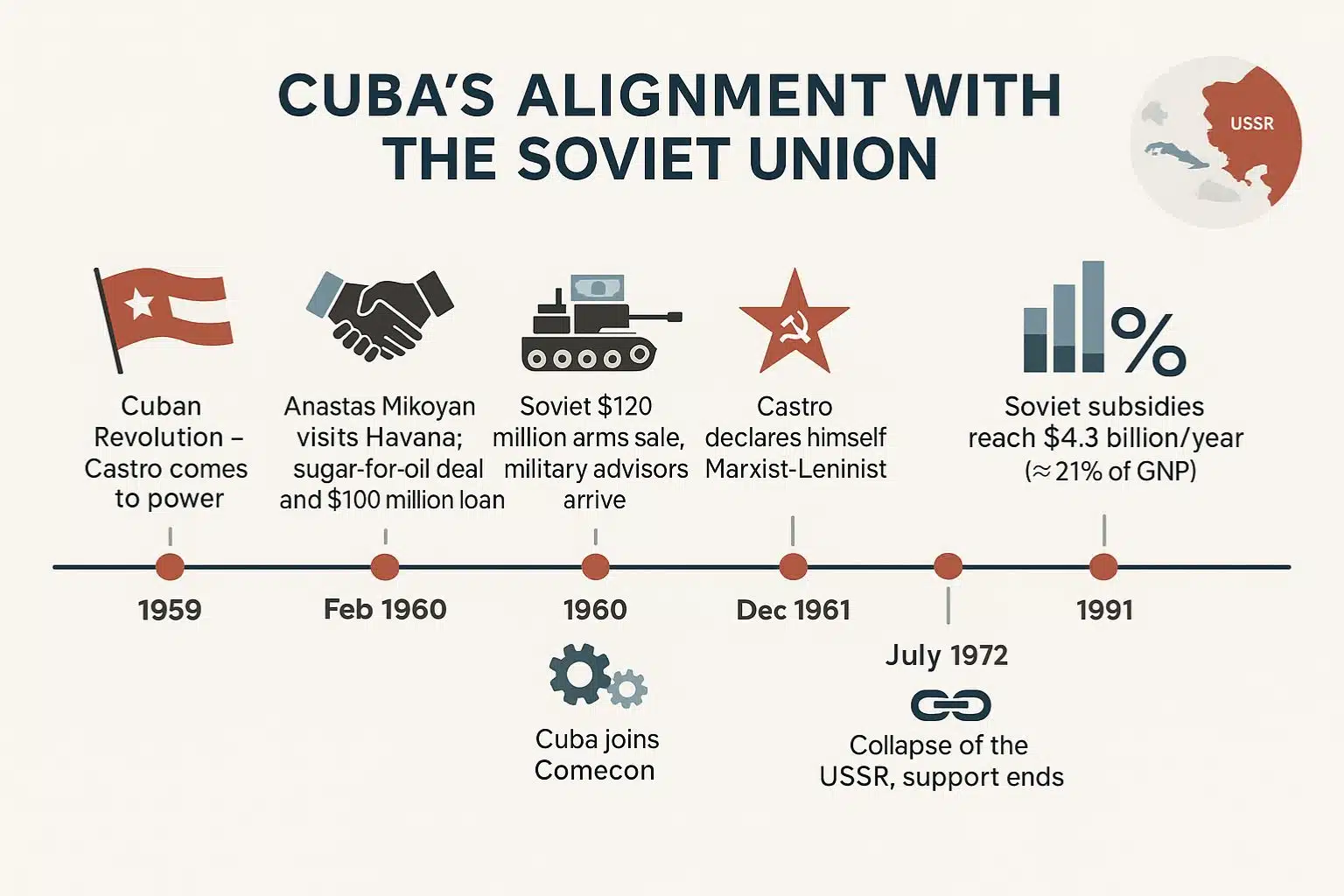
In February 1960, Soviet Deputy Prime Minister Anastas Mikoyan flew to Havana on a critical mission. The two countries hammered out a practical deal: Cuba would trade sugar for Soviet oil. Moscow sweetened the arrangement with $100 million in loans to prop up Cuba’s struggling economy.
This wasn’t just talk. In 1960, the Soviets sold Cuba $120 million worth of weapons and sent military advisors to train Cuban forces. When American-owned oil refineries like Shell, Texaco, and Esso refused to process Soviet oil, Castro nationalized them on the spot.
By December 1961, Castro openly declared himself a Marxist-Leninist. This announcement pulled both countries even closer together. In July 1972, Cuba officially joined Comecon, the Soviet-led economic organization for socialist countries. This membership locked Cuba firmly into Moscow’s orbit as a counterweight to what Castro called “American imperialism.”
What economic and military support did Moscow provide?
The numbers tell the story. According to research on Soviet subsidies, Moscow poured about $4.3 billion per year into Cuba’s economy during the late 1980s. That massive sum made up roughly 21% of Cuba’s entire Gross National Product.
The Soviets also bought Cuban sugar at wildly inflated prices. In 1987, they paid Cuba the equivalent of $0.419 per pound for sugar when the world market price was just $0.0676 per pound. That’s more than six times the going rate.
The oil deal worked in reverse. Cuba bought Soviet petroleum at prices far below world levels, then turned around and re-exported some of it for hard currency. This clever arrangement generated more than 40% of Cuba’s total revenues at times.
Soviet support kept flowing during crucial periods:
- From 1970 to 1972, USSR experts worked with Havana to completely restructure farms and factories
- During Cuba’s leadership of the Non-Aligned Movement from 1979 to 1983, Soviet aid continued at $4 billion to $6 billion annually
- Between 1976 and 1980 alone, the Soviets invested $1.7 billion in constructing and upgrading Cuban industrial facilities
Soviet tanks rolled through Cuban training grounds. Cargo ships brought rifles and military equipment across the Atlantic. Technical experts from Moscow taught Cubans modern farming techniques and helped fix power plants.
This support let Castro stand firm against the U.S. trade embargo for decades. Everything changed in 1991 when Mikhail Gorbachev’s reforms shook up the Soviet system and the USSR itself collapsed.
Key Cold War Events Involving Castro
Castro’s boldest moves created some of the most nail-biting moments in Cold War history. These events nearly triggered World War III.
What happened during the Bay of Pigs Invasion in 1961?
The CIA trained and funded a group of about 1,400 Cuban exiles called Brigade 2506. President John F. Kennedy approved the plan to overthrow Castro, hoping to keep U.S. involvement quiet.
On April 17, 1961, the exiles landed at the Bay of Pigs on Cuba’s southern coast. The operation went wrong almost immediately.
Two days earlier, on April 15, eight CIA-supplied B-26 bombers had tried to destroy Castro’s air force by painting the planes to look Cuban. They missed most of their targets. Kennedy then canceled a crucial second air strike, leaving the invasion force exposed.
Here’s what happened next:
- Cuban forces loyal to Castro mounted fierce resistance within hours
- Castro personally ordered roughly 20,000 troops to advance toward the beaches
- Cuban planes destroyed half of the exile’s air support and sank two escort ships
- Bad weather created soggy conditions and ruined equipment
The invasion collapsed in just three days. About 114 members of Brigade 2506 were killed in the fighting. Nearly 1,189 surrendered and were taken prisoner.
Those captured fighters spent 20 months in Cuban jails. The Kennedy administration eventually negotiated their release by paying $53 million worth of baby food and medicine. Attorney General Robert F. Kennedy personally reached out to pharmaceutical companies to secure contributions.
The failure pushed Castro to publicly declare himself a Marxist-Leninist by December 1961. It also drove Cuba much closer to the Soviet Union, setting the stage for an even bigger crisis the following year.
What was the Cuban Missile Crisis of 1962?
In October 1962, American U-2 spy planes captured photographs that changed everything. Soviet ballistic missiles were being installed in Cuba, just 90 miles from Florida.
The crisis actually began earlier than most people realize. According to research by the National Security Archive, Soviet nuclear warheads arrived in Cuba on October 4, 1962, not when Kennedy announced the crisis publicly. Those warheads stayed on the island until December 1, meaning the real crisis lasted 59 days, not the famous “13 days.”
Castro had asked Moscow for help to protect Cuba from another U.S. invasion. Nikita Khrushchev agreed and began shipping weapons in the spring and summer of 1962. The Soviets deployed both medium-range and intermediate-range nuclear missiles that could hit most of the continental United States.
On October 14, a U-2 aircraft piloted by Major Richard Heyser took photos clearly showing missile sites under construction near San Cristóbal. Kennedy was briefed two days later, on October 16.
The timeline got tense fast:
| Date | Event |
|---|---|
| October 22, 1962 | Kennedy announced a naval “quarantine” of Cuba on national television |
| October 24 | Soviet ships approaching Cuba stopped at the blockade line |
| October 27 | Cuban forces shot down a U-2, killing pilot Major Rudolf Anderson |
| October 28 | Khrushchev agreed to remove missiles after secret negotiations |
Kennedy demanded the missiles be removed immediately. He shut down Operation Mongoose, the CIA’s covert operation against Cuba, because the threat was too serious.
Khrushchev and Kennedy exchanged messages during those terrifying days. The Soviet leader eventually agreed to withdraw the missiles in exchange for a public promise that the U.S. would never invade Cuba. Kennedy also secretly agreed to remove American missiles from Turkey.
Here’s the kicker: Khrushchev didn’t consult Castro before making the deal. When Carlos Franqui told Castro about the agreement, he was furious at being left out of decisions affecting his own country’s future.
The world had come dangerously close to nuclear war. This confrontation is widely considered the closest the Cold War ever came to turning into a full-scale nuclear conflict.
Castro’s Influence on Global Socialist Movements
Castro didn’t just focus on Cuba. He exported his revolution across Latin America, Africa, and beyond, making enemies in Washington along the way.
How did Castro support revolutionary movements in Latin America?
In 1966, Castro made a bold promise. He pledged Cuban support to any group fighting for revolution, and he kept his word.
Cuba sent weapons, money, and trainers to rebel groups across the region. Places like Nicaragua, El Salvador, and Guatemala received significant backing. The Sandinistas in Nicaragua scored a major victory in 1979, thanks partly to Cuban assistance.
Che Guevara served as Castro’s right-hand man for spreading revolution until he died in Bolivia in 1967 trying to spark an uprising there. His death didn’t stop Cuba’s efforts.
Castro’s support extended far and wide:
- Cuban troops landed in Angola on November 7, 1975, fighting alongside the MPLA during the civil war
- Maurice Bishop formed a revolutionary government in Grenada around 1980 that partnered closely with Havana
- Cuba backed the Viet Cong during the Vietnam War
- The Black Panthers in the United States received moral and some material support
Cuba also sent doctors, teachers, and intelligence operatives throughout Central America and the Caribbean. These missions helped spread Castro’s communist ideology despite U.S. efforts to contain it and the economic embargoes Washington imposed.
In July 1972, Cuba officially joined the Council for Mutual Economic Assistance, known as Comecon. This Soviet-dominated organization included most Eastern Bloc countries. The alliance gave Cuba crucial access to trade deals, financial assistance, and goods like oil and food that kept the economy running.
By 1985, trade with the Soviets accounted for over 70% of Cuba’s entire trade volume. As many as 10,000 Soviet advisers were working on the island by 1972, helping with everything from agriculture to military training.
Cuban forces didn’t just talk about solidarity. They acted on it:
| Conflict | Cuba’s Role |
|---|---|
| Angola Civil War | Thousands of Cuban troops supported the Marxist MPLA government |
| Ogaden War (Ethiopia-Somalia) | Cuban forces fought alongside Ethiopia |
| Yom Kippur War | Cuba provided support to Arab socialist states |
| Independence of Namibia | Cuban troops helped fight against South African forces |
In the 2000s, Fidel Castro formed a close partnership with Hugo Chávez in Venezuela. Together they created the Bolivarian Alliance for the Americas, linking socialist states across the region in a new network designed to counter U.S. influence.
These alliances made Castro a major player in global politics, far beyond what a small island nation might normally achieve. His willingness to send troops abroad earned him both admirers and enemies around the world.
The Dissolution of the Soviet Union and Its Impact on Cuba
When the Soviet Union collapsed in 1991, it hit Cuba like a hammer. Overnight, the island lost its economic lifeline and plunged into the worst crisis since the revolution.
What economic challenges did Cuba face during the “Special Period”?
The numbers were brutal. Cuba lost more than $4 billion in yearly Soviet aid when the USSR fell apart. That money had made up about 21% of Cuba’s entire Gross National Product.
According to Cuban economic statistics, GDP fell by 35% between 1989 and 1993. The worst year was 1993, when the economy contracted by 14.9%. To put that in perspective, the 2020 COVID-19 pandemic caused a 10.9% drop, and Cubans considered that devastating.
Factories shut down because oil and spare parts stopped arriving from Moscow. The government later admitted that calories consumed per person dropped from 3,052 per day in 1989 to just 2,600 by 2006.
The crisis touched every corner of daily life:
- Food shortages created hours-long ration lines at stores
- More than 300 medicines disappeared from pharmacies
- Over 50,000 Cubans developed optic neuropathy by 1993 due to vitamin B deficiency
- Power cuts were scheduled to distribute electricity evenly, but blackouts still plagued the island
- About 35,000 “raft people” (balseros) attempted the dangerous 90-mile journey to Miami rather than endure conditions at home
Professionals left for Florida in droves. Doctors and teachers emigrated, creating a brain drain that hurt schools and hospitals even more. Unemployment soared as businesses closed their doors.
The Cuban peso lost value at a shocking rate. People traded whatever they had just to eat. The government officially called this catastrophe the “Special Period in a Time of Peace,” treating it like a wartime emergency happening during peacetime.
Castro refused to budge on his political system. He rejected Mikhail Gorbachev’s reforms like glasnost and perestroika outright, keeping a tight grip on state control no matter how bad things got.
From 2000 to 2006, Castro launched what he called the “Battle of Ideas.” This campaign focused heavily on education and health care for everyone, doubling down on socialist ideals even as people struggled to find food. Schools stayed open and hospitals continued operating by focusing on basic care.
The government made some practical adjustments to survive:
In 1993, Cuba amended its Constitution to allow new forms of private property and regulated foreign investment for the first time. The state also decriminalized holding U.S. dollars and turned state companies into for-profit enterprises.
Tourism became a lifeline. State companies remodeled old hotels and worked with international partners to build new ones. Small airports near beach areas got upgraded to handle flights from Germany and Canada.
Despite severe shortages, Castro maintained strict central planning and censorship. Committees for the Defense of the Revolution kept watching neighborhoods. The government controlled the press and suppressed internal dissent just as firmly as before the crisis.
Life expectancy actually increased slightly during the Special Period, from 75.0 years in 1990 to 75.6 years in 1999. Child mortality rates also improved. Cuba managed this by prioritizing its social safety net even when resources were scarce.
The worst years of the Special Period eventually eased. By the late 1990s, Venezuela under Hugo Chávez emerged as Cuba’s new main trading partner. Venezuela began providing subsidized oil in exchange for Cuban doctors and medical services around 2000. In 2025, Russia pledged $1 billion in economic aid to Cuba spanning through 2030.
But the Special Period never officially ended. Many Cubans still feel they’re living through an extended crisis, especially given economic troubles that continued into the 2020s.
Takeaways
Fidel Castro turned Cuba into one of the most important chess pieces in the Cold War game. His revolution in 1959 kicked off decades of tension that kept the world on edge.
The partnership with the Soviet Union gave Castro the muscle to stand up to the United States right in America’s backyard. The Bay of Pigs disaster in 1961 and the terrifying Cuban Missile Crisis in 1962 showed just how dangerous that relationship could be. Kennedy and Khrushchev came frighteningly close to pressing the nuclear button.
Castro’s reach extended far beyond Cuba’s shores. He sent troops to Angola, backed revolutions in Nicaragua and Grenada, and built alliances with socialist movements across three continents. For a small island leader, he punched way above his weight on the global stage.
When the Soviet Union collapsed in 1991, Cuba lost its economic lifeline and crashed hard. But Castro refused to abandon socialism, gripping power tightly through the brutal Special Period until his retirement in 2008.
The Cold War ended more than three decades ago. But Castro’s decisions during those tense years still shape U.S.-Cuba relations and continue to influence how we think about that dangerous era in history.
FAQs on Fidel Castro Cold War Impact
1. How did Fidel Castro change the Cold War?
Fidel Castro’s 1959 takeover of Cuba brought the Cold War to the Western Hemisphere by establishing the first communist state in the Americas. This strategic shift allowed the Soviet Union to gain a crucial foothold just 90 miles from Florida, fundamentally altering the security map for the United States.
2. What was the Cuban Missile Crisis and why did it matter?
During a terrifying 13-day standoff in October 1962, the U.S. and the Soviet Union nearly started a nuclear war over Soviet ballistic missiles discovered in Cuba. President Kennedy resolved the crisis by blockading the island and secretly agreeing to remove American Jupiter missiles from Turkey.
3. What was the Bay of Pigs invasion?
The CIA-backed Brigade 2506 stormed the beaches on April 17, 1961, in a disastrously failed attempt to spark a counter-revolution against Castro’s new government.
4. How did Castro affect U.S. foreign policy?
Castro’s alignment with the Soviets forced President Kennedy to launch the Alliance for Progress in 1961 to prevent communism from spreading across Latin America. The U.S. also implemented a strict economic embargo in 1962 that continues to shape relations between the two nations today.
5. What role did Cuba play in Africa during the Cold War?
Cuba projected power far beyond its borders by sending over 300,000 troops to support the MPLA government in Angola between 1975 and 1991. This extensive military campaign culminated in the Battle of Cuito Cuanavale, which helped hasten the end of apartheid in South Africa.
6. Who were Castro’s key allies and enemies?
Castro formed a critical partnership with Soviet Premier Nikita Khrushchev, securing billions in subsidies that kept the Cuban economy afloat for decades. While he remained a staunch enemy of ten consecutive U.S. presidents, he maintained close ties with other revolutionary leaders like Nicaragua’s Daniel Ortega.






























