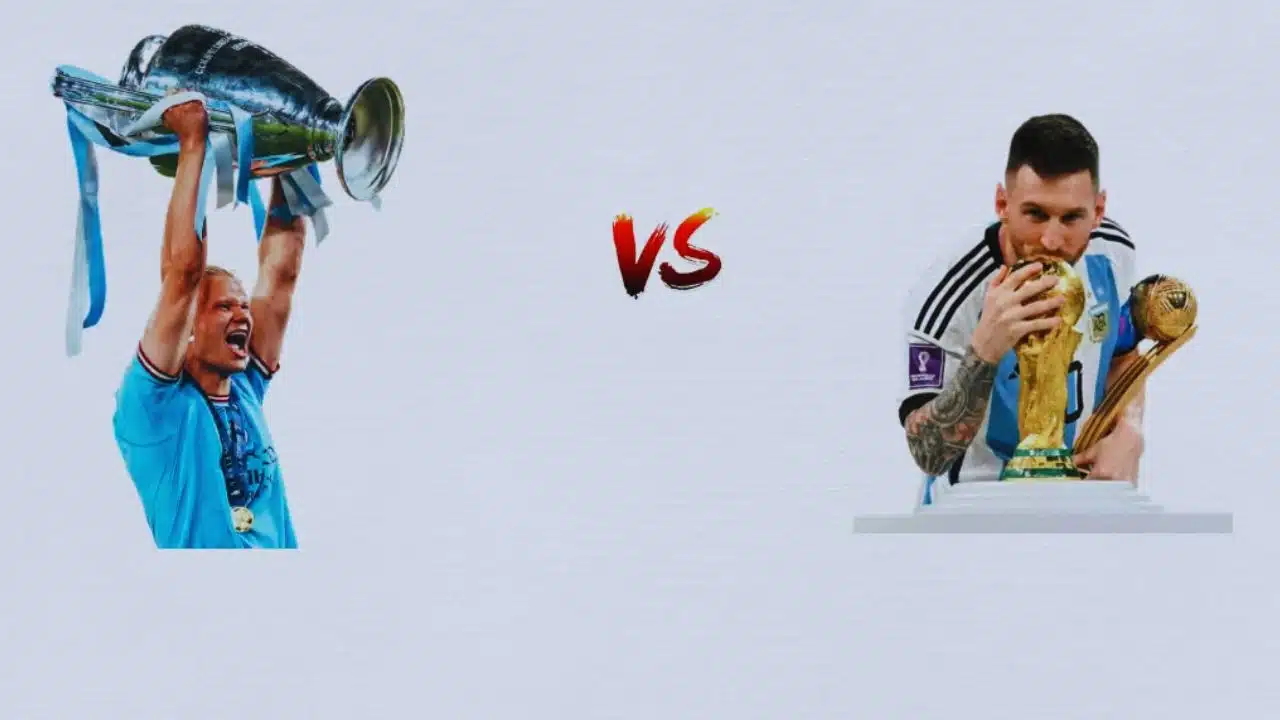
In the 2011–12 football season, Lionel Messi reached heights that seemed almost impossible to replicate. Under Pep Guardiola’s final year at FC Barcelona, the Argentine superstar delivered a campaign that broke records, shattered expectations, and redefined what an individual footballer could achieve in a single year.
Messi finished the season with 73 goals for Barcelona across all competitions, and 9 more for Argentina, bringing his total to an astounding 82 goals in 69 matches. This record remains the gold standard for individual scoring brilliance. His goals came in every form imaginable — curling free kicks, delicate chips, solo runs through packed defenses, and trademark finishes inside the box.
In La Liga, Messi scored 50 goals in 37 games — an unmatched record in Spain’s top flight. He added 14 goals in the UEFA Champions League, 3 in the Copa del Rey, and 3 more in a mix of the Spanish Super Cup, FIFA Club World Cup, and UEFA Super Cup. His total involvement in goals was even more extraordinary when considering his 34 assists, underlining that Messi wasn’t just a finisher; he was also Barcelona’s main creator.
Yet despite his monumental output, that season was not crowned with every possible trophy. Barcelona lost the La Liga title to José Mourinho’s Real Madrid, who set their own record for most points in a single season. They also suffered a heartbreaking Champions League semifinal exit to Chelsea, who would go on to win the competition. Still, Guardiola and Messi finished with one final flourish — a 3-0 Copa del Rey victory over Marcelo Bielsa’s Athletic Club, where Messi, predictably, found the net one more time.
Messi’s 2011–12 season wasn’t just a personal achievement — it became a cultural moment. Analysts, fans, and rivals alike saw it as football perfection, the summit of technical and mental excellence. In international football, Messi added another 9 goals for Argentina, including a spectacular hat-trick against Brazil in a 4-3 friendly win that encapsulated his dominance.
By the end of that year, the football world was unanimous: Lionel Messi’s 2011–12 season was the most productive, breathtaking, and consistent goalscoring campaign in the history of the sport. It stood not just as a record, but as a myth — one that many believed could never be broken.
Haaland’s 2025–26 Season: The Machine Chasing Immortality
Fast forward fourteen years, and Pep Guardiola once again finds himself managing another extraordinary forward — Erling Haaland. The Norwegian striker has redefined modern goalscoring since his arrival at Manchester City, blending physical dominance, clinical finishing, and a relentless hunger for goals that mirrors the greats of the past.
As of now, Haaland’s 2025–26 campaign is off to a frighteningly explosive start. Across competitions, he has already scored 19 goals for Manchester City — with 14 in the Premier League and 5 in the UEFA Champions League. On the international stage, Haaland has added 9 goals for Norway, with 8 coming in World Cup qualifiers and another in a friendly match. That brings his current total to 28 goals in just 18 matches, an average of 1.55 goals per game.
To put that in perspective, at the same stage of the 2011–12 season, Lionel Messi had 24 goals in 22 matches for club and country. Haaland, remarkably, is already four goals ahead of that pace.
If Haaland maintains this astonishing scoring rate, projections suggest he could reach or even surpass 100 goals across all competitions by the end of the season — a feat no player in the modern era has ever achieved. Even if he slows slightly, he’s still on course to comfortably eclipse Messi’s legendary total of 82 goals.
However, this prediction depends on several key factors. First, Haaland’s ability to stay fit and avoid injuries during a grueling season will be crucial. Modern football’s fixture congestion — with the Premier League, expanded Champions League, FA Cup, and international matches — puts immense strain on even the fittest players. Guardiola has already shown caution by resting Haaland during League Cup matches, and he may continue to rotate his star forward to preserve his fitness.
If Manchester City go deep into every competition, Haaland could play up to 65 games for his club, plus potentially nine more for Norway, bringing his total to around 74 appearances. That’s even more than Messi’s 69 matches in 2011–12. But such a scenario requires everything to go perfectly — no injuries, no early cup exits, and consistent selection.
More realistically, if Haaland ends up playing between 55 and 65 matches, his final tally will depend on maintaining a scoring rate above 1.3 goals per game. Even then, that would still likely put him somewhere between 75 and 95 goals — a number that would rank among the greatest seasons ever recorded.
It’s also worth noting that while Messi was not purely a striker — he often dropped deep to create play and provide assists — Haaland is a pure finisher. He may not match Messi’s creative influence, but his efficiency inside the box is beyond comparison. The Norwegian’s goals come from every angle: instinctive tap-ins, towering headers, blistering runs behind defenses, and thunderous shots from tight spaces.
Under Guardiola’s system, which is built around maximizing movement and possession in the final third, Haaland has found an environment that could genuinely allow him to threaten Messi’s record. With playmakers like Kevin De Bruyne, Phil Foden, Bernardo Silva, and Julián Álvarez feeding him chances, Haaland has all the ammunition required to keep scoring at a record-breaking pace.
Can Haaland Truly Surpass Messi’s 2011–12 Miracle?
It’s tempting to believe that Erling Haaland is destined to break Messi’s all-time record. The raw numbers support the possibility. His current scoring rate is not just elite — it’s unprecedented in the Premier League era. His physique, mentality, and finishing ability give him the kind of consistency few have ever possessed.
But surpassing Messi’s 82-goal total isn’t just about raw output; it’s about sustaining world-class performance over an entire season across multiple competitions, maintaining fitness, and performing at the highest level in crucial matches.
Messi’s record wasn’t merely statistical — it was the product of unrelenting excellence, artistry, and endurance over a year of nearly 70 matches. He didn’t just score; he dominated games with his vision, dribbling, and leadership. Haaland, by contrast, represents a new era of football: one where efficiency, athleticism, and precision take center stage over flamboyant artistry.
If Haaland continues at this pace through May, the football world could witness the most prolific season of all time. But even if he falls short, his pursuit of Messi’s record has reignited a debate that defines eras — the creative genius of Messi versus the mechanical brilliance of Haaland.
One thing is certain: Pep Guardiola is again coaching a generational talent capable of rewriting football history. And whether Haaland ends with 82, 90, or even 100 goals, his 2025–26 season will be remembered as one of the defining campaigns of the modern game — a season that might finally make the impossible seem possible.
The Information is Collected from BBC and MSN.