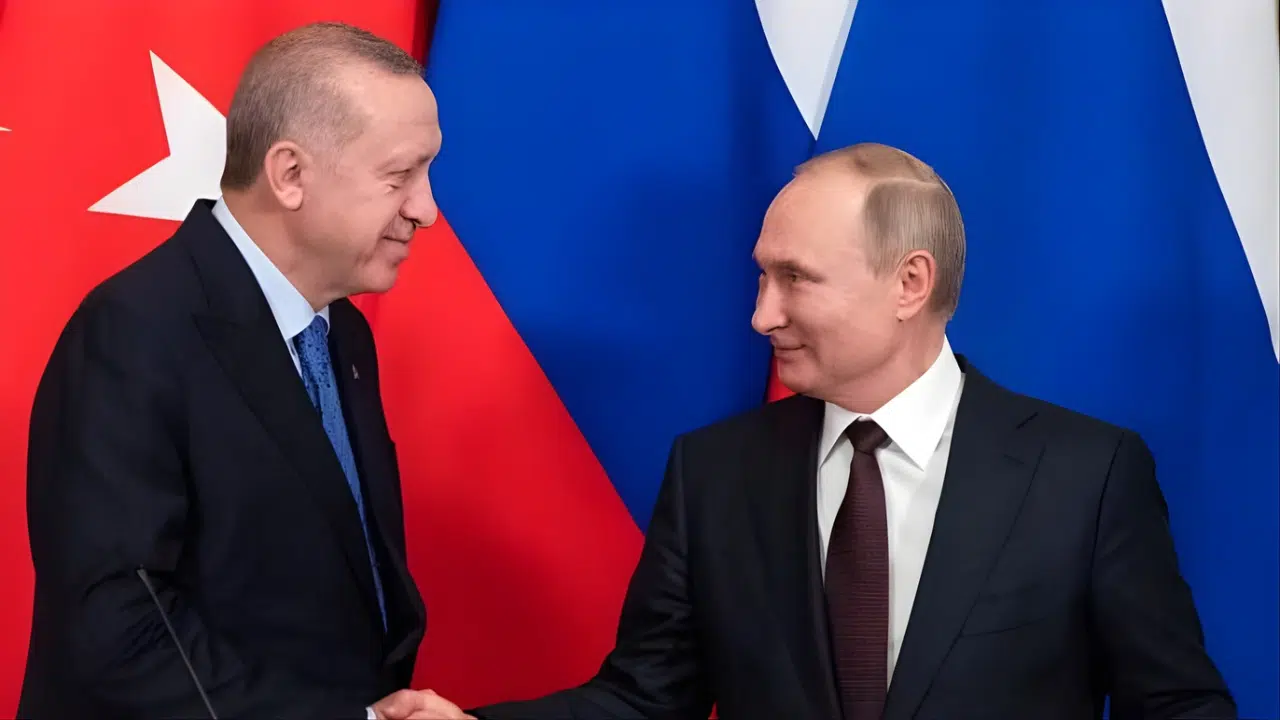
In a high-stakes diplomatic intervention aimed at de-escalating the most dangerous maritime and infrastructural phase of the Russia-Ukraine war, Turkish President Recep Tayyip Erdoğan has formally urged Russian President Vladimir Putin to accept a “limited ceasefire.” The proposal, delivered during face-to-face talks in Turkmenistan on Friday, specifically targets a cessation of hostilities against energy infrastructure and commercial ports—a move Ankara hopes will serve as a critical confidence-building measure toward a broader peace settlement.
The meeting, held on the sidelines of the International Peace and Trust Forum in Ashgabat, marks one of the most significant diplomatic maneuvers of late 2025. With winter tightening its grip on Eastern Europe and the war recently spilling violently into the Black Sea with strikes on commercial tankers, Erdoğan’s initiative seeks to cordon off the most volatile economic flashpoints of the conflict.
According to the Turkish Communications Directorate, Erdoğan framed the proposal not as a demand for total capitulation, but as a pragmatic necessity to safeguard global energy security and prevent a humanitarian catastrophe. “Implementing a limited ceasefire, primarily targeting energy facilities and ports, could be beneficial,” Erdoğan told the Russian leader, emphasizing that progress in these specific sectors could “offer practical benefits for both sides.“
The “Limited Ceasefire” Proposal: A Strategic Off-Ramp?
The specifics of the Turkish proposal reveal a nuanced understanding of the current deadlock. Rather than pursuing an immediate, all-encompassing armistice—which both Moscow and Kyiv have viewed with skepticism—Ankara is advocating for a functional compartmentalization of the war.
1. The Energy Grid Shield: The primary pillar of the proposal is a mutual halt to missile and drone strikes on power generation facilities and electrical grids. For Ukraine, this is existential. Relentless Russian bombardment has degraded much of its non-nuclear generation capacity, leaving millions vulnerable to freezing temperatures. For Russia, a cessation offers security for its own border energy refineries and depots, which have increasingly come under fire from deep-strike capable Ukrainian drones.
2. The Maritime Safety Zone: The second pillar focuses on the Black Sea ports. Following a recent spike in hostilities where Russia-linked tankers were targeted—sparking harsh rebukes from Ankara—the proposal seeks to neutralize the waters. This would ostensibly allow for the safe passage of not just grain, but also Russian hydrocarbons, a trade flow that remains vital to the global economy despite Western sanctions.
“President Erdoğan is essentially trying to recreate the success of the 2022 Black Sea Grain Initiative but on a more robust, militarized scale,” said Dr. Ahmet Sözen, a geopolitical analyst based in Istanbul. “He is telling Putin that while the land war may grind on, the economic war at sea and against civilians’ heat must stop for the sake of stability.”
Zelenskyy’s Unexpected Support and the “Difficult Decisions”
In a surprising alignment, Ukrainian President Volodymyr Zelenskyy has signaled readiness to back this specific sectoral truce. Speaking to reporters in Kyiv just hours before the Ashgabat meeting, Zelenskyy confirmed that Turkey was working on plans specifically linked to energy and shipping.
“President Erdoğan mentioned this to me. I told him we would support it,” Zelenskyy said. “He wanted to organize a corresponding meeting—initially at the team level, then at the leaders’ level. I told him we are ready.”
However, this readiness is shadowed by a grim reality in Kyiv. Turkish Foreign Minister Hakan Fidan, who has been instrumental in shuttling between capitals, offered a stark assessment of the diplomatic landscape. Speaking to international media, Fidan noted that Europe must help Ukraine make “very difficult choices” to prevent greater losses.
“Indeed, some choices, some decisions are very tough for Ukraine,” Fidan admitted, hinting at the intense pressure Kyiv faces to stabilize the frontlines, potentially at the cost of deferring maximalist territorial goals. “But to prevent greater losses—for the greater good—the bad, the harmful, must be removed.”
Fidan’s comments have been interpreted by analysts as a signal that the “limited ceasefire” might be the precursor to a de facto freezing of the conflict along current lines—a scenario Kyiv has historically rejected but may now be forced to consider due to manpower shortages and Western “negotiation fatigue.“
Moscow’s Calculation: “Welcoming” Mediation, Demanding Territory
The Kremlin’s response to Erdoğan’s overture was characteristically guarded yet visibly more receptive than in previous months. Kremlin spokesman Dmitry Peskov confirmed that Moscow “welcomes” Turkey’s mediation role.
“The Turkish president spoke about Türkiye’s readiness and willingness to continue its intermediary activities and contribute to the peace process, which is welcomed by our country,” Peskov told reporters in Ashgabat.
However, behind the diplomatic pleasantries, Vladimir Putin remains entrenched. During his own address at the forum, Putin reiterated that any peace deal must reflect “the realities on the ground”—a euphemism for Russian control over the annexed regions of Donetsk, Luhansk, Zaporizhzhia, and Kherson.
Putin’s willingness to entertain a limited truce on energy and ports likely stems from economic self-interest rather than a desire for de-escalation. Recent Ukrainian drone strikes have harassed Russia’s oil export terminals in the Black Sea, raising insurance premiums and threatening the revenue streams that fund the Kremlin’s war machine. A mutual “hands-off” agreement regarding ports would secure Russia’s southern export flank.
Moreover, engaging with Erdoğan allows Putin to demonstrate to the “Global South” and non-aligned nations that Russia is open to diplomacy, shifting the burden of refusal onto Kyiv and its Western backers.
The Shadow of the “28-Point Plan”
The Ashgabat talks did not happen in a vacuum. They are part of a broader, shadowy diplomatic push involving a rumoured “28-Point Plan,” which sources suggest has been drafted by US and European diplomats and heavily revised in recent weeks.
While the full details of the plan remain classified, leaks suggest it outlines a roadmap for a phased reduction in violence, starting with the energy/port ceasefire Erdoğan is now championing. The plan reportedly includes:
-
Phase 1: Cessation of strikes on critical civilian infrastructure (Energy/Ports).
-
Phase 2: A prisoner exchange “all for all.“
-
Phase 3: Resumption of broader political talks on the status of disputed territories, potentially involving a “deferred status” mechanism similar to historical precedents in frozen conflicts.
According to Turkish diplomatic sources, the plan was whittled down to 20 points by European actors before being presented to Moscow. The fact that the US—according to Zelenskyy—believes parties are “close to an agreement” on the energy component suggests that the Biden administration (or the incoming administration, depending on the precise post-election transition dynamics of late 2025) is pushing hard for a win before a potential shift in US foreign policy.
The Black Sea Escalation: Why Now?
The urgency of Erdoğan’s intervention is driven by the alarming militarization of the Black Sea. For the first two years of the war, the maritime domain was defined by the blockade and the subsequent Grain Deal. However, late 2024 and 2025 saw a shift. Ukraine, lacking a conventional navy, utilized sea drones to devastating effect, forcing the Russian Black Sea Fleet to retreat from Sevastopol.
In retaliation, Russia began targeting not just Ukrainian port infrastructure in Odesa and Chornomorsk, but also “shadow fleet” vessels suspected of carrying Ukrainian goods or weapons. This escalation threatened to turn the Black Sea into a “no-go zone” for international shipping, a nightmare scenario for Turkey, which controls the Bosphorus Strait and relies heavily on maritime trade stability.
“The Black Sea has become a battleground,” Foreign Minister Fidan warned. “Merchant ships and tankers are now being attacked there. If the war continues, it will spread to other regions.”
By proposing a limited ceasefire, Turkey is acting to protect its own economic backyard. Ankara has warned that any “uncontrolled escalation” in the Black Sea could inadvertently draw NATO—of which Turkey is a member—into a direct naval confrontation with Russia, specifically if a third-party vessel is sunk in international waters.
The Humanitarian Imperative: A Winter of Darkness
Beyond the geopolitics, the humanitarian stakes of the proposed energy truce are immense. The United Nations has warned that Ukraine faces its harshest winter yet. With over 60% of its thermal generation capacity damaged or destroyed, the Ukrainian grid is teetering on the brink of collapse.
A successful agreement to halt strikes on energy facilities would allow Ukrainian engineers to repair substations without the fear of “double-tap” missile strikes. It would ensure that hospitals, schools, and heating plants can function through January and February, potentially saving thousands of lives that would otherwise be lost to hypothermia and lack of medical care.
Simultaneously, a port truce would stabilize global food prices. While the grain corridor has functioned intermittently through unilateral Ukrainian corridors, it remains perilous. A formal, Russia-endorsed ceasefire would lower insurance costs and increase the volume of grain exports to the Global South, reinforcing Erdoğan’s image as a champion of the developing world.
Global Reactions: A Fragmented West
The Western response to the Turkish initiative has been cautiously supportive, though fragmented.
-
The United States: Washington appears to be quietly coordinating with Ankara. Having struggled to pass additional large-scale military aid packages in a divided Congress, the US sees a limited ceasefire as a way to stabilize Ukraine’s economy without requiring massive new kinetic investments.
-
The European Union: Brussels remains divided. While major powers like Germany and France see the energy truce as vital for European stability (and preventing a new wave of refugees fleeing a freezing Ukraine), the Baltic states and Poland are wary. They fear that any “limited” deal allows Russia to regroup, repair its own logistics, and freeze the conflict in a favorable position.
-
The Global South: Nations in Africa and the Middle East, represented at the Ashgabat forum, have overwhelmingly backed Erdoğan’s call. For them, the priority is the normalization of food and fuel prices, regardless of the territorial outcome in the Donbas.
Analysis: The Risks of a Partial Peace
While the proposal offers a glimmer of hope, history suggests caution. Partial ceasefires in the post-Soviet space have a poor track record. The Minsk Agreements (2014-2015) were ostensibly ceasefires that failed to stop low-level fighting and eventually collapsed into full-scale invasion.
Military analysts warn that a “limited” ceasefire is difficult to police.
-
Definition Problems: If a power plant is used to power a military factory, is it a legitimate target? If a port hosts naval drones alongside grain ships, is it immune?
-
Redeployment: Both sides could use the respite from deep strikes to move air defense systems closer to the front lines, intensifying the ground war in the Donbas while the rear remains “safe.“
Furthermore, there is the risk of “salami slicing” negotiations. By agreeing to a limited truce, Kyiv might find itself under immense pressure to make further concessions. As Fidan noted, the “difficult choices” are looming. If the energy war stops, the focus shifts entirely to the land war, where Russia currently holds the initiative in terms of manpower and artillery volume.
What Comes Next?
President Erdoğan has returned to Ankara with a mandate to push this initiative forward. The next steps, according to diplomatic sources, involve the formation of technical working groups. These groups, likely meeting in Istanbul or Riyadh, will attempt to map out the exact coordinates of “protected” energy and port facilities.
The world now watches Moscow. Will Putin accept the off-ramp to secure his oil revenues, or will he gamble that a freezing winter will break Ukrainian resolve faster than Ukrainian drones can break his refineries?
For now, the “Ashgabat Proposal” stands as the only viable diplomatic track on the table. It is not peace—far from it—but in a war that has spiraled toward total destruction, a limited ceasefire represents a desperate attempt to pull the emergency brake before the conflict plunges into an even darker abyss.