The 2026 release of a major collection of previously sealed Epstein documents is not a gossip drop; it is a forensic audit of systemic failure. This Epstein Files Testimony reveals how a trafficking operation functioned in plain sight, shielded by legal anomalies and social influence, demanding we read it as history, not a scandal sheet.
The Mirage of “The List”
The internet treats the unsealing of the Epstein documents like a spectator sport.With every new tranche released by the courts, thousands of pages of depositions, redacted emails, and legal motions emerge; a digital frenzy ensues. It is a frantic, algorithmic hunt for famous surnames, a collective “Control+F” searching for political rivals, Hollywood royalty, and scientific titans. It is a search for villains that has transformed a grim federal docket into a global tabloid, reducing years of documented abuse to a viral game of “Who’s Who.”
But to read these files simply as a “Client List” is to misread them entirely.
When stripped of the social media hysteria and the partisan point-scoring, the documents reveal something far more harrowing than celebrity gossip. They do not just offer a list of names; they offer a blueprint of how abuse was enabled and sustained. These documents should be read not as a scandal sheet, but as a testimony, a historical archive detailing how wealth, proximity to power, and institutional failure conspired to silence vulnerable women for a generation.
This is not a story about who flew on a plane. It is a story about how the plane was allowed to fly at all. It is a story about the architecture of a trap that was built in plain sight, maintained by legal brilliance, and shielded by a culture that consistently mistook net worth for moral character.
To understand the gravity of these documents, we must first dismantle the distraction that surrounds them: the obsession with “The List.” In the popular imagination, fostered by clickbait headlines and conspiracy threads, there exists a single, master ledger, a “Black Book” that definitively categorizes the guilty. The reality of the unsealed files is far more mundane and far more complex. The names that appear in these thousands of pages are a chaotic mix. They include alleged perpetrators, yes, but they also include unwitting witnesses, domestic staff, journalists, and people who simply attended a dinner party or flew on a jet for legitimate charitable or business reasons.
The “Tabloid Reading” flattens this complexity. It equates presence with participation. If a famous actor’s name appears in a lawyer’s question during a deposition, even if the answer is “No, I never saw him”, that actor is branded by the internet as “named in the files.” This flattening serves a dangerous purpose: it creates a smokescreen. By focusing on the celebrity cameos, we allow the actual mechanism of the abuse to fade into the background.
The “Testimony Reading,” by contrast, asks a different question. It does not ask, “Who was there?” It asks, “What was the system?”
The Architecture of Coercion: A Pyramid of Silence
The most revealing aspect of the unsealed files is the detailed description of how the abuse was engineered. The depositions dismantle the popular image of a shadowy, chaotic kidnapping ring and replace it with something more unsettling: an organized system of exploitation.
The testimony describes a system that relied on informal recruitment and financial inducements. The documents reveal that the perpetrators did not always hunt for victims themselves; they recruited victims to do the hunting for them. The files include testimony indicating that some young women were paid to introduce others.
The mechanism was brutally simple. A girl would be paid a “service fee” for her own abuse, but she could earn a “referral fee,” cited in some testimony as amounts in the range of a few hundred dollars, if she brought in a friend, a classmate, or a cousin.
“The structure was designed to compromise everyone it touched.”
This distinction is vital for understanding why the silence lasted so long. By introducing payments and referrals, the perpetrators created a layer of coerced complicity. A victim who had recruited her best friend was no longer just a victim in her own eyes; she was a participant. She carried a burden of guilt that made going to the police unthinkable. This was not just physical coercion; it was psychological entrapment. It blurred the lines between the abused and the abuser, a muddying of the waters that kept the machinery running without the need for locked doors or physical chains.
The Recruitment Hierarchy & Incentive Structure
A breakdown of the operational tiers described in witness testimony and FBI summaries.
| Operational Role | Function in the “System” | Primary Incentive | Systemic Outcome |
| The Architect | Central funding & directive control. | Power, control, social leverage. | Established the “brand” and provided the venue. |
| The Groomer | Logistics, normalization, and scheduling. | Financial dependence, proximity to power. | Normalized the environment for victims. |
| The Recruiter | Peer-to-peer outreach (often coerced). | Cash bonuses ($200-$300 “referral fees”). | Created a self-sustaining cycle of complicity. |
| The Target | Entry-level “massage” service. | Promise of easy money/career help. | The raw “commodity,” often unaware of the endgame. |
The files also document the banality of the entry point: “massage.” This was the euphemism that sanitized the crime. The testimony repeatedly describes how the initial approach was never overtly sexual or violent. It was framed as a job opportunity—a way to make easy money after school. The word “massage” stripped the encounter of criminal language. It allowed the abuse to begin with a request for a service, slowly escalating boundary by boundary until the trap had snapped shut.
The Normalization of Influence
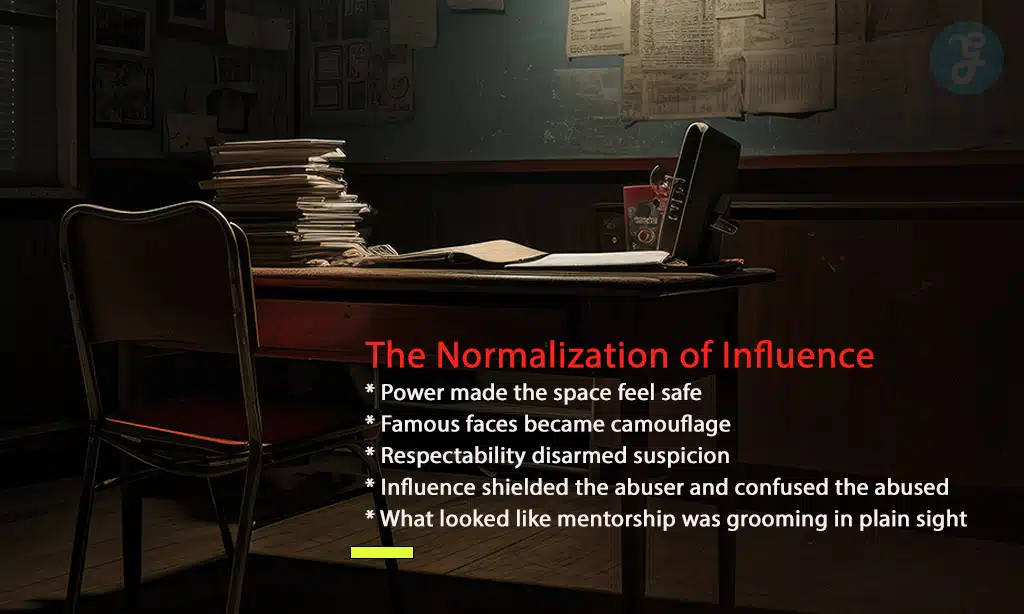
The “Tabloid” reading of the files focuses on the men at the top, the financiers, the princes, the presidents. The “Testimony” reading, however, draws our attention to the enabling layer in the middle: the normalization of the environment.
The documents illuminate the critical role that social legitimacy played in the grooming process. The presence of high-society figures, acclaimed academics, and celebrated scientists, many of whom are not accused of sexual impropriety, served a specific, darker purpose. They provided the camouflage.
For a young victim entering that orbit, the presence of respected world leaders and intellectuals signaled safety. The logic of the teenager is straightforward: If these powerful, famous, respectable people are comfortable here, then this place must be safe. If this was a crime scene, surely the former President or the famous physicist would not be sitting in the living room.
The files show how influence was weaponized not just to protect the abuser from the law, but to disarm the abused. The “List” is not merely a roster of friends and acquaintances; it is a partial map of the social shield that delayed scrutiny. The social capital of the guests was transferred to the host, creating a “reality distortion field” where normal rules of conduct seemed to be suspended.
Testimony regarding figures like Ghislaine Maxwell further clarifies this dynamic. Survivors often describe not a monster lurking in the shadows, but a figure who presented herself as a mentor. They describe a woman who acted as a “cool big sister,” who taught them how to dress, how to speak, and how to navigate high society. This mentorship was the spoon-sugar that made the poison palatable. It desensitized the victims to the sexual demands that followed, framing the abuse as a sophisticated exchange rather than a violation.
A Systemic Failure of Imagination
Perhaps the most damning narrative within the unsealed documents is not the conduct of the individuals, but the conduct of the state. The files serve as a comprehensive timeline of institutional failure.
To read the legal motions and the FBI interview summaries is to witness what critics and later reviews have described as a “failure of imagination” by the Department of Justice. Early investigations, particularly those in the mid-2000s, often framed the activities as isolated instances of prostitution. The authorities initially framed the allegations as individual acts of prostitution and the perpetrator as a “john.” They failed to see the interstate, coordinated trafficking enterprise that connected New York, Florida, New Mexico, and the US Virgin Islands.
Timeline of Institutional Missed Opportunities
Key moments where intervention was possible but failed, based on legal histories.
| Year | Event/Flag | Institutional Action | Result |
| 2005 | First police report filed in Palm Beach. | Local investigation begins; evidence seized. | Case moves slowly; federal involvement remains limited. |
| 2006 | FBI opens federal probe. | Extensive interviews; draft indictment (50+ pages). | Indictment is never filed; plea negotiations begin. |
| 2008 | Non-Prosecution Agreement (NPA). | Immunity granted to “potential co-conspirators.” | Investigation effectively closed; victims not notified. |
| 2026 | Final Unsealing of Documents. | Public release of names and depositions. | Exposure of the “system” rather than just the man. |
The documents capture the friction between local law enforcement, who often saw the crimes clearly and wanted to pursue them, and federal levels where the waters became murky. The influence of high-priced legal defense teams is evident on every page. The files reveal a “protection racket” not of thugs, but of motions, delays, and plea deals.
The Non-Prosecution Agreement (NPA) of 2008, which is dissected and referenced throughout the later civil suits, stands as a monument to this failure. It was a legal anomaly, a secret deal that granted immunity not just to the primary suspect, but to any “potential co-conspirators.” It effectively stalled further criminal pursuit for over a decade.
This is where the “Special Story” angle becomes crucial. A breaking news report might focus on who signed the deal. A contextual story asks why the system was susceptible to such a deal. The files suggest that the justice system, when faced with overwhelming wealth and political connection, blinked. It defaulted to a position of deference. The “Testimony” reading forces us to confront the uncomfortable reality that the law is not blind; it is often dazzled by the glare of status.
The Economics of Silence
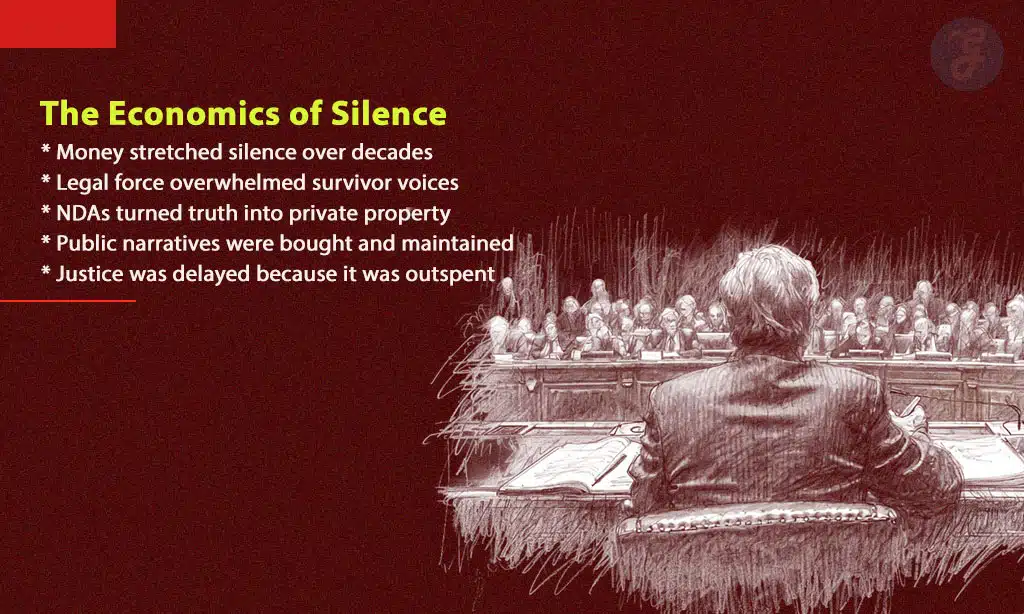
The Epstein files are also a text about economics. They are a case study in the disparity of resources.
The litigation history revealed in the documents shows how the legal system was weaponized against the survivors. For years, victims who attempted to speak out were met with defamation lawsuits, aggressive private investigators, and a barrage of legal threats. The files show how NDAs were used to discourage public testimony and prolong silence.
This economic disparity created a timeline of two truths. There was the “Public Truth,” maintained by high-powered public relations firms and legal teams, which painted the allegations as the fantasies of gold-diggers. And there was the “Private Truth,” locked away in sealed depositions, where the reality of the abuse was recorded in excruciating detail.
The unsealing of these documents is the collapse of that paid-for reality. It is a market correction of the historical record. But it comes too late for many. The documents remind us that justice delayed is not just justice denied; it is justice outspent. The survivors had to fight a war of attrition against a seemingly bottomless war chest. That they succeeded in getting these documents unsealed is a testament to resilience, but it is also an indictment of a system where the truth is often a luxury good.
The Gamification of Trauma
Why, then, do we cling to the “Client List” narrative? Why does the internet treat this profound tragedy as a game of Clue?
Focusing on celebrities allows the public to externalize the evil. If we can identify a few famous monsters, we can quarantine the problem. We can say, “Those people are bad,” and by extension, “We are good.” It is easier to make memes about a politician or an actor than it is to confront the reality that the legal system, the banking system, and the social registry all functioned exactly as they were designed to, protecting capital and status at the expense of human dignity.
To treat these files as a tabloid is to participate in a continuation of harm: the erasure of the victim’s voice.
Media Framing Analysis – Tabloid vs. Testimony
A comparative look at how the story is consumed versus how it should be understood.
| Feature | The “Tabloid” Frame (Viral) | The “Testimony” Frame (Editorial) |
| Primary Focus | “The List” (Celebrities/Politicians). | The Survivors (Jane Does). |
| Key Question | “Who is guilty?” | “How did the system allow this?” |
| Treatment of Context | Ignored; mere mention = guilt. | Critical; distinguishes witness from accused. |
| Goal | Political points/Social media engagement. | Historical record/Systemic reform. |
Every time a screenshot of a flight log goes viral without context, the testimony of a survivor, describing her fear, her confusion, and her pain, is drowned out. Every time we prioritize the reputation of a powerful man over the statement of a vulnerable woman, we are reinforcing the very hierarchy that made the abuse possible.
The “Tabloid” reading consumes the trauma as entertainment. The “Testimony” reading honors the trauma as history.
What the Files Leave Behind: An Archive of Resilience
The true value of the Epstein files lies in their dullest details: the dates, the locations, the email timestamps, and the sworn statements of women who refused to go away.
These documents are a vindication of the “Jane Does.” They are a permanent record that their stories, once dismissed by the media and the courts as “fantastic” or “money-seeking,” were factual. They are a retrospective on how a minor’s testimony was weighed against a billionaire’s legal machinery.
We must stop reading these files looking for a smoking gun. The gun went off years ago. The shots rang out in 2005, in 2008, in 2019. We are now reading the ballistics report.
The story is not about who is hiding in the redactions; the story is about the women who fought to rip the black tape off the page. It is a story about systems… legal, social, and financial, that we still inhabit today. The names on the list will eventually fade from the news cycle, replaced by the next scandal. But the lesson of the testimony must remain: vulnerability is not a flaw in the victim; it is a flaw in the society that fails to protect her. This is why we read the files. Not to judge the past, but to inoculate the future.