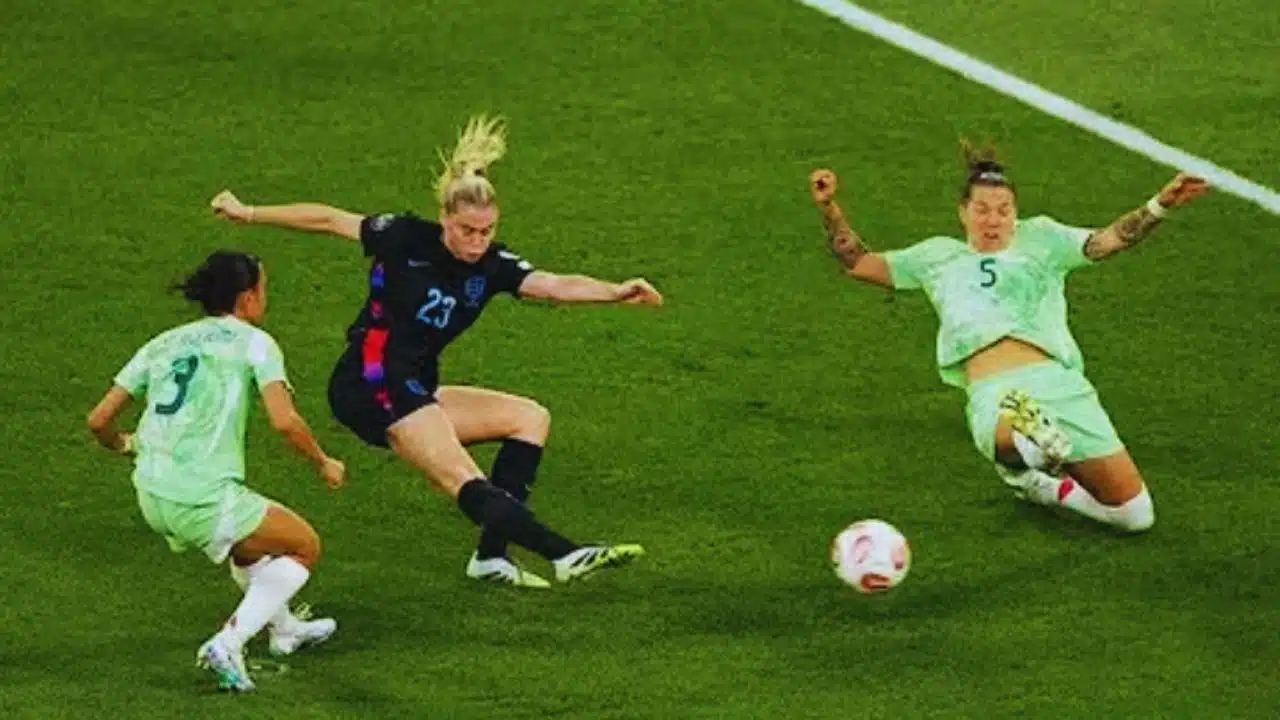
England produced another breathtaking comeback at UEFA Women’s Euro 2025, defeating Italy 2-1 after extra time in Geneva to advance to the final. With the clock ticking down and defeat looming, 19-year-old Michelle Agyemang came off the bench to score a stunning equalizer in the sixth minute of stoppage time.
Chloe Kelly then sealed the dramatic win by converting a rebound after her penalty was saved in the 118th minute. The Lionesses will now prepare to face either Spain or Germany in the final at Basel’s St. Jakob-Park on Sunday.
Agyemang the “Saviour” Strikes Again in the Final Moments
Michelle Agyemang has emerged as England’s ultimate game-changer in this tournament. Once again, her presence flipped the script. Introduced in the 85th minute, Agyemang brought a spark that had been missing for most of the match. With six minutes added to regular time, she made the most of a tight space in the Italian box, finishing smartly with a double nutmeg that left defenders stunned. It was a goal of remarkable composure for such a young player.
Just like her crucial equalizer against Sweden in the quarterfinals, Agyemang became the heartbeat of England’s revival. Her confidence, timing, and eye for goal have turned her into a fan favorite and a tactical weapon. She almost gave England the lead in extra time with a delicate lob that struck the crossbar. The Swiss crowd gasped as the ball dropped agonizingly close.
Eventually, the winning moment came when Beth Mead was fouled inside the penalty area. Chloe Kelly, another substitute, stepped up in the 118th minute. Although her initial penalty was saved by Italian goalkeeper Laura Giuliani, she reacted first to poke the rebound into the net, sending England’s bench and fans into euphoria.
Tactical Delay: Were Wiegman’s Substitutions Too Late?
While the result vindicated Sarina Wiegman’s decisions, many questioned the timing of her substitutions. England looked disjointed and uninspired for most of the match, especially in attack. Yet Wiegman stuck to her conservative substitution strategy, even as England struggled to find a breakthrough.
Beth Mead came on at halftime, likely due to Lauren James’s injury, but the impactful duo of Kelly and Agyemang only arrived in the 77th and 85th minutes, respectively. Aggie Beever-Jones also joined late in the game. While these players changed the match’s outcome, it felt like the manager waited far too long.
Wiegman is known for her disciplined approach, but given how England only began to threaten Italy’s goal after the changes, many experts argue that earlier introductions could have spared the team from so much late drama.
Italy’s Brilliant Strategy Falls Just Short
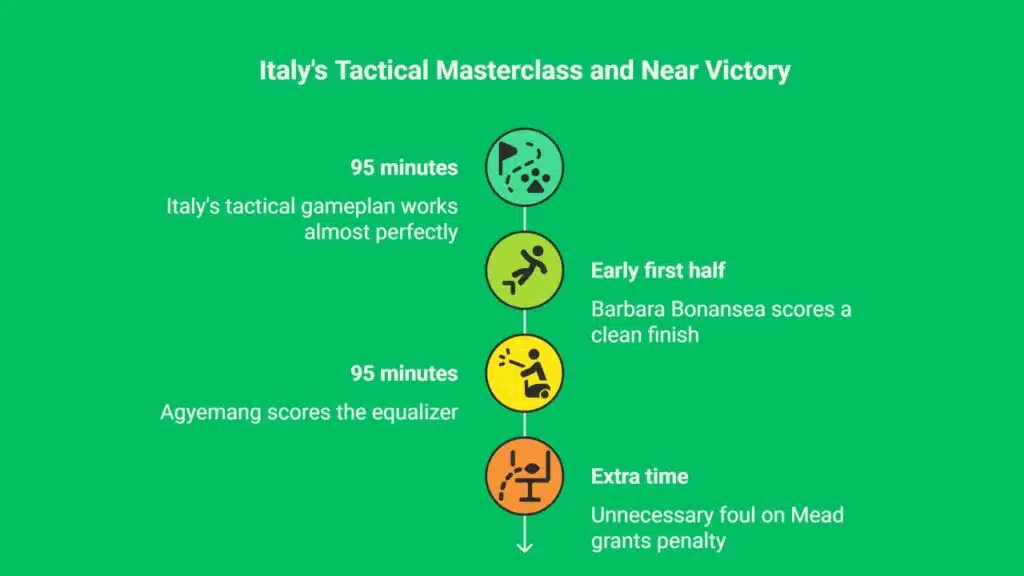
Italy entered this semifinal with a detailed and disciplined gameplan, and for 95 minutes, it worked almost perfectly. They stunned England early in the first half when veteran forward Barbara Bonansea, 34, struck a clean finish after a well-executed build-up on the right wing.
It was the fifth match in this tournament where Italy scored first—a clear sign of their aggressive early approach. Their tactical awareness under manager Andrea Soncin stood out. Italy effectively nullified Keira Walsh, England’s midfield anchor, by tightly marking her out of the game. Without Walsh’s playmaking, England were forced to bypass the midfield with long balls, which were easily contained by Italy’s well-organized defense.
Italy also doubled up on Lauren James before her injury, keeping England’s most creative attacker quiet. Their compact shape made it difficult for the Lionesses to find rhythm or space in the final third.
However, as fatigue set in and the clock wore down, cracks began to appear. A momentary lapse allowed Agyemang to score the equalizer, and an unnecessary foul on Mead in extra time handed England the penalty opportunity. The margins were razor-thin, but they proved decisive.
Defensive Vulnerability Still Haunting England
Despite their comeback win, England’s defensive weaknesses remain a major concern. In the group stage and knockout rounds, they’ve repeatedly struggled to keep opponents out. France and Sweden both exposed their backline with speed and precision, and Italy followed suit.
Bonansea’s goal was the result of a chain of defensive errors. Esme Morgan, brought into the starting XI in place of Jess Carter, failed to block the cross. The defenders then missed a chance to clear the ball on its first bounce, and Bonansea was left completely unmarked.
Captain Leah Williamson appeared off-pace, possibly still nursing an ankle injury picked up against Sweden. Alex Greenwood, usually a central defender, was shifted to left-back, weakening both defensive coverage and distribution. Without a natural left-back, England’s shape looked uncomfortable.
To win the final, England will need a more disciplined and cohesive performance at the back—especially against high-scoring teams like Spain or Germany.
Emotional Exit for Italy’s Veteran Stars
For Italy, the loss was even more painful due to the emotional exits of key veterans. Star striker Cristiana Girelli left the field in tears after suffering what appeared to be a hamstring injury in the 64th minute. The 35-year-old forward, who had scored both goals in their quarterfinal win over Norway, likely played her final Euro match.
Girelli’s leadership and spirit have been instrumental in Italy’s run. Despite criticism that the team relies too heavily on older players, her form and passion remained top-tier throughout the tournament. Barbara Bonansea, who scored against England, also made history by becoming the second-oldest player to score in a Women’s Euro semifinal. Only Elisabetta Vignotto in 1989 was older.
Italy now faces a generational crossroads. While players like Girelli and Bonansea have been the backbone of the team, new stars like Sofia Cantore, 25, offer hope for the future. Cantore’s aggressive runs and ability to exploit England’s defensive gaps showed that Italy has emerging talent to build around.
England’s Attack Needs More Precision
While England’s fighting spirit cannot be questioned, their attack continues to lack sharpness. They had more possession than Italy but struggled to convert that into clear-cut chances.
Alessia Russo, often isolated up front, had to drop deep to support midfielders instead of staying in the box. Italy’s defensive trio surrounded her at every opportunity, cutting off any service.
Lauren Hemp, known for her pace, often reached the byline but couldn’t deliver consistent crosses. With Walsh out of the game tactically, England lacked creativity in central areas. Ella Toone and Lucy Bronze made smart runs, but those went unnoticed, further frustrating England’s forward momentum.
Against stronger defenses like those of Spain or Germany, such inefficiency will likely be punished. The Lionesses must find their attacking rhythm in the next five days to stand a chance of retaining their title.
Italy Bows Out With Pride, Not Regret
Although heartbreak was written across every Italian face at the final whistle, the squad can leave Euro 2025 with their heads held high. Their resilience, tactical execution, and passionate support made them one of the tournament’s standout stories.
Italy had not reached a Euro semifinal in 28 years, and this run has re-energized the women’s game back home. In Geneva, the crowd was electric. Songs of “Girelli” echoed throughout the stadium, and the Italian national anthem was belted with pride from the stands.
Their exit is a loss for the competition, but also a signal that Italy’s women’s football is on the rise. With more investment, more young players breaking through, and the emotional drive of this tournament, Italy could become a regular contender in years to come.
England Faces a Huge Test in the Final
England has now survived two consecutive knockout games with last-minute miracles, but questions remain. Can they tighten their backline and improve their finishing in time for the final?
With only five days before the showdown in Basel, Wiegman and her coaching team will need to address tactical discipline, substitution timing, and player fitness. Spain and Germany pose a completely different kind of challenge—technically sharp, tactically organized, and ruthless in front of goal.
But for now, England will enjoy the victory. Once again, the Lionesses refused to quit. And once again, Michelle Agyemang proved that sometimes, youth can save the day.