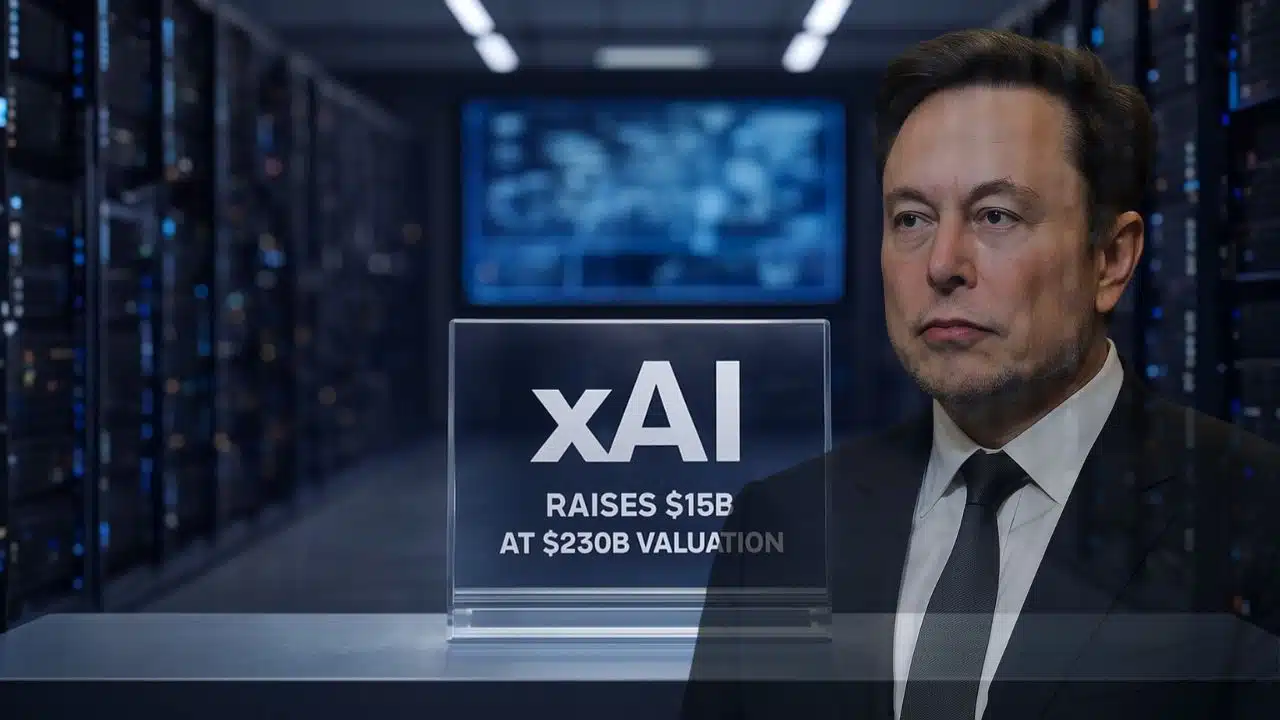
Elon Musk’s artificial intelligence company, xAI, is reportedly in the final stages of negotiating a massive new funding round that could bring in $15 billion in fresh equity, pushing the company’s valuation to around $230 billion. This would more than double xAI’s valuation from earlier this year and place the two-year-old startup among the most valuable private tech companies in the world.
The fundraising details were shared with potential investors in a briefing led by Jared Birchall, who manages Musk’s family office. Although the documents reviewed by investors did not clarify whether the $230 billion figure represents the company’s pre-money or post-money valuation, the scale of the raise itself signals enormous confidence in xAI’s rapid expansion. The new valuation jump is significant considering that only months ago, xAI disclosed a valuation of about $113 billion following its all-stock merger with the social media platform X (formerly Twitter). That merger combined xAI’s fast-growing AI operations with X’s user-driven ecosystem, creating one of the most ambitious AI-media integrations in the tech industry.
One of the key arguments attracting investors to xAI is its pathway to early profitability, especially when compared with other leading AI labs. During an investor presentation, Jonathan Shulkin of Valor Equity Partners said that xAI is generating revenue at a faster-than-expected pace and is positioned to become cash-flow positive within 2.5 to 3 years. This relatively accelerated timeline sets xAI apart in an industry where heavy infrastructure spending often delays profitability for many years. Shulkin also emphasized that xAI currently maintains around $10 billion in cash reserves, giving the company a significant buffer for its aggressive expansion plans.
This projection places xAI in a similar timeframe to Anthropic, another major AI competitor, which also expects to reach positive cash flow by 2028. In contrast, OpenAI—currently valued at over $500 billion—does not anticipate becoming cash-flow positive until around 2030, despite generating approximately $13 billion in annual revenue. With OpenAI forecasting a large cumulative cash burn through 2029, investors see xAI as a potentially more capital-efficient alternative with a faster path to sustainability.
A major portion of the new funding will be directed toward xAI’s infrastructure goals, particularly the development of its Colossus supercomputer facility in Memphis, Tennessee. The company is scaling up its computing environment at an unprecedented speed. According to internal briefings, Colossus already contains more than 200,000 GPUs, and xAI aims to expand that number to one million GPUs, which would make it one of the most powerful AI supercomputers in the world. The scale of this build-out underscores Musk’s ambition to compete not only with OpenAI but also with large cloud providers that serve the global AI industry.
In parallel with the equity raise, Valor Equity Partners is also structuring a special purpose vehicle (SPV) designed to raise an additional $15–$20 billion. This vehicle would purchase high-demand Nvidia GPUs and lease them back to xAI. This financing method is intended to significantly reduce the capital burden typically associated with such large-scale computing infrastructure. Nvidia itself has reportedly committed around $2 billion to the vehicle, reinforcing its strategic partnership with xAI and its broader bet on the AI hardware boom. According to Shulkin, this financing structure represents a “market innovation” that aims to keep xAI’s capital costs far below the 40–50% dilution impact that traditional equity financing would impose.
The latest developments also highlight the increasingly connected nature of Musk’s business empire. Earlier this month, Tesla shareholders approved a proposal that would allow the electric vehicle company to invest in xAI. While the approval passed, a notable number of shareholders abstained or voiced concerns about potential conflicts of interest. This debate reflects a broader conversation around the overlapping roles that Musk occupies across Tesla, SpaceX, X, and xAI.
Supporters argue that Musk’s interconnected venture ecosystem enables technological breakthroughs and accelerates innovation across industries—from electric vehicles to rockets to artificial intelligence. Critics, however, worry that the shared leadership and interlinked ownership structures may complicate governance, transparency, and capital allocation. As xAI continues to grow rapidly and raise increasingly large amounts of capital, these questions are likely to become more prominent.
If finalized, this fundraising round would cement xAI as one of the dominant players in the global AI landscape—on a valuation level approaching the largest privately held companies. The combination of rapid revenue growth, a faster-than-expected profitability outlook, and one of the most ambitious AI infrastructure projects in development signals that xAI intends to directly challenge the industry’s established leaders.
Its latest chatbot, Grok 4.1, has already been introduced to the market with claims of outperforming competitors in areas such as emotional understanding and creative reasoning. The combination of expanding product capabilities, large-scale compute investment, and Musk’s ability to attract mega-capital rounds suggests that xAI is entering a critical new phase.
As the company advances toward completing this major raise, xAI is positioning itself not just as another AI lab but as a heavyweight platform seeking to shape the next era of artificial intelligence—from foundational models to hardware infrastructure to integrated consumer applications. Whether its aggressive trajectory proves sustainable long-term will depend on execution, transparency, competitive dynamics, and the rapidly evolving regulatory environment around AI. But in the immediate term, xAI’s surge signals a transformative moment in the global race for AI leadership.