
The long-promised Elon Musk launches encyclopedia project is not a separate website, but a new information ecosystem being built in plain sight on X.com. By integrating his Grok AI and championing ‘Community Notes’ as a new model for “fact-checking,” Musk is creating a real-time information hub that aims to supplant traditional media, but which critics and data analysis warn is “fact-checked” by algorithms and users increasingly aligned with right-wing views.
Key Facts: The ‘Musk-pedia’ Ecosystem
- The ‘Encyclopedia’ Defined: This is not a static website like Wikipedia, but the dynamic integration of X’s real-time feed, the user-driven ‘Community Notes’ moderation system, and the ‘Grok’ AI chatbot from Musk’s xAI.
- The ‘AI Fact-Checker’: Musk’s primary “fact-checker” is Community Notes, which uses a “bridging algorithm” to surface notes written and rated by users. Musk has also integrated Grok to summarize news, positioning it as a “truth-seeking” alternative to other AI.
- The Bias Allegation: Multiple independent analyses and reports indicate that Community Notes are disproportionately applied to content from mainstream and left-leaning sources, while content from prominent right-wing sources is noted far less frequently.
- Stated Motivation: Musk has explicitly stated his goal is to combat “woke mind virus” in media and AI. He launched his AI firm, xAI, to create “TruthGPT” (which became Grok) as a “maximally truth-seeking” alternative to “liberal-biased” AI from Google and OpenAI.
- The ‘Truth’ Vertical: This new ecosystem allows Musk to control the platform (X), the real-time information feed (X’s users), the moderation layer (Community Notes), and the AI-driven summarization and search layer (Grok).
The ‘War on Wikipedia’ and ‘Woke AI’
For years, Elon Musk has publicly feuded with Wikipedia, the platform he seeks to displace. In 2023, he offered the nonprofit encyclopedia $1 billion to change its name to “Dickipedia,” a crude gesture that underscored his deep-seated criticism of its editorial neutrality and perceived left-wing bias
This disdain for established information sources is the philosophical bedrock of his new project. When he announced his artificial intelligence company, xAI, in 2023, he did so with a clear mission: to build “TruthGPT.“
In an interview with Tucker Carlson in April 2023, Musk framed this venture as an existential necessity. He argued that AI models from competitors like Google and OpenAI were being trained on “politically correct” data, effectively programming them to be “woke” and, in his view, dishonest. “The danger of training AI to be woke—in other words, to lie—is deadly,” Musk stated.
His “encyclopedia” is the fusion of this “truth-seeking” AI with the “free speech” platform of X. It is not just a repository of facts; it is an active, real-time machine intended to adjudicate truth, minute by minute, directly challenging the mainstream media and information consensus.
What Happened: Building the ‘Encyclopedia’ in Plain Sight
Musk’s information ecosystem is built on two key pillars, both of which are controlled by him and designed to work in concert on the X platform.
Pillar 1: Community Notes as the ‘People’s Fact-Checker’
The most visible component is Community Notes, the user-moderation system Musk has hailed as “a game-changer for combatting false info.“
Unlike old Twitter’s centralized moderation, Community Notes allows users who join the program to write “notes” adding context to any post. These notes are not published automatically. They only become public if they are rated “helpful” by a sufficient number of other contributors.
The system’s core is an “AI” or, more accurately, a “bridging algorithm.” A note is only surfaced if it receives “helpful” ratings from users who have historically disagreed in their past ratings. In theory, this is designed to find consensus and prevent partisan brigades from controlling the system
However, critics argue this system has been co-opted. As the X platform’s user base and most active contributors have shifted politically rightward since Musk’s 2022 acquisition, the pool of users creating and rating these notes has allegedly skewed. The “bridging” algorithm can only find consensus among the people who are in the system. If that pool of raters leans in one direction, the “consensus” it finds will reflect that lean.
Pillar 2: Grok as the ‘AI Oracle’
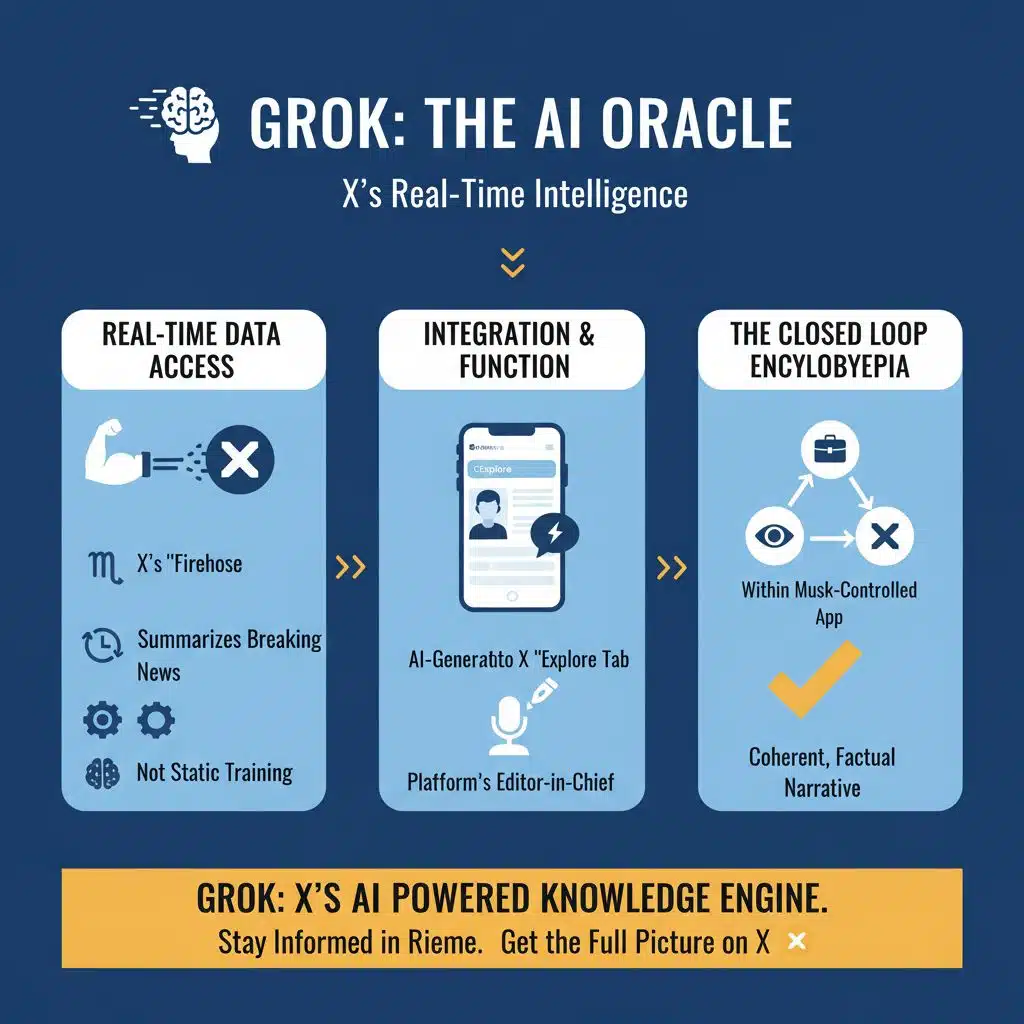
The second pillar is Grok, the AI chatbot from xAI. Grok’s unique selling point is its real-time access to X’s “firehose” of data. While ChatGPT or Google’s Gemini rely on static training datasets, Grok can (and does) summarize breaking news as it happens on X.
Musk has begun integrating Grok directly into X’s “Explore” tab, where it provides AI-generated summaries of trending topics. This effectively makes Grok the platform’s editor-in-chief, digesting millions of user posts and presenting a coherent, “factual” narrative.
This integration is critical. It means a user can see a trending event, read an AI-generated summary from Grok, and see “fact-checks” from Community Notes all within a single, Musk-controlled app. This closed loop is the “encyclopedia.“
Latest Data & Statistics: Analyzing the ‘Right-Wing’ Alignment
The core of the criticism against Musk’s project is that this ecosystem is not neutral, but actively biased. The data, while complex, highlights several statistical warning signs.
1. The Community Notes Discrepancy
An analysis by The Washington Post in 2023 found a significant disparity in how Community Notes were applied. The investigation reviewed posts from 10 prominent liberal-leaning news organizations and 10 prominent conservative-leaning one.
- Result: The study found that notes were “affixed to 32 percent of the liberal-leaning outlets’ tweets,” while only “5 percent of the conservative-leaning outlets’ tweets” received notes
- Analysis: While X defenders claim this is simply because liberal outlets post more misinformation, critics argue it shows a clear partisan bias in what gets “fact-checked” by the community.
2. The ‘Correction’ of Grok’s Politics
When Grok-1 was first released in late 2023, independent researchers ran it through standard political orientation tests. The results, published by researchers and tech publications, found the AI registered as “left-libertarian,” similar to other models.
- Musk’s Response: Musk publicly declared this a “major concern.” On his X account on December 9, 2023, he posted: “This is a major concern. We are taking immediate action to move Grok closer to politically neutral.
- Analysis: For critics, this was a smoking gun. Musk’s definition of “neutral” was a correction away from the industry baseline, an explicit action to shift his AI’s political alignment to match his own worldview, which he often describes as “centrist” but which aligns with many right-wing social and political talking points.
3. The Content Environment on X
Since the 2022 acquisition, numerous reports have detailed a shift in the content environment on X. The Institute for Strategic Dialogue (ISD), a non-profit monitoring extremism, reported in 2024 that “narratives related to ‘white genocide’ and the ‘Great Replacement’ theory” saw a “significant and sustained increase” on the platform following Musk’s takeover
- Analysis: This shift in the content on X directly impacts the context that Grok learns from and the pool of users operating Community Notes. If the platform’s discourse shifts right, the inputs for its “fact-checking” encyclopedia inevitably follow.
What to Watch Next
The full deployment of this “encyclopedia” is far from complete. The key developments to watch are:
- Grok-3 and Beyond: Future iterations of Grok will be more powerful and more deeply integrated. Watch for its ability to not just summarize, but to debate and argue its version of facts within X threads.
- Electoral Integrity: With major global elections ongoing, this system will be the primary source of news for millions of users. Its neutrality (or lack thereof) could have tangible political consequences.
- Regulatory Scrutiny: The European Union’s Digital Services Act (DSA) imposes strict rules on large platforms regarding algorithmic transparency and moderation. X is already under investigation, and this integrated “truth machine” will likely face intense regulatory pressure.
The narrative of Elon Musk launching an encyclopedia goes beyond a straightforward product launch. It tells the tale of the development of a novel, potent, and very contentious information architecture.
Musk has effectively created a closed loop: a user-driven algorithm to monitor it (Community Notes), a real-time AI to analyze it (Grok), and a forum for discourse (X). Although he presents this as a “maximally truth-seeking” effort to combat “woke” bias, an increasing amount of data indicates that this system is a reflection of its creator’s own ideological beliefs both in terms of design and implementation.
With its “fact-checks” in line with Musk’s “community” rather than conventional journalistic or scientific consensus, it is a huge experiment in algorithmic truth. Its live-test audience is now the entire world.
The Information is Collected from MSN and Yahoo.