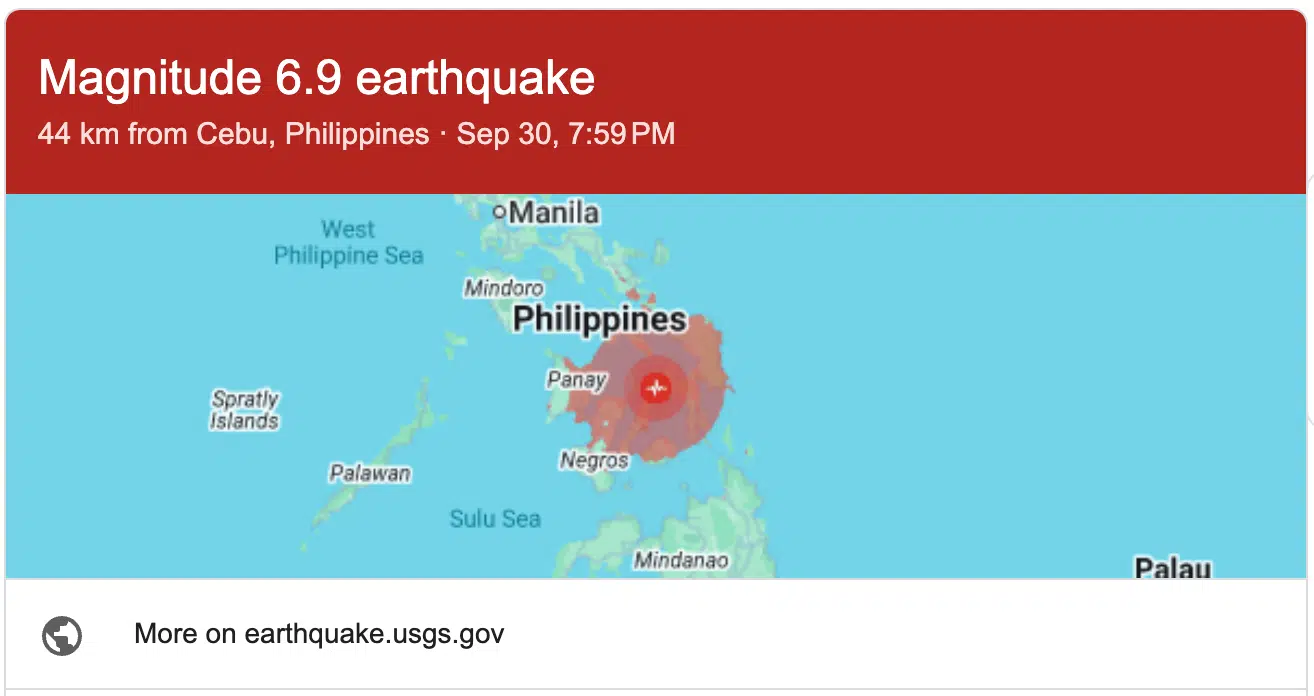
The death toll from the powerful magnitude 6.9 earthquake that struck the central Philippines earlier this week has tragically climbed to 69, officials confirmed on Thursday, as search and rescue efforts intensified across the hardest-hit areas of Cebu province.
The upward revision of fatalities comes from new data compiled by local disaster agencies and reported by Reuters, reflecting the grim reality as rescuers reach more remote and devastated communities.
The shallow offshore tremor, which hit late Tuesday night, has also left over 200 people injured and caused extensive damage to homes, infrastructure, and historical sites. With many areas still difficult to access due to landslides and impassable roads, authorities caution that the death toll could continue to rise.
Key Facts & Quick Take (Updated)
- Magnitude: 6.9 (Source: PHIVOLCS, USGS)
- Time: Tuesday, September 30, 2025, at 9:59 PM PST
- Epicenter: 17 km Northeast of Bogo City, Cebu
- Fatalities: At least 69 reported dead (Updated from 26), according to officials cited by Reuters.
- Injuries: Over 200 reported injured (Updated from 147). These figures are subject to ongoing validation.
- Impact: Widespread power outages, severe damage to homes, roads, bridges, and heritage churches. Landslides reported, particularly in Tabuelan.
- Response: President Ferdinand R. Marcos Jr. has ordered an immediate rollout of relief and rehabilitation. The NDRRMC remains on red alert, with government agencies mobilizing emergency funds and personnel.
The Rising Toll: What Happened
The magnitude 6.9 earthquake, which struck at a shallow depth of 10 kilometers, unleashed devastating force across northern Cebu and surrounding islands. Initial reports indicated 26 fatalities, but as rescue teams have navigated through blocked roads and collapsed structures, more casualties have been discovered. The updated death toll of 69 highlights the severity of the quake’s impact on densely populated areas.
“The number of dead has risen as we’ve been able to access more areas and confirm reports from local communities,” said a provincial disaster official, speaking anonymously to Reuters. “Many were trapped in collapsed homes.”
The intensity of the shaking, which lasted for a harrowing minute, caused widespread panic. Eyewitnesses described buildings swaying violently, leading to immediate structural failures. The series of powerful aftershocks that followed further terrorized residents, forcing thousands to remain outdoors.
Latest Data & Statistics (Updated)
Official figures are continually being updated as the situation evolves.
- Casualties (as of Oct. 2, 2025): The death toll has reached 69, with over 200 injured, according to officials cited by Reuters. This marks a significant increase from the previous count of 26 fatalities. (Source: Reuters)
- Infrastructure Damage: Reports confirm severe damage to numerous structures, including at least eight major infrastructure assets like the Daanbantayan church and several bridges. A critical highway in Tabuelan remains affected by a significant landslide, impeding relief efforts.
- Power and Communication Outages: Power remains out in several municipalities, including Daanbantayan, Bogo, and San Remigio. Communication lines, while partially restored in some areas, continue to pose challenges for coordination.
PHIVOLCS continues to monitor a flurry of aftershocks, underscoring the instability of the region. Dozens of tremors, ranging up to magnitude 3.7, have been recorded, adding to the anxiety of the affected population.
Official Responses & Expert Analysis
President Ferdinand R. Marcos Jr. reiterated his call for urgent and comprehensive relief operations. “Every effort must be made to save lives and provide immediate assistance to those affected,” the President stated through his communications office.
Budget Secretary Amenah Pangandaman confirmed that Quick Response Funds (QRF) from agencies like the Department of Social Welfare and Development (DSWD) and the Department of Public Works and Highways (DPWH) are being rapidly deployed. The DSWD has expanded its distribution of relief goods, including family food packs and non-food items, to accommodate the rising number of displaced individuals.
Renato Solidum, director of PHIVOLCS, reminded the public of the Philippines’ location on the Pacific “Ring of Fire,” emphasizing the country’s vulnerability to such powerful seismic events. The shallow depth of this earthquake significantly contributed to its destructive potential.
Impact on People
The updated casualty figures underscore the profound human cost of the disaster. Entire communities are grappling with loss, injury, and displacement. Many residents are still recovering from the psychological trauma of the violent shaking, compounded by the ongoing aftershocks.
Local officials in severely affected towns, such as San Remigio and Tabuelan, which have already declared a state of calamity, continue to appeal for more aid. Access to clean water, food, and temporary shelter remains a critical need for thousands whose homes have been destroyed or deemed unsafe. Classes and non-essential work remain suspended in numerous areas to facilitate recovery and safety assessments.
What to Watch Next
The immediate focus remains on humanitarian assistance and comprehensive damage assessment. Key developments will include:
- Final Casualty Validation: As rescue operations wind down and official counts are finalized.
- Infrastructure Repair: Efforts to clear landslides, repair critical roads, and restore essential services like power and water.
- Long-term Rehabilitation: Planning for the rebuilding of homes and infrastructure, as well as psychosocial support for affected communities.
- Aftershock Monitoring: Continued vigilance from PHIVOLCS regarding seismic activity.
The devastating 6.9 magnitude earthquake in the central Philippines has left a trail of destruction and a significantly higher human toll than initially reported. With 69 lives lost and hundreds injured, the nation mourns its dead while galvanizing efforts to support the survivors. The coming days will be critical for providing relief, securing affected areas, and laying the groundwork for a resilient recovery.