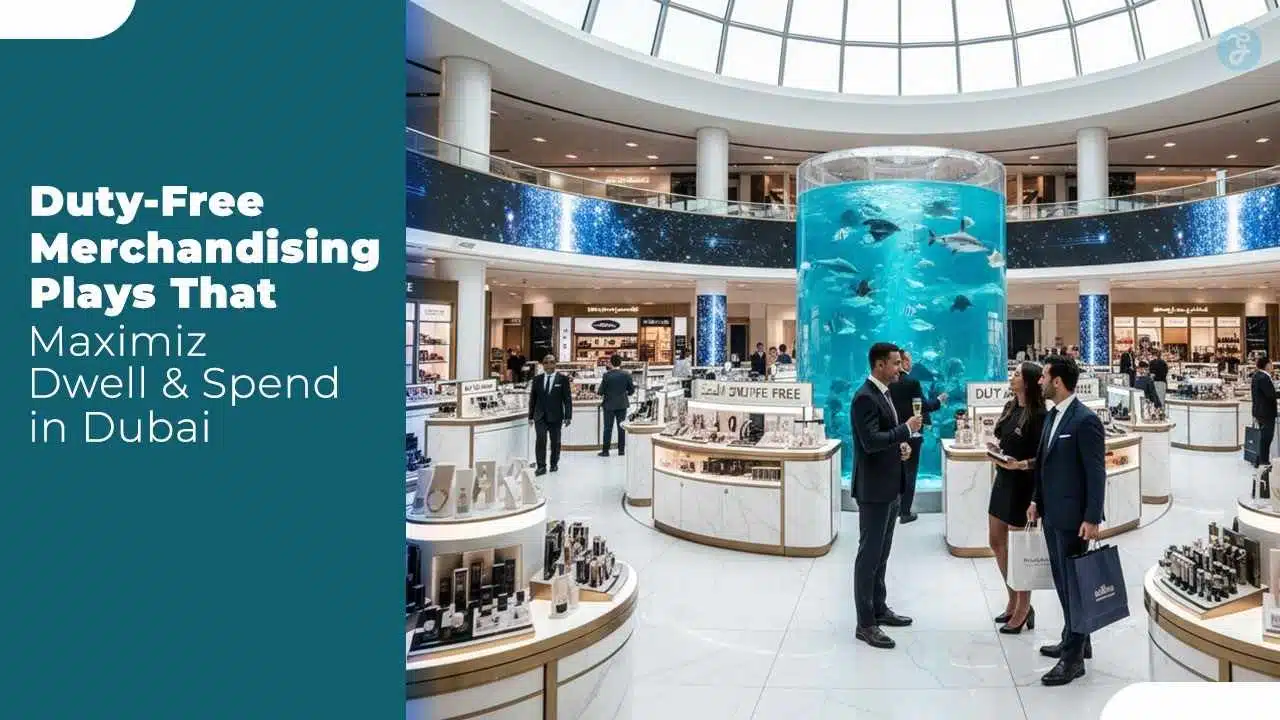
In 2026, duty free merchandising strategies that win in Dubai are the ones built for two realities at once: travelers are time-compressed, yet still willing to spend—especially when the store makes discovery effortless, gifting obvious, and checkout frictionless. The goal isn’t simply “more time in store.” It’s better dwell time—the kind that converts into higher basket size, stronger conversion rate, and more spend per passenger.
Dubai’s airport environment (high volume, international mix, transit-heavy flow, premium demand) rewards operators who treat merchandising like a performance system: layout, storytelling, category management, activation, and digital all working together.
Why Dubai is a unique duty-free merchandising environment
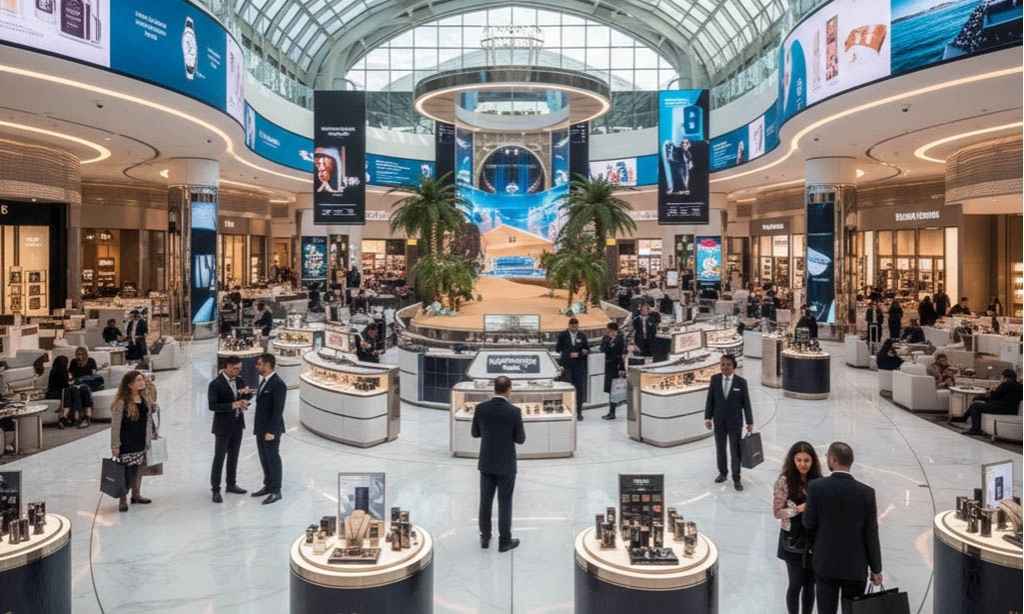
Dubai shoppers often arrive with multiple “missions” at the same time:
-
Transit mission: “I have 20–45 minutes—show me something good, fast.”
-
Gifting mission: “I need a premium gift that looks expensive and feels local.”
-
Self-reward mission: “I want a treat I can’t easily justify at home.”
-
Replenishment mission: “I’m out of essentials—help me restock quickly.”
The merchandising implication is simple: you can’t build one store for one mission. Your zoning, signage, and assortment need to help travelers self-select their mission within seconds.
Mission-to-merchandising map (use this to shape your zones)
| Traveler mission | What they want most | Best merchandising approach | Categories that fit naturally |
|---|---|---|---|
| Fast gifting | Speed + premium packaging | “Gift in 60 seconds” zone, pre-wrapped options, clear price ladders | Fragrance sets, premium chocolates, accessories, watches, and premium skincare |
| Self-reward | Story + exclusivity | Brand theater, limited editions, discovery bars | Prestige beauty, niche fragrance, luxury, premium spirits |
| Replenishment | Convenience | Grab-and-go fixtures, top sellers, travel sizes | Minis, skincare essentials, toiletries, basic electronics |
| Deal-seeking | Value + trust | Transparent promotions, bundles, and comparison signage | Liquor multi-buys, beauty bundles, confectionery multipacks |
The metrics that connect dwell to spend (track these weekly)
If you only track total sales, you’ll miss what merchandising actually changes. These are the “bridge metrics” that show whether dwell is becoming profitable.
| Metric | What does it tell you | How merchandising influences it |
|---|---|---|
| Footfall / Passerby count | Opportunity size | Store entrance visibility, wayfinding, digital fascia |
| Store entry rate | How many people step in | Decompression zone, clear “hero” view, uncluttered entry |
| Dwell time (zone-level) | Where attention accumulates | Hotspot placement, activation, and navigation clarity |
| Conversion rate | Browsers → buyers | Trial, trust cues, price clarity, staff positioning |
| Average transaction value (ATV) | Quality of each sale | Bundles, premium trade-up, gifting upgrades |
| Units per transaction (UPT) | Basket depth | Cross-merchandising, add-on prompts, travel sets |
| Queue time/abandonment | Lost revenue | Checkout layout, self-checkout, mobile pay, and staff scheduling |
Tip: Measure dwell by zone (beauty, spirits, gifting, checkout runway), not only store-wide. Most “lost” money hides in the transitions between zones.
The 7 plays: Duty-free merchandising strategies that lift dwell and spend in Dubai
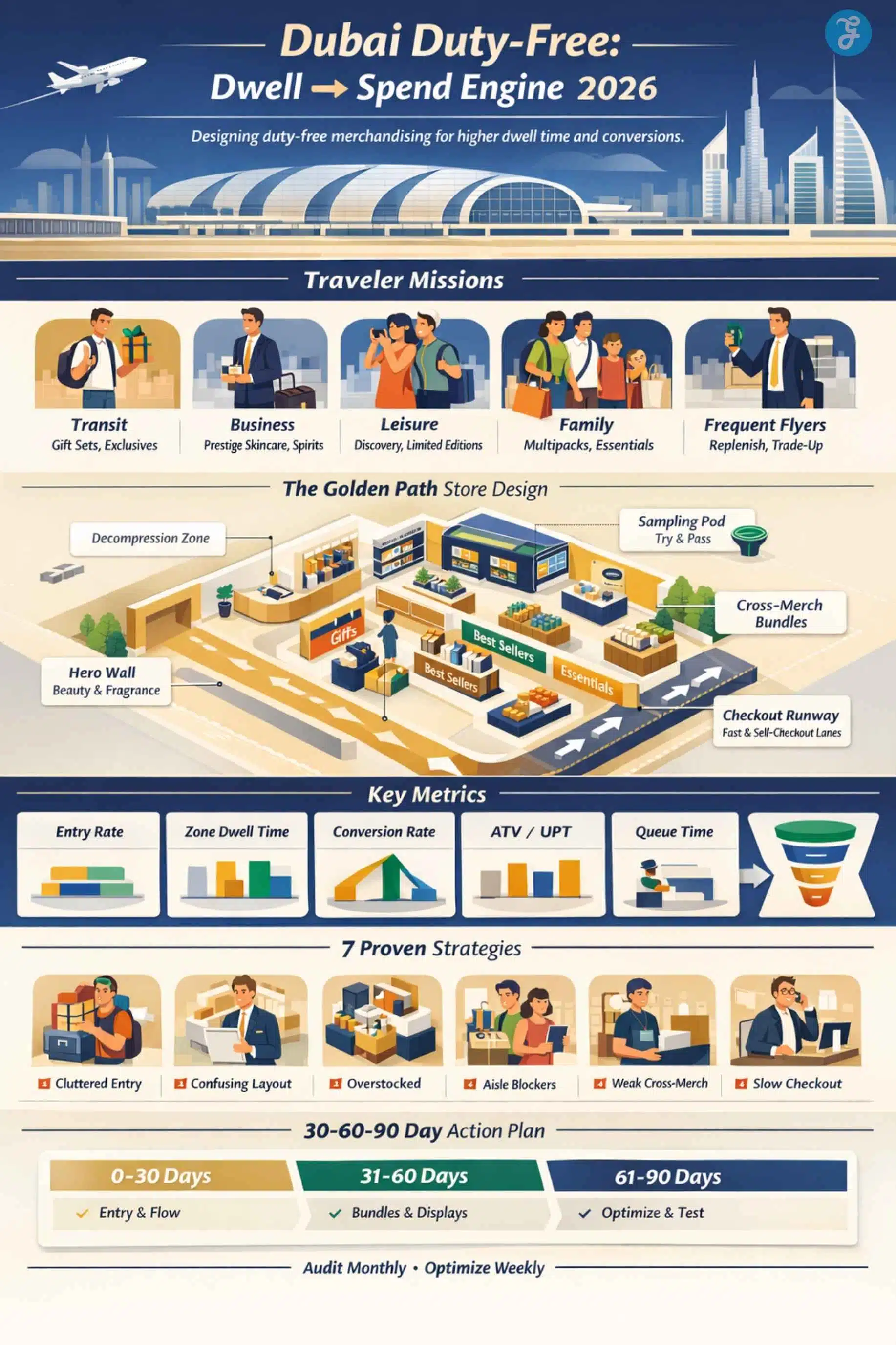
Introduces the core framework—seven practical plays that improve flow, discovery, conversion, and basket-building in Dubai-style airports.
1) Design a “Golden Path” that turns passenger flow into discovery
The fastest way to increase profitable dwell time is to stop fighting the terminal’s passenger flow and start shaping it.
A strong “golden path” does three things:
-
Welcomes (decompression zone): reduces overwhelm at the threshold.
-
Guides (clear sightlines): make the store feel easy to navigate.
-
Rewards (hero moments): creates micro-destinations that pull people deeper.
In Dubai, where travelers often arrive with luggage and limited time, cluttered entry displays can backfire. Aim for a clean entry with one unmistakable message: what this store is best at right now.
Practical execution:
-
Keep the first 5–10 meters visually open: light fixtures, fewer hard stops, clear aisle.
-
Create a hero view to a high-interest category (often beauty or premium gifting).
-
Use overhead wayfinding and consistent category blocks so shoppers don’t “loop and exit.”
Merchandising outcome: higher entry rate, more dwell in priority zones, fewer bottlenecks.
2) Build “Mission Zones” that solve shopping intent in under a minute
Dubai’s duty-free advantage is variety. Dubai’s duty-free challenge is time. Mission zones convert time pressure into confidence.
A “Mission Zone” is a tight merchandising unit with:
-
A label travelers instantly understand (Gift, Exclusives, Best Sellers, Travel Essentials)
-
A short decision set (8–20 SKUs, not 80)
-
A clear price ladder (good / better / best)
-
Packaging-first presentation (what looks great in hand)
Examples that work well:
-
Gift in 60 Seconds: premium chocolates, fragrance sets, small leather goods, travel-retail exclusives.
-
Best of Dubai: not gimmicky souvenirs—curated premium picks with subtle regional relevance (design, ingredients, exclusives).
-
Last Call Essentials: minis, skincare essentials, travel tech, chargers, adapters.
Merchandising outcome: higher conversion, fewer “I’ll come back” walkaways, faster basket building.
3) Make your hero categories irresistible with “theater + clarity”
In high-performing duty-free, hero categories don’t just sit on shelves—they perform. But “theater” without clarity becomes noise.
The winning pattern is:
-
Theater at the front
-
Clarity at the shelf
-
Confidence at the handoff (staff + checkout path)
For prestige beauty and fragrance, Dubai travelers respond to discovery—if it’s organized. For spirits, premiumization works best when you simplify comparisons and remove the fear of “choosing wrong.”
How to execute without overwhelming:
-
One brand “moment” per sightline, not five.
-
Use simple shelf logic: bestseller blocks, fragrance families, skin concerns, or “occasion-based” gifting.
-
Add micro-signage that answers: What is it? Why here? Why now?
Merchandising outcome: more stopping power, longer dwell in hero zones, stronger ATV.
4) Use cross-merchandising to increase basket size (without cheapening the store)
Cross-merchandising is one of the most underused duty-free growth levers—because many stores do it like a discount aisle. In Dubai, it should feel curated. The goal is to create high-compatibility bundles that feel like convenience, not upselling.
High-compatibility pairings (Dubai-friendly)
| Primary purchase | Best add-ons | Why it works |
|---|---|---|
| Fragrance | Travel atomizers, minis, body lotion | Completes the “set,” increases UPT naturally |
| Premium spirits | Chocolates, glassware, mini gift bags | Turns a bottle into a gift, lifts the ATV |
| Skincare | Travel sizes, masks, tools | Supports routines, increases repeatability |
| Luxury accessories | Care items, premium packaging | Protects the purchase, feels premium |
Placement matters: Put add-ons on the runway to checkout or at “pause points” (corners, junctions), not buried at the back.
Merchandising outcome: higher UPT and ATV with minimal promo dependency.
5) Convert dwell into decisions with activation that doesn’t block flow
Travelers buy what they can understand quickly—and what they can experience confidently. Activation is most profitable when it’s designed as a decision accelerator, not just a brand display.
Activation formats that fit the Dubai flow:
-
Sampling bars with two-lane access (try + pass through)
-
Guided discovery (fragrance finder, skincare matching)
-
Mini pop-ups that rotate (weekly/monthly) to keep frequent flyers curious
Done well, activation increases both dwell and conversion. Done poorly, it creates congestion and makes shoppers avoid the area.
Merchandising outcome: higher conversion in sensory categories, stronger premium trade-up.
6) Let digital reduce decision time (not just “look modern”)
Digital works best in a duty-free zone when it answers questions faster than a shopper can ask them.
Use digital for:
-
Wayfinding (“Exclusives →”, “Best Gifts →”)
-
Storytelling that explains value quickly
-
Dynamic merchandising (switch messages by time of day, passenger mix, flight waves)
-
Pre-order/reserve messaging (when available) to extend the purchase window
Digital screens should support the golden path, not compete with it. If everything flashes, nothing guides.
Merchandising outcome: higher entry confidence, faster decisions, better flow through zones.
7) Fix checkout friction (because queues destroy profitable dwell time)
Checkout is where baskets die. In busy Dubai concourses, even small delays create abandonment—especially among transit travelers.
Your checkout strategy should match your shopper mix:
-
Self-checkout / assisted self-checkout for small baskets
-
Dedicated premium checkout for high-value purchases
-
Queue design that keeps add-ons visible (without feeling like a trap)
Also ensure your “last 10 meters” are merchandised intentionally: premium add-ons, travel essentials, gifting upgrades, and clear “you’re almost done” signals.
Merchandising outcome: fewer walkaways, more completed baskets, better throughput at peak waves.
Putting the 7 plays into an execution plan (30–60–90 days)
| Timeline | Focus | What do you change first | What you measure |
|---|---|---|---|
| 0–30 days | Flow + clarity | Entry declutter, golden path signage, mission zones | Entry rate, dwell by zone, queue time |
| 31–60 days | Basket building | Cross-merch bundles, checkout runway, best-seller blocks | UPT, ATV, conversion |
| 61–90 days | Experience + optimization | Rotating activations, digital message testing, and staff positioning | Conversion by category, repeat performance by flight wave |
This phased approach prevents the common mistake of “re-merchandising everything at once” and losing what actually moved the needle.
Dubai traveler segments and what each buys
Dubai’s airport retail ecosystem serves one of the world’s most diverse passenger mixes. That diversity is exactly why duty free merchandising strategies need to be segment-aware: travelers don’t shop the same way when they’re transiting for 30 minutes, landing for a week-long holiday, or flying out after a business trip. When you merchandise with segments in mind, you reduce decision fatigue and increase conversion because shoppers instantly see “this is for me.”
A practical way to think about DXB-style shoppers is not by nationality, but by time window + mission. Time determines whether someone browses a brand story or grabs a gift and runs.
Segment-to-mission-to-category map
| Traveler segment | Typical time window | Primary mission | What they buy most often | How to merchandise for them |
|---|---|---|---|---|
| Transit travelers | 15–45 minutes | Fast gifting + self-reward | Fragrance gift sets, premium chocolates, small luxury, travel-retail exclusives | “Gift in 60 seconds” zone, best-seller blocks, clear price ladder, fast checkout lanes |
| Business travelers | 20–60 minutes | Self-reward + premium replenishment | Prestige skincare, niche fragrance, premium spirits, accessories | Curated premium wall, quick comparison signage, staff-led discovery, and premium packaging options |
| Leisure couples / solo tourists | 30–90 minutes | Discovery + souvenirs-with-status | Limited editions, Dubai-relevant exclusives, beauty, confectionery | Storytelling displays, experiential sampling, “Best of Dubai” curated bay (premium, not kitsch) |
| Families/group travelers | 15–60 minutes | Convenience + value | Multipacks, confectionery, travel essentials, mid-tier gifting | Grab-and-go fixtures, bundle offers, wider aisles, simple signage, quick-browse endcaps |
| Outbound residents / frequent flyers | 20–60 minutes | Replenish + trade-up | Trusted beauty favorites, premium spirits, recurring essentials | “Top picks” refresh, loyalty prompts, rotating newness shelf near best sellers |
Category-specific merchandising tactics
Not every category responds to the same playbook. The most effective duty free merchandising strategies in Dubai come from aligning each category’s natural buying behavior with the right merchandising triggers: trial for beauty, clarity for spirits, and speed for gifting.
Beauty and skincare (prestige + routine-based buying)
Beauty wins when you reduce complexity. Travelers often know the brand but hesitate on the exact product, shade, or set—especially when they’re rushed. Make the shelf do the explaining.
What works best:
-
Concern-led shelving: “Hydration,” “Brightening,” “Anti-aging,” “Sensitive” (simple, universal language).
-
Routine bundles: cleanser + serum + moisturizer sets positioned as “complete solutions.”
-
Travel sizes beside full sizes: encourage add-ons and increase units per transaction.
-
Staffed micro-consult zones: small “help desks” outperform large counters in busy flows because they feel approachable.
Dubai-specific angle: emphasize giftable skincare sets (premium packaging, clear value story) and keep your top global bestsellers visible at first sightline.
Fragrance (sensory category + gifting powerhouse)
Fragrance is one of the strongest duty-free categories because it’s emotional, giftable, and often linked to travel rituals. But it can also overwhelm quickly.
What works best:
-
Family blocks: fresh, floral, woody, oriental—so shoppers can navigate by preference.
-
“Hero set” wall: curated top gift sets with clear price steps (good/better/best).
-
Fast discovery tools: “If you like X, try Y” mini cards; avoid long brand essays.
-
Tester logic: testers placed where people can stop without blocking flow; replenish often.
Dubai-specific angle: put a premium “exclusive/limited edition” fragrance shelf near the main fragrance zone, not hidden—exclusivity increases trade-up when it’s easy to find.
Spirits (high ATV, high need for clarity)
Spirits sell when shoppers feel confident they’re choosing well. Unclear pricing, confusing bottle comparisons, or crowded shelves reduce conversion—even if demand is high.
What works best:
-
Premium ladder: core → premium → super-premium in one sightline (so trade-up feels natural).
-
Occasion prompts: “Gift,” “Celebration,” “Collector,” “Smooth & Easy,” “Bold & Smoky.”
-
Bundle-with-gifting: premium chocolates, gift bags, mini glassware—presented as curated pairings.
-
Clear promo mechanics: travelers don’t want to calculate; make multi-buy offers obvious and clean.
Dubai-specific angle: keep the path wide and the shelf readable—spirits zones can attract crowds; plan for flow so the category’s success doesn’t create a bottleneck.
Confectionery (impulse + family + value)
Confectionery is your basket-builder and last-minute “I should bring something” solution. It performs best when it’s visually abundant but still organized.
What works best:
-
Gifting stacks: premium boxes at hand level; value multipacks slightly lower or side-bayed.
-
Multi-buy clarity: “2 for X” should be readable at a glance—don’t clutter.
-
Pairing near spirits: chocolate + spirits is a natural gift combination.
-
Seasonal rotations: keep a “newness” shelf so frequent flyers see change.
Dubai-specific angle: anchor the gifting story—premium presentation drives higher spend than pure discounting.
Common mistakes that reduce dwell time and spend in Dubai duty-free
Even strong stores lose revenue when the basics of passenger flow, clarity, and conversion get ignored. These mistakes don’t always look dramatic on the floor—but they quietly lower store entry rate, cut dwell time in high-margin zones, and shrink basket size.
1) Turning the entrance into a “promo wall”
When the first sightline is packed with price cards, bins, and competing brand messages, travelers feel friction before they even step in. In Dubai’s fast-moving concourses, an overloaded entry makes shoppers choose the simplest option: keep walking. A clean decompression area with one clear “why enter” message typically performs better than a wall of deals.
2) Making shoppers decode the store layout
If wayfinding is inconsistent—or categories are split in non-intuitive ways—people waste time searching instead of browsing. That “search time” doesn’t translate into spend; it produces frustration and early exits. Duty free merchandising strategies work best when zones are visually obvious, signage uses plain language, and the store can be understood in seconds.
3) Too much assortment, too early
Leading with the full range of products can backfire. Travelers with limited time don’t want an endless shelf; they want a curated decision set. If the first 1–2 minutes feel like work, they postpone the purchase (“I’ll come back later”) and often don’t. Use best-seller blocks, gift-ready sets, and a clear price ladder to help them decide quickly.
4) Activation that blocks the aisle (or feels like a sales trap)
Sampling and pop-ups can increase conversion—but not if crowds clog the path. When activation creates congestion, it discourages entry and interrupts the golden path. The best activations are designed like “two-lane” experiences: easy to try, easy to pass, with staff positioned to help rather than pressure.
5) Treating cross-merchandising like a discount corner
Bundles and add-ons should feel premium and helpful, not cheap or chaotic. When cross-merch is messy—random products, unclear pricing, loud signage—it can damage the store’s luxury cues and reduce trust. Keep pairings logical (gift completion, routine completion, travel convenience), and present them as curated solutions.
6) Leaving checkout to “operations” instead of merchandising
Queues destroy profitable dwell time. If travelers see slow registers or unclear lines, they abandon baskets or avoid shopping altogether. Checkout is part of the store experience: it needs clear lanes, peak-time staffing, self-checkout where appropriate, and a smart final runway that adds value without feeling pushy.
7) Running on guesswork instead of weekly performance signals
Many travel retail teams refresh displays based on habit or brand pressure rather than store performance. Without tracking zone-level dwell, entry rate, conversion, ATV, and queue time, it’s hard to know what actually worked. A simple weekly cadence—test, measure, adjust—often outperforms big seasonal resets.
FAQs: duty-free merchandising strategies in Dubai
How do you increase dwell time without slowing passenger flow?
You increase quality dwell by creating micro-destinations—mission zones, hero moments, and activation points—placed at natural slow areas (junctions, corners) while keeping the main aisles open and readable.
Which categories benefit most from merchandising upgrades?
Prestige beauty, fragrance, and premium spirits typically respond strongly to improved storytelling, sampling, and clearer shelf logic. Gifting zones also lift performance because they reduce decision fatigue.
How often should displays rotate in a Dubai duty-free environment?
Rotate high-visibility “moments” frequently enough that repeat travelers notice change (often monthly for major moments, weekly for small features). The key is consistent structure with fresh highlights—so the store stays navigable.
What’s the fastest way to lift conversion?
Reduce friction: simplify the entry, clarify price ladders, improve staff placement in hero zones, and make checkout faster. Conversion often rises when shoppers feel confident and unblocked.
Final Thought: Duty Free Merchandising Strategies
The strongest duty free merchandising strategies for Dubai in 2026 are not “more promotions.” They’re better systems: a golden path that respects passenger flow, mission zones that compress decisions, hero category theater backed by clarity, basket-building cross-merchandising, activation that accelerates confidence, digital that reduces decision time, and checkout that never becomes the bottleneck.
If you want, tell me your target reader (Dubai Duty Free managers, brand partners, or general travel retail professionals), and I’ll tailor the examples and add a Dubai-specific category mix section (beauty vs spirits vs gifting) without changing the keyword strategy.