As the autumn air in Bengal grows crisp and the scent of shiuli flowers mingles with incense, the grand festival of Durga Puja reaches its crescendo. This five-day spectacle of art, faith, and community transforms the landscape into a vibrant tapestry of devotion and celebration.
After the initial days of welcoming the goddess and the solemn observances of Saptami and Ashtami, the festival culminates in Durga Puja’s Mahanavami, the ninth day. Mahanavami is not just another day of worship; it is the energetic climax, the final, powerful surge of rituals and festivities before the bittersweet farewell of Bijoya Dashami.
It is a day charged with spiritual intensity and boundless public enthusiasm, marking the final phase of Goddess Durga’s epic battle against the buffalo demon, Mahishasur. On this day, the atmosphere in both Kolkata, the cultural capital of West Bengal, and across Bangladesh, where the festival is a beacon of cultural harmony, is electric. It is a day of powerful ceremonies, grand feasts, and all-night revelry, representing the peak of Durga Puja’s spiritual and social fervor.
The Mythological Significance: The Final Day of Battle
The spiritual heart of Mahanavami lies in its profound mythological context. According to the sacred Hindu text, the Devi Mahatmya, the battle between Goddess Durga and the shape-shifting demon Mahishasur raged for nine days and nine nights. Mahanavami marks the ninth and final day of this celestial conflict. On this day, the battle reached its most ferocious point. Durga, in her awe-inspiring form as Mahisasuramardini (the Slayer of the Buffalo Demon), was at the peak of her power.
It is believed that during the final, most intense moments of this battle, she took on the terrifying form of Chamunda, who sprang from her third eye to annihilate the demon’s most powerful allies, Chanda and Munda. Mahanavami, therefore, symbolizes the imminent victory of good over evil.
The rituals performed on this day are designed to honor the goddess at her most powerful, celebrating her divine rage and righteous fury that ultimately restored peace and order (dharma) to the universe. It is a day of immense power, and the prayers and offerings are imbued with a special significance, seeking the goddess’s blessings for strength, courage, and the ability to overcome all obstacles in life.
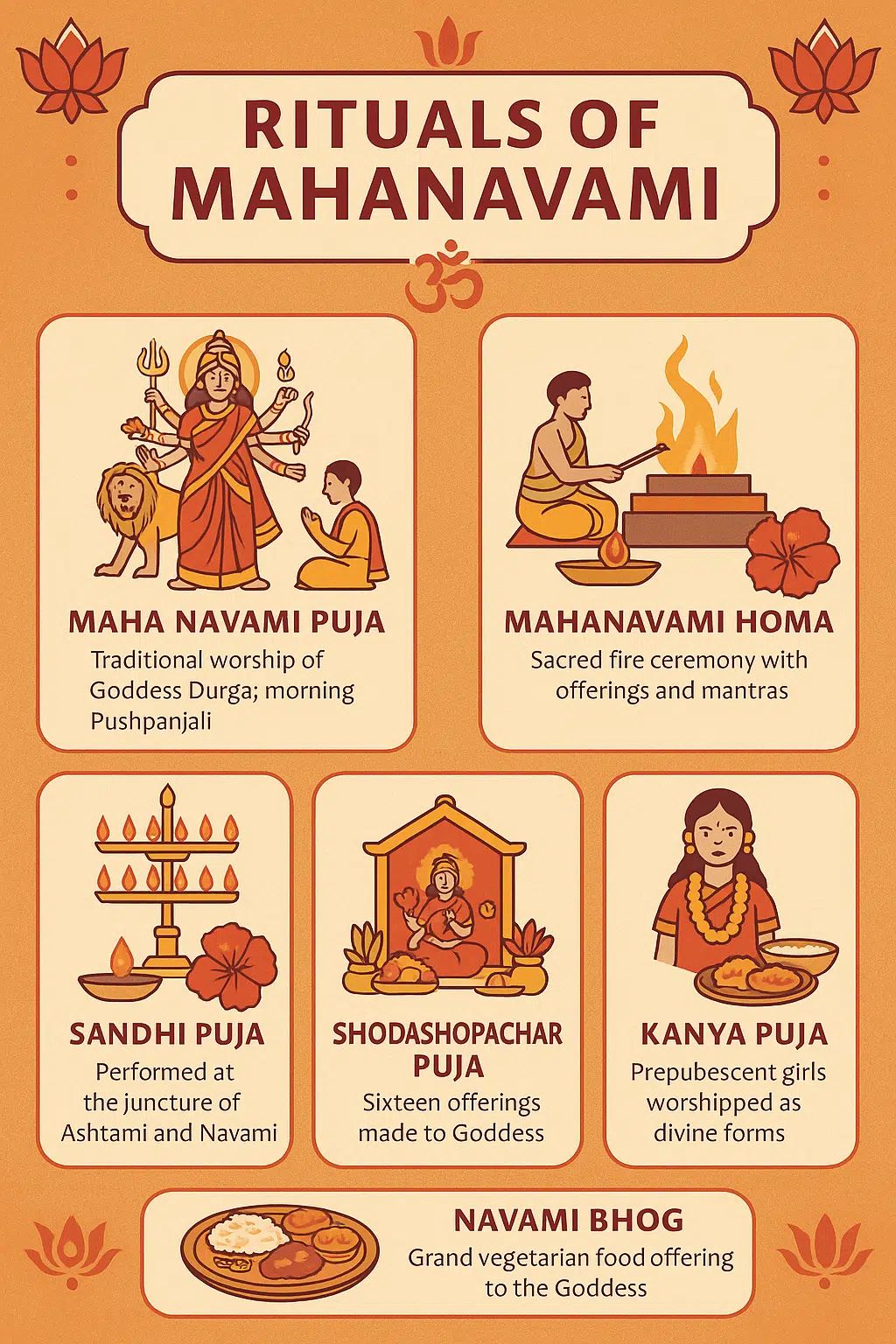
Mahanavami is packed with some of the most significant and visually spectacular rituals of the entire Durga Puja festival. These ceremonies are performed with meticulous care and deep devotion, each carrying layers of symbolic meaning.
Sandhi Puja: The Climax of Worship
The most crucial ritual of this period is the Sandhi Puja, a powerful worship that takes place during the Sandhikhan, or the “moment of junction.” This is a precise 48-minute window that straddles the end of the eighth lunar day (Ashtami) and the beginning of the ninth lunar day (Navami). According to mythology, this exact moment was when the goddess transformed into her Chamunda form to slay the demons. This ritual is therefore considered the absolute climax of the entire Durga Puja.
The ceremony is a grand spectacle of devotion. One hundred and eight earthen lamps are lit to banish darkness and invoke the goddess’s luminous power. The number 108 is sacred in Hinduism, representing cosmic completeness. Similarly, one hundred and eight lotus flowers, symbolizing purity and divine beauty emerging from the mundane, are offered while chanting powerful mantras.
A unique aspect of the offering is the balidan (sacrifice), which in modern times is symbolic. A whole fruit or vegetable, like a white pumpkin, banana, or sugarcane, is offered uncut, symbolizing a complete and unblemished surrender of the ego to the divine. The air grows thick with the sound of ringing bells, the blowing of conch shells, and the frantic, pulsating beats of the dhaak, creating an atmosphere that is both overwhelming and spiritually uplifting. It is during Sandhi Puja that the goddess is believed to be fully present in the idol, and the devotees’ prayers are considered most potent.
Hom or Havan: The Concluding Fire Ritual
Mahanavami concludes with the Hom or Havan, a sacred fire ritual that marks the formal completion of the puja ceremonies. A consecrated fire is lit in a special pit, and the priest, on behalf of the devotees, makes offerings of ghee (clarified butter), wood, grains, and other sacred items into the flames. The fire god, Agni, is considered a messenger who carries these offerings and prayers directly to the gods.
This ritual is a powerful act of purification and a final, comprehensive offering to the goddess and the entire pantheon. The rising smoke from the Hom symbolizes the prayers ascending to the heavens. The ceremony culminates with the Purnahuti, the final offering, often a whole coconut or a red cloth filled with herbs, signifying complete self-surrender and the successful conclusion of the rites. Once the Hom is completed, the main religious observances of Durga Puja are officially concluded, paving the way for the social celebrations to take over completely before the immersion on the next day.
On Mahanavami, Kolkata transforms into a city that truly never sleeps. The festive energy, which has been building for days, reaches a fever pitch. This is the last night for “pandal hopping,” and millions of people pour onto the streets to see the myriad artistic interpretations of the goddess and her temporary home.
The atmosphere is one of a massive, open-air art festival, an event so significant that it was inscribed on the UNESCO Representative List of the Intangible Cultural Heritage of Humanity in 2021. The competition between different community puja committees leads to breathtaking creativity, with pandals built to resemble everything from ancient temples and famous monuments to futuristic spacecraft and abstract concepts.
Recent years have seen pandals used as platforms for powerful social commentary, with themes addressing women’s rights, environmental conservation, and mental health awareness. The lighting is spectacular, turning the entire city into a dazzling wonderland. The beat of the dhaak is omnipresent, providing a constant, energetic soundtrack to the night’s festivities.
Food is central to the Mahanavami experience in Kolkata. The streets are lined with thousands of food stalls offering a dizzying array of options, from traditional Bengali street food like puchka, egg rolls, and ghugni to a variety of other cuisines.
However, the most special meal of the day is the bhog, a community feast served at the pandals. On Navami, the bhog is often elaborate, traditionally featuring dishes like khichuri (a savory rice and lentil dish), labra (a mixed vegetable curry), fried items, chutney, and a sweet dish like payesh (rice pudding). This food is first offered to the goddess and is then distributed to everyone, regardless of social standing, embodying a spirit of community and togetherness.
In Bangladesh, Mahanavami is celebrated with equal fervor and devotion by the Hindu community, but the context gives it a unique and powerful significance. As a festival celebrated by a religious minority, Durga Puja in Bangladesh, and especially its climax on Mahanavami, becomes a profound statement of cultural identity and communal harmony. Recent data shows a consistent rise in the number of puja mandaps (pandals) across the country, with over 32,000 being erected in recent years, according to the Bangladesh Puja Udjapan Parishad (Bangladesh Puja Celebration Council).
The celebrations are centered around major temples, such as the historic Dhakeshwari Temple in Dhaka, and hundreds of community pandals across the country. While the grand, thematic pandals of Kolkata are less common, the focus here is often on the traditional beauty of the idols (protima) and the meticulous performance of the rituals.
The government plays a visible role by providing security to ensure the festivities proceed peacefully, and it is a common sight to see political leaders and prominent citizens from the Muslim majority visiting the pandals to extend their greetings.
This cross-community participation is the hallmark of the celebration in Bangladesh. People from all faiths engage in pandal hopping, enjoying the artistry and the festive atmosphere. This interaction transforms the religious festival into a universal cultural event, strengthening the syncretic fabric of Bengali culture that transcends religious divides.
The bhog distribution also takes on a special meaning, as people from all communities are welcomed to share the blessed food. Mahanavami in Bangladesh is not just a religious climax; it is a powerful and heartwarming display of unity, mutual respect, and shared cultural heritage.
| Aspect of Celebration | Kolkata | Bangladesh |
|---|---|---|
| Scale and Atmosphere | A massive, city-wide carnival and art exhibition. Recognized as a UNESCO Intangible Cultural Heritage event. The atmosphere is of a frenetic, all-night street party. | A major festival for the Hindu community, with over 32,000 mandaps nationwide. The atmosphere is festive but also emphasizes communal harmony and tradition. |
| Ritualistic Focus | Rituals like Sandhi Puja are performed with great pomp. Major centers like Belur Math draw huge crowds for Kumari Puja. | Strong emphasis on the traditional and scriptural accuracy of the rituals. Major temples like Dhakeshwari are focal points for devotional activities. |
| Community Participation | Primarily a Hindu festival, but the artistic and cultural aspects attract people from all communities. It is a massive public event. | A powerful symbol of interfaith harmony. People from the Muslim majority actively participate in the cultural festivities, visiting pandals and socializing. |
| Food Culture | Enormous variety of street food alongside the traditional community feast (bhog). The commercial food scene is a huge part of the celebration. | The traditional bhog is central. The sharing of this consecrated food often includes people from all communities, reinforcing social bonds. |
| Pandal Artistry | Famous for its highly competitive and elaborate theme-based pandals, often with social messages. | The focus is often on the traditional beauty and craftsmanship of the clay idols (protima) rather than avant-garde pandal themes. |
| Public Role | Managed by thousands of private community committees, with massive corporate sponsorship and government logistical support. | The government provides significant security and support. The festival serves as a state-endorsed symbol of the nation’s cultural diversity. |
Takeaways: The Final Flourish of Joy and Devotion
Mahanavami stands as the vibrant, beating heart of the Durga Puja festival. It is a day where the profound spiritual energy of the rituals merges seamlessly with the uninhibited joy of social celebration. It is the day of the powerful Sandhi Puja, the divine Kumari Puja, and the purifying Hom. It is also the night of endless pandal hopping, of sharing delicious food, and of dancing to the intoxicating rhythm of the dhaak.
In both Kolkata and Bangladesh, while the scale and context may differ, the essence of Mahanavami remains the same: a grand celebration of the divine feminine, the imminent victory of good, and the strengthening of community bonds.
As the night of Mahanavami fades, it leaves behind a sense of fulfillment, but also a touch of melancholy. The grand celebration has reached its peak, and the next day will bring the inevitable, tearful goodbye. Mahanavami is the final, brilliant flourish before the curtain falls on Bengal’s greatest festival.