

You type your product name into Google, eager to see it shine on the first page. Instead, you find nothing. Even worse, you might see the same product popping up multiple times with strange, messy web addresses. It’s frustrating, isn’t it? Duplicate content issues in e-commerce SEO are a headache for shop owners and site managers just like you. I’ve been there, staring at a screen, wondering why my best-selling item isn’t ranking.
Did you know that more than 29% of web content is duplicate? Search engines often get confused when they see this. This guide will explain why having copycat pages can hurt your search rankings and exactly what you can do about it. So, grab a cup of coffee, and let’s fix this together. I’ll show you the steps that worked for me.
What is Duplicate Content in E-Commerce SEO?
Duplicate content means that the same or very similar text appears on more than one web page. This can happen on your own site or across different sites entirely. In eCommerce SEO, this frequently occurs with product pages where items share descriptions, titles, or images.
Think of it this way. If you sell a blue t-shirt, you might have one page at /products/blue-shirt and another at /collections/mens/blue-shirt. To you, it’s the same shirt. To Google, it looks like two separate pages fighting for attention.
Search engines like Google can get confused by this. They may not know which version to rank, so they might not rank any of them highly in search results.
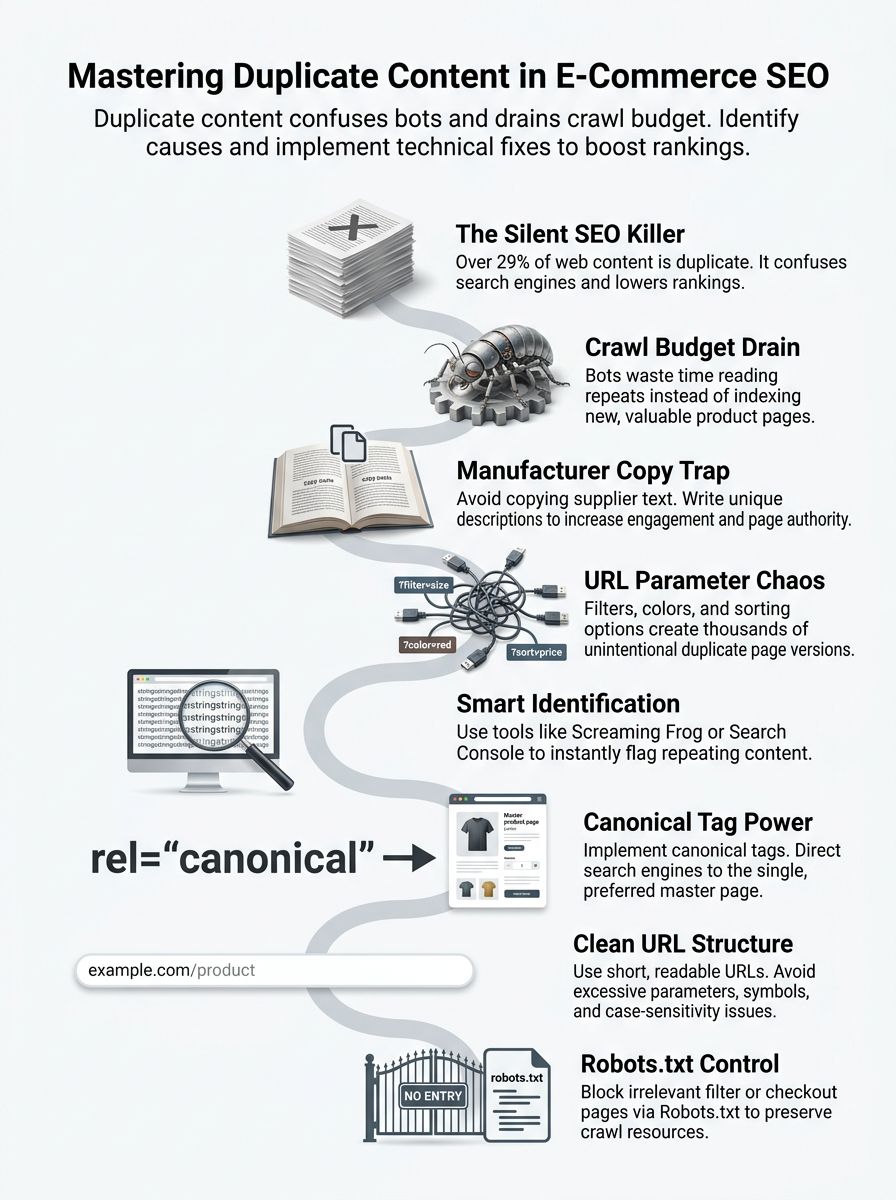
Having many copies of a product description or repeating blocks of text also wastes your crawl budget. This means Google spends time reading your repeated pages instead of finding new ones to index.
Duplicate content can even happen from small changes in website addresses caused by tracking codes or sorting options. If too much duplicate content exists, it puts both ranking factors and organic traffic at risk for your site.
Real-World Examples of Duplication
It helps to see what this looks like in practice. Here are the most common ways duplicate content sneaks into an online store:
- URL Variations: www.shop.com/product vs. www.shop.com/product?category=sale
- Printer-Friendly Pages: Creating a separate text-only version of a page without blocking it.
- Session IDs: Unique codes added to URLs for tracking users, creating thousands of unique links for the same content.
- HTTPS vs HTTP: If your site loads on both secure (https) and non-secure (http) versions without redirecting.
Why is Duplicate Content a Problem for E-Commerce Websites?
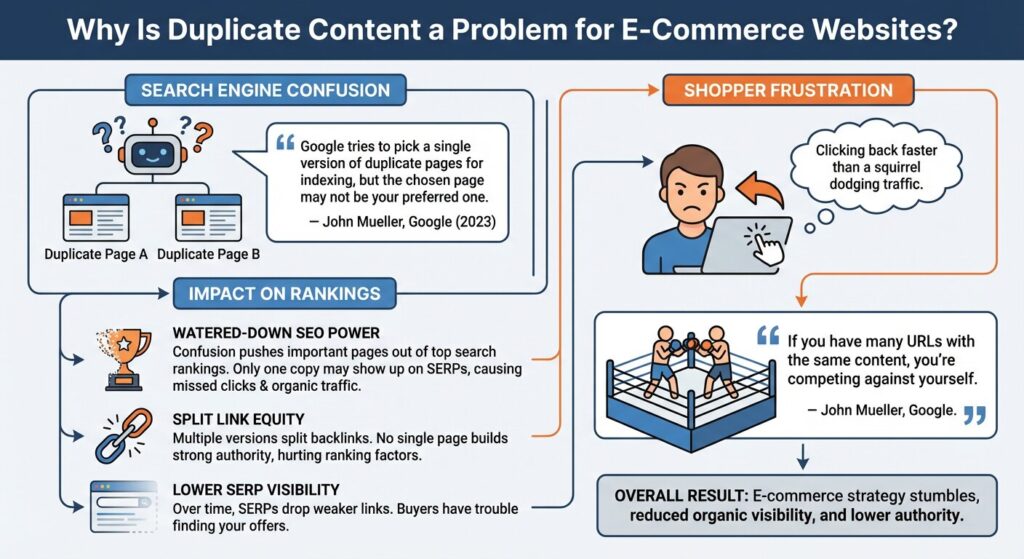
Duplicate content confuses search engines, making it tough for your pages to rank well. Shoppers get frustrated too, clicking back faster than a squirrel dodging traffic.
Impact on Search Engine Rankings
Search engines get confused by content duplication. Google’s John Mueller said in 2023, “Google tries to pick a single version of duplicate pages for indexing,” but the chosen page may not be your preferred one.
This confusion can water down SEO power and push important web pages out of top search rankings. Only one copy might show up on Search Engine Results Pages (SERP), so your other product or category URLs will miss clicks and organic traffic.
Multiple versions also split link equity, hurting your website ranking factors. If each URL with repeated content gathers backlinks, no single page builds strong authority in Google’s eyes.
Over time, SERPs drop those weaker links from showing up high. Your e-commerce strategy stumbles as buyers have trouble finding your offers through organic searches.
If you have many URLs with the same content, you’re competing against yourself. – John Mueller, Google
Reduced Crawl Efficiency
Duplicate content confuses search engine bots. Bots waste time crawling the same or similar pages again and again. This eats up your crawl budget fast, leaving fewer resources for new or important web pages.
For large sites with over 10,000 pages, this is a critical issue. Googlebot has a limit on how much time it spends on your site. If it spends 80% of that time checking five versions of the same t-shirt, it might never see your new blog post or seasonal collection.
As a result, fresh product listings and category updates get ignored or delayed by Google’s crawlers.
Large eCommerce sites often see this problem with thousands of duplicate URLs caused by filters, session IDs, and sorting options. Small mistakes in URL structuring hurt crawl efficiency hard.
Poor User Experience
Shopping feels frustrating fast if you keep landing on web pages with the same content. Users get bored, confused, and may doubt your store’s credibility. One wrong click might lead a customer back to products they have already seen, wasting their time instead of helping them find what they want.
Long lists full of similar or repeated product details make visitors lose trust in your website. Search Engine Optimization suffers because searchers leave your eCommerce site quickly for more helpful results elsewhere. Poor user experience means lower page authority and less organic traffic, hurting sales and brand reputation over time.
Common Causes of Duplicate Content in E-Commerce
Duplicate content can sneak into online stores for many surprising reasons. Stick around to spot the culprits and save your search traffic.

Duplicate Product Descriptions
Copying product descriptions from manufacturers often causes duplicate content issues in SEO for e-commerce. Search engines see the same text across many web pages and may lower your website ranking.
Your crawl budget shrinks as search engines skip over repeated information, missing important new products on your site. Shoppers spot matching details between sites, so trust drops.
Google has given hints since 2011 that unique, helpful copy beats stale repeats every time. In early 2023, studies showed that almost 58% of online shops had some identical product info copied word-for-word from suppliers or competing websites.
Using original sentences helps boost page authority and keeps users engaged longer. This can lead to more sales and happier customers. Fresh content also gives better chances for rich snippets in SERP results, something everyone wants in today’s crowded e-commerce space!
URL Parameter Issues
URL parameters can create endless page versions that look almost the same. For example, ?color=blue or ?sort=price will change how a product page displays, but not its main content.
Search engines may see each version as a new web page, causing confusion about which one to rank in search results.
This sprawl eats up your crawl budget fast and waters down your website ranking. Content duplication can spread across thousands of URLs with small tweaks that do not add value for visitors or help SEO.
The next hurdle comes from faceted navigation challenges, which often go hand-in-hand with messy URLs.
Moving past URL issues, filters, and sort options on eCommerce sites can stir up a hornet’s nest of duplicate content. Each filter, like color or size, creates new page versions with different URLs.
Search engines spot these as separate web pages, but the information is often almost identical. Faceted navigation eats up crawl budget fast. The same product can appear under many combinations, such as “red shoes” plus “in stock.” This messes with search engine rankings and makes indexing harder.
Before you know it, thousands of near-copy pages swamp your site, hurting both user experience and SEO performance. Store owners must wrangle these filters to keep their websites tidy for crawlers and users alike!
Pagination Problems
Switching gears from faceted navigation, let’s tackle another twist in the SEO story. Pagination splits long product lists into many pages. This sounds neat, but it often creates duplicate content issues that sneak up like socks missing their match in the laundry.
Search engines may struggle to find which page matters more for search rankings. Instead of boosting one strong page for a keyword, your crawl budget can get spread thin over dozens of similar URLs with tiny changes.
Common pagination pitfalls include:
- “View All” Pages: These often duplicate the content of the paginated series (Page 1, Page 2, etc.) without proper canonical tags.
- Overlapping Products: If products appear on both Page 1 and Page 2 due to sorting changes, Google sees duplication.
- Title Tags: Failing to add “Page 2” to the title tag causes duplicate title errors in Google Search Console.
How to Identify Duplicate Content on Your E-Commerce Site
Finding repeated text on your store pages can feel like finding the same socks after laundry. It is frustrating and time-consuming. Start by looking for patterns, then act quickly to clear out what doesn’t belong.
Using SEO Tools
SEO tools like Screaming Frog, Ahrefs, or SEMrush help spot duplicate content fast. They scan web pages, flag repeating product descriptions, and highlight messy URLs.
For example, Screaming Frog crawls every page on your e-commerce site. It then reports each match in seconds using its “Exact Duplicate” check. You can even set it to find “Near Duplicates” with a 90% similarity threshold to catch slightly edited descriptions.
That’s a real time-saver. Google Search Console gives clues, too. It shows which pages compete for the same keyword or appear as duplicates in search results.
Look specifically for the “Duplicate without user-selected canonical” status in the Pages report. Spotting these SEO issues early helps protect your ranking factors and keeps your crawl budget from draining away.
Conducting Manual Audits
Start by checking your website pages, one by one. Look for duplicate content issues on product descriptions, category pages, or blog posts. Spot repeated text and see if URLs look too similar. Write down any matching titles or meta descriptions that pop up.
Scan through different web pages with a keen eye, like a detective looking for clues of copied words. Try searching for snippets of your own content in Google using quotes to spot where it repeats across your eCommerce site. Simple steps like these help keep web pages fresh for better search rankings and crawl budget use.
Solutions to Eliminate Duplicate Content
Getting rid of copycat pages calls for smart fixes and careful planning. Spotting trouble early can save your store’s search rankings, keeping customers happy and coming back.
Canonical Tags
Canonical tags help search engines know which version of a web page to show in search results. They act like a signpost. They point Google and Bing to the main or “preferred” page when there are many that look almost alike.
If your eCommerce site has product pages with several URLs due to filters or tracking codes, use canonical tags to avoid duplicate content headaches.
Google first introduced canonical tags back in 2009 as part of Search Engine Optimization strategies for websites flooded with similar pages. For large online stores, this simple tag can protect your site’s crawl budget and keep your best product pages ranking high on the SERP.
Place it in the HTML head section and link it to your main product URL. Job done. No tech jargon needed! This tiny bit of code can feel like magic glue holding together good SEO and clean URL structure.
Proper URL Structuring
Short, clean URLs help search engines understand your web pages. For example, www.shoestore.com/shoes/blue-sneakers is clearer than www.shoestore.com/product?id=1234&color=blue. Clear structures boost SEO and make store navigation smooth for users.
Ugly URLs with endless numbers or symbols confuse both people and bots. Follow these rules for a cleaner structure:
- Use Hyphens: Separate words with hyphens (-) instead of underscores (_).
- Lowercase Only: Avoid mixing capital letters, as some servers treat /Page and /page as different URLs.
- Avoid Deep Nesting: Keep URLs as close to the root domain as possible.
A little care in structuring links helps prevent duplicate content issues before they snowball into bigger problems for your e-commerce strategy.
Consolidating Product Descriptions
After proper URL structuring, cleaning up product descriptions helps reduce duplicate content issues in eCommerce SEO. Product pages often share the same or nearly identical details, especially for items that only vary by size or color.
Google spots these duplicated texts and sometimes lowers search rankings as a result. Shortening and combining similar product descriptions keeps each page unique enough to stand on its own. Writing strong, clear text for each item can boost your organic traffic and brand trust.
Instead of copying one description over many products, use varied language while staying accurate about features. Good content management saves your site’s crawl budget, too, since search engines won’t waste time crawling near-duplicate web pages again and again.
Implementing Robots.txt and Meta Tags
Robots.txt files tell search engines which pages they should not crawl. Hiding filter or checkout pages with this file helps protect your crawl budget. Googlebot will skip these blocked URLs, giving more time to important web pages.
Meta tags like “noindex” can stop certain pages from showing up in the search results. Use meta robots tags for things like duplicate categories or sorting URLs, so that only one main version gets indexed.
Shoppers do not want to find five versions of the same product page on Google, right? Both robots.txt and meta tags help keep your website clean for users and better for Search Engine Optimization SEO.
Smart use protects against ranking drops caused by content duplication headaches on e-commerce sites, large or small.
Best Practices to Prevent Duplicate Content
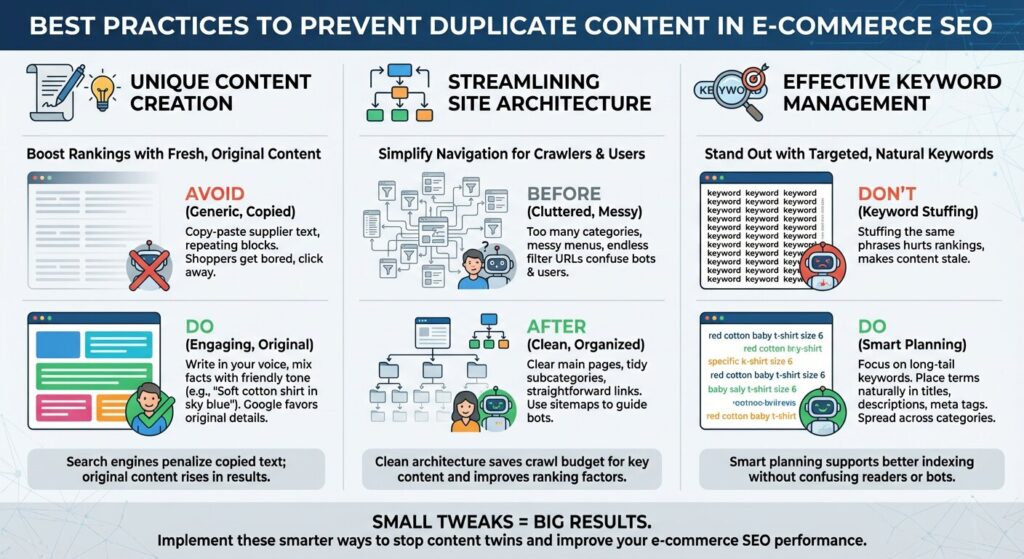
Small tweaks to your shop’s setup can save you big headaches later. Curious about smarter ways to stop content twins cold in their tracks?
Unique Content Creation
Fresh content helps your e-commerce store rise in search engine results. Google favors pages with original descriptions, titles, and product details. Shoppers notice if every item sounds like a copy-paste job from another site or even elsewhere in your own store. They get bored fast, click away faster, and may never return.
Write each product description in your voice using clear words people actually use. A good mix of facts and a friendly tone goes far. For example, swap “comfortable blue shirt” for “Soft cotton shirt in sky blue, ready for Saturday adventures.”
Avoid copying supplier text or repeating blocks across pages. Search engines see right through it and might push those pages way down the list.
Streamlining Site Architecture
Cluttered web pages can multiply duplicate content issues in eCommerce SEO. Shoppers want quick access to products, but too many categories or messy menus confuse both users and crawlers.
Simple navigation helps search engines crawl sites faster and improves user experience. Structure your site with clear main pages, tidy subcategories, and straightforward links.
Site maps guide search engine bots so they index important product pages instead of endless filter URLs. Limit the use of unnecessary filters that create hundreds of similar URLs. Clean architecture saves your crawl budget for key content and assists with better ranking factors in organic traffic performance.
Effective Keyword Management
Good keyword management helps web pages stand out in search engine results. Use clear, targeted words that real shoppers type in the search box. Avoid stuffing every page with the same phrases; this hurts your rankings and makes content feel stale fast.
Focus on long-tail keywords like “red cotton baby t-shirt size 6” instead of just “t-shirt.” Tools such as Google Keyword Planner can help you track what people actually look for.
Place key terms naturally within product descriptions, titles, and meta tags to boost organic traffic without confusing readers or bots. Spread keywords across categories so each URL targets a different topic, not duplicates from another page.
Smart keyword planning supports better indexing by search engines while keeping users happy with helpful details.
Wrapping Up
Search engines need clear signals. Messy URLs, copied product descriptions, or tricky filters can confuse even Google’s best bots. That means your shop may show up less often in search results, while competitors pass you by on the SERP like a rabbit sprinting past a turtle.
Clean up those duplicate content potholes and watch indexing improve. Use canonical tags, fine-tune URL structure, and keep an eye on crawl budget to grow organic traffic. Tidy web pages make it easier for shoppers to find what they want and boost your e-commerce strategy without breaking the bank.




























