Are you tired of waiting for a parcel delivery, stuck in last-mile delivery traffic? You might not know that the global drone delivery market will hit $9.51 billion by 2027.
This post shows seven drone delivery technologies, using GPS, artificial intelligence, and machine learning to boost real-time tracking and cut wait times. We cover autonomous vehicles, LiDAR sensors, predictive maintenance, and hybrid drone designs that extend battery life.
Read on.
Key Takeaways
- The global drone delivery market will reach $9.51 billion by 2027 with a 44.2% CAGR.
- In August 2020, the FAA approved Amazon Prime Air drones using GPS, LiDAR, and AI for safe, autonomous flights.
- UPS Flight Forward uses AI and ML with digital twins for real-time route planning and predictive maintenance.
- Hybrid VTOL and solar drones carry 1–5 kg parcels up to 25 km and can fly over six hours on clear days.
- 5G, IoT sensors, and mesh networks stream live data on weather, air quality, and battery health for last-mile delivery.
Self-piloting drones fuse global navigation systems, motion sensors, and laser range finders to find clear routes. They tap a satellite link, smart gadgets, and an auto-pilot program to stream real-time data and dodge stray trees, like a leaf on the wind.
GPS-Integrated Drones
GPS-equipped quadcopters link to satellite networks for real-time tracking. They adjust flight paths using data from GPS receivers and onboard IoT sensors.
These UAVs carry 1–5 kg parcels up to 25 km and serve last-mile delivery. Communities gain fast access to food and medicines in remote locations.
Advanced Obstacle Detection and Avoidance
Drones use artificial intelligence and computer vision to spot obstacles. Sound sensors, radio scanners and light scanning map the flight path. They avoid trees, wires, birds and other hazards in seconds.
The system feeds real-time tracking data to operators. It boosts last-mile delivery and operational efficiency.
Pilots monitor the feed and step in if needed. This tech helped Amazon Prime Air deliver parcels during the COVID-19 pandemic. It cut contact risks for health and supply chains. The rise in unmanned aerial vehicle use raised worries over job losses.
Predictive maintenance and smart sensors keep flights safe and reliable. The setup meets aviation safety and beyond visual line of sight rules.
AI-Powered Route Optimization

AI trims delivery times by crunching live telemetry from weather sensors and street cameras, slicing through traffic like a hot knife through butter. Neural nets spot choke points and use time series forecasting to plot the quickest path.
Real-Time Data Processing
Cost-effective drone fleets feed real-time data from IoT sensors and global positioning system modules into the cloud via satellite communications. Teams view live telemetry, check battery health, and flag issues with predictive maintenance tools.
Engineers build a digital twin of each route to predict hazards. Cloud servers use artificial intelligence and predictive analytics to adjust routes instantly.
Significant investments and low upfront costs push the market in its introductory stage. Amazon Prime Air and United Parcel Service test services in e-commerce, healthcare, and food delivery.
This surge in real-time tracking and data collection boosts reliability in parcel delivery.
Machine Learning Algorithms for Efficient Routing
Machine learning (ml) models scan real-time data from cameras, connected probes, and positioning system logs. They tap digital twins and predictive analytics engines to map swift routes.
This approach helps drone delivery services speed up last-mile delivery with real-time tracking. UPS Flight Forward uses these artificial intelligence (ai)-driven maps to reroute autonomous drones on the fly.
High initial investment costs can top $1 million per fleet and limit market growth. Teams still must prove delivery feasibility and build proper fleet management that meets regulatory compliance rules before takeoff.
The design also tackles data security concerns in internet of things deployments. It triggers predictive maintenance alerts when a power cell shows defects, keeping a UAV aloft.
Payload Management Systems
Drones juggle parcels like a circus clown tosses pins, using scanners and clamps to spread weight evenly. They tap IoT networks and inventory software to track loads and drive predictive maintenance.
Smart Weight Distribution
Load control shifts weight across motors. Sensors in cargo bays feed data from IMU and load cells. AI uses sensor fusion to spot imbalances. Balanced drones avoid sudden drops and improve flight stability.
Amazon Prime Air won FAA nod in August 2020, thanks to smart modules built for autonomous vehicles. It meets 2020 FAA proposed certification criteria for delivery drones. IoT devices link IMU sensors and load cells to parcel delivery systems.
Routes adapt fast with real-time data and predictive maintenance to cut downtime in last-mile delivery.
Adaptive Cargo Handling
Smart cargo handling shifts parcels, so drones stay level in wind gusts, juggling weight like a street performer. Flytrex Aviation Ltd, which launched an on-demand drone delivery service in Reykjavik, Iceland, uses strain gauges and piezoelectric actuators on its rotorcraft for food and prescription drop-offs.
Dynamic balancing relies on gyroscopes, accelerometers, and IoT modules to feed real-time data into ML models. Global drone delivery services and autonomous vehicles, from e-commerce and healthcare fleets to UPS and Amazon Prime Air, tap this adaptive cargo system for smoother last-mile delivery.
Long-Range Battery Technology
High-density energy cells help UPS drones cruise past 100 miles on one charge. A power monitor learns from wind and sun shifts, so parcel jets go the extra mile without drama.
High-Efficiency Batteries
Engineers pack more power into lithium-ion cells. These packs cut weight and run flights over long ranges. They boost last-mile delivery speed and reliability. The global drone delivery service market will hit USD 9.51 billion by 2027, at a 44.2 percent CAGR.
Artificial intelligence and battery management systems handle real-time tracking and predictive maintenance. They scan cell health and tweak charge cycles.
Solid-state cells add safety and faster charging. Many tests link them to Amazon Prime Air routes. IoT sensors feed live data to ground stations. That data aids predictive analytics and drone delivery services in remote locations.
Solar-Powered Drone Innovations
Solar drones sport sun-powered cells on wide wings that charge batteries as they fly. They extend flight times past six hours under clear skies, cutting carbon footprints. Their light panels add only ounces to the frame, so they drop into sustainable farming zones and handle parcel delivery in remote locations.
During the COVID-19 pandemic, delivery drones with solar wings flew above crowded streets to slash human contact. They tied into 5G networks for real-time tracking and predictive analytics.
Amazon Prime Air tested these craft near deserts, and they met FAA rules as green couriers in last-mile delivery.
Hybrid Drone Designs
Operators mount fixed wings onto multi-rotor UAVs to cut wait times, and they send data with IoT sensors in real time to speed last-mile delivery, making these craft fly like postal jets.
The UAV uses a GNSS module, an autopilot system, and a laser altimeter so teams can run predictive maintenance on each flight.
Fixed-Wing and Multi-Rotor Hybrids
Hybrid drones merge long wing designs with multi-rotor blades. They climb fast, cruise far, then hover for precise drops. Tech teams load waypoints so autonomous vehicles fly missions.
Distance scanners and light detection modules guide safe landings in tight yards.
The FAA set new rules in 2020 for these craft. Amazon Prime Air got FAA sign-off in August 2020. Parceled goods cross remote zones as part of drone delivery services, with predictive maintenance running in background.
Drones use artificial intelligence to track battery health, and map clear routes for last-mile delivery. Shippers tap real-time tracking for regulatory compliance and data collection, cutting costs and carbon output, and boosting eco-friendly delivery.
Vertical Takeoff and Landing (VTOL) Drones
VTOL drones lift straight up and hover, then they glide forward. They shift from hover to forward flight, darting like a hummingbird. This move cuts travel time on last-mile delivery.
Each craft can haul 1–5 kg parcels up to 25 km. E-commerce and healthcare firms praise that reach.
Engineers blend rotor arms with a winged body. Amazon Prime Air trials use those designs for food and medicines. Real-time tracking links each mission to global positioning system units.
Service teams tap 5G networks to stream real-time data. Small unmanned vehicles zip over towns, and drone delivery services reach remote locations fast.
Advanced Communication Systems
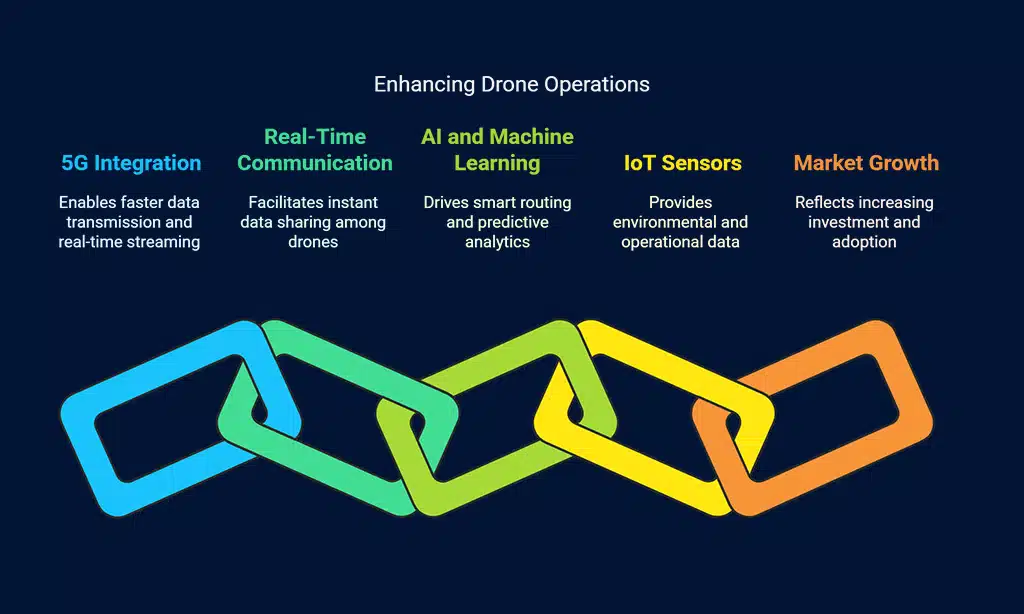
Drones chat like a hive over mesh grids, fifth-gen networks, and telemetry channels. You’ll learn how software-defined tuners and connected sensors keep every drone in sync and speed last-mile drops.
5G Integration for Faster Data Transmission
5G integration cuts lag in drone links. It streams high-res video, telemetry and weather data in real time. Amazon Prime Air won FAA approval in August 2020 under new certification rules proposed by the FAA in 2020.
This boost fuels real-time tracking, predictive maintenance and smarter parcel delivery in remote locations.
It powers fast drone-to-drone communication across an intelligent transportation system. Artificial intelligence taps that feed to run machine learning for on-the-fly route shifts.
IoT sensors and radar systems share wind, temperature and obstacle alerts. Last-mile delivery teams gain better data collection and stronger regulatory compliance.
Real-Time Drone-to-Drone Communication
Drones share status and location over a mesh network in the drone industry. They alert each other to obstacles and weather shifts. Each unit streams real-time data for predictive analytics and predictive maintenance.
Investors pour money into cost-effective drones, and the market sees a 44.2% CAGR. These links boost regulatory compliance and safe flights across the drone industry.
Operators use drone delivery services in last-mile delivery and remote locations. AI steers each drone with smart routing and real-time tracking. Mesh bridges drive Amazon Prime Air and UPS flights.
IoT tools tie sensors, cameras, and GPS for data collection. The flow cuts fuel consumption and speeds parcel delivery.
Environmental Sensing Technologies
Drones scan the air with LiDAR, thermal cameras, and wind gauges, then push that data into IoT networks for quick fixes. You’ll see how air sensors and blockchain logs boost predictive maintenance at remote drop sites.
Weather Adaptation Sensors
Sensors gauge wind speed, temperature, humidity. They send data through IoT modules for real-time tracking and environmental monitoring. AI systems use that information for routing and obstacle tolerance.
These tools help drones avoid gusts and downdrafts during last-mile delivery flights in remote locations.
Flytrex Aviation Ltd launched an on-demand drone delivery service in Reykjavik for food and prescriptions. Complex weather profiles need sensors to adjust lift in gusty, cold air. This approach lowers maintenance costs with predictive maintenance alerts.
The drone delivery services market may reach USD 9.51 billion by 2027.
Air Quality Monitoring Features
Air quality monitors ride on delivery drones to measure PM2.5 and ozone levels during flight. Operators stream real-time data through IoT links and 5G modules to cloud dashboards. They adjust last-mile delivery paths to dodge polluted zones, cutting delays and emissions.
A drone that hauls 1 to 5 kg can scan a 25 km route in under 30 minutes. This data also feeds predictive maintenance systems to spot wear in drone motors.
Particle detectors and air monitors plug into on-board computers for live tracking. AI models in the cloud flag high pollutant zones and reroute drones on the fly. Food service firms use this feature to meet eco-friendly delivery targets in cities.
Medical parcels reach patients in remote locations faster, with low exposure to smog. Engineers log data collection in blockchain ledgers to boost regulatory compliance and trust across the drone industry.
Takeaways
These advances push drone delivery to new heights. GPS modules guide aircraft with pinpoint accuracy. Machine learning algorithms tweak routes fast. Lithium batteries store more power, fueling long flights.
Solar panels top up storage units mid-flight. 5G antennas boost data flows while predictive analytics flag repairs ahead of failures. WMS platforms track parcels from warehouse to doorstep.
FAQs on Drone Technologies Revolutionizing Parcel Delivery
1. What is real-time tracking in drone delivery services?
Real-time tracking uses sensors, IoT and data collection. It sends real-time data to your phone. It lets you see your parcel in flight.
2. How do autonomous vehicles and artificial intelligence help last-mile delivery?
They guide drones, avoid obstacles, speed up parcel delivery. AI learns routes like a map reader to cut delays. Drones act like smart robots to drop off fast.
3. How do predictive maintenance and predictive analytics keep drones flying?
Sensors gather data, AI checks for wear. It spots parts that need service, before they break. This cuts downtime, like magic, so drones fly like clockwork.
4. How do Amazon Prime Air and UPS meet regulatory compliance in the drone industry?
Major players in the drone industry work with local rules, get permits, share flight paths. They log flight reports, track data, and stay in touch with regulators. They fly safe and legal.
5. How do drone deliveries cut carbon and boost eco-friendly delivery?
Drones use electric power, not fuel, to curb road traffic and emissions. They fly light loads on direct paths, and shrink carbon footprints like a green arrow.
6. Can drones reach remote locations or aid in disaster response?
Yes, they zip over rough roads, carry meds or snacks to camps. They scan fields to track crops, or drop supplies when roads fail. They prove agile in real-time, even off the grid.