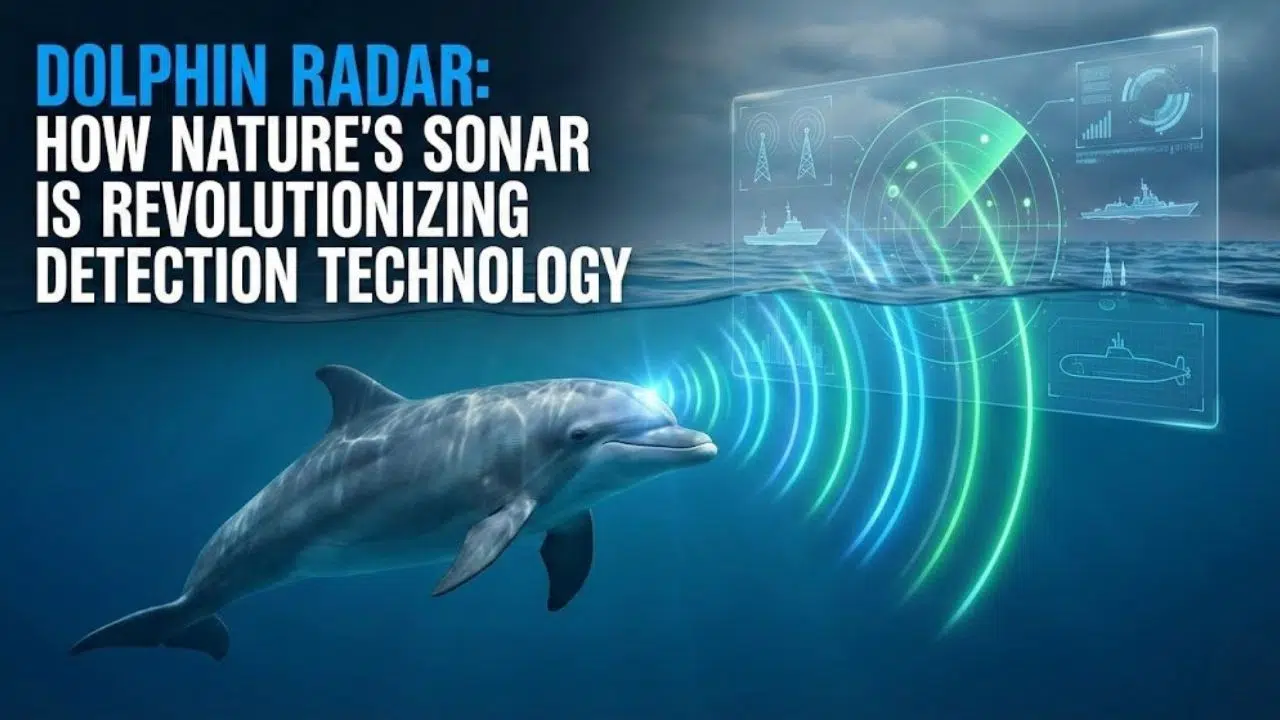
What if a dolphin could help find buried earthquake victims or detect hidden explosives? That question isn’t as far-fetched as it sounds. Engineers and scientists have spent years studying how dolphins use sound to navigate and hunt in the ocean’s darkest, most complex environments. The result is a groundbreaking innovation often referred to as “dolphin radar” technology that applies biological sonar principles to electromagnetic detection systems.
Dolphin radar represents a convergence of marine biology and advanced engineering. By mimicking the sophisticated echolocation techniques dolphins use to find fish through curtains of bubbles, researchers have developed radar systems that can distinguish between genuine threats and harmless clutter with unprecedented accuracy . This biomimetic approach is transforming how we approach security, search-and-rescue, and even marine mammal medicine.
Understanding Dolphin Radar: From Biology to Technology
What Is Dolphin Radar?
Dolphin radar isn’t radar in the traditional sense; it’s a radar system inspired by dolphin biosonar. The formal name is Twin Inverted Pulse Radar (TWIPR), and it was developed by a team led by Professor Tim Leighton at the University of Southampton, in collaboration with University College London and Cobham Technical Services.
Traditional radar sends out a single pulse and listens for its reflection. Dolphin radar sends out two pulses in quick succession, the second being the phase inversion (mirror image) of the first. This seemingly simple modification yields extraordinary results when detecting specific types of targets .
How Dolphins Inspired the Technology
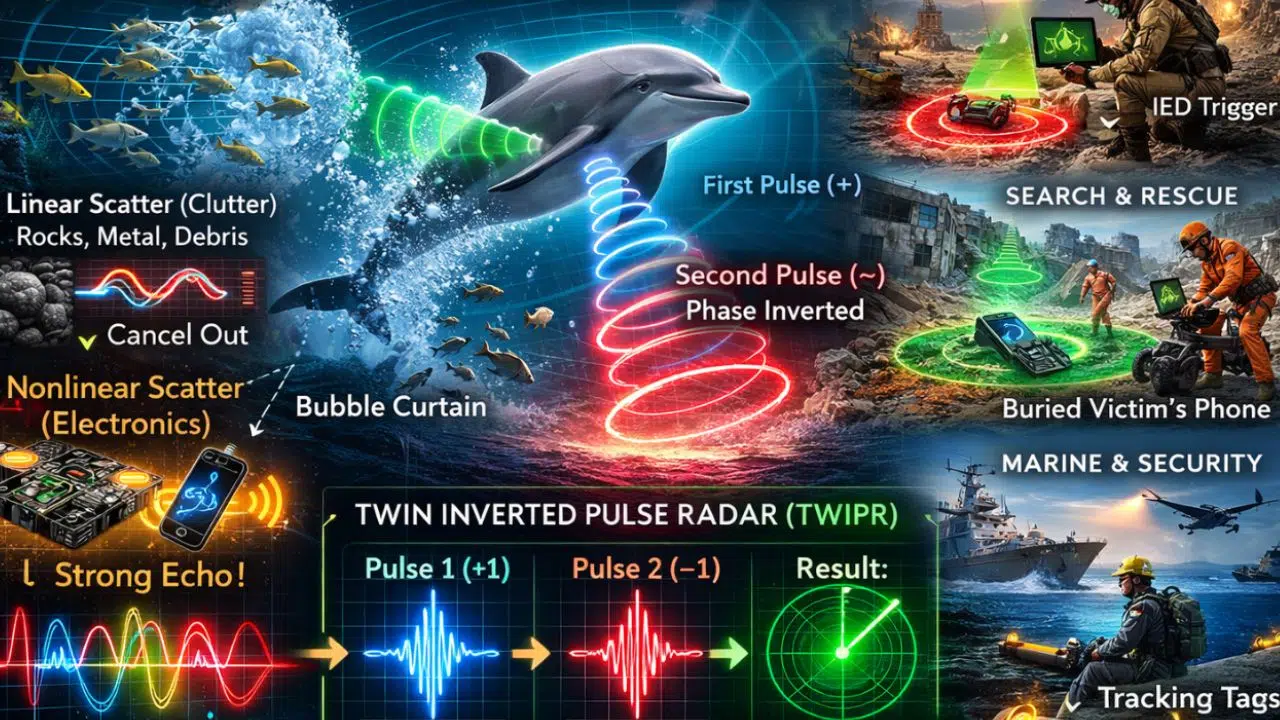
Some dolphin species, like bottlenose dolphins, employ a hunting strategy called bubble netting. They release curtains of bubbles from their blowholes to corral fish into tight clusters . This creates a significant problem for their sonar bubbles are excellent sound scatterers and would normally mask the fish entirely.
Yet dolphins have no trouble finding their prey through these bubble clouds. Their biological sonar processes return echoes in ways that allow them to distinguish between the nonlinear scattering from bubbles and the linear scattering from fish . This capability fascinated researchers, who asked: Could the same principle work with radio waves instead of sound?
The Science Behind Twin Inverted Pulse Radar (TWIPR)
Linear Versus Nonlinear Scattering
To understand why dolphin radar works, you need to understand how different objects scatter electromagnetic waves.
Most natural objects rocks, pipes, nails, aluminum plates scatter radar signals linearly. When you double the strength of the transmitted pulse, the echo strength doubles proportionally. More importantly, these objects preserve the symmetry of the incoming pulse .
Electronic components behave differently. Devices containing diodes, transistors, or other semiconductor junctions scatter signals nonlinearly. When an oscillating electromagnetic field hits a diode, current flows in one direction but not the other, breaking the symmetry of the incoming signal . This is mathematically similar to how bubbles scatter sound asymmetrically.
The TWIPR Pulse Sequence
Dolphin radar exploits this difference through clever signal processing. Here’s how it works:
- First pulse: Standard polarity (represented as +1)
- Second pulse: Phase-inverted version of the first (represented as -1)
When these pulses hit a linear scatterer (like clutter), the echoes preserve the polarity relationship. Subtracting the second echo from the first cancels them out nearly completely: [+1 – (-1) = 0].
When these pulses hit a nonlinear scatterer (like an electronic circuit), the echoes become distorted. The nonlinear device essentially squares the signal. Adding the echoes together produces a strong signal: [+1² + (-1)² = 1 + 1 = 2] .
The result is dramatic. In laboratory tests, a small electronic target measuring just 6 cm long and weighing 2.8 grams produced an echo 100,000 times stronger than a 34 cm by 40 cm aluminum plate the exact opposite of what conventional radar would show .
Practical Applications of Dolphin Radar
Explosive Device Detection
The most immediate application for TWIPR is detecting improvised explosive devices (IEDs) and roadside bombs. Bomb triggers contain electronic circuits with nonlinear components that produce the characteristic TWIPR signature. The system can distinguish these circuits from surrounding metallic debris discarded cans, nails, pipes that plague conventional metal detectors and radar systems.
This capability saves lives by reducing false alarms and increasing detection confidence. As Gary Kemp of Cambridge Consultants noted, “Any technology that increases the probability of detecting IEDs or buried earthquake victims while reducing false alarms will undoubtedly save lives” .
Surveillance and Espionage Countermeasures
The same technology that finds bomb triggers can locate hidden listening devices and surveillance equipment. These devices contain diodes and transistors that scatter TWIPR signals nonlinearly, making them stand out against walls, furniture, and building materials . Law enforcement and counterintelligence agencies can sweep areas more thoroughly with this approach.
Search and Rescue Operations
Perhaps the most humanitarian application involves locating catastrophe victims. When buildings collapse from earthquakes or avalanches bury people, every minute counts. TWIPR can detect the resonances from mobile phones, even when the phones are turned off, have dead batteries, or have been crushed .
Victims don’t need to carry specialized tags. Their existing electronics become beacons that rescue teams can detect through rubble. The system’s ability to distinguish these nonlinear signatures from construction debris provides a powerful tool for urban search-and-rescue teams.
Low-Cost Identification Tags
The technology also enables inexpensive tracking tags. A diode-based tag measuring centimeters in length, costing under one Euro, and requiring no battery can be attached to animals, pipelines, or personnel . These tags can be tuned to specific resonant frequencies, creating unique “TWIPR fingerprints” that identify individual assets .
For hazardous environment entry like firefighters entering burning buildings or workers entering confined spaces these tags could help track personnel locations through walls and debris.
Marine Mammal Health Monitoring
Interestingly, the relationship between dolphins and radar works both ways. While dolphin biosonar inspired TWIPR, radar technology is also helping study dolphins themselves.
Researchers at the Space and Naval Warfare Systems Center (SPAWAR) and Lawrence Livermore National Laboratory developed Micropower Impulse Radar (MIR) to monitor cardiac function in dolphins . This non-invasive tool detects heart motion, respiration, and physiological movement without touching the animal, something previously impossible because dolphins cannot undergo cardiac catheterization .
The MIR system uses extremely low-power microwave pulses (orders of magnitude weaker than cell phones) to detect chest wall movements from cardiac and respiratory cycles. This helps veterinarians assess cardiopulmonary health in marine mammals and could aid in studying deep-diving adaptations .
Advantages Over Traditional Detection Methods
Superior Discrimination
Conventional radar and metal detectors struggle with clutter. A nail and a bomb trigger can look similar. Dolphin radar’s ability to distinguish nonlinear from linear scatterers eliminates this ambiguity .
Penetration Capability
Radio waves penetrate materials that light cannot. TWIPR can see through walls, soil, and rubble to find electronics hidden from view .
Passive Target Detection
Unlike active beacons or RFID tags, TWIPR targets require no power source. Electronic circuits scatter TWIPR signals whether they’re powered on or off, alive or dead .
Hardware Compatibility
Converting existing radar systems to TWIPR doesn’t require completely new hardware. The inventors published the method freely, so manufacturers can implement it by changing waveforms and processing algorithms . This lowers adoption barriers.
Limitations and Considerations
Dolphin radar isn’t a universal solution. The transmitted pulse must be sufficiently strong at the target location. For buried or distant targets, this may require bringing the radar source close using robots, drones, or ground-penetrating approaches . Additionally, the technique specifically targets nonlinear electronic components; it won’t help find non-electronic threats or victims without electronics.
Future Developments
Research continues into extending these principles to other parts of the electromagnetic spectrum. Magnetic resonance imaging (MRI) and LIDAR (light detection and ranging) could potentially use similar nonlinear scattering techniques. Early fire detection might become possible by detecting nonlinear scattering from combustion products .
China’s recent launch of the intelligent research vessel “Haitun 1” (Dolphin 1) demonstrates ongoing interest in dolphin-inspired sensing technologies. Equipped with advanced lidar and sound signal recognition systems, the vessel represents the next generation of biomimetic maritime sensing .
Frequently Asked Questions About Dolphin Radar
What exactly is dolphin radar?
Dolphin radar refers to Twin Inverted Pulse Radar (TWIPR), a detection system inspired by dolphin echolocation. It sends paired, phase-inverted pulses to distinguish electronic targets from ordinary metal objects .
How is it different from regular radar?
Conventional radar uses single pulses and detects everything that reflects signals. Dolphin radar uses paired pulses with opposite polarity, allowing it to identify nonlinear scatterers (electronic circuits) while canceling linear scatterers (clutter) .
Can dolphin radar really find buried mobile phones?
Yes. TWIPR can detect resonances from mobile phone components even when phones are turned off, have dead batteries, or are crushed. This makes it valuable for locating buried avalanche or earthquake victims .
Why do dolphins need this ability in nature?
Dolphins hunt using bubble nets curtains of bubbles that trap fish. These bubbles would normally blind their sonar, but dolphins evolved signal processing capabilities that distinguish fish echoes from bubble clutter. TWIPR applies the same principle to radar .
Is dolphin radar currently available?
The technology has been proven in laboratory settings and published in peer-reviewed journals (Proceedings of the Royal Society A). The method is freely available for radar manufacturers to implement in their systems .
How much does a TWIPR tag cost?
The electronic components for a basic tag can cost less than one Euro, weigh under three grams, and require no battery. They can be manufactured inexpensively at scale .
Can it detect humans directly?
Dolphin radar detects humans indirectly by finding the electronics they carry (phones, watches, tracking tags). Direct human detection would require different mechanisms, though the related MIR technology can detect human heart motion through walls .
Final Thoughts
Dolphin radar represents one of the most elegant examples of biomimicry in modern engineering. By studying how dolphins solve the complex problem of finding prey through bubble curtains, researchers unlocked a new approach to electromagnetic detection that outperforms conventional methods in specific, high-value applications.
The technology’s ability to distinguish electronic targets from ordinary clutter with 100,000-fold contrast has profound implications for security, search-and-rescue, and asset tracking. Whether finding buried explosives, locating disaster victims through their mobile phones, or tracking personnel through hazardous environments, dolphin radar saves lives by seeing what traditional systems miss.
As research continues and adoption spreads, we can expect this dolphin-inspired innovation to become an increasingly common tool in the effort to protect and preserve human life. Nature evolved elegant solutions over millions of years. Our job is to recognize them and adapt them to our needs.