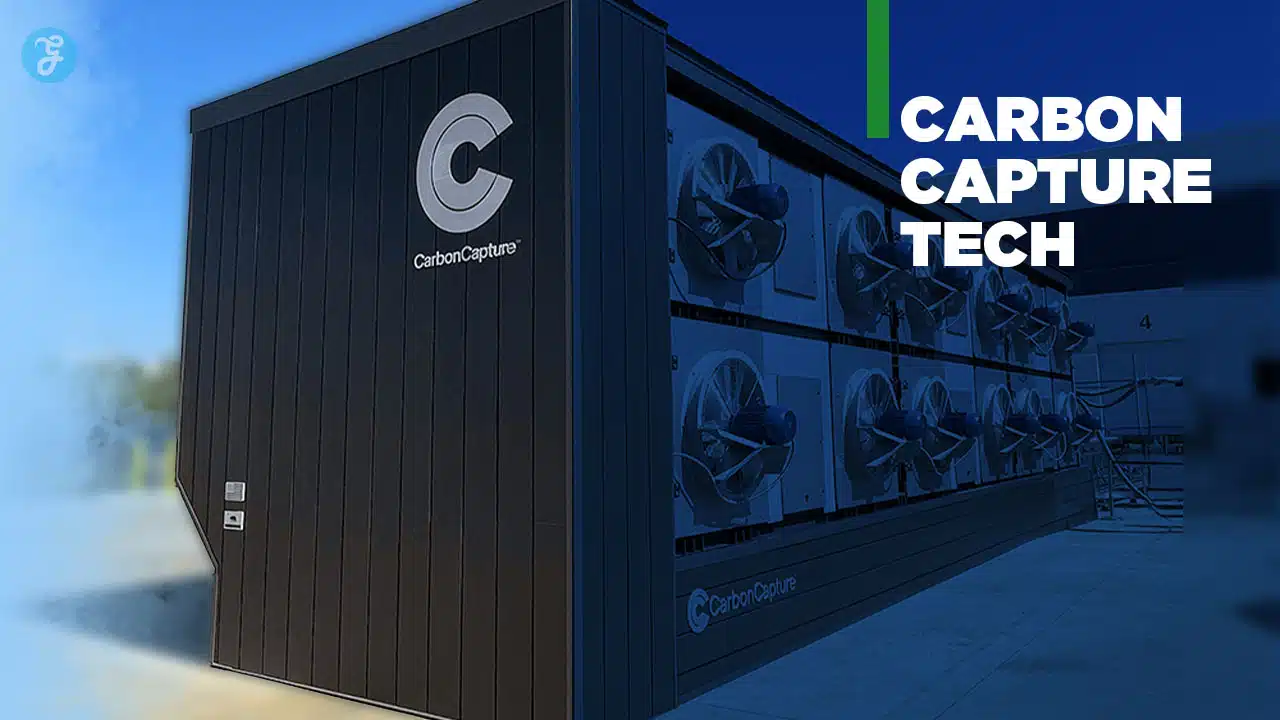
Direct air capture has moved from a fringe concept to a serious climate conversation. People call it “giant vacuums” because the systems often use large fans to pull air through machines that selectively trap CO2. The core promise is simple and bold: remove carbon dioxide that is already in the atmosphere, instead of only reducing new emissions.
The big question is not whether it works in a lab or pilot setting. The real question is whether direct air capture technology can scale fast, run clean, and prove durable climate impact at a cost the world can sustain. That is where excitement, skepticism, and policy attention collide.
This cluster deep dive explains how DAC works, what it can and cannot do, why energy and verification matter, and how to judge projects without falling for hype. You will also see how DAC fits into the wider green tech shift reshaping digital life, corporate climate plans, and infrastructure decisions.
Why Direct Air Capture Is Suddenly Everywhere
Climate action has two jobs. The first is to stop adding greenhouse gases. The second is to deal with what is already in the air and what will likely remain even with aggressive cuts. DAC sits firmly in the second job.
Many sectors can cut emissions with cleaner power, electrification, and efficiency. But some emissions are stubborn. Aviation, cement, steel, shipping, agriculture, and parts of chemicals may continue to emit for decades. Even the cleanest plans often leave a “residual” slice that is hard to eliminate fully.
Direct air capture appeals because it targets the atmosphere itself. It does not need a smokestack. It can theoretically be placed where clean energy and storage geology make sense. That flexibility makes it easy to imagine, and harder to execute.
What Direct Air Capture Is And What It Is Not
Direct air capture removes CO2 from ambient air. Ambient CO2 concentrations are low, so the process must move large volumes of air to capture meaningful amounts of CO2. That physics fact shapes everything about cost, energy use, and plant design.
DAC is not the same as capturing CO2 from a power plant. Point-source capture starts with higher CO2 concentrations, which can make capture more energy-efficient. DAC works with a dilute source, which is why critics often describe it as “hard mode.”
DAC is also not a substitute for cutting emissions. If DAC becomes a reason to delay decarbonization, it fails the climate test. The most credible role for DAC is as a complement to deep reductions, aimed at truly hard-to-avoid emissions and legacy CO2 already in the atmosphere.
How DAC Works In Simple Terms
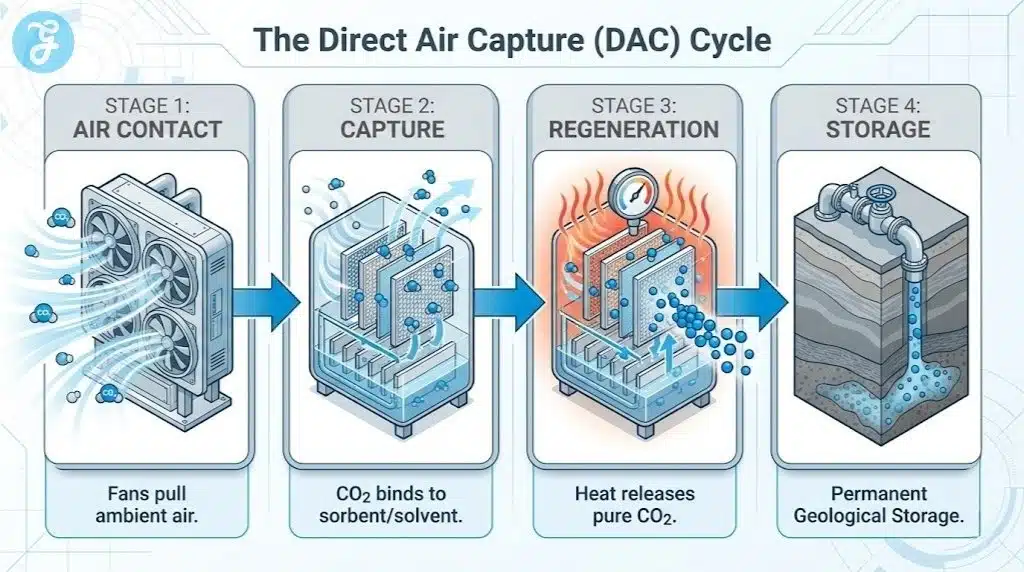
DAC systems generally follow the same loop: move air, capture CO2, release CO2 in concentrated form, then store or use it.
Most systems rely on one of two broad approaches:
- Solid sorbent systems that bind CO2 on a solid material
- Liquid solvent systems that absorb CO2 into a liquid solution
Both approaches need energy to regenerate the capture medium so it can be reused.
The Basic DAC Cycle
A simplified DAC cycle looks like this:
- Air contact
- Fans pull air through a contactor.
- Air touches the capture medium.
- Capture
- CO2 molecules bind to the sorbent or dissolve into the solvent.
- Regeneration
- Heat, pressure, or a chemical step releases the CO2 from the capture medium.
- Concentration
- The released CO2 becomes a high-purity stream.
- Compression and handling
- The CO2 is compressed for transport or on-site storage.
- Storage or utilization
- CO2 is injected into deep geological formations for long-term storage, or used in products with clear accounting.
This sounds linear, but each step has engineering tradeoffs. Improving one step can worsen another. That is why DAC design often becomes a careful optimization problem.
Direct Air Capture Technology And The Energy Problem
Direct air capture technology lives or dies by energy. If the system uses high-carbon electricity or heat, it can erase much of its benefit. If it uses clean energy but consumes massive amounts of it, it can compete with other decarbonization needs.
DAC needs energy in two major forms:
- Electricity for fans, pumps, controls, compression, and auxiliaries
- Heat for regeneration, depending on system design
The cleanest DAC project is one that matches low-carbon energy with high efficiency. It should also avoid pulling clean power away from critical uses where emission cuts are cheaper and faster.
Why Energy Use Is Hard To Avoid
Capturing CO2 from air is challenging because:
- Air has low CO2 concentration
- Moving air at scale takes power
- Regeneration requires breaking chemical bonds
- Compression requires mechanical work
DAC can still be climate-positive, but only when the full system is designed around clean energy and verified storage.
The Two Main DAC Pathways
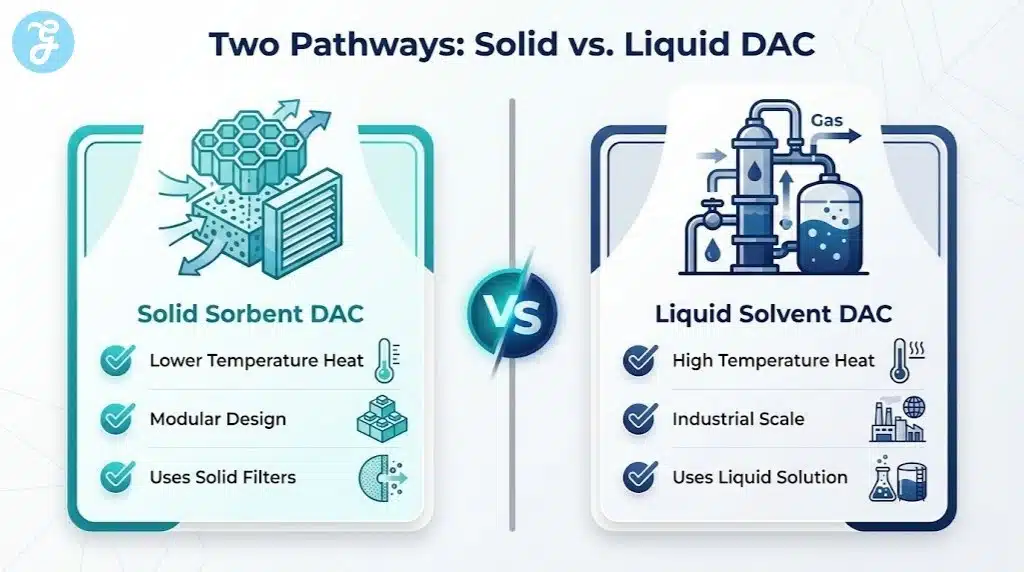
Most DAC projects fall into one of these categories: solid sorbents or liquid solvents. Both can work, and both face different cost and scaling constraints.
Solid Sorbent DAC
Solid sorbent systems often use materials that attract CO2 molecules. The process typically runs at lower temperatures than some solvent systems, though it still needs heat.
Common strengths
- Modular design can support factory-style scaling
- Potentially simpler operations in some designs
- Can pair with low-grade heat sources depending on configuration
Common challenges
- Sorbent degradation over time can raise costs
- Air contactor design must balance pressure drop and capture efficiency
- Water and humidity can affect performance depending on materials
Liquid Solvent DAC
Liquid solvent systems absorb CO2 into a liquid and then use a regeneration step to release it. Some designs resemble chemical processes used in other industries.
Common strengths
- Can leverage chemical engineering know-how and existing industrial practices
- Potential for strong capture rates at scale in certain configurations
Common challenges
- Regeneration can require higher heat, depending on the chemistry
- Larger plants can be complex and capital intensive
- Solvent management and corrosion control can add operational demands
In practice, projects vary widely. You should not judge DAC by labels alone. You should judge it by energy source, measured capture, and storage integrity.
Can DAC Really Suck CO2 Out Of The Sky At Scale
Yes, DAC can remove CO2. The “at scale” part is what remains uncertain, and that uncertainty is not one single obstacle. It is a bundle of obstacles that include cost, energy, materials, land, permitting, and storage.
DAC scale depends on five realities:
- You must build many plants to remove meaningful amounts of CO2
- You must power them cleanly or you lose the climate benefit
- You must verify removals with strong measurement and reporting
- You must store CO2 durably to avoid re-release
- You must keep costs falling while scaling manufacturing and operations
Each reality is solvable in theory. The hard part is solving them together, at the same time, under real-world constraints.
The Economics: Why DAC Is Still Expensive
DAC is expensive today because it combines heavy infrastructure with energy use and specialized materials. Many projects operate in early-stage learning curves where costs are higher than future expectations.
Costs typically come from:
- Air contactor systems and large fans
- Capture media that must be replaced or maintained
- Heat systems for regeneration
- Compression equipment
- CO2 transport infrastructure if storage is off-site
- Storage site development, monitoring, and verification
- Operations, maintenance, and labor
DAC cost declines will likely depend on repeatable manufacturing, better materials, improved heat integration, and standardization. But cost declines are not guaranteed. They must be earned through engineering and deployment.
A Simple Cost Drivers Table
| Cost Driver | What It Includes | Why It Matters |
| Capture unit hardware | Contactor, fans, modules | Sets capital cost and efficiency |
| Energy supply | Electricity and heat | Determines climate value and operating cost |
| Capture media | Sorbent or solvent | Impacts replacement cycles and uptime |
| Compression | CO2 pressurization | Needed for transport and injection |
| Storage and monitoring | Wells, geology, verification | Defines permanence and credibility |
| Financing | Cost of capital | Strongly affects total cost per ton |
If you want to judge whether DAC is improving, follow measured energy use, uptime, and verified storage. Those metrics matter more than marketing.
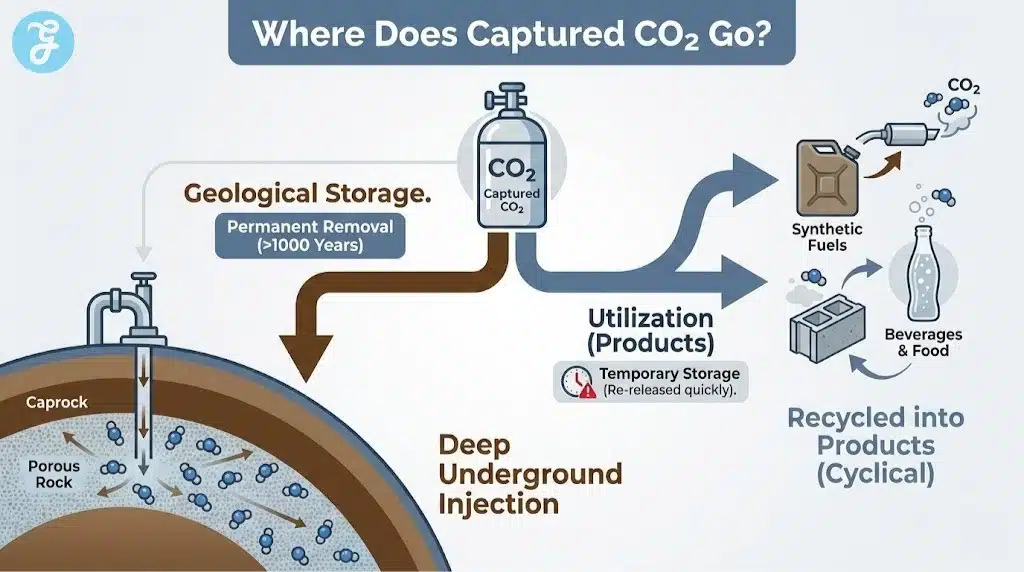
Where The Captured CO2 Goes: Storage Vs Use
Capturing CO2 is only half the story. The climate value depends on what happens next.
Geological Storage
Geological storage injects CO2 into deep underground formations designed to trap it for very long periods. This route typically offers the strongest permanence when done correctly and monitored well.
Key elements include:
- Suitable geology and site characterization
- Well design and injection management
- Monitoring systems to detect migration
- Long-term stewardship and regulatory oversight
CO2 Utilization
Some projects use captured CO2 in products. This can be climate-positive, climate-neutral, or climate-negative depending on the product and how long the carbon stays out of the atmosphere.
Examples vary widely:
- Mineralization into concrete-like materials can offer longer storage
- Synthetic fuels often re-release CO2 when burned, which is not durable removal
- Greenhouse enrichment typically releases CO2 quickly, which is not durable removal
A practical rule is simple. If CO2 gets re-released soon, it is not removal. It may have other value, but it is not durable climate drawdown.
Measurement And Verification: The Real Trust Layer
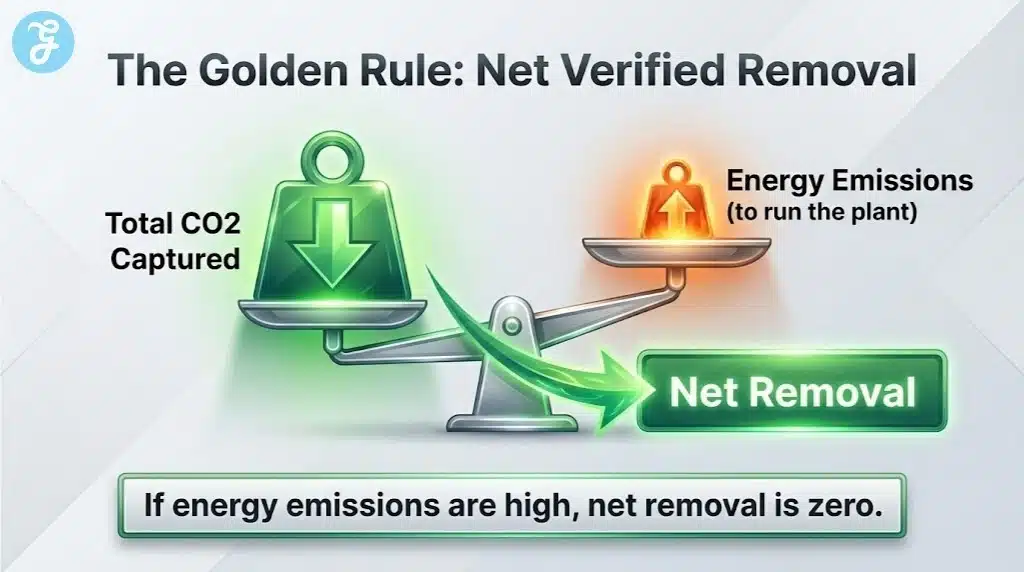
DAC needs trust. Not emotional trust, but measurable trust. That means strong MRV: measurement, reporting, and verification.
If a company sells “one ton removed,” buyers need to know:
- The plant captured that ton
- The process emissions were accounted for
- The CO2 went into durable storage
- The storage is monitored and reported
What Strong MRV Usually Includes
- Direct measurement of captured CO2 streams
- Accounting for electricity and heat emissions
- Transparency on plant uptime and performance
- Chain-of-custody tracking for CO2 transport
- Independent verification and standardized reporting
This matters because DAC often connects to carbon credit markets and corporate climate claims. Weak MRV can turn a promising tool into a credibility crisis.
Around this point, it is worth repeating a key phrase because it defines the entire debate: direct air capture technology must prove not only capture, but also net removal.
How DAC Fits Into The Green Tech Revolution
At first glance, DAC seems far from digital life. But the connection is real, especially as sustainability becomes part of how the digital economy is built and marketed.
Here is how DAC intersects with modern digital ecosystems:
- Data centers and cloud services face increasing scrutiny for carbon footprints
- AI workloads raise energy demand and intensify decarbonization pressure
- Corporate climate targets create demand for credible removals, not only offsets
- Digital measurement systems support MRV, monitoring, and transparency
- Policy and finance increasingly tie to data-driven verification
DAC will not make websites greener directly. But it may become part of how companies address residual emissions after efficiency, renewable energy, and clean design do their share.
What DAC Can Do Well
DAC can play a valuable role in a realistic climate strategy, especially when paired with deep emission cuts. It has strengths that other options do not always offer.
Situations Where DAC Makes Sense
- Residual emissions that remain after aggressive decarbonization
- Legacy CO2 already in the atmosphere, if society pursues net-negative pathways
- Location flexibility when paired with clean energy and storage geology
- Modular scaling in some designs that can benefit from manufacturing learning curves
DAC can also help create a “removal infrastructure” that supports future climate stabilization efforts.
What DAC Cannot Fix
DAC is not a permission slip to keep emitting. It also cannot replace cheap and fast mitigation measures.
Common Misuses And Misunderstandings
- Treating DAC as a substitute for cutting fossil fuel use
- Using DAC claims without durable storage
- Buying “removal” credits without strong MRV
- Assuming DAC will be cheap enough to solve climate change alone
The cleanest strategy still starts with prevention. Cut emissions first, then remove what remains.
The Scaling Bottlenecks You Should Watch
Scaling DAC is not only about building capture machines. It is about building an entire system around them.
The Main Bottlenecks
- Clean energy availability
- DAC needs low-carbon power and often low-carbon heat.
- Competition for clean power can become intense.
- Capture media supply
- Sorbents and solvents must be produced at scale and maintained reliably.
- Manufacturing capacity
- Building modules quickly and consistently requires industrial scaling.
- CO2 transport
- Pipelines or transport logistics add cost and permitting complexity.
- Storage site development
- Storage requires geology, regulation, monitoring, and long-term stewardship.
- Permitting and public acceptance
- Large industrial facilities face local concerns about land, water, and safety.
A Bottlenecks Table For Fast Evaluation
| Bottleneck | What To Check | Why It Matters |
| Energy source | Grid intensity, dedicated renewables, heat source | Determines net climate benefit |
| Net removal | Full lifecycle accounting | Avoids “capture-only” storytelling |
| Storage plan | Site details, monitoring approach | Defines permanence |
| Transparency | Reporting frequency and independent review | Protects credibility |
| Scale pathway | Manufacturing plan, supply chain readiness | Predicts cost decline potential |
If a project cannot explain these points clearly, treat its climate claims as unproven.
How To Judge A DAC Project Like A Pro
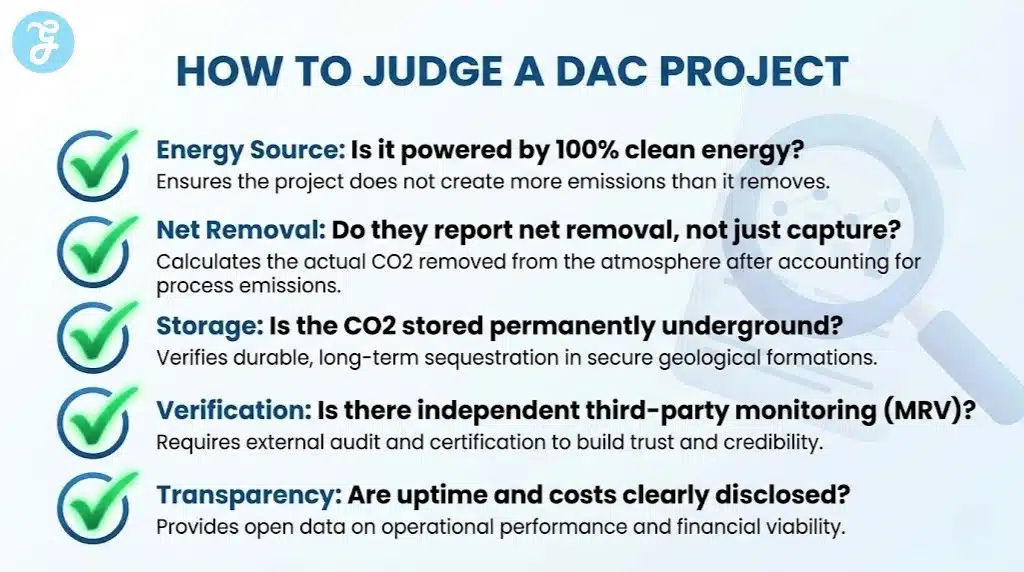
You do not need engineering credentials to evaluate DAC claims. You need a checklist that focuses on outcomes, not slogans.
The Practical DAC Credibility Checklist
- Does the project disclose its energy sources clearly?
- Does it report net removal, not just gross capture?
- Does it use durable geological storage, or short-lived utilization?
- Does it publish MRV methods and allow independent verification?
- Does it disclose uptime, capture rate, and performance variability?
- Does it explain its plan for scaling and cost reduction without vague promises?
If most answers are unclear, the project might be more about narrative than impact.
At roughly this stage of the discussion, the key phrase matters again because it anchors the evaluation: direct air capture technology should be judged by net, verified, durable removal per unit of clean energy used.
How DAC Could Evolve Over The Next Decade
DAC will likely improve through engineering iteration. Some improvements will come from better materials, and others will come from systems integration.
Likely Improvement Areas
- Better sorbents and solvents
- Longer lifetimes, higher selectivity, lower regeneration needs
- Smarter heat integration
- Using waste heat or low-carbon heat sources more effectively
- Lower pressure drop contactors
- Reducing fan energy while keeping capture performance
- Standardized modular designs
- Factory production that reduces build time and cost
- Stronger MRV standards
- More consistent reporting, clearer permanence rules, and better oversight
What Would Signal Real Progress
Real progress looks like:
- Lower energy per ton captured
- Lower cost per verified ton removed
- Higher uptime and predictable operations
- Transparent MRV with third-party verification
- Durable storage at scale with monitored performance
Hype looks like vague claims, selective reporting, and “future cost” promises without evidence.
The Big Ethical Question: Who Pays And Who Benefits
DAC raises a fairness question. If DAC becomes a major pathway, who funds it, and who gets to use it to claim climate progress?
There are several competing visions:
- Governments fund DAC as a public climate stabilization tool
- Companies fund DAC to meet residual emissions obligations
- Carbon markets fund DAC through credit systems, with strong rules
- Hybrid models spread cost across public and private stakeholders
The ethical risk appears when wealthy actors use DAC to delay cuts, while climate impacts hit vulnerable communities first. The ethical opportunity appears when DAC supports net-negative pathways after real reductions, with transparent accounting.
Can Giant Vacuums Really Suck CO2 Out Of The Sky
Yes, they can capture CO2 from air. The real issue is whether it happens cleanly, credibly, and at meaningful scale. DAC is not magic. It is industrial climate engineering with strict constraints.
The strongest case for DAC is focused and realistic. Use it for residual emissions that remain after deep cuts. Build it where clean energy is abundant and storage is durable. Measure it with transparent MRV and independent verification. Treat it as a tool, not a loophole.
If the world does those things, direct air capture technology can become a valuable part of the carbon removal portfolio. If the world skips those things, DAC risks becoming an expensive distraction and weak accounting.
Either way, one truth holds. The climate era will reward systems that prove outcomes, not promises. DAC will earn its place only through verified net removal and durable storage at scale.