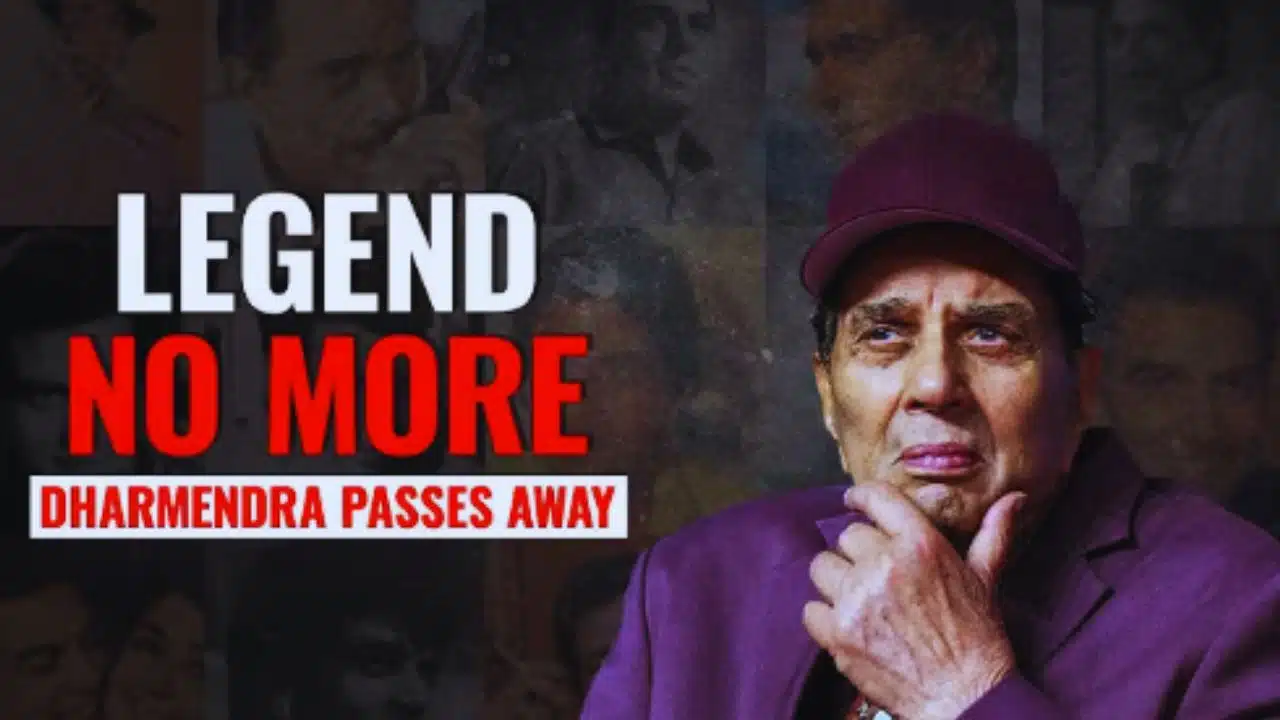
Veteran Bollywood icon Dharmendra, lovingly known as He-Man of Hindi Cinema and Dharam Paaji, passed away earlier today at the age of 89. His death marks the end of a cinematic era that spanned more than six decades, leaving behind a remarkable body of work, millions of admirers, and a legacy that shaped Indian cinema in profound ways.
Born Dharmendra Singh Deol on 8 December 1935 in Punjab, he grew up in a simple household far removed from the glamour of the film industry. Yet his innate charm, natural acting talent, and screen presence soon transformed him into one of the most beloved stars Indian cinema has ever known. Widely admired for his humility and grounded personality, Dharmendra remained a favorite among fans and colleagues throughout his long and illustrious career.
Earlier this month, he was admitted to Mumbai’s Breach Candy Hospital due to respiratory complications. Though he returned home after initial treatment, his health continued to deteriorate. Surrounded by his family, he breathed his last at his residence today. News of his passing spread rapidly, evoking grief across the nation. Film personalities, fans, and political leaders expressed deep sorrow at the loss of a man who had become synonymous with mainstream Hindi cinema’s golden age.
Dharmendra began his acting journey in 1960 with the film Dil Bhi Tera Hum Bhi Tere. He quickly rose to stardom, displaying a rare versatility that allowed him to shine in romantic roles, intense action sequences, family dramas, and light-hearted comedies with equal ease. Over the course of his career, he appeared in more than 300 films, many of which went on to become classics and are still cherished today.
Among his most unforgettable performances is his portrayal of Veeru in the timeless blockbuster Sholay. His on-screen pairing with Amitabh Bachchan, his effortless comedic timing, and his iconic dialogues turned the character into a phenomenon. Dharmendra also delivered milestone performances in films like Phool Aur Patthar, Chupke Chupke, Seeta Aur Geeta, Pratigya, Dharam Veer, and countless others that showcased his range and charisma.
Throughout the 1960s and 1970s, Dharmendra became a household name—an actor whose presence alone could draw audiences to theaters. He was celebrated as one of Indian cinema’s most handsome leading men, often referred to as the “Garam Dharam” of Bollywood for his magnetic personality and physically powerful screen image. Yet beyond his action-hero persona, he was deeply respected for his emotional depth, natural dialogue delivery, and ability to connect with viewers from every generation.
His contribution to Indian cinema earned him several honors, notably the Filmfare Lifetime Achievement Award in 1997. In 2012, the Government of India bestowed upon him the Padma Bhushan, recognizing his immense impact on Indian film and culture. Despite his legendary status, Dharmendra continued to work, delighting viewers with appearances in new-age Bollywood films as recently as the 2020s.
He was highly praised for his role in the blockbuster Rocky Aur Rani Kii Prem Kahani, where his tender, heartfelt performance touched audiences and critics alike. In 2024, he appeared in Teri Baaton Mein Aisa Uljha Jiya, playing a warm and emotional grandfather—a role that further showcased his timeless ability to light up the screen. His final film, Ikkis, starring Agastya Nanda, will forever remain his last gift to the industry. In the film, he once again played the role of a grandfather, bringing his signature softness and grace to the character.
Beyond the world of cinema, Dharmendra’s personal life was equally well-known to the public. He is survived by his wife, actress Hema Malini, his first wife Prakash Kaur, and his children—actors Sunny Deol and Bobby Deol, and daughters Esha Deol and Ahana Deol. His extended family, including several grandchildren, had been a source of pride and joy for him in his later years.
The loss of Dharmendra has left a void that will be impossible to fill. Fans across the country gathered outside his residence and shared emotional tributes online, recalling moments from his films, interviews, and public appearances. Members of the film fraternity described him as warm, affectionate, and deeply inspiring—a true pillar of the Indian film industry.
Dharmendra’s legacy will continue to influence actors, filmmakers, and storytellers for decades to come. His journey—from a young boy in Punjab with dreams bigger than his reality to one of the most celebrated actors in Indian history—stands as a testament to talent, perseverance, and passion. Even in his absence, his films, songs, characters, and memories will continue to live in the hearts of millions.
A titan of cinema is gone, but his light will never dim.